
An issue of the Society’s newsletter, transcribed from the original.
(8 pages, 1.4 MB)
the full-resolution scan, 23 MB, for close research
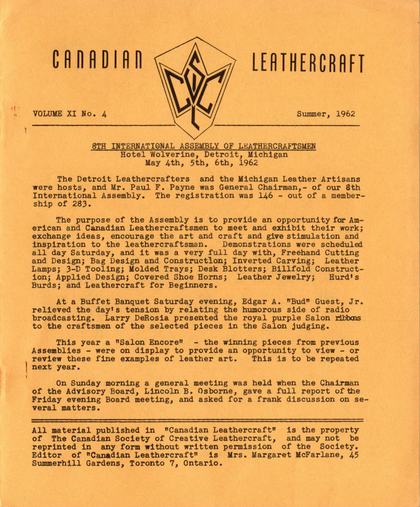
Page 1 — 8TH INTERNATIONAL ASSEMBLY OF LEATHERCRAFTSMEN
Canadian Leathercraft
VOLUME XI No. 4 Summer, 1962
8TH INTERNATIONAL ASSEMBLY OF LEATHERCRAFTSMEN
Hotel Wolverine, Detroit, Michigan
May 4th, 5th, 6th, 1962
The Detroit Leathercrafters and the Michigan Leather Artisans were hosts, and Mr. Paul F. Payne was General Chairman,- of our 8th International Assembly. The registration was 146 - out of a membership of 283.
The purpose of the Assembly is to provide an opportunity for American and Canadian Leathercraftsmen to meet and exhibit their work; exchange ideas, encourage the art and craft and give stimulation and inspiration to the leathercraftsman. Demonstrations were scheduled all day Saturday, and it was a very full day with, Freehand Cutting and Design; Bag Design and Construction; Inverted Carving; Leather Lamps; 3-D Tooling; Molded Trays; Desk Blotters; Billfold Construction; Applied Design; Covered Shoe Horns; Leather Jewelry; Hurd's Burds; and Leathercraft for Beginners.
At a Buffet Banquet Saturday evening, Edgar A. "Bud" Guest, Jr. relieved the day's tension by relating the humorous side of radio broadcasting. Larry DeRosia presented the royal purple Salon ribbons to the craftsmen of the selected pieces in the Salon judging.
This year a "Salon Encore" - the winning pieces from previous Assemblies - were on display to provide an opportunity to view - or review these fine examples of leather art. This is to be repeated next year.
On Sunday morning a general meeting was held when the Chairman of the Advisory Board, Lincoln B. Osborne, gave a full report of the Friday evening Board meeting, and asked for a frank discussion on several matters.
All material published in "Canadian Leathercraft" is the property of The Canadian Society of Creative Leathercraft, and may not be reprinted in any form without written permission of the Society. Editor of "Canadian Leathercraft" is Mrs. Margaret McFarlane, 45 Summerhill Gardens, Toronto 7, Ontario.
The page prints “Hurd’s Burds”, an apparent Society typo for “Birds”, kept as printed.
Page 2
There are Rules and Regulations laid down for the conduct of the Salon at each Assembly. Members were asked if they were satisfied with them, or if not, to make suggestions to be tried at Rochester next year. To open the discussion, Linc Osborne suggested that five judges from the Guilds, three from Canada and two from the U.S. decide on "best in show". Many opinions were expressed - for and against - selection as to design (art) or craft. It was finally agreed that the following method be tried out,-
Five Craftsmen, members of IALC, first judge the display and their selection to be put on a separate table.
Judges - selected according to Rules and Regulations on Salons,- then go over the entire exhibit. Their selection to be put on a separate table.
This method would virtually give a Salon on design and one on craft. We are striving to raise the level of every individual who belongs to: the Guilds by improving his knowledge of design and the craft.
In presenting the written comments of the Detroit judges, Paul Payne stated these gentlemen were highly skilled,- they make,design and build. He said they were much impressed with the workmanship, and wondered why we did not have two categories, one for recognition of workmanship only. They judged on a combination of the idea that had been conceived, and brought forth in reality. This applies whether leather, metal or any other medium. The artist and craftsman is one and the same. There is no great art without great skill. Let us be concerned that we are ever striving for a higher and higher goal. Dig in and find out why it is good design, Paul admonished.
Flint regretted no flags were used at an International Meeting. Matched flags were not available, so Linc Osborne was authorised to purchase these, or a suitable banner bearing flags for future use.
An Addresserette was purchased for easier mailing, and it was announced that Paul Payne had volunteered to edit a Newsletter for IALC members. Items of interest must needs be supplied to Paul.
When announcing the 9th IALC - Hotel Manger, at Rochester - May 3-4-5, 1963- we were reminded that it is up to each Guild to ask for demonstrations they wish to see, and suggest the names of demonstrators. The more supplied, the more can be put on the programme. If necessary duplicate demonstrations can be arranged for those who missed one while watching another.
The 10th IALC is to move to Canada, and it is expected to be held in Toronto May 1-2-3, 1964.
Fred Brown voiced congratulations of members present to Paul and his Committee on a very successful Assembly. A similar business meeting is to be scheduled next year.
The page prints “Linc Osborne” both times, short for Lincoln, matching the same page’s “Lincoln B. Osborne, Chairman of the Advisory Board”. “authorised” is the page’s own spelling.
Page 3 — SALON AWARDS - Detroit, May 5, 1962
SALON AWARDS - Detroit, May 5, 1962
The pieces in the Salon were selected from the Guilds' displays by Mr. William A. Allen, Professor of Art at Wayne State University and Mr. Wilfred C. Becker, Head of Industrial Design and Associate Professor of Art at Wayne State University. Each piece was selected on the basis of originality, workmanship, techniques used and their suitability to leather. Ten pieces were judged "best in show" and the craftsmen recognized and honored by the presentation of a Salon Ribbon at the Assembly Banquet. The selections were:- a stamped belt by Irva Ford, FCSCL, Hamilton, Ont. a round box, braided design by Toni Genco, Rochester, N.Y. an octangular two-tone box by Frank Torry, ACSCL, Hamilton,Ont. a playing card box by Viola Harris, ACSCL, Toronto, Ont. a book cover by Toni Genco, Rochester, N.Y.
a handbag by Harry Frick, Detroit, Mich.
a handbag, hair calf, by Alvin Haig, ACSCL, Hamilton, Ont. a handbag, by Reta Larmour, FCSCL, Toronto, Ont. a portfolio case, zippered, braided design, by Toni Genco, Rochester, N.Y.
a decorative pin (flower) by Clara Cavanagh, FCSCL,
Barrie, Ont.
In commenting on their judging Mr. Allen said,-
"My first concern was for a unity between the organic qualities of leather, the total shape or form and how well the articles would be expected to function. Craftsmanship is also of great importance to a degree that aroused admiration for a great many pieces not chosen for awards--articles which seemed less successful in their unification of the above factors.
"The awards themselves carry considerably in all of these factors, largely, I believe, because of the differences, in purpose or function of the objects. A handbag with its obvious utilitarian qualities must necessarily make very different demands on the designer from those inherent in a decorative pin or simple box."
Mr. Wilfred Backer said,-
Strengths:--- Excellent craftsmanship.
Some attempts at innovations in use of leather --- though not always successful.
Beautifully tooled leather in the traditional sense. Good use of shaped or molded forms, though questionable in come cases as to why.
Two readings are kept exactly as printed: “questionable in come cases as to why” (the page prints “come” for what reads like “some”) and “The awards themselves carry considerably in all of these factors” (“carry” may have been meant as “vary”). The page names the Wayne State University judge “Mr. Wilfred C. Becker” in its opening paragraph and “Mr. Wilfred Backer” two paragraphs on; both are as printed.
Page 4 — WORKSHOP TIPS
Weaknesses:--- Lack of coordinated design between two sides of object.
Poor color relationships between background and decoration.
Selection of leather which looks cheap.
Use of hardware which is uninteresting or flamboyant. Poorly designed decorations which are not compatible with the object.
He felt more attention should be paid to using the leather naturally in a way that contributes creatively to the finished product. Less time should be spent on decoration and more on general planning of the whole for better integration between the two,- craftsmanship and concept.
WORKSHOP TIPS
Cementing: (Barge)
When you buy Cement, also buy an equal quantity of thinner- to keep cement at right consistency - clean hands - clean brushes.
Keep brush in thinner in a sealed long slim bottle and in time the thinner, when slightly thickened, can be added to the cement. when cementing two pieces of leather together,put two or three coats on allowing each coat to soak into the leather. This can be left for a few hours, if interrupted. When resuming work,all it requires is another light coat of cement.
Keep cement in proper thin thickness by adding thinner to replace what evaporates.
Edge Dressing:
It is not so much the dressing as it is the heat you apply by friction. The more you heat it up by rubbing, the quicker it is going into the leather, and the sooner it will dry. If you do not get a shine the first time, put more on and rub vigorously, with canvass. Natural Leather:
First, you must realize leather is a skin, and if you expose it to light and sun it is going to tan. Lacquer, not too thin, will prolong the light colour, but eventually it is going to darken.
Page 5 — INVERTED LEATHER CARVING
INVERTED LEATHER CARVING as demonstrated by Harry B. Wykes, Flint, Mich. at DETROIT IALC This type of carving can be classified into three groups:- 1) Silhouette Stamping.
2) Inverted Carving.
3) Rough-out Carving.
and each of the groups can be combined with one or the other making a total of six different ways they can be used.
Before showing you all the fun that can be found, in this type of carving, let us define - "INVERTED". From the dictionary
INVERT is to - REVERSE IN DIRECTION OF ORDER
= TO CHANGE OR TURN TO THE OPPOSITE
If you keep in mind that we are reversing our direction in doing this, it will be easier to follow the steps taken.
(1) Silhouette Stamping is the simplest, and easiest of the three. It consists of cutting only the outlines of the design and beveling (in reverse- inside the lines instead of outside)- and matting down the design within these lines. It offers the craftsman unlimited uses of design and self-expression and will open a whole new field of leather carving and stamping enjoyment.
Proper Silhouette designing should be of fine line, with few heavy overlapping segments or large open areas requiring excessive matting.
Very few stamping tools are required as the entire operation is the matting down of the leather inside the design. The Swivel knife and the 4" angled blade #100 will give you the best fine line carving. The most adaptable tools for silhouette style are,-
Smooth Beveler #203; #935.
Checked Beveler #702; #936.
Checked Background #98; #99; #117; #899; #976. After carving is finished, go around the inside lines of the design with the smooth bevelers, to give a good firm break. Use #935 to get into the small areas. Then use the modelling spoon to slightly roll over the edge of the design. Any slight errors in the design edge can be corrected at this time. Then, go back over where you have beveled with checked beveler #702. After a good firm edge is obtained, mat down the rest of the leather, using the background tools making sure that a good flat surface is stamped in the design.
The opening "De" is not printed text; the top of the page carries only a faint stray ink mark above the "INVERTED LEATHER CARVING" heading, and it is dropped — the same kind of stray mark as the 1961-summer issue’s page 1 "ane".
Page 6
Then using a thin solution of black dye - Mac's Antique - and a small brush cover all the area that has been stamped down.Go over several times until it is a solid black in the design. When project is thoroughly dry you can finish as you wish.
(2) Inverted Carving differs from regular carving only in that the design is beveled inside the lines the same as Silhouette. Regular stamping procedures are used, but the carving is done a little different. You cut towards the stem of the leaves, instead of toward the tips, so as not to leave a cut mark outside of the design. Avoid cutting into the stem, so as not to have a sliver left. When the leaves overlap change the bevel from one side to the other, keeping in mind that your carving is "inverted" - i.e. reversed.
No background stamping is done, so it takes less time to complete. More delicate designing is possible, in that the thin stems and single line cuts can be used.
(3) Rough-out Carving is carving on the flesh side, not the grain side of the leather.
This is important. When you case your leather, watch the back (flesh) side. If the moisture sets in evenly, it is o'k, but if it does not, then you have to clean the coating or wax off the flesh side. This is to allow the dye to absorb evenly. Another way would be to use a thin lacquer coat in the design before you use the dye. If you want to clean it, you can use a leather cleaner.
Do a careful job of casing the leather and be careful to make a good clear impression when you transfer the pattern to the leather, as the lines do not show too clearly on the flesh side. Also when carving be sure the swivel knife is sharp and cut deeper than usual. You will find it is harder to cut than the grain side, more pressure will have to be used. After the carving is done, stamp in the usual manner, but be sure to stamp deep.
When the leather is thoroughly dry, sand it - in a circular motion. Use plenty of pressure, and rub vigorously in all directions to obtain a nice even suede effect. Use a sanding block with #150 sandpaper and the block should be a little larger than the width of your leather. You will see now why the extra depth is needed to keep the tool impressions from being roughed while sanding the suede. Remove the dust or loose particles from the design by using a soft brush or blowing. Then it is ready for dye. If you wish to finish it in the natural colour use a thin mixture of Lac-kot and cover it several times.
Harry Wykes strongly recommends the purchase of Al Stohlman's new book - "INVERTED LEATHER CARVING" if you are interested in trying these new techniques.
Page 7 — Why not make these - more ideas picked up by a SHOP HOUND; STRUCTURE OF THE HIDE
Why not make these - more ideas picked up by a SHOP HOUND
Paper opener for desk. Leather handle cemented with barge, sewn around edge - see shoe horn technique Vol. 9, No. 4, Page 7. Leather guard to insert blade of opener.
Jacket for a telephone directory - red calf - with black stencilled design. Try drawing your own.
Cover piece of pottery with very thin leather dyed to match painted design, around which leather is fashioned to show pottery design as decoration. Small pieces of pottery to hold matches, etc. Cover a cigarette case (for packet cigarettes) with cherry red cobra skin - and your lighter to match.
STRUCTURE OF THE HIDE
Nature designed the covering of the animal as a protection and as an organ of secretion and elimination. Cattle hides, like most all animal structures, are made up of three layers. The outer is called the epidermis while the inner, which is made up of two of the structures, one mucous and the other fibrous, is called the corium or true skin.
The epidermis, or grain of the hide as seen in the finished leather, is a very thin skin or scale, and cannot be tanned as it is not of a fibrous nature. To a certain extent it is waterproof. Nourishment of the epidermis is provided by the lymph system of the true skin cells, which grow outward from the source of supply. As the cells are pushed further from their source of nourishment, they become dead and flat, similar to scales, developing a scurf or dandruff.
The corium is composed of a fibrous inner layer, with a mucous structure separating it from the epidermis, and it is this fibrous structure with which the tanner works.
continued
The stray "v" before "Cover piece of pottery" (the same page’s "a_ soft" is the same fault) comes from a line drawing, not from printed text, and is dropped. Two items on this page illustrate their project with a small pen sketch rather than words — a leather-handled paper-opener or shoe-horn, and a round piece of pottery with a leather cover — and are described only by the prose already given, since there is no text in the drawing itself to transcribe.
[A stray underscore is not part of the printed text: "developing a_ scurf" is set out here as "developing a scurf".]
Page 8 — STRATFORD SHAKESPEAREAN FESTIVAL
The corium is a structure of interlaced fibres, made up of, and surrounded by gelatinous compounds. It is this gelatinous matter that is dehydrated by the action of salt in curing. The process of tanning provides for the filling of the spaces between these fibrous interlacings with the tanning oils and agents.
STRATFORD SHAKESPEAREAN FESTIVAL
CSCL members who have articles on display this year at the Stratford Exhibit are as follows:
Irva Ford - Leather bound book
Anne Hook - Framed purse
Reta Larmour - Two handbags
Isobel C. Mair - Picture frame and bill fold
Clarice Packham - Framed purse - one pair each of lady's and men's gloves Sadie Roebuck - A double pen desk set and a letter opener
We are pleased to have you come in and choose from our wide selection of Quality Leathers and Accessories. If not convenient, phone or write:
Lewiscraft
284 King Street West
Toronto 2B, Canada
EMpire 3-5206
AN ALL-CANADIAN COMPANY SERVING CANADIANS SINCE 1913
A trailing "4" after "STRATFORD SHAKESPEAREAN FESTIVAL" is dropped; the heading prints no digit, and the mark is likely a stray from the decorative divider above it. The six Stratford Exhibit credits below it — Irva Ford, Anne Hook, Reta Larmour, Isobel C. Mair, Clarice Packham, Sadie Roebuck — name no office or award, so they are left here as a bare exhibition credit, as printed.