An issue of the Society’s newsletter, transcribed from the original.
(8 pages, 1.3 MB)
the full-resolution scan, 22 MB, for close research
Page 1 — WORLD CRAFTS COUNCIL CONFERENCE, HUAMPANI, PERU, 1968
Canadian Leathercraft
Volume XVII -1 Fall, 1968
WORLD CRAFTS COUNCIL CONFERENCE
HUAMPANI, PERU, 1968
The Conference was eminently successful, bringing together as it did over 850 people from 47 countries, all of whom enjoyed each others society and the many planned events and discussions.
In addition to Miss Mary Eileen Muff, Canadian Representative, many distinguished people and craftsmen participated in and attended the Conference. On the program were Dr. D'Arcy Hayman, Head, Section of Arts, Education and Cultural Development of the Community; Representative of UNESCO, Mrs. R. Dayan; organizer of Israeli crafts and wife of General Moshe Dayan;Mme. Kamaladevi Chattopadhyay and Mme. Pupul Jayakar, both outstanding in the world of Indian handicrafts; Dr. Rubin de la Borbolla and Mr. Jose Chavez-Morado of Mexico; Dr. Fernando Silva Santisteban of Peru, Mme. Olga Fisch of Ecuador, Sra. Olga Amaral of Colombia, Perla de Bardin of Argentina, Mr. Kichenosuke Tonomura of Japan, Mr. Hubert Wakefield and Mr. Henry Rothschild of England, Mr. Werner Jacobsen of Denmark and Professor Rose Mario Eggman of Switzerland.
A highlight was the demonstration area where in a number of specially provided areas craftsmen from Ecuador and various Peruvian communities demonstrated and sold their work.
The exhibition of work brought by conferees and beautifully staged in the Casino was viewed not only by the conferees but by over two thousand people on Sunday, September 1, when Huampani was opened to the public and over 1500 school children on September 2nd. The last three days of the Conference were
All material published in "Canadian Leathercraft" is the property of the Canadian Society of Creative Leathercraft, and may not be reprinted in any form without written permission of the Society.
Editor is Mrs. Gerry Mills, 1739 Jane Street, Weston, Ontario.
Authorized as Second-Class Mail by the Post Office Department, Ottawa and for payment of postage in cash.
Page 2
set aside for trips, the majority of the people going to the world famous area of Cuzco and Machu Picchu.
The Conference was honored by the Peruvian Government, first by a reception on August 25th at the Presidential Palace in Lima, and on August 27th by the address, opening the formal Conference in Huampani by the President of Peru, Architect Fernando Belaunde Terry.
The World Crafts Council is the only international organization belonging to the non-governmental body of UNESCO devoted solely to the development of high standards in craftmanship and public appreciation of the crafts. It holds international conferences and maintains a wide information service and publication program. The most recent book "The Crafts of the Modern World" has just been published.
Two business sessions of the World Crafts Council were held. The first order of business was to seat the new countries who had applied for membership and were enthusiastically elected. At this session eleven new countries were seated: Ceylon, Malaysia and Sikkim of Asia, Ivory Coast and Nigeria of Africa, Colombia, Guatemala, Haiti, Panama, Paraguay and Uruguay of Latin America. This brings the total of member countries in the World Crafts Council with official representation to 62. In addition the following members of the Direction to serve for the two years were elected, the Direction at a further meeting electing the officers as listed below:
Mrs. Vanderbilt Webb, U.S.A., President: Mme. Kamaladevi Chattopadhyay, India, Vice President for Asia; Mr. James Noel White, United Kingdom, Vice President for Europe; Mr. Jose Chavez-Morado, Mexido, Vice President for Latin America; Mr. Vahnjah Richards, Liberia, Vice President for Africa; Mrs. Geo. W. Patch, U.S.A., Secretary and Miss Eileen Muff, Canada, Treasurer. Mrs. James S. Plaut, U.S.A., was appointed to serve as Secretary General.
Other Directors were: Mrs. Perla de Bardin of Argentina, Mr. Farid Belkahia of Morocco, Mrs. Nan Berkeley of New Zealand, Mr. Albert Botbol of the Ivory Coast, Mr. John Davis of Peru, Dr. Karel Hettes of Czechoslovakia, Dr. Erich Kollmann of Germany, Mrs. Grete Korsmo of Norway, Mr. Georges Lecuyer of France, Dr. J.E. Salden of the Netherlands, Mr. Vjenceslae Richter of Yugoslavia, Mrs. Farangis Yeganegi of Iran.
["of dArgente in a" restored to "of Argentina" (a word broken oddly across the line and a stray letter picked up); the rest of this Directors list is printed exactly as shown, in the order printed.]
[The page prints "Mexido" for Mexico; kept as printed.]
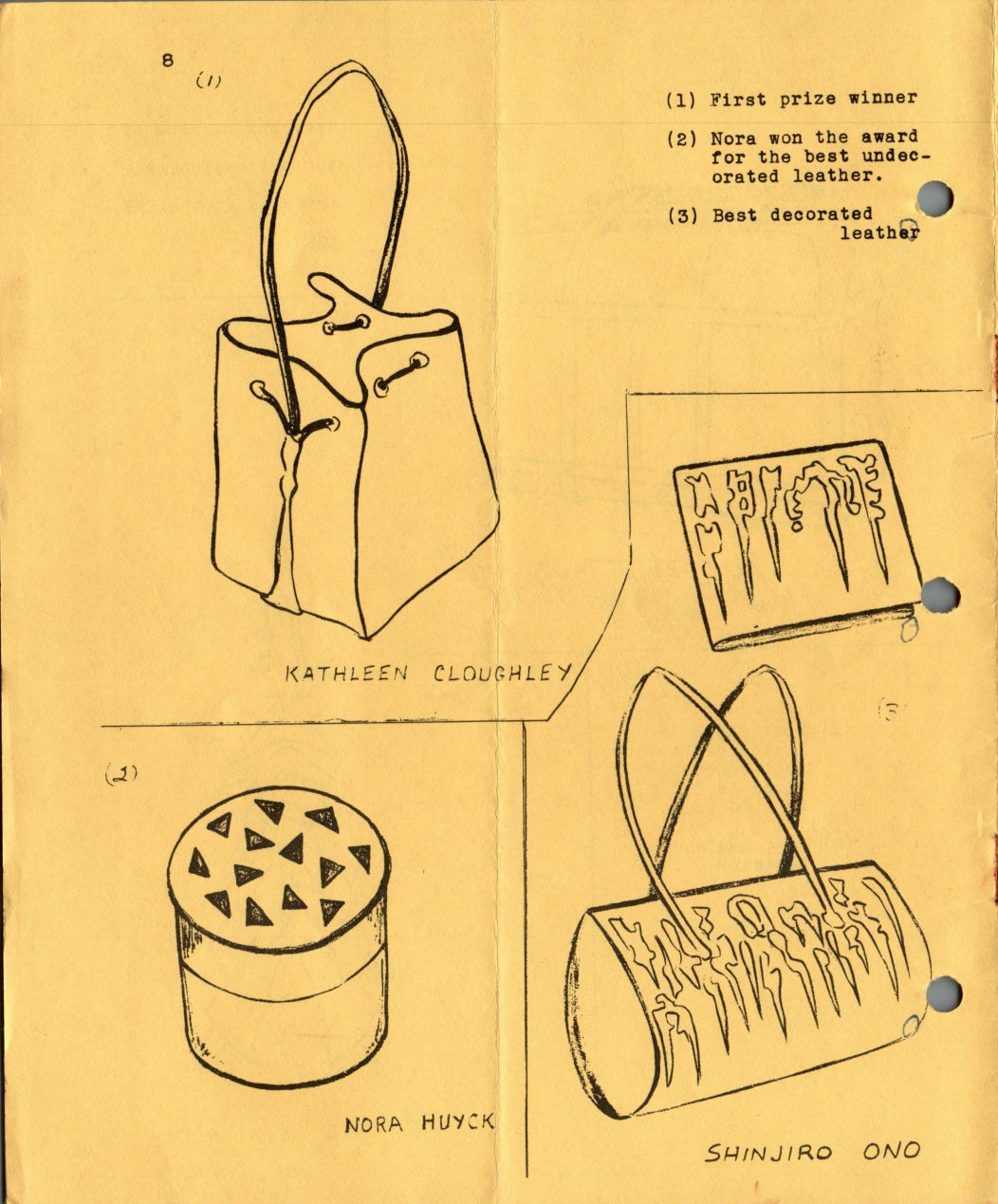
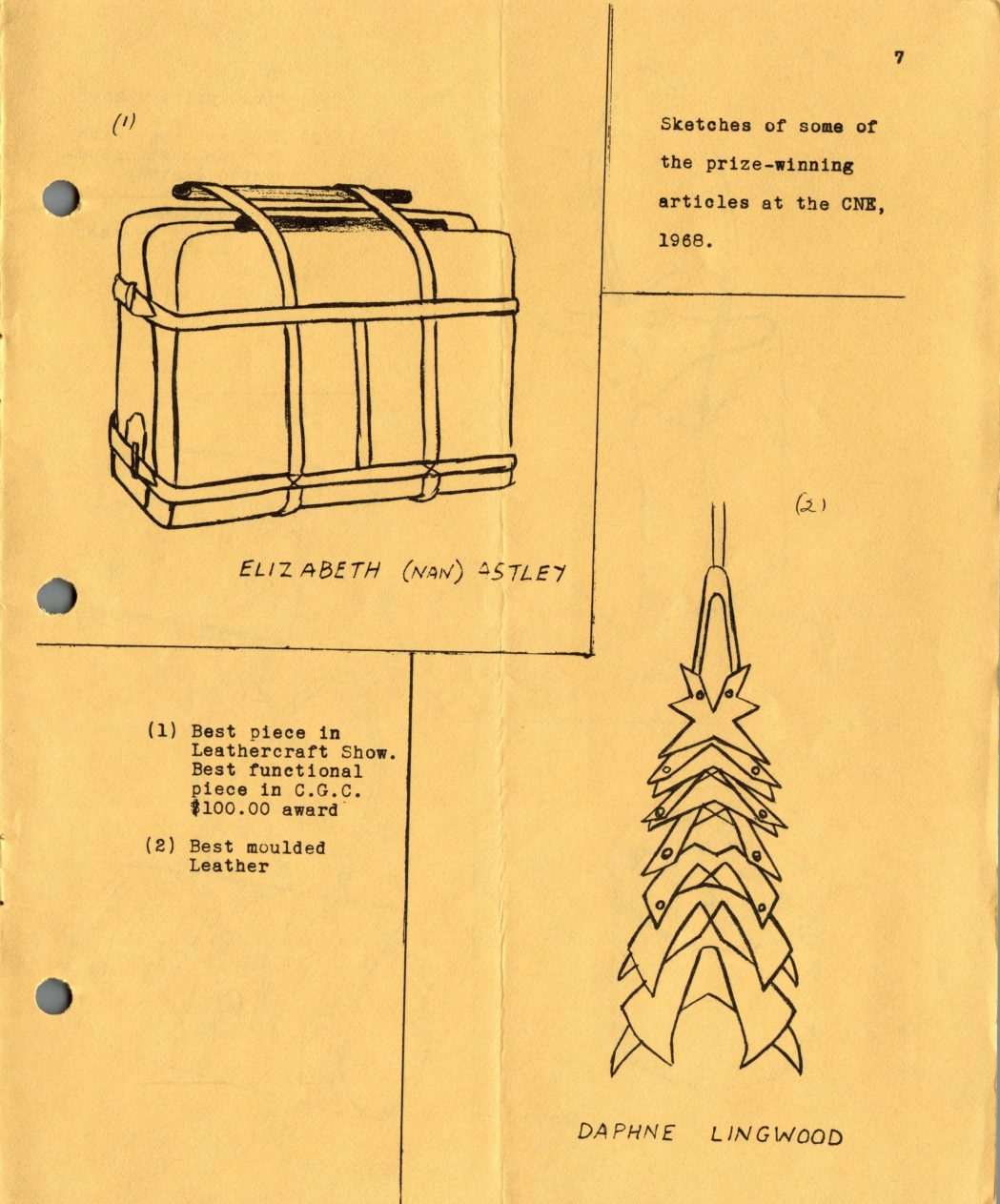
Page 3 — WINNERS OF THE BUILD OF CRAFTS COMPETITION AT THE 1968 C.N.E.
WINNERS OF THE BUILD OF CRAFTS COMPETITION AT THE 1968 C.N.E.
Best Leather Entry - F.W. Woolworth Co. Ltd. $50.00
Mrs. Elizabeth Astley, Scarboro
Binder-briefcase
Decorated Leather - Tandy Leather $50.00 credit note
Shinjiro Ono, Toronto
Handbag and wallet
Undecorated Leather - Lewiscraft (Toronto) $40.00 credit note
Mrs. Nora Huyck, Newmarket
Letter caddy
Molded Leather - Canadian Society of Creative Leathercraft $25.00
Mrs. Daphne Lingwood, Caledon
wall hanging
Any leather entry - not a previous winner - Cdn. Guild of (Ont)
Mrs. Kathleen Cloughley, Barrie
Moulded tote bag
Our Spring Exhibition will be a prestige exhibition in place of the customary Fall sale. Due to uncertainty as to the location of this exhibition, no definite date can as yet be announced, but members are reminded that a good number of well crafted articles will be needed.
In order to avoid more confusion, the Volume numbers are continuing but the publication dates are current. I regret this step has been necessary but due to lack of material, there was no alternative. Please send in articles for publication so it doesn't happen again.
Hamilton Branch will host the 1969 Annual Meeting. This meeting will be held at the Scottish Rites in Hamilton on March 22, 1969 so please keep it in mind and plan to attend, bringing, of course your completed leather masterpieces you have worked on this winter.
Barrie Branch report a busy fall and already have had demonstrations on pattern making, pattern adjustment and design. Toronto opened their fall meeting with a demonstration on spray painting with the members trying their hand at it after.
Page 4 — MAKING STEERHIDE MOCCASINS
MAKING STEERHIDE MOCCASINS by Edith Roscoe )
Here is an interesting "Adventure - in - Doing." In our group we make moccasins for the whole family - mother, dad, children - all to the same general pattern. This is a good way of using pieces of steerhide that are too scratched or marred for making purses and other larger projects.
This type of leather is pliable and long-wearing. The pattern suggested makes use of fairly small sections of leather and can be made to fit any foot-size from a tracing made from wearer's own low-heeled shoe. Shearling insole and cuff may be cemented lightly into place, and removed for washing. If you do not have steerhide on hand, moccasins to this plan are very attractive and wear well when made from suede splits, which are low in price and come in brilliant colors.
Pattern
1. Make tracing on brown paper, around sole of shoe, pencil held vertically. Allow 1/4" all around for seams (1).
2. Cut pattern of vamp - shield-shaped.
Dimensions are shown for ladies' medium size. Children's should be smaller; men's larger. Vamp pattern should be about same size as tracing of toe of shoe (2).
(1)
VAMP
3. Pattern for moccasin UPPER - - as shown (3). Just a long strip, tapered from 1 1/2" at toe to 2 1/2" at heel—about 13" long for ladies', men's longer, children's shorter. CONSTRUCTION
(3) i UPPER
1. Decorate vamp in any desired manner - sections of tooling or carving cowhide may be used for these. Cement a leather lining on back of vamp after decoration. (The illustration shows carved and colored pine-cones, in two shades of brown with green pine needles),
On other moccasins we have made (in colored suede splits) we used a decorative stamp around edge (leaving 1/4" margin for
Page 5
lacing) - and a central motif stamped or carved to represent Indian bead-work. This was colored with Mongol pencil dyes in bright colors to represent the bead motifs.
2. Cut out soles - from scrap carving cowhide, or heavy steerhide, Two soles for each foot. Cement together, grain sides out.
3. Join heel sections of UPPER - with criss-cross lacing,
- with straight lacing
- with saddle-stitching.
4. Form flange, or ridge, at lower edge of UPPER - and starting in middle of heel-back, cement flange to sole (holding along edge with clamps) and bringing sections together at middle of toe, trim off any excess length, and join at toe, as at heel. (Try this first with brown paper pattern to be sure UPPER section is plenty long enough to require trimming at toe when in place.
5. Punch through flange and edge of sole together for lacing or saddle stitching (5). After stitching we dampened the UPPER leather very slightly, put moccasin on carefully over heavy sock, and molded it into instep and around foot for contour; slip foot out carefully and allow to dry in shape.
6. Punch holes around edge of vamp, spacing evenly. (Holes may also be punched in UPPER, in decorative pattern, for ventilation with shearling insole).
7. Punch holes along top edge of UPPER (starting at join at toe) to correspond with holes punched in vamp. Holes on UPPER should be very slightly farther apart on UPPER, to bring it in place under vamp (6). Lace and pull firmly in place, starting at centre of toe section and working either way. Fasten off firmly.
8. Cut thong of steerhide (3/8" wide) to go around heel section. Punch large holes, or make slits, to pull thong through and up and around foot to make heel firm. Sew in place at each end, with heavy linen thread (7). Sew this into place along top edge of upper, with saddle stitching. Dampen and fold down over raw edge of UPPER.
[The small figure numbers (4), (5), (6) and (7) beside the drawings on this page are the drawings’ own labels and are left out of the text here.]
Page 6
9. Cuff - cut cuff of steerhide about 24" wide, and long enough to go right around heel to vamp, to cover thong. (Cut paper pattern first). Shred lower 1 4" of cuff into equal strips, for Indian effect (7). Sew this into place along top edge of UPPER.
SHEARLING LINING
Insole section - cut insole of shearling about 1/8" larger around toe section than sole = slit at 1" intervals. When pushed into moccasins, the slits allow it to extend slightly up, and around inside for softness on toes (8).
Cuff Section - cut cuff pattern about 4 inches by 5¢ inches, two sections for each foot. Overcast with linen thread at heel. Overcast to shearling insole around heel section (9).
Place lining inside moccasin with few dabs of leather cement on bottom of insole, and on sides, just sufficient to hold in place. May be pulled out for washing, and replaced.
FINISHING
1. A section of firm cowhide was cemented inside heel of moccasin, before shearling lining was inserted - curved from UPPER edge to sole, to give extra firmness. 2. Rubber heel lifts (purchased) were cemented in place for comfort - to avoid a too-flat feeling.
If necessary, for closer fit, a band of broad elastic may be sewn from side to side, under vamp, for children. 3. Bow of braided lacing was stitched in place for trim. 4. Antiques - moccasins were antiqued all over with Antique and finished with several coats of Polish Coat.
WE HOPE YOU WILL ENJOY MAKING Your OWN CUSTOM DESIGNED MOCCASINS
Reprinted by special request 9
A human mind should be like a good hotel, open the year 'round. If it's under poor management, it will be empty the year round.
Page 7
Sketches of some of the prize-winning articles at the CNE
1968.
ELIZABETH (NAN) ASTLEY
(1) Best piece in Leathercraft Show. Best functional piece in C.G.C. $100.00 award
(2) Best moulded
Leather
DAPHNE LINGWOOD
Page 8
[This page is the continuation of the sketch plate on p. 7, already embedded as a figure in the C.N.E. competition article; transcribed here to match. Only fragments of this page could be read.]
(1) First prize winner
(2) Nora won the award for the best undecorated leather.
(3) Best decorated leather
KATHLEEN CLOUGHLEY
NORA HUYCK
SHINJIRO ONO