
An issue of the Society’s newsletter, transcribed from the original.
(12 pages, 2.1 MB)
the full-resolution scan, 33 MB, for close research
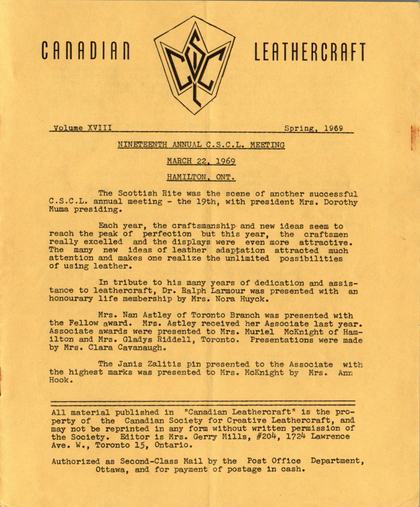
Page 1 — NINETEENTH ANNUAL C.S.C.L. MEETING
Canadian Leathercraft
Volume XVIII Spring, 1969
NINETEENTH ANNUAL C.S.C.L. MEETING
HAMILTON, ONT.
The Scottish Rite was the scene of another successful
C.S.C.L. annual meeting - the 19th, with president Mrs. Dorothy Muma presiding.
Each year, the craftsmanship and new ideas seem to reach the peak of perfection but this year, the craftsmen really excelled and the displays were even more attractive. The many new ideas of leather adaptation attracted much attention and makes one realize the unlimited possibilities of using leather.
In tribute to his many years of dedication and assistance to leathercraft, Dr. Ralph Larmour was presented with an honourary life membership by Mrs. Nora Huyck.
Mrs. Nan Astley of Toronto Branch was presented with the Fellow award. Mrs. Astley received her Associate last year. Associate awards were presented to Mrs. Muriel McKnight of Hamilton and Mrs. Gladys Riddell, Toronto. Presentations were made by Mrs. Clara Cavanaugh.
The Janis Zalitis pin presented to the Associate with the highest marks was presented to Mrs. McKnight by Mrs. Ann Hook.
All material published in "Canadian Leathercraft" 1s the property of the Canadian Society for Creative Leathercraft, and may not be reprinted in any form without written permission of the Society.
Editor is Mrs. Gerry Mills, #204, 1724 Lawrence Ave. W., Toronto 15, Ontario.
Authorized as Second-Class Mail by the Post Office Department,
Ottawa, and for payment of postage in cash.
Page 2 — WESTON TROPHY
WESTON TROPHY
The coveted Weston Trophy was taken home this year by the Barrie branch with an average of 90.3%. Barrie president Mrs. Eleanor Coutts received the trophy on behalf of the Branch. Articles submitted for the trophy were crafted by Kay Cloughley, Clara Cavanaugh, Nora Huyck, Betty Haycock and Hilda Darbyshire.
Mrs. Jean Newton opened the question box and again helped members solve some of their leather problems. More interest is needed in the question box to keep it in operation. Members must have problems that arise during the year so let us help you solve them during the question box.
Mr. Ted Rowan of Rittermere Crafts Study, Vineland, Ontario was guest speaker at the luncheon. His topic "Crafts and the Community" was most informative and a combined commentary with slides taken by the Rowans on a tour of craft shops and schools in Europe aroused interest in many crafts of other countries.
A wide variety of demonstrations attracted many interested craftsmen. Janis Zalitis, Toronto demonstrated Spray Painting; Lillian Beech, Hamilton - Braided Belts; Gladys Riddell, Toronto - Mocassins.
The second hour of demonstrations showed Soft Leather Flower making by Jessie Strain, Hamilton; Enlarging Designs by Pantograph and Slide Projector by Sandy Coutts, Barrie; Folded Wallets by Helen Wheaton, London.
The coffee break closed another successful annual and a special thanks goes to the Hamilton Branch for their hospitality.
Treasurer, Cecil Roebuck has requested me to remind members sending in cheques to please include exchange. Our guardian angel of the finances says the bank balance is taking a real beating due to this oversight.
The Ontario Guild of Crafts formerly on Bloor Street is now located at 140 Cumberland Street. Same phone number:
Hope everyone plans to attend the International at the Hotel London, London on May 3, 4, and 5:
Page 3 — MRS. IRVA FORD NAMED NEW CSCL PRESIDENT
MRS. IRVA FORD NAMED NEW CSCL PRESIDENT
The Hamilton Leathercraft Guild is happy to have the opportunity to host the 19th Annual Canadian Society for Creative Leathercraft meeting and to welcome you here to-day. May this be a memorable occasion.
As convener of this Annual meeting I wish to thank the Hamilton members for their co-operation and tremendous effort. Imagine all these attractive name-tags being made by one member and I am referring to May Wheatly. Helen Caswell made the place cards for the head table. These are only two of our willing workers. Everyone responded and proved dependable.
Personally, I am honoured and somewhat over-awed at the monumental task ahead of me as your President.
So frequently speakers apologize for what they are about to say, because of short notice. In terms of time and preparation, then what I am about to say during the next few minutes should indeed be most interesting. I have had eight years as vice-president to prepare it.
But as I stand before you now, I realize that all the time and preparation in the world could not lessen the feeling of humility and inadequacy that I feel this morning.
It is not easy to follow a long line of such outstanding C.S.C.L. presidents as we have had in the past 19 years and our past president has been no exception. Members respond to good leadership. We have just ended a healthy year with a fine financial report and increased membership. We've tried new things, changes have been made and proven successful - all because we have had a good leader. Dorothy, I will certainly need the benefit of your strength and your wisdom.
I appreciate the confidence you have placed in me and trust that I too will have a fruitful term of office. We have a tremendous responsibility and tradition to uphold.
My personal thanks goes to the nominating committee which has provided me with an able executive. With the ability, experience and enthusiasm of this new executive, I propose that we will enter this 20th year with renewed vigor and do our level best to meet the challenge and uphold tradition established by former executives.
Page 4 — C.S.C.L. EXECUTIVE 1969-70
But the world would be dim if all the little lights were turned out. Each member has his own contribution to make so keep on shining.
I realize that we will make mistakes. We will do things we shouldn't do and not do things we should have done. We may trample on some toes while trying to get a job done, but was it ever thus! We solicit your criticism and your recommendations at all times. Criticism, I expect for I realize in order to avoid it one must say nothing, do nothing, be nothing.
As we go forward into a new year may the interest and loyalty shown during the past continue to grow. Let us all make the best of every oportunity to be of service to our association and keep in mind "The work of to-day's craftsmen will be to-morrows treasured possessions."
C.S.C.L. EXECUTIVE 1969-70
Past President Dorothy Muma
President Irva Ford
Vice Presidents Helen Wheaton Mae Corbett
Corresp. Sec'y Thelma Terry
Record. Sec'y Ruth Haig
Treasurer Cecil Roebuck
EXECUTIVE COUNCIL
| Gel Brigden | Margaret Monteith |
| Nan Astley | Carol McLean |
| Kay Cloughley | George McPhail |
| Betty Henstridge | Sadie Roebuck |
| Anne Hook | Gladys Riddell |
| Nora Huyck | Olivia Smith |
| Del Jacombs | Jack Layton |
Gerry Mills
CHAIRMAN OF COUNCIL OF FELLOWS - Clara Cavanagh
[Printed "COUNCIL UF FELLOWS"; the worn O prints as a U throughout this line, read here as "COUNCIL OF FELLOWS".]
DON'T FORGET THE ARTS, CRAFTS AND HOBBY SHOW at THE C.N.E. AUGUST 14 to SEPTEMBER 1, 1969. CONTACT YOU PRESIDENT FOR MORE DETAILS.
[Printed "SFOv"; read here as "SHOW". "CONTACT YOU PRESIDENT" is printed as shown, apparently missing an R for "YOUR", and is transcribed as printed.]
Page 5 — JUDGES REMARKS ON ARTICLES SUBMITTED FOR WESTON TROPHY
JUDGES REMARKS ON ARTICLES SUBMITTED FOR WESTON TROPHY
BARRIE - 90.3%
Paper Weight - A very attractive piece. The design suits the shape of the glass. It is fascinating the way the circles Change shape as the glass is turned. The holes in the leather are actually graduated in size from the centre to the outer edge, but the curve of the glass makes them appear to be the same size. This is an example of the accessory use of leather. The leather provides the decoration of the piece.
Pocket Secretary - The leather is brown morocco and the very fine morocco lacing has been hand cut. It is beautifully finished - the stitching inside has been hand done - the edges of the pockets are all turned and that requires very skilful skiving, especially on the curves so that the edges aren't thicker than the rest of the pocket. Even the edges of the window for the calendar have been turned. The top and bottom curves of the pocket match the curve of the window above it.
Tray - It is made of sole leather, moulded by hand. The top is finished in the natural colour of the leather and the back and edges are finished with a pigment dye. It is a very eye-catching design and quite suitable to the shape of the tray. While the edge colour tones in with the natural colour of the top, it is still enough different to provide a pleasing contrast.
Pen Stand - The oval shape is a pleasant Change from the usual round or rectangular shapes used for pen stands. Two pieces of leather have been used to cover a form. One goes around the sides with the ends meeting at the centre back. The other piece covers the top. In some places the skiving where it overlaps could have been a bit finer.It is a comfortable size for the average desk.
TORONTO 83.6%
Handbag - At first glance this a a very pleasing bag with its unusual modern slim look. The gusset is very well moulded, but it: limits the room inside the bag. The light lining shows from side view even when the bag is closed. The handle doesn't seem as though it carries the bag in balance, it seems a bit short. It might have been improved by carrying the lines of the bag up into the handle. A curve on the flap rather than points or corners would have been more in keeping with the overalldesign. The workmanship is excellent.
Page 6
Pen Stand - This is a different and interesting shape. It is like a crescent moon. Its design caused some discussion about the merits of concave and convex lines in design - generally, concave lines give a rich look, convex lines give a feeling of poorness. This design was very well liked or not liked at all. It was a matter of personal taste. The colour is excellent and the edges and points of the crescent are beautifully finished.
Pocket Secretary - This seems a bit heavy. Fewer pockets inside would have made a lighter article, but perhaps the person for whom it was made wanted it that way. The edges of the pockets would have looked better if they had been dyed, or skived and turned. A darker lining would have given a better appearance. The shape of the design doesn't seem quite in harmony with the shape of the front. The idea of the design is good and it is well done. Some areas have been depressed with the modeller and smoothed so that the morocco grain is flattened to produce an interesting contrast in textures. It is well constructed, it folds well and it is well laced.
Box - This is not a wooden box covered. It is classed as moulded work. The hexagon shape is achieved by wrapping successive layers of strong paper around a wooden block, gluing each layer to the previous one until the desired thickness is reached. The top and bottom are of millboard. The mitring of the leather at the corners could have been better. The 3-D design should show two distinct levels with no tool marks to mar the effect. At the outer edge, these two levels can be seen quite easily. Towards the centre, there is a sloping effect as though it were impossible to push the leather down to the lower level. Any attempt to press the leather down further with a tool would have marked the leather and spoiled the general appearance. The design is well suited to the shape of the lid. The colouring is good and the choice of colours pleasing.
Tray - This is beautifully finished - top, bottom and edges. There is a good penetration of dye all over. The design seems a bit insignificant, it doesn't add anything and doesn't relate to the shape. It has been well moulded. The bottom is quite flat. It isn't easy to get such small curves around the edge in thick leather.
HAMILTON - 81.6%
Picture Frame - This multi-pose picture frame is a delightful variation of the usual type. It is made of two strips of 6 oz. leather. No applied decoration was needed. There is no colour, just the natural leather with its beautifully finished edges. A very ingenious way has been devised for the insertion and removal of pictures. Strips of Velcro closing have been used to hold the back in place.
[A stray underscore is not part of the printed text: "is a_ sloping" is set out here as "is a sloping".]
Page 7
Paper Weight - Leather alone would not be heavy enough for a paper weight. In this one, the weight is hidden between the layers of leather. When pieces of leather are stacked together like this, they need to be well sanded and well rubbed up to make a neat finish. A bit more work could have been done on these edges. From some angles the design seems to be just a trifle off centre. It is a simple design, done in line tooling and looks well when viewed from any angle.
Bowl - The sole leather from which this bowl was made must have been a very rugged piece. It looks as though it might have been difficult to work up to shape. Since all the curves of the top edge aren't level, one side of the leather was probably more resistant than the other. The back may not be as smoothly finished as we usually think they should be but it is in keeping with the rugged appearance given by the wrinkles on the top of the leather and the unevenness of the sides. It is a very pleasant piece.
Crumb Tray and Brush - While the use of leather for this purpose might be questioned, the construction has been well thought out. The tray has been moulded from one piece of leather and shaped for easy holding. The front edge is thinned so that crumbs can be brushed onto it, but not thinned enough to weaken it. There are a few stamping tool marks along the edge. They have no relation to each other or to the rest of the piece and perhaps should have been omitted. The brush has two kinds of lacing - all one kind would have looked better or maybe another kind of construction since there is no lacing on the tray. The brush handles very well.
Pen Stand - This is a lovely piece. At first glance it looks like marble. It is a wax resist technique - melted wax is dribbled on the leather to prevent the dark dye from colouring certain areas. It brings up the usual question - should leather attempt to imitate other materials. It is very well finished - the edges, back and corners are almost perfect. In the proper setting it would certainly add to the decor of the desk or room. WOODSTOCK - 78.4%
Clock - As far as technique goes, the carving is very well done. It isn't often we see a carving design of this size consistently good throughout - even the animals are good. For a well designed piece it is a bit overdone. The clock is lost in the details of the overall design. Some areas of leather left untouched or a bit of contrast in colour might have helped to focus attention on the clock. The plainness of the frame is quite effective against the heavy decoration. This is another example of the accessory use of leather.
Hat - A lovely hat, quite in keeping with the current trend towards leather clothing. The usual question arose - is it leathercraft or is it millinery? - and as usual there was no
Page 8
answer. It is very well made. A contrast in textures has been provided by using the suede reversed for the band. It is also more practical to use a smooth leather for the band since use would soon mark the suede.
Bowl - This bowl has a very pleasing appearance. It is very well finished - top, bottom and edges. It, like the other trays, is made of sole leather. It is a beautiful piece of leather and being left natural shows everything to advantage. The moulding has been very carefully done. Even when upside down, the top edges are even.
Letter Caddy - This is an interesting idea. It is quite well designed except for the spacing of the pockets. If the space between the pockets had been equal to the width of the base, the appearance would have been improved and it would be easier to get small letters out of the lower pockets. The 3-D design is well done. Close inspection reveals some tool marking but it is not deep enough to mar. the general appearance. The raised edge is a nice bit of detail. The back is nicely finished.
Photo Album - The design is good since it involves the whole area. It is the 3-D technique. Here it is a bit overworked. The front is warped and the excessive rubbing could have caused it. There seems to be a fault in construction which has destroyed the effect of a top, a spine and a back. It could be that the front and back aren't wide enough to accommodate the filler and so, some of the spine has had to be pulled onto the front and back. It is pulled tight enough that the edge of the millboard next to the spine area shows. If 'that edge is bevelled slightly it helps to avoid a sharp line. The corners are very well done and all the edges are turned over neatly.
LONDON - 78.4%
Wallet - The same comment could be made here - should leather imitate another material - in this case a piece of wood - with an interesting grain pressed against the damp leather. It has made a very unusual and pleasing decoration. The interior should have received a bit more attention-the stitching isn't good and the folds are too loose. The gauge for punching the leather slits has been set rather deep. The lacing is very well done.
Book-ends - These are very attractive. The colouring is lovely and well done. There might have been a bit more skiving done on the bottom turnovers to eliminate bumps. The lining is in two pieces - perhaps an easier method could have been worked out for covering the bottom. Otherwise, the craftsmanship is very good and the design is quite suitable for the shape of the article.
Page 9 — BRANCH OFFICERS FOR 1969 - 1970
Desk Pad - The only improvement to suggest here would be the skiving of the turnovers onto the bottom. They have been left quite thick. The design is 3-D tooling and is very well done. It has a heavy appearance - right for a man's desk.
Card Case - This is a very practical item. The tab is a bit snug. It might have looked better if an invisible dome had been used. It is hard to get good hardware for our handcrafted pieces. Since it is hand made, hand stitching might have been better. A simple stylized design - maybe initials alone would have been more suitable - or a design which could be viewed from any angle since it looks like a book. The combination of colours is very pleasing.
Coaster Set - This is a lovely piece of work. It is pleasant to look at. It is very nicely dyed, using the spatter dye technique. The stand is quite an interesting interlocked construction. The edges and backs are well finished. It is smooth all over.
BRANCH OFFICERS FOR 1969 - 1970
| BARRIE | President | Mrs. Eleanor Coutts |
| Vice-President | Mrs. Kay Cloughley | |
| Rec. Secretary | Mrs. Kay Cloughley | |
| Corresp. Secy. | Mrs. Sherle Bottrill | |
| Treasurer | Mr. Dwayne Trew | |
| BELLEVILLE | President | Mrs. Vera Farrara |
| Vice-President | Mr. Harold Connors | |
| Secty-Treasurer | Mrs. Mathel Alexander | |
| HAMILTON | President | Miss Evelyn Burgess |
| Vice-President. | Mrs. Ruth Haig | |
| Secretary | Mrs. Muriel McKnight | |
| Treasurer | Mrs. Jessie Strain | |
| LONDON | President | Mr. Charles W. Fuller |
| Vice-President | Mrs. Sylvia Gerster | |
| Secretary | Mrs. Helen M. Wheaton | |
| Treasurer | Mrs. Margaret Fader | |
| TORONTO | President | Mr. Cecil J. Roebuck |
| Vice-President | Mrs. B. Rushton |
| Secretary | Mrs. Nan Astley |
| Treasurer | Mr. George McPhail |
| WOODSTOCK President | Mrs. Beula Reynolds |
| Vice-President | Mrs. Lorene Manuel |
| Secretary | Mrs. Joy Hutcheson |
| Treasurer | Mrs. Carol McLean |
[The Barrie branch list prints Mrs. Kay Cloughley's name twice in a row, once as Vice-President and once as Recording Secretary; she is transcribed as holding both offices, as printed.]
Page 10 — LEATHER IS "IN" FOR THE FASHION CONSCIOUS; USE SHOE BRUSH
LEATHER IS "IN" FOR THE FASHION CONSCIOUS
Experts have been proclaiming for years, the news that there's nothing like leather - and there isn't, which is why coats suits and overblouses of this material have become wardrobe favorites. And leather boots not only look dashing but keep out snow and rain.
Fine leather shoes and handbags we take for granted but around the house, it's lovely leather too, what with tops on chests chairs and handsome wastebaskets all of leather to add to the matching material in desk accessories.
Modern leather represents an extraordinary technological achievement in its long wear, its attractive appearance and comfort.
Although we know the capacity of leather to maintain its good looks and utility under practically all service conditions, there can be dividend of greater satisfaction with minimum care and treatment of leather products. A minor investment in time for cleaning or polishing will enhance the beauty of leather, extend its life and increase the pride of possession inherent in beautiful leather items.
One general rule applies to all kinds of shoes and types of leather used in the uppers or linings: Wet shoes should never be dried near excessive heat. They should be stuffed with newspaper or put on shoe trees and dried in a moderate temperature. This will preserve the shape of the shoe and the leather will retain the essential oil that gives its flexibility and comfort. Shoe cleanliness promotes later life and fine appearance. Uppers, made of smooth or grain leathers - as distinguished from suede - can be cleaned with the suds of mild soap and subsequently dried with a clean cloth.
USE SHOE BRUSH
After the dirt has been removed, a good shoe polish will give luster to the surface. Liquid polishes, which do not require brushing or shining, can often cover scuff marks.
Suede or brushed leather shoes can be maintained with very little more than a good brushing to remove surface dirt. A light touch-up with fine sandpaper, carefully applied, should restore the nap of scuffed spots. Special commercial cleaners are available for suedes that have been subjected to extreme wear. In a majority of cases, however, the simplest care is the best and more than sufficient.
Page 11 — HARDWOOD DOWEL HANDLE WITH RECESSED GROOVES TO ACCOMMODATE STRAPS
HARDWOOD DOWEL HANDLE WITH RECESSED
GROOVES TO ACCOMMODATE STRAPS by Nan Astley
Materials:
Piece of dowel - length and diameter as required Blotting paper
Glue
Leather cement
Leather
When selecting diameter of dowel, remember that the handle will be larger than the dowel because of the built-up shoulders each side of the grooves. The number of times' the blotting paper has to be wound around the dowel should equal in thickness the straps being used.
Cut a strip of blotting paper, the length of the dowel plus 1/2" and wide enough to roll tightly around dowel to needed thickness.
Diagram: a dowel wrapped in blotting paper, labelled "Skive these two edges," with arrows pointing to the dowel and the blotting paper.
Apply glue to paper and wind tightly around dowel.
Bone well all over to impregnate glue into paper. Let dry, then trim edges flush with dowel, edges may be bevelled. Cut out grooves to fit width of straps plus 1/16" to 1/8" allowance for leather covering.
Diagram: the dowel with the grooves cut, labelled "groove with paper removed," "dowel," "cut," and "cut to dowel," with arrows pointing to each.
[This page illustrates the handle with two line diagrams rather than photographs; their captions are set out above in place of the drawings.]
Cut two circles of leather, big enough to cover ends of handle up to the edge of the grooves. Skive well. Apply glue and mold over ends. Bone well to remove all wrinkles. Trim leather around groove edges.
Page 12
Diagram: a length of handle with its ends capped, labelled "Trim edges of leather," "paper," and "leather caps," with arrows pointing to each.
Cut a piece of leather the length of the handle plus the depth of the grooves, e.g. if the handle is 9" long and the depth of the grooves are 1/8", the required piece of leather will be 9" plus four 1/8" which equals 94". The width of the strip will be equal to the circumferance of the handle plus one-half inch allowance to cover edge. All edges must be feather-edged.
Cement leather strip to handle and bone well into grooves, and along all edges. A length of linen thread wound lightly around groove also helps in securing leather.
Diagram: the finished handle, labelled "Linen thread" with arrows, and captioned "Finished handle."
[This page continues the handle instructions with line diagrams rather than photographs, including one giving the worked measurement from the example on the facing page; their captions are set out above in place of the drawings.]
If people would whistle more and whine less, Hustle more and holler less,
Work more and worry less,
Boost more and Knock less,
Give more and grab less;
Everything would get better fast!