
An issue of the Society’s newsletter, transcribed from the original.
(8 pages, 1.1 MB)
the full-resolution scan, 21 MB, for close research
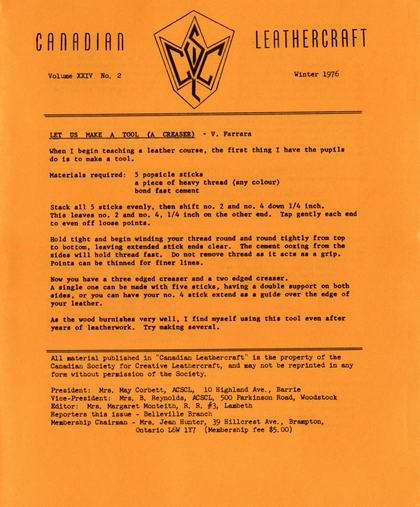
Page 1 — LET US MAKE A TOOL (A CREASER)
Canadian Leathercraft
Volume XXIV No, 2 Winter 1976
LET US MAKE A TOOL (A CREASER) - V. Farrara When I begin teaching a leather course, the first thing I have the pupils do is to make a tool.
Materials required: 5 popsicle sticks
a piece of heavy thread (any colour)
bond fast cement
Stack all 5 sticks evenly, then shift no. 2 and no. 4 down 1/4 inch. This leaves no. 2 and no. 4, 1/4 inch on the other end. Tap gently each end to even off loose points.
Hold tight and begin winding your thread round and round tightly from top to bottom, leaving extended stick ends clear. The cement oozing from the sides will hold thread fast. Do not remove thread as it acts as a grip. Points can be thinned for finer lines.
Now you have a three edged creaser and a two edged creaser.
A single one can be made with five sticks, having a double support on both sides, or you can have your no. 4 stick extend as a guide over the edge of your leather.
As the wood burnishes very well, I find myself using this tool even after years of leatherwork. Try making several.
All material published in "Canadian Leathercraft" is the property of the Canadian Society for Creative Leathercraft, and may not be reprinted in any form without permission of the Society.
President: Mrs. May Corbett, ACSCL, 10 Highland Ave., Barrie
Vice-President: Mrs. B. Reynolds, ACSCL, 500 Parkinson Road, Woodstock
Editor: Mrs. Margaret Monteith, R. R. #3, Lambeth
Reporters this issue - Belleville Branch
Membership Chairman - Mrs. Jean Hunter, 39 Hillcrest Ave., Brampton,
Ontario L6W 1Y7 (Membership fee $5.00)
[A stray underscore is not part of the printed text: "(A _CREASER) -" is set out here as "(A CREASER) -".]
Page 2 — BRAIN STORMING AT THE 25th ANNUAL
BRAIN STORMING AT THE 25th ANNUAL
At the 25th Annual we took time Sunday morning to take a look at the functioning of C.S.C.L. As a basis for looking at ourselves objectively we used C.S.C.L. membership brochure as a guide. The members present were divided into six groups under a leader-recorder. There was to be no discussion allowed, but each person in the group was to give their thought or suggestion on the various headings as listed in the brochure.
It has been quite a task to simmer all the comments down to the essence of thought in each section, in order to have them in printable form. Under each heading the common thought by participating members, is given on the left side with information comments from background knowledge gained over 25 years membership and as immediate Past President of C.S.C.L. by Helen Wheaton, on the right side.
If, after reading the following report, you have anything to add, whether you were at the Annual or not, I would be pleased to hear from you.
The following report respectfully submitted.
Helen M. Wheaton,
100 Grand Avenue,
London, Ontario N6C 1L7.
On this page and page 3, and again on pages 6 and 7, the report is printed in two side-by-side columns headed “Members comments” and “Information comments,” one topic at a time, with Helen Wheaton’s own reply set opposite each. Read down the columns instead of across, the two had run together into a single unbroken paragraph. It is set out below topic by topic, members’ comments first and the information comment answering it second, matching the order the introduction above describes.
What is C.S.C.L.?
Non-Profit. Members comments: 5/6 thought Executive well run--1/6 thought our buffer fund investment should be used up in scholarships.
Information comments: If used for Scholarships would be duplicating programmes already available:
1. Women's Committee of CG of C (now OCC)
2. Art Council of Ontario
3. Culture & Recreation Dept. (find out what they offer in local regions, or go to them with a programme)
4. New Horizon Grants
5. Youth Grants.
Would suggest use of interest only. 5/6 satisfied with things as they are.
Voluntarily Staffed. Members comments: Executive well run; joined to learn but could see volunteering for executive was part of the whole organization.
Information comments: Joining means: volunteering your attention and time at meetings (no knitting) and your support of activities; after a time be willing to serve in offices and demonstrate.
Page 3
Educational. Members comments: 1. More speakers at Branch meetings 2. Workshops oftener than Annual 3. Demonstrations.
Information comments: 1. Branches are autonomous as far as program is concerned. 2. If they have the courage and willingness to work--doors can be opened (see list on other page). Branch could let members know their program agendas so any member could attend. Agendas could be published in Canadian Leathercraft. 3. A list of those willing to go and demonstrate--recompense required--etc. Nora Huyck at one time made up such a list. Where is it now? A new one should be circulated. Also a fee structure set-up for evening meetings and workshops eg. Marie Atken $50.00 per hr. plus travel and equipment.
The fee-structure example names the demonstrator Atken; elsewhere in the archive the same Gravenhurst instructor of weaving and sprang is named Aiken. Printed as Atken here.
Who may join: Membership. Members comments: forms should be made available to all; general lack of communication; promotion material with new memberships (design of the year); novices helped with proper terms for basis projects; more emphasis on new members; fuller reports of Executive Meetings at Branch meetings; new young members, recognize at Annual, list in Canadian Leathercraft.
Information comments: immediate use of present forms so we can assess talents then set up a committee to up-date, and 150 given to each branch; name and address of membership chairman in each edition of Canadian Leathercraft; who to provide? vocabulary of terms be given at meetings and demonstrations; have novice table at Annual; each President receives a copy of minutes each month--if she or he can't present them at the meetings, appoint someone who will.
continued on page 6.
Page 4 — PILLOW AND LADIES VEST
PILLOW AND LADIES VEST - by Doris Miles
A neighbour's garbage and my Scottish ancestry recently led me to an interesting project. Remember the files of leather upholstery samples that suppliers of office furniture used to produce from which the customer chose a colour to match their office decor? Now the cost of leather makes its use prohibitive, vinyls and naughehide are used almost exclusively.
My neighbour was cleaning his basement and fortunately I happened along just as he was dropping two of these sample files into the garbage. One snowy evening last March I dug them out of a deep drawer of leather pieces and began laying them out in a pattern. Weeks later I proudly displayed two reversible leather cushions for our son's bachelor apartment.
The diagram below will give you some idea of the assembly. I began by cutting them all into rectangles 3" x 6", The "quieter' colours I cut again into squares 3" x 3". Then I measured, marked and punched the holes around the edge of each and with phentex crocheted the borders, I tried crocheting the pieces together but this seemed too bulky and I ended up sewing them instead, Finally with the pillow form inside I crocheted the front and back together with two rows of firm single crochet. The finished product is very practical and attractive.
With this experience giving me confidence I attempted another project which incorporated leather and wool. This is a ladies vest, back knitted in ribbing, to ensure a snug fit and the front crocheted from the shoulder down to patches of deerhide (see above) finished around the edges in the same manner as the cushion, Finally I crocheted the fronts, neck and armhole bands, making the buttonholes as I went, I used three colours of wool in this vest, background a dark brown and trimmed the patches with beige and green,
Perhaps these items will spark new ideas among our members for using left over pieces of leather in interesting combinations of materials and techniques.
Page 5 — WORKSHOP TIPS FROM BELLEVILLE
WORKSHOP TIPS FROM BELLEVILLE
To finish the edges and get a high polish on any project not laced, such as a belt, wet the edges with water and burnish with canvas,
Due to different methods used in installing gussets, it is suggested that the gusset lining be cut slightly longer than shown, Cement in place and trim,
For counting off stitch holes on your article, such as gussets, try using the plastic clips from bread wrapping. You can trim them as desired, Use a pencil to mark number of stitches, you can rub the markings off easily. You can also use them in your knitting.
When you have the holes punched in nature tanned leather, try rotating a pencil into the hole from the top side, This will burnish and also spread wax nicely and fit into any size round hole.
When storing boxes for future use, such as size suitable for belts, wallets, jewellery, etc. try placing top under bottom section and stack in according to size. You will be surprised how many boxes you can get into one.
Cut the elastic bands off discarded panty hose, they make good ties for rolls of leather, etc,
The Bulletin needs your help.
Do you have an article or tip that would be of interest to others--why not share it?
Would you like to see an article on a particular technique or item--it so what?
What do you do with your scrapes of leather--any suggestions or perhaps patterns to share with us?
If you have any comments, suggestions or information for your bulletin feel free to send them to me,
Mrs. Margaret Monteith
Lambeth, Ontario N0L 1S0
Page 6
Members on Executive Committee. Members comments: limit time on Executive--do a job or forfeit place.
Information comments: motion in 1969 that 3 years on, and off for at least one year; many types of service required--need people willing and able to travel, and contribute to their expenses.
Objectives.
Members comments: Standards must be in hands of branches and membership generally.
Information comments: published in Canadian Leathercraft; members should read it.
Members comments: Teaching Certificates--there should be strict rules governing who teaches, and those teaching without C.S.C.L. sanction should be discouraged in the strongest order.
Information comments: Teaching is done by those willing to do it, not always the best qualified. C.S.C.L. teaching certificates only certify the holders knowledge--not their ability to teach.
Members comments: Standards--must remain strict, emphatic agreement on this. Standards--should be made available.
Information comments: every member receives Canadian Leathercraft--please read.
Members comments: Benefits--no questions, no comments.
Canadian Leathercraft. Members comments: need all four issues, to keep members at large in touch, as this is the only contact with all members.
Members comments: Question Box--letter to editor.
Information comments: put in and got no reply.
Swap Shop. Members comments: place to sell used tools.
Information comments: can advertise in Canadian Leathercraft; provide table at Annual--who will look after?
Members comments: More technical articles.
Information comments: membership only source; none sent in when asked for or voluntarily submitted; who will supply articles? will the people who made the suggestion? who? who? who?
Members comments: Editorial help to write articles.
Information comments: one sent in on request, we suggested revisions and never heard from them again; editors are willing to help.
Page 7
Exhibitions.
Members comments: Biennial--good timing to come up with high calibre articles.
Information comments: agree.
Members comments: No monetary awards, ribbon enough; one out of six suggested this.
Information comments: the monetary awards o.k. if limited to members; they attract outsiders who contribute nothing to the society--we never see or hear from them until the next exhibit competition; our members can't compete with commercially minded professionals.
Information comments: All exhibitions held in the name of C.S.C.L. must be juried by Council of Fellows.
C.N.E. Sale. Members comments: felt the sale was working efficiently.
Information comments: more members need to send work in--but don't forget it will be screened for good workmanship.
Branch activity: Weston Trophy. Members comments: limit to 1 fellow, 1 associate per branch.
Information comments: this was done at one time and later put aside (also used to be six articles from branch required). It was felt it would give more incentive to gain Associate and Fellow standing. Suggest we need Branch Presidents meeting again at Annuals.
Page 8 — FOR THE POODLE WHO HAS EVERYTHING - LEATHER TRIM JACKET
FOR THE POODLE WHO HAS EVERYTHING - LEATHER TRIM JACKET - V. Farrara
For Jezebel, who is the colour of Buckwheat honey, a dark brown material (such as coating or double knit) was chosen with lining of orange felt. The coat is made of material, lined with felt, but a garment leather over felt could be used. The lining is spot cemented here and there to the brown material, leaving a half inch scalloped or pinked edge of orange showing. Two loops were stitched on to hold the light weight leather strap which had been decorated with a design and her name. The coat is finished with a running stitch of 5/64th lacing--approximately half an inch in from the edge of the top material. The tiny pocket can be made of leather also and attached in the same manner.
A matching parka can be attached with a loose cross stitch, which acts as a hinge to wear forward or back as a collar.
If desired, four garter hooks can hold booties on by using a double piece of elastic which slips into hooks on the booties.
Make garment and hood to suit size of dog.
Booties can be made of knitted material with hooks attached. They must stretch to pull on easy and be a fabric which can be easily washed.
A hand-drawn pattern follows: an oval coat body with a scalloped edge, labelled "JEZEBEL" down its centre strap, a small pocket at the lower left and a collar hook sketched beside it; two marks lettered "G" stand just outside the body at its lower edge, giving the garter-hook positions. A separate hood-shaped piece is drawn to the right, joined to the neck opening by runs of cross stitch lettered "A" on both parts. A small drawing of the dog stands above the pattern.