
An issue of the Society’s newsletter, transcribed from the original.
(8 pages, 1.2 MB)
the full-resolution scan, 22 MB, for close research
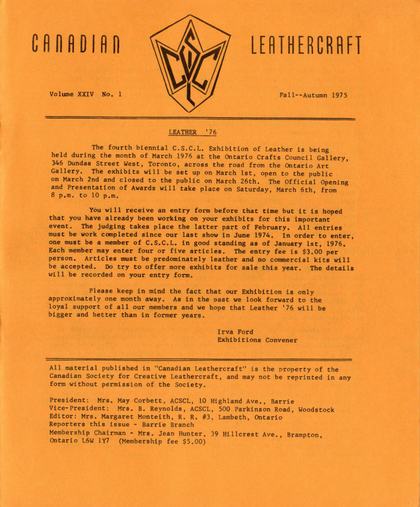
Page 1 — LEATHER '76
Canadian Leathercraft
Volume XXIV No. 1 Fall--Autumn 1975
LEATHER '76
The fourth biennial C.S.C.L. Exhibition of Leather is being held during the month of March 1976 at the Ontario Crafts Council Gallery, 346 Dundas Street West, Toronto, across the road from the Ontario Art Gallery, The exhibits will be set up on March 1st, open to the public on March 2nd and closed to the public on March 26th. The Official Opening and Presentation of Awards will take place on Saturday, March 6th, from 8 p.m. to 10 p.m,
You will receive an entry form before that time but it is hoped that you have already been working on your exhibits for this important event. The judging takes place the latter part of February. All entries must be work completed since our last show in June 1974. In order to enter, one must be a member of C.S.C.L. in good standing as of January 1st, 1976. Each member may enter four or five articles. The entry fee is $3.00 per person, Articles must be predominately leather and no commercial kits will be accepted. Do try to offer more exhibits for sale this year. The details will be recorded on your entry form.
Please keep in mind the fact that our Exhibition is only approximately one month away. As in the past we look forward to the loyal support of all our members and we hope that Leather '76 will be bigger and better than in former years.
Irva Ford
Exhibitions Convener
All material published in "Canadian Leathercraft" is the property of the Canadian Society for Creative Leathercraft, and may not be reprinted in any form without permission of the Society.
President: Mrs. May Corbett, ACSCL, 10 Highland Ave., Barrie
Vice-President: Mrs. B. Reynolds, ACSCL, 500 Parkinson Road, Woodstock
Editor: Mrs. Margaret Monteith, R. R. #3, Lambeth, Ontario
Reporters this issue - Barrie Branch
Membership Chairman - Mrs. Jean Hunter, 39 Hillcrest Ave., Brampton, Ontario L6W 1Y7 (Membership fee $5.00)
Page 2 — DECISION TO AMALGAMATE
DECISION TO AMALGAMATE - from Craft Ontario, October 1975 To members of the Ontario Craft Foundation
On September 24, 1975 a meeting of representatives appointed by the executives of the Canadian Guild of Crafts (Ontario) and the Ontario Craft Foundation was held under the chairmanship of J. Douglas McCullough, Assistant Deputy Minister, Arts Division, Ontario Ministry of Culture and Recreation.
We are happy to report that all present agreed that now is the time to form one provincial multi-craft organization, probably to be called the Ontario Crafts Council.
After considerable discussion, the joint committee agreed on the following points:
- that the Board of Directors of the Ontario Crafts Council would have 24 members, 12 from the Ontario Craft Foundation and 12 from the Canadian Guild of Crafts (Ontario).
- that the Executive Committee would have seven members selected from the Board and that four would be from the Guild and three from the Foundation. - that the Finance Committee would have seven members selected from the Board and that five would be from the Guild and two from the Foundation. - that the Board would have representatives from all six existing regions of the Foundation.
- that all existing programs will be continued for an interim period of 18 months.
- that the Ontario Crafts Council will hold its first Annual General Meeting in May, 1977.
At present, the Canadian Guild of Crafts (Ontario) is renovating a semidetached building at 346 Dundas Street West, Toronto, directly opposite the Art Gallery of Ontario. As it will take approximately 18 months to retire the attendant financial obligations, it was agreed that the term of office for the interim board of the Ontario Crafts Council would be 18 months, and that May 1977 be the date for the first Annual General Meeting of the new organization at which time elections for a new board will be held.
It is proposed that when the building opens to craftsmen and the public on January 14, 1976, it will be under the aegis of the Ontario Crafts Council. This new headquarters will provide superb gallery space for craft exhibitions on the ground floor, storage and preparation space for these shows on the lower level. The second floor will be used for a meeting room and offices. The third floor will be the home of a new Craft Resource Centre, a continuation and strengthening of the information services of both organizations. The Foundation will contribute to the Centre its systematized records and slides. Funding for the first year of the Craft Resource Centre's operation has been underwritten by the Junior League of Toronto, which will also provide volunteers to assist in the Centre's staffing.
The next stage is a meeting of the interim executive committee of the Ontario Crafts Council to be held October 21, 1975. Representing the Foundation will be Jean Burke, Art Morris and David Piper. Representing the Guild will be Joan Chalmers, Mary Eileen Hogg, Ralph Edwards and Douglas Mantegna. Beth Dingman, Leland Thomas and Paul Bennett will also be present.
Page 3 — AWARDS: C.N.E. ARTS AND CRAFTS - WOMEN'S DIVISION, 1975
At that meeting, an agenda will be drawn up for a meeting of the interim Board of the Ontario Crafts Council at 10.00 a.m., Sunday, October 26. Negotiations are proceeding very positively and the Ontario Crafts Council is scheduled to be born on January 1, 1976.
Jean Burke, President, Joan Chalmers, President,
Ontario Craft Foundation Canadian Guild of Crafts (Ontario)
AWARDS
C. N. E. ARTS AND CRAFTS - WOMEN'S DIVISION, 1975.
#217: Household articles: (1) Mrs. Gladys Riddell
(2) Mrs. Carol McLean
(3) Janis Zalitis
#218: Wearing apparel: No entries
#218A: Belts: (1) Mrs. Margaret Monteith
(2) Dave Elliott
#219: Handbags and
Carrying Cases (1) Mrs. Carol McLean CHATELAINE AWARD
(2) Dave Elliott
(3) Richard Wright
#220: Pocket sized items: (1) Janis Zalitis
(2) Mrs. Margaret Monteith (3) Dave Elliott
#221: Moulded articles: (1) Mrs. Carol McLean
#222: Canadian Indian
Bead work: (1) Mrs. H. Quill
#223: Leather Jewellery: (1) Miss Olivia Smith
(2) Mrs. Margaret Monteith (3) Mrs. Joyce Ecker
CANADIAN GUILD OF CRAFTS.
| Best Leather Entry: donated by Woolworths $100 | Rex Lingwood |
| Best Functional donated by C. S. C. L. | Paul Williams |
| Best decorated leather donated by Tandy | Not awarded |
The heading “CANADIAN GUILD OF CRAFTS.” is underlined on the printed page The three Guild of Crafts awards are set out here as the page prints them: each award’s name and its donor stand together at the left, and the winner — or, for the decorated-leather award, “Not awarded” — opposite them at the right.
Page 4 — C.N.E. REPORT 1975 SALE
C.N.E. REPORT 1975 SALE
We are not only celebrating our 25th year of the Society, but we are also celebrating another successful sale at the Canadian National Exhibition.
I am told that this has been the best sale in many years, most members know the pleasures and discomforts when staffing the booth, but few members are aware of the work in preparation for the sale.
The letters to be prepared, the envelopes to be addressed, the purchase of postage stamps, receipt books, paper bags, tissue paper, cleaning supplies and application for sales permit. Arrangements for bank account in the C.N.E. grounds. Passes to the grounds to be distributed and the largest task of all the schedules for persons staffing the booth.
All this preparation begins about three months before the sale starts.
All is not finished at the closing day of the sale, there are items to be returned to storage and sales slips to be counted and sorted, Articles to be counted and sorted, sorted and recounted again, so that everyone receives their proper share of the sales.
After all this work is finished, we found that it was a good year at the C.N.E., but only because I have so many good people to help me.
With this, I say an extra thank you to those who helped me with these tasks.
Robert Sutton
Summary of C.N.E. Sale 1975
Thirty-two members submitted 2,060 articles for sale. Of these, 1,926 were sold.
| Gross sales | $6,367.75 |
| Provincial Sales Tax | 304.65 |
| Net sales | 6,063.10 |
Commission to C.S.C.L. $1,212.62
Value of articles missing $10.40
The bookkeeping has improved again this year and for the most part the tickets on the articles were clear and well marked. However, members are asked to carefully check the price on the ticket against the price entered on the list.
Page 5 — BOOK REVIEW
BOOK REVIEW - by Beula Reynolds
Title "The New Handicraft Processes and Projects by Lester and Kathleen Griswold. This is the 10th edition, printed in 1969, reprinted in 1972 by Van Nostrand Reinhold Ltd. A very entertaining book--many of the materials and methods described start off with a short note on their history and origin. The instructions are clear, concise and for the most part easy to follow, being well complimented by numerous illustrations. As with all craft books covering more than one medium, this book is for basic work; to attain master craftsmanship standards it would be necessary to go to books that specialize. Chapter 1. Design in Handicraft covers the elements of design, principles of arrangement, illustrations of design, motifs taken from impressions of baked clay tablets or clay stamps from prehistoric Mexico, and the principles of proportion in structural design. The last mentioned, of course, recommends the famous "Golden Oblong" as used by the Greek Temple Builders. One most appropriate statement--A fundamental law of design is that it must conform to the requirements of purpose.
Chapter 2. Basketry tells where to look for native material as well as the commercial, what tools are needed, terms, patterns and methods.
Chapter 3. Ceramics. This gives you methods of testing native clays you might find.. Different kilns, glazes, modelling, molds and mold making, decoration, using the potters wheel, tiles and mosaic wall hangings are all described. This also includes how the Southwestern Indians and Mexicans obtain the clay, some speaking to the earth, asking permission, for the Pueblo people believe that men must live on friendly terms with the world around them. There are excellent pictures all through--some of prehistoric pottery and designs.
Chapter 5. Decoration of Fabric, Paper and Wood. This chapter covers stencils, freehand, linoleum block, silk screen, batik and Japanese wax resist method.
Chapter 6. Lapidary goes through classification, cutting, grinding and shaping, sanding and polishing, making of beads, stone sculpture and carving. Stone flaking is the process used to make arrow heads.
Chapter 7. Leather. The classification of leathers, tools, designs, making your own stamping tools, carving. Projects range from key cases to purses, boxes, brief cases and moccasins.
Chapter 8. Metal Craftwork Processes. The different metals used with thumbnail sketches of their history, types and uses start off this chapter; followed by tools and equipment, sawing, bending, molding, annealing and soldering, enameling and jewelry.
Chapter 9. Plaiting Methods and Projects covers many procedures from belts, bolero ties, turks Heads, from 6 through to 16 plait rounds and variations of flat plaiting.
Chapter 10. Plastics Craftwork. Types of plastic, tools, equipment, designs, assembly, cast plastics, shaping, carving and engraving plastics make for a chapter with many new ideas.
Chapter 11. Weaving. Different kinds of weaving, looms and how to dress them, carding wool, spinning, finger weaving, card hammocks, tennis and fish nets are a few of the projects.
Chapter 12. Woodwork. Describes carving woods and tools and finishes; projects from trivets and trays to figure carving.
Page 6 — BRANCH REPORTS
BRANCH REPORTS
Barrie - Following our annual June cook-out the Barrie branch does not hold meetings during the summer months, but was actively involved with a display and sale of leather at the Newmarket Trading Days outdoor sale and the CNE sale.
At a meeting early in September the discussion concerned the small articles that could be made from scrap leather. At the regular meeting which is held on the fourth Wednesday of each month, May Corbett led a workshop on Macramé for plant hangers. October meeting will be devoted to some articles which would be suitable for our Christmas sale to be held in a local Mall on November 22, 1975.
Belleville - The meeting of June 2nd was held at the home of Mona Ray. Following a pot-luck supper Jack Layton showed travel slides. Another social event took place at the summer property of Vera Farrara on the Trent River. During the day a demonstration of covered vases was held and everyone enjoyed a cook-out dinner of stew,
Belleville members assisted at the CNE sale on two different days. On September 13 five of the Barrie Branch members joined with us for a day of leather led by Vera Farrara who demonstrated a small vase covered in leather and holding miniature cat-tails.
Hamilton - The Hamilton Program to date has consisted of spatter dyeing and with so much arthritis in our group an indoor picnic with bazaar items shown, was enjoyed by everyone.
Our tentative program for the coming season will be lace cutting in October followed by Inlay, Christmas Party, One piece wallet, covering a stool, Weston trophy, Design and making turtles. There will be a workshop in the spring on making Jugs. Everyone is welcome to attend our meetings or workshops-- just drop a line to advise us ahead of time.
Irva Ford is hard at work again after a serious operation. We will look for full membership at the Annual in Hamilton in the spring.
Woodstock - The Woodstock Branch meets the fourth Thursday of each month. In June we had a picnic at Middleton Potteries in Washington Village, followed by a tour of the potteries. In August we put on a display and demonstration at the Woodstock and Forest fall fairs. Several members helped out at the CNE sale.
At the September meeting we completed the mystery project--at the June meeting Edith Melchior gave out a pattern for an object to be completed during the summer. The article turned out te be a hanging planter. At the October meeting Edith gave us practical tips on the care of tools,
Page 7 — Ontario Government's New Craft Consultant -- LELAND THOMAS
Ontario Government's New Craft Consultant--LELAND THOMAS from The Simcoe County Arts & Crafts Newsletter
Leland Dwight Thomas has been appointed craft consultant by the Sports and Recreation Bureau, Ministry of Community and Social Services. He will soon be touring Ontario with Mrs. Mary Eileen Hogg who retires this year after 25 years as the government's Craft Consultant. Mr. Thomas is succeeding Mrs. Hogg in this post.
He has worked on cultural projects for the bureau since 1971. He was the Ontario Government's liaison officer for the World Craft Council conference and exhibition in Toronto last year and coordinated the conference at York University. He has, since its inception, assisted the Provincial Handcraft Education Committee through the development of its goals and in research, and is working in interpretation of data from the committee's recent survey for use in its recommendations to the government. Mr. Thomas was coordinator for two summers of Art Trek, the bureau's highly successful program of touring workshops. He is 26 years old, married, was born and raised in Toronto, and studied economics and business administration at York University where he was one of the first four graduates of the arts administration program.
Mr. Thomas "would like to meet with any/all craft groups anywhere in Ontario''. You may reach him at the Sports and Recreation Bureau, 400 University Ave., 23rd Floor, Toronto: Phone (416) 965-6265.
The following is a copy of the letter sent to Mrs. Lorna Brigden:
I am delighted to be in the position to hand you this token of our esteem to-day as Honorary Life Member.
Right from the beginning of the C.S.C.L. you have been part of the backbone in the shadows.
You gave hours, days, months, in forming the constitution, writing the laws which have made the society what it is to-day. All through the years you have extended your hospitality by opening your home for meetings - in fact - you have exemplified the saying "A friend in need is a friend indeed."
Page 8 — BOOK REVIEW
BOOK REVIEW - by Carol McLean F.C.S.C.L.
Title "Handbook of Decorative Design and Ornament" by Mary Jean Alexander
Tudor Publishing Co. This book is written in a simple easy to understand manner and would be of benefit to the novice as well as the expert. A quote from the fly leaf seems appropriate--''The urge to ornament and beautify is as old as man himself''. How true this is!
Included is a vast storehouse of basic motifs to be used as stepping stones toward your own design adaptations. It is a treasury of illustrations from pre-historic times to the present. There are pages of ideas based on squares, circles hexagons and geometric combinations, as well as many band and border designs which could easily be adjusted for belt decorations. Repeat pattern methods are illustrated and explained.
I can see 3-D designs being made from some of the motifs. There are lovely star patterns which would look well done in the onlay or inlay techniques. Included are many "continuous line" presentations which stir the imagination. Some of the ideas could be applied to lino cut block work and pressed into leather projects. Many beautiful tooled and embossed designs could be originated from some of the themes presented,
Tt is a real "fun book" that will send your thoughts soaring with many design ideas and make your fingers itch to pick up a pencil or leather tool and start experimenting.
Good reading, and Good Drawing!
Letters sent to Clarice Packham and Edith Roscoe were as follows:
Clarice Packham
I am honoured to be asked to hand you this Honorary Life Fellowship to-day. In the beginning of this society you and your beautiful work helped to set the high standard expected of C.S.C.L.
If ever we saw beautiful gloves it was certain that the maker would be Clarice Packham.
We have all been so sorry that due to poor sight in recent years-- articles made by you have been missing from our exhibitions.
We hope that this award will give you pleasure and hold you close to us as indeed you are, Edith Roscoe
I am happy that you are accepting this Honorary Life Fellowship for Edith Roscoe to-day.
Any organization has to start with a good foundation, and this is what Edith Roscoe and others were to C.S.C.L. Her teaching and work in the Weston Section will long be remembered. Edith was also the founder of the Weston Trophy.
Will you convey to her our good wishes. We hope that this award will be one of the highlights in the journey we all travel.