
An issue of the Society’s newsletter, transcribed from the original.
(8 pages, 1.3 MB)
the full-resolution scan, 22 MB, for close research
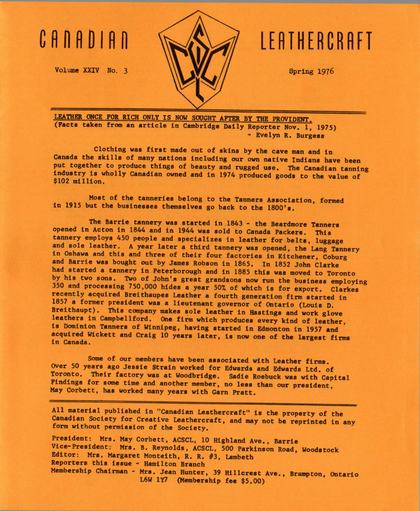
Page 1 — LEATHER ONCE FOR RICH ONLY IS NOW SOUGHT AFTER BY THE PROVIDENT
Canadian Leathercraft
Volume XXIV No, 3 Spring 1976
LEATHER ONCE FOR RICH ONLY IS NOW SOUGHT AFTER BY THE PROVIDENT, (Facts taken from an article in Cambridge Daily Reporter Nov. 1, 1975)
- Evelyn R. Burgess
Clothing was first made out of skins by the cave man and in Canada the skills of many nations including our own native Indians have been put together to produce things of beauty and rugged use. The Canadian tanning industry is wholly Canadian owned and in 1974 produced goods to the value of $102 million.
Most of the tanneries belong to the Tanners Association, formed in 1915 but the businesses themselves go back to the 1800's.
The Barrie tannery was started in 1843 - the Beardmore Tanners opened in Acton in 1844 and in 1944 was sold to Canada Packers. This tannery employs 450 people and specializes in leather for belts, luggage and sole leather. A year later a third tannery was opened, the Lang Tannery in Oshawa and this and three of their four factories in Kitchener, Coburg and Barrie was bought out by James Robson in 1865. In 1852 John Clarke had started a tannery in Peterborough and in 1885 this was moved to Toronto by his two sons. Two of John's great grandsons now run the business employing 350 and processing 750,000 hides a year 50% of which is for export. Clarkes recently acquired Breithaupes Leather a fourth generation firm started in 1857 a former president was a lieutenant governor of Ontario (Louis D. Breithaupt). This company makes sole leather in Hastings and work glove leathers in Campbellford. One firm which produces every kind of leather, is Dominion Tanners of Winnipeg, having started in Edmonton in 1957 and acquired Wickett and Craig 10 years later, is now one of the largest firms in Canada.
Some of our members have been associated with Leather firms. Over 50 years ago Jessie Strain worked for Edwards and Edwards Ltd. of Toronto, Their factory was at Woodbridge. Sadie Roebuck was with Capital Findings for some time and another member, no less than our president, May Corbett, has worked many years with Garn Pratt.
All material published in "Canadian Leathercraft" is the property of the Canadian Society for Creative Leathercraft, and may not be reprinted in any form without permission of the Society.
President: Mrs. May Corbett, ACSCL, 10 Highland Ave., Barrie
Vice-President: Mrs. B. Reynolds, ACSCL, 500 Parkinson Road, Woodstock
Editor: Mrs. Margaret Monteith, R. R. #3, Lambeth
Reporters this issue - Hamilton Branch
Membership Chairman - Mrs. Jean Hunter, 39 Hillcrest Ave., Brampton, Ontario
L6W 1Y7 (Membership fee $5.00)
Page 2 — POCKET SECRETARY
POCKET SECRETARY - by Ruth M. Haig
Materials: Best suited for this project are soft, pliable leathers such as morocco, calf, pin seal, or thin tooling or carving cowhide, with Persian Lamb skiver lining.
Exterior Design: May be tooled, carved, inlay, stamped or 3 "D", depending on leather used.
Pattern: The pattern consists of eight pieces, one of which is liner for interior of exterior, 1 strip each of 1/2" wide for re-enforcement at left top and centre bottom.
Interior: The interior consists of two open pockets with a mitred corner on the left inside, and two closed pockets, (slit type) on the right side. All these interior pieces have a 1/4" turned edge on the open side. These turned edges are skived, and cemented down with white cement, and finished with a fine edge creaser.
Construction: When parts are cut to pattern, (see diagram) cement liner to the interior surface of the front piece. Cement 1/2" strips to left upper and centre bottom of lining. Skive all edges to be turned on 4 parts of interior pockets, cement and edge crease.
Assembly: Cement skived outer edges of smallest open pocket onto larger pocket, then cement to liner. The same procedure is carried out on the open slit pockets for the right side of the interior. The article is ready to punch holes for lacing.
A 5/64 single slot punch must be used for 5/64 lacing. It is most important to have the distance between the slots the same as the size made by the punch. When the lacing is completed dampen the leather slightly, roll interior edge and finish by slightly surfacing with an edge slicker.
Page 3 — OPPORTUNITIES
OPPORTUNITIES - by Irva Ford FCSCL
I was inspired to write this summary after reading an article on Opportunities published in the monthly letter of the Royal Bank of Canada. I could not help but think the contents of the letter applied to us at the present time. Our members are faced with the opportunity to create leather articles not only for the upcoming C.S.C.L Exhibition in the new Crafts Gallery and Resource Centre of the Ontario Crafts Council, 346 Dundas Street, West, Toronto, in March, but for the entries for Weston Trophy Competition and Associate and Fellow standing for our Annual C.S.C.L. meeting. Also some of us are making articles for other exhibitions. The demands and opportunities are great.
All of you have had the urge to prepare leatherwork for all of these events. Here is your opportunity to step in with ideas for something new, something-better, something unique.
Opportunities do not come labelled with your name and accompanied by instructions for making use of them. Not many opportunities are the "sometime" sort, to be attended to when you get around to them, Besides, credit for achievement goes to the person who does things, not to the person who first thought of them. Opportunity is to be grasped when offered, Determination is a big asset. No matter how good our intentions may be, if we do not take advantage of every favourable opportunity to act, our condition, remains unaffected.
Every achievement is first of all an idea in the mind, Then follows venturesome thinking, which is a potent force in bringing to light all the possibilities inherent in the idea. One needs to have a generous open-mindedness to new ideas and motions. When you are day-dreaming, think of ways to remove obstacles or get around them. After the flash of inspiration comes sober inquiry and planned activity. Think things through. Here is your opportunity. Your resolution to take advantage of it must be specific, concrete and definite. To every person, each opportunity is worth exactly what he is prepared to make of it.
To make the best of opportunities, requires several qualities: alertness to see, quick comprehension, initiative, patience and energy. Seizing opportunities is one way to find out the full range of your talents. The experience may throw light upon qualities you have hitherto overlooked. A person with ordinary ability, with keen perception, can accomplish much but opportunity has no meaning to the indolent or light-minded person.
To detect opportunity one must keep in touch with what is going on. Take note of new styles and modern trends. Put yourself into contact with events and people so as to have a hundred eyes on the look-out for ideas. When you get an idea your interest deepens and your creative talent is driven into high gear. If you wait until the outcome of your effort is certain you will never move..Translate your plans into action as soon as possible. Seize the opportunity and work at it with warmth of feeling, fervour and zeal Do not let your present load of work put you off. A crowded life is a happy life. To have more than you can do, tends to arouse your energies and sharpen your faculties, Make up your mind to try. Francis Bacon said "A wise man will make more opportunities than he finds".
Page 4 — SOME HINTS ON GARMENT MAKING AND HOW TO MAKE A LEATHER BUTTON HOLE
SOME HINTS ON GARMENT MAKING AND HOW TO MAKE A LEATHER BUTTON HOLE by Hope C. Drysdale
Purchasing your leather:
To measure enough material for your garment, use the yardage required for 54" material, since one yard of 54" material equals 13 1/2 square feet, multiply yardage required by 13 1/2 and add 15% for wastage. If you are really careful in cutting you may be able to skimp a bit.
Sewing:
Do not use pins. Use paper clips, masking tape or scotch tape. Cut with razor or knife. Sew with a heavy mercerized cotton or a good polyester thread. Use a size #14 to #16 needle in your machine and set stitches at 7 to 10 to the inch.
Finishing:
Skive a bit off the outside of the wrong side of the seams glue and press down firmly. This way the seams will lay smoothly instead of rippling.
Button hole:
1. Cut in the appropriate place a rectangle the length of your button by width either 3/4" for thick leather or 1/2" for light weight leather 2. Cut two patches 1" longer and 1/4" wider Fold than the rectangle removed from the hole. Apply Barge cement to wrong side and when dry enough fold lengthwise to 1/4" of bottom side of patch.
3. Apply Barge to wrong side of material around opening and apply patches, folds at middle and short sides to the opening 4. Apply Barge to wrong side of facing and edges of patches. Press firmly together.
5. Turn garment to right side and stitch as closely to the opening as possible.
6. Turn garment to wrong side and cut out facing 1/8" from stitching.
Cut out
This completes your button hole.
Page 5 — LEATHER DOLLS
LEATHER DOLLS - Ethel Zimmerman
Leather in its various types such as rawhide, deerhide, pigskin, seal skin, other tanned leathers, sheepskin and kid is a type of leather used for dolls both in United States, Canada, Europe and other parts of the world,
There are in existence, all leather dolls from South Africa, South America, North American Indians, Greenland, Zulu, Morocco, Europe and even in Egyptian tombs which were used for cult or religious purposes.
Although kid was used for doll bodies almost two hundred years ago, it was not until 1865 that a patent was issued in the United States for the making of leather doll heads. Lucretia Sallee of Illinois made doll heads of pressed leather, reinforced inside with plaster. The following year 1866, Frank Darrow of Bristol Conn, manufactured doll heads of rawhide. The rawhide was cured, cut into required size blanks and immersed in a solution of 1 lb. lye and 2 gallons of hot water. The blanks were taken out one at a time and introduced to the die and press. Few Darrow dolls remain as their manufacture was short lived. Rodents enjoyed the rawhide and after repeated damage from these pests the factory was abandoned in 1877.
Later chamois was stretched over a plaster doll head mold glazed and hand-painted, Very fine white kid glove leather was stretched and glued onto a doll head and many coats of delicate water colours were applied until the head looked like a fine porcelain or bisque head,
Our North American Indians are noted for making deerskin dolls mainly hand sewn and dressed in leather and decorated with bright coloured beads.
The fine French and German kid bodies were generally made by splitting the leather so that is was more pliable. Good seamstresses were employed to do this hand sewing. Bodies were stuffed with cork, sawdust, horse hair and a type of moss and seaweed. In the early years of the twentieth century skins came from Australia and were tanned in England, France and Germany. Now these kid bodied dolls are precious antiques.
In the northern regions of Russia, East Greenland, Alaska and tribes of North Western America fur dolls predominate. Again such dolls have been found in graves belonging to tribes long extinct.
Those of Alaska and East Greenland are deft at making leather dolls dressed in sealskin. These dolls are hand sewn and decorated with minute 1/16 inch squares of coloured leather hand sewn to form a pattern. Also very narrow strips of different shades of seal skin are sewn together to form a design. I know this because I have a doll made in East Greenland in my possession,
Many old china headed dolls possess bodies arms and legs of leather well preserved, The kid bodied doll, leather headed, leather covered, Indian and Eskimo dolls and many others are real collector's items of a century past.
Page 6 — DOUBLE KEY CASE
DOUBLE KEY CASE - by Mildred Kemp
Here is a suggestion for a compact key case for the person who carries many keys. It is two key cases fastened together.
Each key case has a four-key bar. The leather is wallet weight and the lining is the regular thin lining.
Cut leather 5 3/4" x 3 3/4". Shape corners and flaps as desired. Put a different design on each outer flap. Glue on lining which is cut a bit larger and trim edges even,
Fasten the two key cases together by stitching each side of centre sections near fold. Punch the two tops together and the two bottoms together. Punch the four flaps separately. Lace the two tops together and the two bottoms together. Lace the four flaps separately. Plan the method of lacing to have as much continuous as possible.
Now you are ready to fasten on the key bars. They are placed back to back, so the same punch holes do for each--mark and punch, Be sure they are at the top of key cases. Place both key bars and fasten with small bolts and nuts. If the bolts are too long trim and file off Put domes on flaps and key case is ready for use.
example-
Cut leather and Lining i
(Cut lining a bit larger)
5 3/4" x 3 3/4"
Two different
designs
bolt 2 key bars
back to back
2 lines of stitching
i 2 a lace together
2 tops and 2 bottoms
Bottom
Page 7 — BOOK REVIEW
BOOK REVIEW by Margaret Monteith
THE ENJOYMENT AND USE OF COLOR by Walter Sargent
Dover Publications, Inc. 180 Varick Street, New York, N.Y, 10014
The Enjoyment and Use of Color is arranged primarily as a textbook in colour for art departments of secondary schools and colleges, but also as a book for general reading. It deals with the study of color in two quite different ways--as a subject in physics, or as a subject in art,
If we consider it from the point of view of physics we are dealing with exact laws of light and optics, and may proceed on a basis of fairly well established facts.
If we study it as a part of the language of art we are concerned with what has always been an important source of artistic enjoyment, but a matter of human experience so varied and individual that we have as yet little knowledge of any systematic way of attaining that experience and enjoyment.
Mr. Sargent points out little known facts about color values, intensities, effects of high and low illumination, complementary colors, and color harmonies--facts that most artists have had to learn for themselves by trial and error.
He also included many hints of extremely practical value--how to mix colors, how to use near-complements and "triads" in design and composition, how to relate your colours as harmoniously as possible, the representation of sunlight, and a score of experiments covering wide areas of painting technique. Many of these experiments are useful and beneficial for craft workers,
The purpose of the book is not primarily to present a new or original theory of color, but to offer some analyses of color effects, and to give a series of typical and interpretative experiments together with references to examples in nature and art.
There are a number of references suggested, 7 color illustrations and 29 black and white illustrations. At the end of the 7 chapters there are questions or problems which help you understand the knowledge from the chapter.
It is a most interesting and informative book--an excellent reference book,
Page 8 — SONG OF THE CRAFTMAN'S MALLET; THE CRAFTSMEN IN AMERICA
THE CRAFTSMEN IN AMERICA - Published by the National Geographic Society. Book review by Hope C. Drysdale.
Although this book in fact, has little to do with leather, the design and inspiration available, make it a worthwhile addition to your collection of Craft Books.
The flyleaf quotes Fred Fenster "All I need to live are my tools and myself". A Potter "If I fail it hurts", and another "It came out 'so Beautifully'". From James Russell Lowell "A grass blades' no easier to make than an Oak; if you've once found the way, you've achieved the grand stroke,"
The philosophy and history on crafts in this book are outstanding, showing articles on wood carving, lathe work, macramé, carved ivory, pottery, pewter, canvas stitchery, weaving, knitting, crocheting, quilting, soapstone, coppering, dolls and doll furniture, glass blowing and numerous other crafts, taking one from the seventeenth century right up to the present day. Ideas abound, making it one of those books once picked up cannot be put down until finished and will then be referred back to many times.
SONG OF THE CRAFTMAN'S MALLET
Tis a beautiful song that the mallet sings When held in a craftman's hand,
From a blank piece of leather and working together
The articles turned out are grand;
There is joy in one's soul as the pattern takes form
Which came from some creative heart, With the shaders, the seeders, the tools and the plan
And the mallet they all do their part.
UNDER THE HAND
Man must remain a creator or perish, He must forever strive to make ideas grow into things, under his hand. Thought and action are inseparably coupled and together they make modern man.
We must go on creating things--things great or small, lasting or fleeting, beautiful or homely, because into each thing that takes form and substance under the hand, there enters some quality conceived in the mind of the maker.