
An issue of the Society’s newsletter, transcribed from the original.
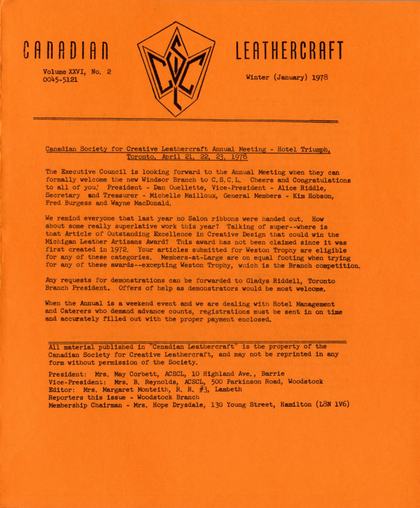
(8 pages, 1.2 MB)
the full-resolution scan, 23 MB, for close research
Page 1 — Canadian Society for Creative Leathercraft Annual Meeting - Hotel Triumph, Toronto
CANADIAN LEATHERCRAFT
Volume XXVI, No. 2
0045-5121
Winter (January) 1978
Canadian Society for Creative Leathercraft Annual Meeting - Hotel Triumph,
Toronto, April 21, 22, 23, 1978
The Executive Council is looking forward to the Annual Meeting when they can formally welcome the new Windsor Branch to C.S.C.L. Cheers and Congratulations to all of you! President - Dan Ouellette, Vice-President - Alice Riddle, Secretary and Treasurer - Michelle Mailloux, General Members - Kim Hobson, Fred Burgess and Wayne MacDonald,
We remind everyone that last year no Salon ribbons were handed out, How about some really superlative work this year? Talking of super--where is that Article of Outstanding Excellence in Creative Design that could win the Michigan Leather Artisans Award? This award has not been claimed since it was first created in 1972. Your articles submitted for Weston Trophy are eligible for any of these categories, Members-at-Large are on equal footing when trying for any of these awards--excepting Weston Trophy, which is the Branch competition, Any requests for demonstrations can be forwarded to Gladys Riddell, Toronto Branch President. Offers of help as demonstrators would be most welcome,
When the Annual is a weekend event and we are dealing with Hotel Management and Caterers who demand advance counts, registrations must be sent in on time and accurately filled out with the proper payment enclosed,
All material published in "Canadian Leathercraft is the property of the Canadian Society for Creative Leathercraft, and may not be reprinted in any form without permission of the Society.
President: Mrs. May Corbett, ACSCL, 10 Highland Ave., Barrie
Vice-President: Mrs. B. Reynolds, ACSCL, 500 Parkinson Road, Woodstock
Editor: Mrs. Margaret Monteith, R. R. #3, Lambeth
Reporters this issue - Woodstock Branch
Membership Chairman - Mrs. Hope Drysdale, 130 Young Street, Hamilton (L8N 1V6)
Page 2 — A Testimonial for Irva Ford
A Testimonial for Irva Ford
Irva Ford, who passed away on October 11th, 1977 was one of C.S.C.L.'s Most enthusiastic and capable workers. She was interested in all crafts, particularly woodcarving and leathercraft. Born in the Hanover-Owen Sound area; taught school in Toronto; married and moved to Hamilton; mother of two boys and a girl--all professional musicians of whom she was very proud. The Hamilton Leathercraft Guild, of which Irva was Charter President, was formed twenty-one years ago on October 11, 1956.
Irva earned her Fellow standing in C.S.C.L. in 1958.
She was President of C.S.C.L. from 1969 to 1972. During her time as president She was the guiding force behind our first Prestige Exhibition, which was held in 1970.
Irva received many awards for her work at our own C.S.C.L. exhibitions, the C.N.E. Canadian Guild of Crafts, Hamilton Artisans Guild, and International Assemblies in U.S.A. and Canada, to mention just a few. She was an outstanding craftsperson, turning out many beautifully designed and excellently crafted articles.
Unsparing of herself and so wonderfully sure that you could do just about anything, yourself, many of us are sadly missing her cheerful moral support. Irva Ford was a dedicated leather craftsman for all the years I knew her-- an expert designer, a willing mentor as well as worker. Nothing was too difficult to tackle--she never let you down--full of encouragement and always gave 110%.
She took pride in her work and accomplishments to the point she sacrificed herself. She was a going concern with a keen interest that inspired others. She kept everyone on their toes and was a strong force behind our guild. Irva Ford a wonderful person, a highly skilled craftsperson and a wonderful friend.
We all feel we lost a friend when Irva left us so suddenly.
She was so vital and an inspiration to all who knew her.
It is hard to put in words the loss one feels when a good friend is suddenly gone from this world. Especially when so many lovely memories keep coming too mind.
by Members of the
Executive Council.
Page 3 — Leather Scraps
Leather Scraps: - Beula Reynolds
Door Stop designed for the elderly, arthritic or blind,
You never have to stoop over to move it and it can't get lost as the loop slides over the door knob, To move you just lift the weight and open or shut your door leaving the long strap from the stop hooked over the knob at all times.
Materials:
1. a rock, with a flat side, weighing about 1½ lbs.
2. scraps of leather to sew together to make a neat bag large enough to make a fold-over on the top when the stone is inside. We used deer skin and suede pieces.
3. Approximately 38 inches of belt leather 1/2" or 3/4" or 1".
We had a belt blank with a soft spot in the middle that would never have worn well as a belt. You could use latigo or braided lacing.
4, needle and linen thread or lacing to fasten strap in the bag and a loop in the free end of the strap.
Method:
Piece the bag together, put the rock in and as you sew the top shut fasten one end of the strap securely in the middle top. Need we say that the strap has been edge bevelled, boned and coloured to match or contrast with your scraps and polish coated before assembly begins?
Next you fasten the free end of the strap in a loop. Leave the strap just long enough so that when the loop is slipped over the door knob the weight rests on the floor.
pieced bag
Page 4 — MAKING BONERS
MAKING BONERS by Sid Taylor
The method of making Boners (not the verbal type) is somewhat more practical than technical. It emerged, for me, from having to choose between buying the plastic type and having one of genuine bone.
I am certain, that with specialized equipment, it would be a relatively simple operation to turn out uniform shapes and sizes of "Boners". Lacking this type of equipment, I settled for whatever tools I already had on hand. These consisted of: 1 vice, 3/8" electric drill, non-ferrous cutting wheel, sanding discs of various grades, Rasps-coarse and fine, and files plus a hack saw and several blades. I may also add--much ambition and the urge not to buy a piece of plastic. I knew from meat cutting experience, which piece of bone was needed and where it was located. It is the Femur, from the upper part of the hind leg of a cow, preferably an elderly Holstein cow, because the femur would be longer and more mature. Other leg bones could be used to make tools for use on leather, even Stamping Tools. The Bone which one buys from a butcher shop would look like this:
BoNE
BoNE HELD IW VICE
From this bone, one can cut at least three (3) strips about one inch wide and an irregular shaped piece which may be used, dependant on ones imagination. First, the Bone must be boiled until the gristle and marrow can be removed. This requires about two hours. I abandoned the use of the power tools (for indoors) on account of the dust created. I Place the bone in the vice and cut the strips with the hacksaw. These strips will not be flat but may be more or less flattened by rasping down the high spots.
Some words of caution about the use of a Rasp, for anyone not familiar with this tool. Being the most coarse of files, its indiscriminate use Would splinter, instead of gradually grinding away the bone, and should never be used "across" the sharp edges of the Bone. These edges may be tapered off with the use of a finer file and in both cases it is advisable to begin by using very light pressure until one begins to have the 'Feeling" of how much is enough. It should be noted here, that the Bone is held in the vice, horizontally with about half of its length protruding, and therefore you are working on only half of the bone at one time. The Rasp is used firstly to "try" to make the bone conform to a desired shape. When this has been achieved, the files are used to remove the marks left by the more coarse files.
The removal of the file marks becomes essential to the final
Polish, and when the first half of the bone has been shaped it becomes necessary to protect it from being marked by the jaws of the vice as you reverse ends. I usually wrap it in a heavy fold of cloth. It isn't necessary to complete one end before changing to the other end because you are going to remove all traces of file marks with sanding papers. It is best to buy sanding papers in sheets (approx. 8" x 10") or rolls about 1 1/2" - 2" wide.
Page 5 — Quotes of note from the Woodstock Glove Workshop
Making Boners continued
The sheets may be cut into strips about 2" wide and I use them in the Shoe shine manner, across the top of the Bone, then turn the bone in the vice to work on the underside. You may find that by rubbing the paper lengthwise of the bone, it will remove nicks and scratches more quickly. This is the messy part as it creates so much dust. Begin with the coarse Paper working down through to the finer grades, ending with 400 grit. By this time the bone will have acquired a luster and is ready for the final polishing using tin oxide. This is a fine powder which is dissolved to a thin creamy consistency with water and used on a polishing disc in the electric drill.
Hopefully at this point, you have a Boner which suits your hand and will perform the tasks for which it is intended.
You have the choice of making both ends different, for special purposes. A by-product of your efforts is Bone Meal which some dogs like and is very beneficial to roses.
I have hesitated to include the time element in these operations, but, from sawing the strips to the final polishing it usually occupies about two hours of my time to make a complete Boner.
Quotes of note from the Woodstock Glove Workshop conducted by Helen Wheaton
To "Thumb-up" our thoughts of the weekend
We decided not to include "Quirks" in our gloves. They'1l think we're all Girl Guides--we each have just the left glove with which to shake hands.
It fits! It fits!
Better cut it before we lose it.
Who has Helen's long pin?
You can't get 2 thumbs and a finger into the thumbhole at the same time. Fourchettes in not a dirty word!
Upon completion of the thumb--you become a "Thumbody"! If the glove doesn't fit--cut off your finger--it's easier than adjusting a sewn glove--sigh! The fingers are just the right length! Look! You can't get there from here.
Some gloves take 5 years to complete (more or less) 5 years for the first glove and 1 day for the 2nd.
LEATHER 78 - Our bi-ennial exhibition is to be held at the Civic Centre in Etobicoke during the month of November.
Have you started work on your articles yet??
Page 6
Craft News - OCC Vol. 2, Number 6 - November 1977
Robert Muma-Honor to a Craftsman in Leather
Robert Muma tooling the title of a book in gold.
Robert Muma, of Toronto, was declared the winner for Ontario of an honorary membership in the Canadian Crafts Council at its recent conference and annual general meeting in Price Edward Island. At an awards dinner during the conference, Joan Chalmers read the following tribute to him:
Robert Muma was born in 1907 at Coldstream, near London, Ont. His whole life has been motivated by three major fields of interest—nature, art, and making things with his hands. Because of ill health for most of his life, Robert Muma had to find some combination of these interests and aptitudes for a livelihood at home. The result was the formation in 1947 of Mumart Leather Studio.
Except for six months at one art school and six weeks at another, he was entirely self-taught. He says: ‘I always had confidence I had a different “mouse trap” to offer and my classes in leathercraft proved this.’
Mr. Muma revived and refined some ancient and almost forgotten techniques and pioneered leather coloring ones. His published portfolios of Canadian Leathercraft Designs and his book Color in Leathercraft, published and sold extensively in both Canada and the U.S., brought advanced students for summer classes from Halifax to Wisconsin and Long Island to Regina.
About 1949, the (then) Toronto Art Gallery sponsored an exhibition of handcrafts. Badly shaken because leathercraft was almost totally ignored, he wrote to Deane Russell of Ottawa, who had founded the Ottawa Valley Leathercraft Guild, and discussed with him the possibility of wider organization for the purpose of channelling leather creatively into a higher art form. The result was the Canadian Society for Creative Leathercraft.*
At their peak, proceeds from Robert Muma’s publication of books and technical articles accounted for about one-third of his income. He had been working two years in commercial binderies and had been accepting important commissions in bookbinding. So now he turned full-time to bookbinding, book restoration and teaching. He did many creative jobs for industrial corporations, municipalities, hospitals, universities, organizations and individuals too numerous to mention except for HRH Princess, later, Queen, Elizabeth II.
In book restoration, he did extensive work for the Buffalo Reference Library Rare Book Room, the Royal Ontario Museum Library, and the New Brunswick Provincial Archives after they were damaged by the flood of the Saint John River a few years ago.
Robert Muma writes: ‘I believe the most significant contribution I have made to the field of book restoration is the discovery of a method of removing the leather spine of an old book in one piece so it can be replaced on the new leather spine and so retain its original character. It seemed incredible to me that restorers for centuries have been agonizing over the heart-breaking task of trying to remove an elaborately gilded, fragile leather spine in as few pieces as possible and then replacing them meticulously in proper order onto the new spine.’
Two years ago, Robert Muma’s health deteriorated further and a new doctor just ‘stumbled onto’ a very rare chemical imbalance that led to the removal of a large but obscure benign tumour which had apparently been interfering with his functioning for 40 to 50 years.
So now, phases of his life, long denied to him, open up for fulfillment. Over several years now, macro photography led him to the fantastic world of mosses. Arthritis in his hands has caught up with his bookbinding ability. So at 69, he says, it is time to retire and do something else new and strange—and that is to seriously collect and identify some of the over 400 species of mosses of Ontario.
For many years, Robert Muma has cherished this little verse which I think is a fitting comment on the man and his work:
Growth means constant change
so only those who dare
to do things new and strange
are getting anywhere
[This page reprints an article from Craft News, set in three columns beside a photograph; it is set out here in the order the columns are read. The meeting is printed Price Edward Island. A reference mark stands after “Creative Leathercraft” and the note it points to is not on this page.]
Page 7 — Members at Large
Members at Large
All branches welcome guests to their meetings.
Belleville meets the first and third Monday of each month from 7:30 to 10:30 p.m As they have no definite meeting place just now contact their president, Laura Bush, Telephone 392-1475.
Hamilton meets the second Thursday of each month at the Spectator Bldg., Li Fred Street from 7:30 to 10:00 p.m, Dan Hannington is President,
Barrie meets the last Wednesday of each month at St. Monica's School on the north side of Steele Street from 8 to 10 p.m, They often have in between workshops, President is Emma Knowles.
Toronto meets the second Friday of each month from 8:00 to 10:30 p.m, at 2000 Weston Road. Gladys Riddell is President.
Woodstock meets the fourth Thursday of each month at Springbank Public School, Sprucedale Ave., from 7:30 to 10:30 p.m, Beula Reynolds is president, Windsor--a new branch that is forming--contact President Dan Ouellette.
As stated all welcome guests, but if you can attend on a near regular basis common courtesy rules that you should join the branch and accept the very small amount of responsibility that goes with it. All branches would welcome your help with demonstrations or workshops--we know there is a tremendous amount of talent among the members at large but this seems for the most part to elude our program committees.
A request:
As stated above, we know there is a lot of talent among the members at large. Quite a few of you are night school teachers and master craftsmen, and we know you must read a lot of craft books as some of you are self-taught, Would you share some of your knowledge with the rest of us?
All you have to do is send in a technical article, a book report, a clipping of interest to leathercrafters; some tips or hints, Anything to do with Leathercraft. Margaret Monteith, the editor of Canadian Leathercraft is a member at large, and would be happy to receive these and hold them for your own Members-at-Large Edition.
The Canadian National Exhibition 1978
We need a Chairman! Could we have a volunteer? If you have some spare time and could take on even part of the duties please contact any member of the executive council.
1978 is the Centennial Year for the C.N.E. It has been suggested that the workers in the booth arrange to wear the traditional dress of the 1870's. Think it over--many of you probably have centennial dress and would welcome an opportunity of using it again.
Page 8 — The Complete Book of Arts and Crafts
The Complete Book of Arts and Crafts by Arnold Arnold $5.95
While this book is not primarily a leathercraft book it contains a wealth of information that could be of great help to any teacher, parent or recreation worker who is interested in the creative side of crafts.
Mr. Arnold states that most art and craft manuals and even teachers stress production, following or tracing patterns or plans. This is the denial of the very essence of creative tool use. It is essential that Children be sheltered from such production in early as much as in later years. They need exposure to the creative processes of art and craft. Parents, teachers and camp counsellors must not only be familiar with tools and materials and their uses, but also with the role played by art and Craft in the development of general intelligence, ethics and competence.
The book starts with a detailed explanation of the author's ideas on approaches and attitudes. It includes a section on workspaces, lighting and clothing as well as safety. Mr. Arnold emphasizes that the learning process requires a foundation of sensory experience. The child needs to see, hear, smell and touch any material he works with. Proper respect for and care of tools, a clear work space, neatness, economic use of material-much of it salvage, proper clothing--all these are stressed in each chapter. He gives a short history of each craft at the beginning of the chapter-- not enough to be tiresome to a child--just a few facts that could be mentioned as you set up the work table with them.
He starts with toddlers learning to tear, twist and crumple paper and put each piece in a box as it is finished. This is to be done only while sitting in your chair in front of your work table. They are led on through Sorting, wrapping, lacing, collages, folding, embossing, beads, armatures and molding with paper mache. When it comes to the section on gluing, there are recipes for short and long term adhesion pastes, library paste, transparent glue, etc. Carpentry begins with the pounding bench for a toddler and goes through to peg jointing, rabbet and butt joints and wood finishing.
Leathercraft, after a bit of history of the tanning process in different countries, suggests the child make a collage with some scrap leather. He Stresses the use of paper templates and mock-ups before working with the more expensive leather. Wire and Metal Craft; Drawing and Painting; Working with Clay--three recipes for modeling dough start it off; Printing from blotter paper monoprints to lino block printing; Audio visual Media Craft; with shadow pictures and,photocollage to begin with; Reed and Fibre Craft; Fabric Craft. These are finished off with a chapter on Planning and Design.
Lots of room for argument about this book but everyone should agree with some part of it--if not all the stress on creativity for the young people then you will like the parts about neatness, taking care of your tools etc.