
An issue of the Society’s newsletter, transcribed from the original.
(6 pages, 1.5 MB)
the full-resolution scan, 20 MB, for close research
Page 1
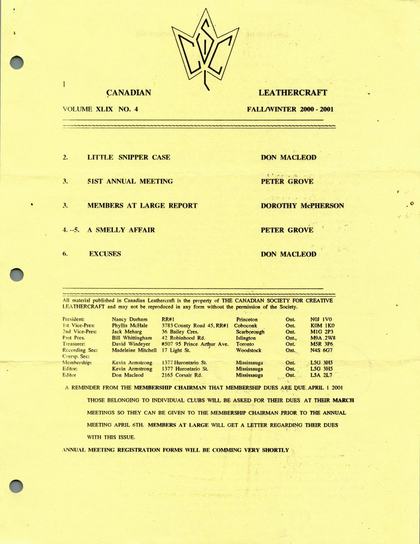
CANADIAN LEATHERCRAFT
VOLUME XLIX NO. 4 — FALL/WINTER 2000-2001
2.          LITTLE SNIPPER CASE           DON MACLEOD
3.          51ST ANNUAL MEETING          PETER GROVE
3.          MEMBERS AT LARGE REPORT      DOROTHY McPHERSON
4.-5.       A SMELLY AFFAIR              PETER GROVE
6.          EXCUSES                      DON MACLEOD
All material published in Canadian Leathercraft is the property of THE CANADIAN SOCIETY FOR CREATIVE LEATHERCRAFT and may not be reproduced in any form without the permission of the Society.
President:      Nancy Durham        RR#1                        Princeton     Ont. N0J 1V0
1st Vice-Pres:  Phyllis McHale      3783 County Road 45, RR#1   Coboconk      Ont. K0M 1K0
2nd Vice-Pres:  Jack Meharg         36 Bailey Cres.             Scarborough   Ont. M1G 2P3
Past Pres.:     Bill Whittingham    42 Robinhood Rd.            Islington     Ont. M9A 2W8
Treasurer:      David Windeyer      #507, 95 Prince Arthur Ave. Toronto       Ont. M5R 3P6
Recording Sec:  Madeleine Mitchell  17 Light St.                Woodstock     Ont. N4S 6G7
Corrsp. Sec:
Membership:     Kevin Armstrong     1377 Hurontario St.         Mississauga   Ont. L5G 3H5
Editor:         Kevin Armstrong     1377 Hurontario St.         Mississauga   Ont. L5G 3H5
Editor:         Don Macleod         2165 Corsair Rd.            Mississauga   Ont. L5A 2L7
A REMINDER FROM THE MEMBERSHIP CHAIRMAN THAT MEMBERSHIP DUES ARE DUE APRIL 1, 2001. THOSE BELONGING TO INDIVIDUAL CLUBS WILL BE ASKED FOR THEIR DUES AT THEIR MARCH MEETINGS SO THEY CAN BE GIVEN TO THE MEMBERSHIP CHAIRMAN PRIOR TO THE ANNUAL MEETING APRIL 6TH. MEMBERS AT LARGE WILL GET A LETTER REGARDING THEIR DUES WITH THIS ISSUE.
ANNUAL MEETING REGISTRATION FORMS WILL BE COMING VERY SHORTLY.
Page 2 — LITTLE SNIPPER CASE
LITTLE SNIPPER CASE
By Don Macleod, Mississauga.
If you were at the 2000 Annual, one of the freebies you received in your Goodie-Bag was a pair of Snippets. These little scissors that cut close at the end of a leather stitching job. These were the gift of the Mississauga (M.S.C.L.) Club, and engraved with C.S.C.L., to be a memento celebrating the 50th year since C.S.C.L. was founded. They are very sharp and need a case to prevent getting dull, and to protect you when you are handling them in your tool box.
Case — #1: 10" piece of 2-3 oz. leather, 1 1/4" wide makes the whole case. #1 piece is 6 1/2" long, #2 piece is 3 1/2" long (the remainder of strip). A cut-off piece from a belt is often about the right size.
From the free end of the long piece, score on the flesh side two cross lines, one at 2" from the end and the second at 1 1/2" from the end. At 1/2" from this same end punch a #3 hole for the dome top. In the second piece punch a hole at the same time 1/2" from the square end for the dome bottom. Both ends of the main piece (6 1/2") are rounded — I used a Twoonie to lay out the cut; also the one end of the 3 1/2" piece is cut using a Twoonie. The other end is square cut. Fasten your dome parts to the leather at this time. Run a trace of contact cement around the edge (flesh side) of the small piece, but not across the dome end, put the two pieces together, and let dry. With your stitching grouver cut the stitch line, then with your stitching wheel (#5 or #6) locate your stitching holes. Here you can either use your 00 punch if you are going to lace the piece or use your awl and pierce the holes for the stitching.
After you have done your stitching, soak the piece, and get water down the throat. Insert two pencils and let the piece dry at least 24 hours, with the pencils in place.
Finish your piece your way, dye if you like. After it is thoroughly dry, a few drops of Neetsfoot oil or Lexol into the pocket will stop any rusting or corrosion happening to the scissors — they are not chrome plated or stainless steel, but do have a fine sharp edge that should last a long time.
[The lower half of this page carries a hand-drawn pattern diagram for the case, with dimension callouts (6 1/2", 3 1/2", 1/2", 1 1/2", "stitch line", "#3 punch"). Faint mirror-image text bleeding through from the reverse of the sheet is visible under the diagram and is not transcribed. Read from the printed page, the long piece is also lettered SCORE LINES ON FLESH SIDE.]
Page 3 — 51st Annual Meeting; Members at Large Report
51st Annual Meeting
The Hamilton group is in charge this year and are planning the activities to cover the three day period. Friday evening a workshop, Saturday morning the annual meeting, after lunch workshops, and Saturday night the Banquet and Awards, Sunday morning a workshop.
Now you have the activities — the dates are Friday April 6, Saturday April 7, and Sunday April 8 (one week before Easter) at the Beacon Inn at Jordan Harbour.
So mark that weekend on your calendars and get your leather pieces ready for your club tables, and that goes for the Members at Large too.
Also, the Fellows will have to have the Weston Trophy pieces even earlier from each club, so they can judge and appraise them. The time and dates for this judging will be confirmed and you will see them in the next issue of the Bulletin.
So the challenge is there, whether you belong to an organized club or are a Member at Large. Remember, if a group of 4 or 5 Members at Large get together they can enter the Weston Trophy contest, and definitely they can. Each and everyone can be at the Annual and put their pieces on the tables to be judged on the Friday night.
So mark April 6-7-8 on your calendars and we will see you there. Much more information and registration forms will be in the next Bulletin.
Members at Large Report
This is all past but very interesting to see what our members at large are up to these days.
Dorothy McPherson's installation CHRYSALIS: JOURNEY, featured leather art and poetry at Galleries@the Galleria, London, August 4 – September 30. Included in that exhibition in Galleria's three windows were 13 leather pieces. At the opening on September 8 Dorothy was pleased at the attendance of friends and relatives among the crowd that gathered for her artist reception and the opening of a group show. Two London leathercrafters also attended. C.S.C.L. membership forms were available; gallery visitors from around the world commented favourably on the exhibition.
"Each window measures 6' x 6' x 12' high, making it a challenge to create a 3-dimensional show for such a large area," Dorothy said.
Central Public Library, Queens Ave., London, featured Dorothy McPherson's work in FOLKART DOLLS, an exhibit of 21 different types of pioneer dolls in the main foyer, September 21 – October 30. Attracting attention in that exhibit are the "Jack and Jill" leather dolls she designed for the C.S.C.L. 1999 convention, where they won a Craftsman ribbon. They were included in LEATHER 2000, WOODSTOCK. Also displayed is the "Will Donnelly" leather doll she designed for the C.S.C.L. 1998 convention, where it was awarded a Salon ribbon. It was also displayed at the C.S.C.L. 2000 convention.
"Also featured in the doll exhibit is a poem, 'CREATION 1', written about dollmaking, as I feel that poetry should forge a place for itself in public art space," Dorothy said.
McPherson's Rememberenc Day show FREEDOM RUNNER, featuring her Rememberance Day poetry, ran October 4 – November 12 at Galleries@the Galleria. Thanks to Wolseley Barracks, London, the WWII action figure, The Unknown Soldier, was clad in an authentic uniform. Leather is used as an art medium in this show in a stylized poppy made by wrapping green suede loosely around a large roll of red suede.
"Our ancestral Woodman home at Black Cape, south shore of the Gaspe Peninsula, was bought by the McRea family," Dorothy pointed out, adding, "I often wonder if when John McRea wrote 'In Flanders Field' he was thinking of Gaspesian servicemen. In any case, I wish to honour them including my relatives who helped Canada grow to nationhood and adopt its own flag."
[Printed exactly so: "McRea" and "In Flanders Field" (singular) — checked against the page. The historical figure usually associated with the poem is John McCrae, author of "In Flanders Fields"; the Society's own spelling is kept as printed. "Rememberenc Day" and, on the next line, "Rememberance Day" are both printed so — two different misspellings of the same word in the same sentence, neither corrected here.]
Page 4 — A Smelly Affair
A Smelly Affair
Peter Grove (Hamilton) sent me this little story regarding the other side of leather.
Peter sent this little story that his uncle Don Grove sent to him. His uncle was a CNR trainman for years in southern Ontario, around Guelph and Woodstock. Basically it's about leather, or at least the left-over parts that don't become leather, but go to the glue factory. It's exactly as his uncle Don wrote it, and could be called very graphic in its description.
When I was growing up on the farm, there was an expression, "smelled bad enough to drive a dog off a gut wagon", which was used to describe something that smelled really rank. I never knew what a gut wagon was, or how bad they smelled, until I started work on the CNR. And did they smell!
When I worked out of Stratford during the 1950's the Beardmore Co., at Acton, produced all kinds of leather, which was made from horse and cow hides. Most of the green hides were shipped by rail in box cars, some from as far away as South America. The plant was on the south side of the CNR mainline, a little east of the station at Acton. Acton is about 35 miles west of the Toronto Union Station on the present day Guelph Sub.
Before the green hides could be made into leather they had to be cleaned of all the raw flesh and trimmed; this was called fleshing. The fleshings were shipped to the Bradford Glue Company, at Brantford, Ontario, where they were used to make glues, such as mucilage, which is used on stamps and envelopes.
The fleshings were loaded in assigned gondola cars, dubbed gut cars or gut wagons. A layer of fleshings were laid down in the car and then a coating of lime was applied to help preserve the fleshings. This was repeated until the car was full, just a few inches from the top of the car. During hot weather this all turned to soup and the mix would surge back and forth like water in a bathtub. It was inevitable that during switching operations, the soup would slop over the ends of the cars. There were flies and maggots everywhere; when you coupled onto cars the maggots would run on the ground like peas.
The normal routing for the gut wagons was from Acton to Guelph Junction, then on the next train to Stratford; from Stratford the cars would move on train 510, to Brantford, via the Drumbo sub and Paris Junction. At Brantford, the cars were interchanged with the Toronto, Hamilton and Buffalo Railway, who spotted them to the customer's siding.
Because of the smell of these cars there were embargoes on them at Guelph Junction and Brantford. The cars could not be moved out of Acton on a Friday or Saturday if it meant they would lay over at Guelph Junction on the weekend. The same applied at Brantford; if a crew had one of these cars on their train on a weekend, they had to be set off at the extreme west end of the yard at Paris Junction, well away from all people and houses.
There was a pool of five 126, 127 or 128 series wooden-sided gondolas assigned to this service between Acton and Brantford. These cars would be pulled from the Beardmore plant once or twice a week and shipped to Brantford. The switching at Acton was done by the east local, which was a way freight ordered out of Stratford six days a week. The normal power on this assignment were 4-6-2 light Pacifics in the 5500 series (locomotives); with a light train these engines would run like a deer.
The switch points for the Beardmore Plant faced east; normally the plant was switched by the way freight on their way east to Georgetown, and any cars for Acton to the west would be lined up to be lifted on the return movement. However, occasionally the plant would have to be switched in the afternoon on the westward movement.
Almost every conductor and brakeman I know has a story to tell about gut wagons. My friend Bob Buck (deceased) tells of a hilarious incident involving one of these cars, one hot summer day when he was the Assistant Agent at Acton. As Bob tells the story, there was a gut car that had to be switched out of the plant on the way back to Guelph Junction. The crew was running a little late, so instead of putting the gut car in the run-around track to get it behind the engine, they decided to drop** the car onto the train. Well, the drop was made too fast and the brake did not work very good, and the gut car hit the train pretty hard. The brakeman was riding the handbrake on the leading end of the car; when the car hit the train, the soup surged over the end and literally covered the brakeman with fleshings. What a mess.
Needless to say, no one wanted to be near him on the ride home.
Page 5 — A Travel Agent's Nightmare
Gut cars were also shipped to Brantford from other locations and could include such things as entrails from slaughter houses and even whole animal carcasses. The Brantford Glue Co. was eventually closed down for environmental reasons and the fleshings were then shipped to Tonawanda, New York.
I was working as a brakeman on train 510, a way freight from Stratford to Fort Erie, when I had an incident with one of these gut wagons. The car was back towards the rear of our train and we noticed it had developed a hot box (wheel bearing failure). We stopped to inspect the car and decided we would have to set it off at Dunnville.
We had no problem cutting the car away from the train, but when we had to cut away from the car in the siding it was a different story. There was fleshings, flies and maggots all over everything. What a mess. Cyril Webb was the conductor and we had quite a debate about who was going to reach in and turn the angle cock and pull the pin, as he outranked me. I was elected to do the job. This was the middle of June and the weather was hot. I have often wondered how the people at Dunnville felt about being invaded with such a smell.
[The passage explaining "making a drop" is marked in the original with two asterisks (**) keying it to "drop**" on the previous page, where the gut car is dropped onto the train.]
**Making a drop, some call it a running switch, is required when you have a car on one end of the engine and you want that car on the other end of the engine. Two tracks, a switch, and sometimes three men, depending on which end of the car the handbrake is on, are required to make a drop. One man stands at the switch, another man rides the footboard or steps of the engine, and the third man is on the handbrake. The engineer gets the car moving and then bunches the slack; the man on the engine pulls the pin and the engineer opens the throttle and runs away from the car. When the engine is clear of the switch, the switch is lined into the other track. When the car runs into the clear, the switch is lined back and the engineer pulls up over the switch and backs down on the car, which is now on the other end of the engine. Making a drop can be very dangerous and things can, and do, go wrong, especially if there is not enough room. Most railways have banned the practice of making a drop.
Don Grove
CNR Conductor (Retired)
It Makes Sense—
"Why in the name of heaven did they build the station three miles from town!" asked the weary Irishman. "I guess they wanted it near the trains," was the reply.
A Travel Agent's Nightmare
There was a woman who tried to make reservations "from Chicago to Hippopotamus, New York". The agent apologized, saying, "I've looked up every airport code in the country and can't find a Hippopotamus anywhere." The woman replied, "Oh don't be silly. Everyone knows where it is. Check your map." The agent did so and finally suggested, "You don't mean Buffalo, by chance, do you?" "That's it," said the woman, "I knew it was a big animal".
Page 6 — The Excuse of the Year 2000; Irish or Scotch
The Excuse of the Year 2000
In June, with the 2 or 3 big rain storms we had, our eavetroughs were filled with leaves and they overflowed, filled the front window wells and ran into the basement like Niagara Falls into my wife's basement art studio. What a mess! We borrowed a neighbour's wet/dry vac and sucked the water out. Then we ripped the broadloom into strips and took it out to the back deck to dry out and then into the garbage. Thank goodness they took it all. This all happened one week before my wife was leaving for the Rockies on a painting tour. She came home and I had moved most of the things out of the room, making an even greater mess. She lost a lot of special art paper, and the cushion floor that was down under the broadloom had started to go mouldy.
She came home to Mississauga and the mess. Everything was all over the basement and the man came to do over our bathroom. First thing out was the tub and toilet. We have only one bathroom in our house, so that was bad news! After 2 days and nights we moved to the cottage and left him our cottage telephone number and a key to the house. "Call us when it is finished." We came home two weeks later and put things back into our new bathroom. The next day the men came to install new steel front and back doors, and storm doors. We couldn't work downstairs, so we went back to the cottage. We also had new eavestroughs installed, with leafguards on top, to prevent the leaves from clogging the down pipes. We also had the window wells dug out almost to the drainage tile and stone put in to better carry away any water in the future, and new basement windows installed to replace the old wooden ones and storms.
In September, with mildew and mould growing under the cushion flooring, we ripped it all out. I broke it into approximately one foot squares and took 4 loads to the dump. Then washed the cement floor and let it dry, for the next step—a new floor. We decided on a flooring called "3 Steps Uniclic", made in Belgium of all places. My son Gordon and I moved all the furniture pieces out of her studio, a bigger mess!! We started at the west wall and laid the floor. It interlocks and snaps in place, over a special underlay plastic mat, and of course it has to be cut at the wall at the end. The only thing that cut the pieces was the saber saw with a metal cutting blade; it is very hard and tough. There is no glue, which makes it very clean to work with. Each panel is about 3/8" thick and approximately 8" by 48", so it does go down fairly fast. Three weekends and the room was done; it's a hardwood (oak) appearing laminate flooring. With panels left over, I decided to do the lower hall and over to our basement stairs; I had to buy a few more boxes of the laminate and the underlay, but it was worth it, it looks beautiful, and seems to be warmer to walk on, like a giant hardwood dance floor.
I do all my printing in the hallway, so it had to be finished before I could get the copier into place and shape to do my printing.
So you see, I really did have a mess, and an excuse for being late. I apologize for being extra late.
Don Macleod, Co-Editor
Irish or Scotch
Two fellows met in a bar and were discussing the merits of Scotch vs. Irish Whiskey. They agreed to experiment. They met in the bar a couple of weeks later and one fellow said Irish Whiskey was the most potent one. The other fellow said, "Irish Whiskey? How do you know that!" The first replied, "My wife and I sat down and drank a bottle of Irish one night and got up and went to 6:00 a.m. Mass at the Cathedral". His friend said that doesn't prove anything, and the first replied, "It sure does. We are both Presbyterians".
Page Closer—
Today the career girl would rather bring home the bacon than fry it.