
An issue of the Society’s newsletter, transcribed from the original.
(8 pages, 1.6 MB)
the full-resolution scan, 22 MB, for close research
Page 1
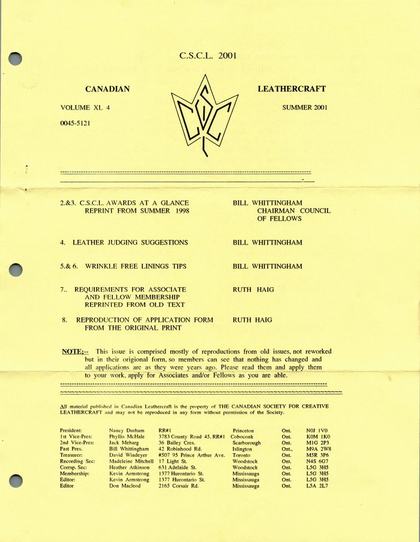
CANADIAN LEATHERCRAFT
VOLUME XL 4 — SUMMER 2001
0045-5121
2.&3.       C.S.C.L. AWARDS AT A GLANCE               BILL WHITTINGHAM
            REPRINT FROM SUMMER 1998                CHAIRMAN COUNCIL OF FELLOWS
4.          LEATHER JUDGING SUGGESTIONS               BILL WHITTINGHAM
5.&6.       WRINKLE FREE LININGS TIPS                 BILL WHITTINGHAM
7.          REQUIREMENTS FOR ASSOCIATE                RUTH HAIG
            AND FELLOW MEMBERSHIP
            REPRINTED FROM OLD TEXT
8.          REPRODUCTION OF APPLICATION FORM          RUTH HAIG
            FROM THE ORIGINAL PRINT
NOTE:— This issue is comprised mostly of reproductions from old issues, not reworked but in their original form, so members can see that nothing has changed and all applications are as they were years ago. Please read them and apply them to your work, apply for Associates and/or Fellows as you are able.
All material published in Canadian Leathercraft is the property of THE CANADIAN SOCIETY FOR CREATIVE LEATHERCRAFT and may not be reproduced in any form without permission of the Society.
President:      Nancy Durham        RR#1                        Princeton     Ont. N0J 1V0
1st Vice-Pres:  Phyllis McHale      3783 County Road 45, RR#1   Coboconk      Ont. K0M 1K0
2nd Vice-Pres:  Jack Meharg         36 Bailey Cres.             Scarborough   Ont. M1G 2P3
Past Pres.:     Bill Whittingham    42 Robinhood Rd.            Islington     Ont. M9A 2W8
Treasurer:      David Windeyer      #507, 95 Prince Arthur Ave. Toronto       Ont. M5R 3P6
Recording Sec:  Madeleine Mitchell  17 Light St.                Woodstock     Ont. N4S 6G7
Corrsp. Sec:    Heather Atkinson    631 Adelaide St.            Woodstock     Ont. L5G 3H5
Membership:     Kevin Armstrong     1377 Hurontario St.         Mississauga   Ont. L5G 3H5
Editor:         Kevin Armstrong     1377 Hurontario St.         Mississauga   Ont. L5G 3H5
Editor:         Don Macleod         2165 Corsair Rd.            Mississauga   Ont. L5A 2L7
Page 2 — C.S.C.L. Awards At-A-Glance
For those of you who do not read your bulletin on a regular basis, the following information is a reprint from the Summer 1998 issue.
C.S.C.L. Awards At-A-Glance
At our May 1998 meeting, the C.S.C.L. executive talked about each and every award given at C.S.C.L. Annual and Biennial events. The following is a comprehensive listing of when each award is given, why it is given, how much is given, and the account the funds are drawn from. It is our hope, that armed with a better understanding of the awards available, you, the leathercrafter, will be more likely to produce work to compete for these special awards.
I. General Awards
ZALITIS PIN: Given to the NEW ASSOCIATE with the highest overall percentage on their successful Associate Status Exam. Four pieces with an average of at least 79%.
[Printed "ZALITIS PIN" here, and "Zalaitis Pin" in the report of the Annual Meeting printed in (Spring 2001, page 2) — the same award, spelled both ways by the Society's own writers; kept as printed in each place.]
II. Biennial Awards
1. C.S.C.L. Executive Award — Given for the most functional piece. $100.00. Taken from General Funds. (C.S.C.L. Award re-named.)
2. Judge's Special Choice Award — Given for the piece that shows most originality and "PANACHE". $100.00. Taken from General Funds.
3. Michigan Leather Artisans Award — Given for best soft leather or best colour at the Judge's discretion. $50.00. Taken from Michigan Leather Funds.
4. Irva Ford Memorial Award — Given at the Biennial OR the Annual but not both in the same calendar year. Given for best moulded work. $100.00 at the Biennial. From Hamilton Guild funds.
III. Annual Awards
1. Irva Ford Memorial Award — If this award has not been given in the same calendar year at the Biennial it can be given at the Annual. Given for the best moulded work. $50.00 at the Annual. From Hamilton guild funds.
Page 3
IV. Non-C.S.C.L. Awards
These awards are given solely at the discretion of outside sources supplying them.
1. Ontario Crafts Council Award — Offered at the discretion of the Ontario Crafts Council. Given at the annual to the piece with the best design.
2. Moore-Pearsall Award for Best Belt — Available solely at the discretion of Moore-Pearsall. Given at the Biennial for the best belt. Gift Certificate set at a value of their choosing.
3. Moore-Pearsall Award for Best Carving — Available solely at the discretion of Moore-Pearsall. Given at the Biennial for best carved work. Gift Certificate set at a value of their choosing.
I would like to take this opportunity to thank Richard Pearsall of Moore-Pearsall Leather Ltd, and Karen Zwart of the Ontario Crafts Council for their continuing support of the C.S.C.L. and for making these Special Awards available to us.
I would also like to thank Dorothy Muma for all the research she did to assist the Executive in their efforts to clarify once and for all the long list of awards available. I'm willing to bet that some of you had no idea that there were so many opportunities available to you, and I hope it will inspire you to get to work on your entries for the next annual. I'm already half done my first piece. How about you????
Respectfully submitted,
William H.G. Whittingham FCSCL
President C.S.C.L.
Page 4 — Leather Judging Suggestions
Leather Judging Suggestions
Swivel knife cuts should be smooth with no undercutting, unless a special effect was desired and notations made.
Pearshading and beveling should be smooth and not choppy, unless a special effect was desired and notations made.
Check all tool impressions, they should be distinct and not blurred.
Check for neatness of antiques and dyes.
Overall appearance should be neat. Also, check for neatness of the insides. No glue smudges, no pulled or stretched liners.
Backside of belts, buckles, coasters, etc. should have a finished appearance. There should be snaps for the buckle end and holes in the billet end, if appropriate.
Ballpoint pen marks should not show.
Watch for bulkiness of wallets.
Utility items should function properly.
Garments should not show signs of wear.
Check that folds have not cracked.
Filigree — Make sure cuts touch to prevent pull back of edges. No bits of fuzz should show, cutting should be clean and even.
Lacing — Should be smooth and even, kept in a straight line. Check for neatness of holes. Lace should be hammered down to lie flat. Ends should be hidden, multiple laced corners (consistent number of stitches in the corner), also check inside lace.
Saddle stitching — Check for neatness of stitching holes. They should be in a straight line. Stitches should be uniform and be the same length. Stitches should be recessed in a stitching groove, ends should be well hidden. Thread should be kept clean. Check inside stitches.
Buck stitch — Should be hammered down, again check for neatness.
Edges — all exposed edges should be burnished smooth. Run your finger along the edges to check for smoothness.
["Pearshading" printed so, kept as printed; the usual leathercraft term is pear shading, a bevelling/shading technique.]
Page 5 — Wrinkle-free Linings
Wrinkle-free Linings
Have you ever wondered why you add two inches to a waist measurement when you're making a belt, or why the distance runners at the Olympics start at staggered distances? It's basic geometry really. The inside of a curve is always a shorter distance than the outside of a curve and thus you must compensate for that fact.
This same principle holds true for gluing lining into wallets, key cases, book covers and so on. If you don't compensate for the curve in the bend of the item you are making, the result is unsightly wrinkles on the lining leather when the item is folded. In many cases, that may be the difference between the item receiving a craftsman ribbon or receiving nothing at all.
The following is a simple way to install a wrinkle-free lining every time.
First of all, cut your skiver lining a little larger than you need all the way around the wallet back, key case or whatever item it is you are lining. You will be trimming this excess off at a later time, but the excess material makes this whole process much simpler and greatly improves your chances for success.
Apply contact cement to both the wallet back and the skiver lining and let it dry for at least 10 minutes so there is just a very slight tackiness to the surface. Now cover 2/3 of the glued wallet back surface with a piece of waxed paper to act as a barrier and prevent that portion of the leather from coming in contact with the glued skiver. Gently place 2/3 of the skiver lining on top of the waxed paper barrier and then keeping the remaining 1/3 of the skiver raised from the wallet back, center the skiver so it will cover all of the wallet back when applied. (FIG. 1) Once you're happy with your centering job, firmly place the flat of your hand on the skiver lining where it meets the waxed paper and use a slow, sliding motion to the end of the wallet back to adhere the leathers together. Make sure you get all the bubbles and wrinkles out.
Now we have to move the waxed paper. (FIG. 2) Double the unglued part of the skiver lining back over itself to prevent it from contacting the wallet back too soon and move your waxed paper to expose another 1/3 of the wallet back. Place your hand in between the skiver fold allowing the skiver that is yet to be glued to drape over the back of your hand. The "X" in FIG. 2 shows your hand placement. Slightly raise the end of the wallet back that has already been lined from your workbench about 10 to 15 degrees, and slowly but firmly slide the flat of your hand along the skiver towards the waxed paper. This puts the curve in your lining. Once again, make sure to get all the wrinkles and bubbles out.
PLEASE NOTE: We are not putting in a huge curve like a boomerang, we are just adding a very slight curve which will still lay flat quite easily.
Page 6
Repeat the same steps for the last 1/3 of the wallet back. Drape the unglued skiver over the back of your hand, remove the waxed paper entirely, place your hand where the "X" is in FIG. 3 and slowly but firmly slide the flat of your hand along the skiver to contact the two glued surfaces together. Make sure to get all the wrinkles and bubbles out. If you wish to use a roller to increase the adhesion of the leathers, now is the time to do that.
Wait a good 10 minutes before you trim the excess skiver away from the wallet back.
CONGRATULATIONS! You have just installed a wrinkle-free lining. It works every time. All it takes is a little patience and a piece of waxed paper.
Respectfully submitted,
Bill Whittingham
F.C.S.C.L.
[The lower half of this page carries three hand-drawn diagrams (FIG. 1, FIG. 2, FIG. 3) illustrating the wallet back, the skiver lining, the waxed paper barrier and the hand placement described in the text. Read from the printed page, they are lettered: FIG. 1, WAXED PAPER, SKIVER LINING and WALLET BACK; FIG. 2, SKIVER LINING, WAXED PAPER, WALLET BACK and X = HAND PLACEMENT; FIG. 3, SKIVER LINING, WALLET BACK and X = HAND PLACEMENT.]
Page 7 — Requirements for Associate Membership; Requirements for Fellow Membership
The Canadian Society of Creative Leathercraft
Requirements for Associate Membership
- Not less than 3 years' satisfactory practice of leathercraft.
- Two years of satisfactory service to the Society, e.g. helping with exhibitions, sales, bulletin writing, service on executive, (local, national, or international), increasing membership by promotional work, or working in some other way towards the development of leathercraft.
- Demonstrated ability to produce work of a high standard of craftsmanship. While originality of design is not necessary for Associate standing, it will receive favourable consideration. Copied designs should bear some stamp of the individuality of the craftsman, and should not be an exact duplicate in every sense of the copied design.
- Approval by the Board of Selection of submitted work as follows:
- Handbag or other large article involving gusset construction
- Belt of 6 or 8 oz. leather
- Optional
- Optional
- Articles submitted for Associate Standing will be marked according to the Society's Point System of Judging. The minimum passing mark for each article is 75 points. If ONE of the articles has failed to receive 75 points, the candidate will receive credit for the three qualifying articles, and a condition on the fourth; the candidate may submit another article the following year, and, if it qualifies, will receive his associate standing and certificate at the next Annual Meeting when all four articles must be displayed. A candidate may fail on only ONE article to receive this condition.
- Work submitted must be accompanied by the signed declaration on the application form that the work is solely that of the candidate. Work done in a leathercraft studio may be submitted for the Associate Standing, provided it is done without assistance.
- Enclose fee as set forth on application to cover exam and certificate.
Requirements for Fellow Membership
- At least one year as an Associate Member, and three years of service to the Society.
- Wide experience and meritorious achievement in the field of leathercraft.
- Approval by the Board of Selection of submitted work as follows: 4 articles, (2 large, 2 small), of the applicant's choice. All pieces to have different function, size and treatment, as well as demonstrating versatility in the craft, and grasp of techniques. No piece submitted for Associate will be eligible.
- Articles will be marked according to the Society's Point System of Judging. The minimum passing mark on each of the four articles is 80 points. All four articles must qualify.
- All work submitted must be original in design and decoration, and should include, if possible, new forms and uses. Simplicity of design is most acceptable. Commercial, or copied patterns must NOT be used.
- Candidate shall submit an article, not necessarily technical, for publication in Canadian Leathercraft for the approval of the Board of Selection. An article previously published may be submitted.
- Work submitted must be accompanied by the signed declaration on the application form that the work is solely that of the candidate, done without supervision or assistance.
- Acceptance by a two-thirds vote by the active available Fellows.
- Enclose fee as set forth on application to cover examination and certificate.
[This page is captioned on page 1 as a reprint "from old text". The page is uniformly worn typewriter type throughout, but "candidate" and "construction" (as in "gusset construction") both print plainly and needed no reconstruction from context.]
Page 8 — Application Form for Associate or Fellow Membership
The Canadian Society of Creative Leathercraft
Application Form for Associate or Fellow Membership
A blank application form, reproduced from the original print, with fields for: deadline year; where to send articles; the examination fee and parchment certificate (with a note that part of the fee is returned if the candidate is unsuccessful); a declaration of application for ASSOCIATE or FELLOW membership; the applicant's name, telephone and address; length of time practising leathercraft; number of years as a C.S.C.L. member; services rendered to the Society; instruction received; teaching experience and any CSCL Teaching Certificate grade held; exhibitions the applicant's articles have been accepted for, with dates; awards, if any; articles published in Canadian Leathercraft or elsewhere; special skills; a list of the articles submitted for the application; and, at the foot, two separate signed declarations (one for an Associate application, one for a Fellow application) that the submitted work is the candidate's own, done without assistance or supervision.
[This page is a blank, unfilled form — a reproduction of the Society's standard application, not a completed application by any individual member — so it carries no one's personal information; summarized here rather than transcribed field-by-field, since the original is a series of blank ruled lines for the applicant to fill in, not connected prose.]