
Tenth Anniversary — a history of the Society's founding, c.1960
Its continuation, 1959 to 1975, in the Society's own typescript for the twenty-fifth anniversary: The Society's history, 1959–1975 — typescript for the twenty-fifth anniversary.
the original (PDF) · 8 pages · 1.6 MB · the full-resolution scan, 30 MB, for close research
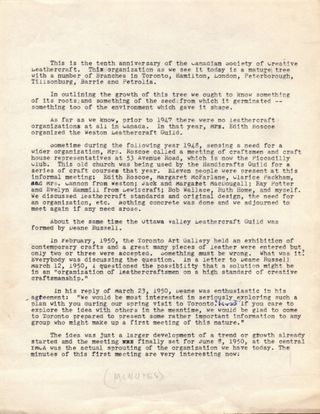
Page 1
This is the tenth anniversary of the Canadian Society of Creative Leathercraft. This organization as we see it today is a mature tree with a number of Branches in Toronto, Hamilton, London, Peterborough, Tillsonburg, Barrie and Petrolia.
In outlining the growth of this tree we ought to know something of its roots, and something of the seed from which it germinated -- something too of the environment which gave it shape.
As far as we know, prior to 1947 there were no leathercraft organizations at all in Canada. In that year, Mrs. Edith Roscoe organized the Weston Leathercraft Guild.
Sometime during the following year 1948, sensing a need for a wider organization, Mrs. Roscoe called a meeting of craftsmen and craft house representatives at 53 Avenue Road, which is now the Piccadilly Club. This old church was being used by the Handicrafts Guild for a series of craft courses that year. Eleven people were present at this informal meeting: Edith Roscoe, Margaret McFarlane, Clarice Packham, and Mrs. Cannon from Weston; Jack and Margaret MacDougall; Ray Potter and Evelyn Hammill from Lewiscraft; Bob Wallace, Ruth Home, and myself. We discussed leathercraft standards and original design, the need for an organization, etc. Nothing concrete was done and we adjourned to meet again if any need arose.
About the same time the Ottawa Valley Leathercraft Guild was formed by Deane Russell.
In February, 1950, the Toronto Art Gallery held an exhibition of contemporary crafts and a great many pieces of leather were entered but only two or three were accepted. Something must be wrong. What was it? Everybody was discussing the question. In a letter to Deane Russell March 12, 1950, I questioned the possibility that a solution might be in an "organization of leathercraftsmen on a high standard of creative craftsmanship."
In his reply of March 23, 1950, Deane was enthusiastic in his agreement: "We would be most interested in seriously exploring such a plan with you during our spring visit to Toronto. If you care to explore the idea with others in the meantime, we would be glad to come to Toronto prepared to present some rather important information to any group who might make up a first meeting of this nature."
The idea was just a larger development of a trend or growth already started and the meeting finally set for June 8, 1950, at the central YMCA was the actual sprouting of the organization we have today. The minutes of this first meeting are very interesting now:
Page 2
[This side of the sheet is blank; only a faint mirror-image shadow of the facing page's typing shows through the paper.]
Page 3
Deane Russell continued as President of the Society for four years giving a great deal of his time and energies developing the Society through this formative period. Our quarterly 12-page bulletin, "Canadian Leathercraft", came into existence in September, 1951, with Deane as Editor until he resigned from both positions in 1954.
Dr. Larmour followed for two years as President, succeeded by Mrs. Jean Newton for one year, and Mr. Fred Brown, who begins his fourth term today. Dorothy Muma became Editor of the Bulletin in 1954 and is relinquishing it this year to Mrs. Margaret McFarlane.
When we were barely two years old in 1952, our President attended the Annual Meeting of the Canadian Arts Council in Montreal with a brief from our Society and we were accepted into full membership in that co-ordinating body of the arts and crafts in Canada now known as the Canadian Conference of the Arts.
In February, 1952, our first travelling exhibition called "Canadian Handmades in Leather", was organized by Mrs. Reta Larmour, the Exhibitions Chairman. During the sixteen months it was on the road, it travelled an estimated 14,000 miles, was shown 39 separate times and was seen by approximately 150,000 people. The second Travelling Exhibition, called "Canadian originals in Leather", went out on March 1st, 1954, and toured 29 centres across Canada. The name of this second exhibition indicates the extent to which we had already achieved our goal in encouraging leathercraftsmen to attempt original design.
Since 1955, Mrs. Nora Huyck has been in charge of Exhibitions. It would be a surprisingly long list of collections of leathercraft that these two have handled during our history not only for exhibitions but for Membership and CNE competitions as well. A few of the more noteworthy events at which our exhibition of leathercraft was a prominent feature were: Nine of our Annual Meetings, 5 International Assemblies, the First and Second International Hobby and Homecraft Shows in the Colliseum, the Canadian Shoe and Leather Fair in November, 1952 in the Automotive Building, two years at the Handyman Show, and M'Lady Fair in Montreal in December 1952, Pacific National Exhibition in 1955 where we received the Bedford Cup for the best leathercraft and the PNE Medal for Best Club. This winter we also had a special exhibition in the Lord Simcoe Hotel.
Special mention should be made of the exhibition which was assembled and sent on invitation to the First British International Handicrafts, Homecrafters and Hobbies Show at Olympia, London, England, in 1953. This was visited by 100,000 people during nine days and the officials reported to us that our display of leathercraft was the best single exhibit in the show.
Page 4
[This side of the sheet is blank; only a faint mirror-image shadow of the facing page's typing shows through the paper.]
Page 5
1954 was a big year in our history. It was then we became affiliated with the Canadian Handicrafts Guild, and this has proven to be a valuable association in various ways, especially in regard to the annual CNE Guild competitions and the pre-Christmas sale of work through the Guild Shop.
In February, from 5-12, 1954, we arranged an extensive exhibition of leathercraft in conjunction with a sale and demonstration of work for the Intarnational Hobby and Homecraft Show at the Colliseum. One evening during this show a delegation of 16 members from the Eastern Leathercraft Guild of Rochester, N.Y., visited our display and met with us later at the home of Dr. & Mrs. Larmour where plans were briefly discussed for organization on a larger scale. In April, 16 of our members returned the visit to the Rochester Guild and plans were made for the First International Assembly of Leathercraftsmen at the Hotel Statler in Buffalo in the fall of that year. With one exception this has continued as an annual event in which our Society has played a very important role.
For the Fourth International Assembly of Leathercraftsmen held in Rochester, our Society had proposed the inauguration of a Salon of Leathercraft to be based on art standards. A jury of Rochester art and craft authorities of national distinction selected the pieces and made four Honor Awards, which were won by four of our Charter Members.
Early in our history we set up the graded membership system: General members, Associate and Fellows. This has had much to do with making us keenly aware of leathercraft standards and other organizations have called on us to provide qualified judges for leathercraft competitions. We also developed a system of grading teachers of leathercraft according to their experience and training.
Every organization, in order to function properly, needs a set of rules. The Constitution not only provides a set of rules but architecturally provides the framework of the building. This framework of our Society was begun at the organizational meeting and rapidly took shape through many Executive meetings during the first few years. However, many weaknesses became apparent and had to be repaired. Indeed whole sections of the structure had to be torn out and rebuilt and new sections added. The architect in charge of this very important job of reconstruction, has been Mrs. Larmour/with the expert help of Mrs. Brigden, the wife of one of our members, has worked untiringly anticipating our Society's needs and checking the legal angles. A nucleus of devoted members has always been on hand when needed giving many hours to threshing and rethreshing the many complex details involved. Now on our tenth Anniversary we are happy to have adopted this Constitution in its finished form. Now we have a sound foundation. Now we can continue our building in the knowledge that we have a structural framework that is secure.
Page 6
[This side of the sheet is blank; only a faint mirror-image shadow of the facing page's typing shows through the paper.]
Page 7
Today on our tenth Anniversary, we have only to glance at many of the fine pieces of work on display to verify this imposing outline of the development of our society in the realization of its ideals. Here is a challenge to each individual member to look for even greater opportunities for development in the years that go on from here.
Page 8
[This side of the sheet is blank; only a faint mirror-image shadow of the facing page's typing shows through the paper.]
The words above are the document’s own, as the paper prints them. Spelling and spacing are left as they stand.