
An issue of the Society’s newsletter, transcribed from the original.
(14 pages, 2.4 MB)
the full-resolution scan, 39 MB, for close research
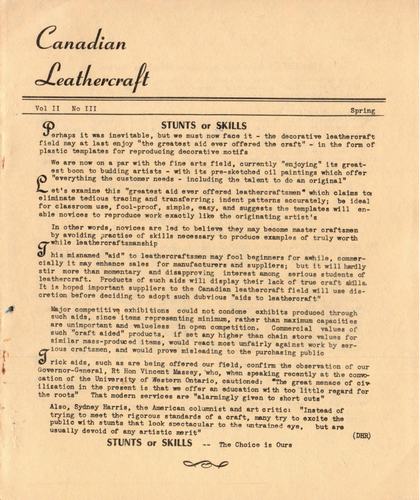
Page 1 — STUNTS or SKILLS -- The Choice is Ours
Canadian
Leathercraft
Vol II No III Spring
STUNTS or SKILLS
Each section on this page opens with a large decorative initial letter, printed apart from the rest of its first word; it is joined back into plain running text throughout what follows.
Perhaps it was inevitable, but we must now face it - the decorative leathercraft field may at last enjoy "the greatest aid ever offered the craft" - in the form of plastic templates for reproducing decorative motifs
We are now on a par with the fine arts field, currently "enjoying" its greatest boon to budding artists - with its pre-sketched oil paintings which offer "everything the customer needs - including the talent to do an original"
Let's examine this "greatest aid ever offered leathercraftsmen" which claims to: eliminate tedious tracing and transferring; indent patterns accurately; be ideal for classroom use, fool-proof, simple, easy, and suggests the templates will enable novices to reproduce work exactly like the originating artist's
In other words, novices are led to believe they may become master craftsmen by avoiding practise of skills necessary to produce examples of truly worthwhile leathercraftsmanship
This misnamed "aid" to leathercraftsmen may fool beginners for awhile, commercially it may enhance sales for manufacturers and suppliers; but it will hardly stir more than momentary and disapproving interest among serious students of leathercraft. Products of such aids will display their lack of true craft skills. It is hoped important suppliers to the Canadian leathercraft field will use discretion before deciding to adopt such dubvious "aids to leathercraft"
Major competitive exhibitions could not condone exhibits produced through such aids, since items representing minimum, rather than maximum capacities are unimportant and valueless in open competition. Commercial values of such "craft aided" products, if set any higher than chain store values for similar mass-produced items, would react most unfairly against work by serious craftsmen, and would prove misleading to the purchasing public
Trick aids, such as are being offered our field, confirm the observation of our Governor-General, Rt Hon Vincent Massey, who, when speaking recently at the convocation of the University of Western Ontario, cautioned: "The great menace of civilization in the present is that we offer an education with too little regard for the roots" That modern services are "alarmingly given to short cuts"
Also, Sydney Harris, the American columnist and art critic: "Instead of trying to meet the rigorous standards of a craft, many try to excite the public with stunts that look spectacular to the untrained eye, but are usually devoid of any artistic merit" (DHR)
STUNTS or SKILLS -- The Choice is Ours
Page 2 — First CSCL Fellow and Associate Members Named
First CSCL Fellow and Associate Members Named
Eight members of CSCL have the honor to be chosen as the first group of Fellows in the Society; and eight members have been chosen as the first group of Associates in the Society
Fellows and Associates were decided in a confidential vote, suggested by the Canadian Arts Council as being used in other societies for a like purpose. Each member of the Executive and Executive Council was invited to submit a list of candidates deemed worthy of this honor in the Society. A composite list of the most-mentioned names was then prepared by the Secretary, and this list mailed back to each member of the Executive and Council for their confidential vote of eight Fellows and eight Associates. Elections were guided by the sections of our Constitution which read: "Qualifications for Associate and Fellow Membership shall be based on meritorious achievement in the craft, and active participation in furthering the objectives of the Society, which include:
-- to encourage originality of design
-- to establish high standards of craftsmanship
-- to advance education in the art
-- to participate in exhibitions
The Executive and Council have much pleasure in conferring the Society's highest honors on the following worthy members who have been untiring in their efforts to further the interests of their Society:
| FELLOWS | Place | ASSOCIATES | Place |
|---|---|---|---|
| LARMOUR, Reta | Toronto | BURGESS, Arthur | London |
| LARMOUR, Ralph (Hon) | Toronto | JENNINGS, Margaret | London |
| MacKINNON, Don | Toronto | LLOYD, Nora | Toronto |
| MUMA, Robert | Toronto | McFARLANE, Margaret | Weston |
| RICHARDSON, Margaret | Ottawa | PACKHAM, Clarice | Weston |
| ROSCOE, Edith | Weston | SURGENOR, Irene | Cornwall |
| RUSSELL, V Lara | Ottawa | TYRELL, Jessie | Ottawa |
| RUSSELL, Deane | Ottawa | VILLMANN, Iiva | Toronto |
This page prints her given name as "Iiva", as pages 6 and 7 of the 1952-53-winter bulletin do; page 2 of that bulletin prints "IIva", with two capital I’s. Each is set out here as its own page prints it.
Fellows will be asked to sit on the first Board of Selection at the forthcoming Annual Meeting, when work will be received from other members for further Fellow or Associate rating. Members are invited to submit two small and two large leathercraft projects of high standard. Submissions should be sent to Mrs R K Larmour, 59 High Park Boulevard, prepaid, NOT LATER than June 1
Page 3 — COMPETITION in Natural Grained and Marked Leathers
COMPETITION in Natural Grained and Marked Leathers (a News-Item Article by Deane Russell)
Interest in the Competition for Best Use of Natural Grained or Marked Leather is rapidly gaining momentum among Canadian leathercraftsmen
Since the competition was first mentioned in the last issue of "Canadian Leathercraft" four prominent Canadian leathercraft supply houses have volunteered to cooperate in offering cash awards to craftsmen producing best examples of articles showing natural grained or marked leathers
The Executive of CSCL are pleased to acknowledge the friendly co-operation of the following leathercraft suppliers as co-sponsors donating awards:
| Bedford Fine Leathers, Ltd | Vancouver |
| CORBEIL-HOOKE INC. | Montreal |
| Lewis Craft Supplies, Ltd | Toronto |
Ottawa Valley Leathercraft Studios - Ottawa
For this competition, believed to be the first of its kind among Canadian leathercraftsmen, awards at present total: 1st $15.00 2nd $10.00 3rd $5.00 To help craftsmen get into the spirit of the game, we offer the following suggestions:
Several types of "natural grained or marked leathers" commonly confront students of leathercraft. These may be:
1) Shoulder Graining - light, medium, or deep, depending upon tannery finishing. When Shoulder Graining is not too pressed or rolled out, some interesting uses suggest themselves for such leather (see below)
2) Natural Growth Marking - to be found in many skins or hides which have enjoyed most healthy growing conditions. Often the very best skins and hides display "fat growth graining"
3) Drawn Graining - sometimes induced by drum tannage, when leather is tumbled and becomes slightly wrinkled into cross-check markings. Even though well-smoothed out, such markings often show up in natural russet leathers 4) Natural Veining - occasionally hides display an interesting pattern of natural veining - considered desirable and valuable for large-area leather coverings, as for table top finishing, boxes and lamp bases
5) Healed Scar Markings - from cuts suffered by animals during normal growth. Well-healed scars do not detract from the strength nor practical uses of leather, but, unfortunately, are too often considered as just "scrap" by beginners who will not experiment with it. Leathercraftsmen, if not interested in using "healed scar" leather without further embellishment, may combine such pieces with leather under type 6)(immediately below)
6) Assisted Graining - effects which craftsmen may give certain pieces of leather in order to make them more attractive for special uses - even though they may contain one, or more of above Suggested grainings or markings (see note x)
Page 4
Suggestions for using natural or assisted grained leathers:
By looking for and experimenting with leather which is not entirely "blemish free" craftsmen may set themselves different and economical projects. Rather than becoming too quickly discouraged at "first-glance" discoveries of natural grained or marked leathers, craftsmen might do well to study these areas carefully and consider how they may be turned to good advantage
We should learn to practise a trick of experienced cabinet makers. If a skilled cabinet maker were to become as easily discouraged by his first glance at graining in natural mill-finished woods, he would lose many chances for finishing woods with effects which may set his work apart from the work of "run-of-'*--mill" fellow woodworkers. Experience has taught him to look beyond the dull, flat appearing newly-milled wood, until he can conceive exciting possibilities for "bringing out the grain'' rather than obliterating it with heavy pigments and too much ornamentation
So may instructors of leathercraft encourage their students to learn how to "bring out the grain of good leathers" Skill in leather finishing will help craftsmen to salvage and, indeed, turn to good account, many pieces of otherwise "scrap leather" Learn to see the possibilities of grained or marked leathers; learn to accent, rather than hide, certain grainings and markings, and you will enjoy your craft more
HOW MAY NATURAL Grained and MARKED LEATHERS BE USED? We suggest --
-- first try something simple but effective, such as: a book cover. Prepare a paper pattern for area of leather needed and turn it around on your grained or marked leather until you see the most interesting direction for "bringing out the grain"
-- then try selecting grains or markings which will appropriately "decorate" the front, back or flap panels of otherwise "undecorated" handbags
-- look for pieces suitable for panels or covers of lamp bases, boxes or desk set items
-- many pieces, not considered quite suitable for the finer examples of personal leather goods, can be used for items of outdoor sports equipment: belts, belt-bags; axe, knife and gun sheaths, archery quivers, wrist guards, et cetera (x) Watch the next issue of "CL" for helpful and interesting suggestions for craftsmen who will experiment with "Assisted Graining" -- the old and successful skill among craftsmen who have learned to get the most out of such a natural product as "genuine leather"
START LOOKING NOW for Natural Grained or Marked Leather. Make up articles. during the summer months and be ready to enter your examples by September 15. Results and awards will be reported in the first issue of "Canadian Leathercraft" Volume III
Page 5 — LEATHER DOOR PLATES
LEATHER DOOR PLATES
by Elizabeth Arnold - CSCL Member, Kirkland Lake
Necessity has been the mother of many inventions, and so began my door plates. Having moved into an apartment with several entrances, I felt my friends needed some assurance before knocking on yet another door
[Below this paragraph a leather door plate is pictured, oval and stamp-bordered, reading "H. Elizabeth Arnold".]
This plate was made of 3½oz natural cowhide, later mounted on brown morocco to add firmness and color contrast against the door. This mounting has not been necessary with larger and heavier plates made later
A draft was made on paper, marking off the centre area for the name with a double line separating it from the border area. The width depends on size of letters and length for number of letters used. I usually leave the right of the sketch open until the name is filled in, then, complete it. This avoids having to centre the name and makes it easier to get even spacing
In this first plate I incised single line letters then bevelled left and upper sides of each stroke. Basket and seed stamps were alternated across top and bottom borders. Camouflage and plain seeders were combined at the ends and a moroccan seeder was stamped in each corner and a fine veiner stamped right through the leather to give a scalloped finish to each end. Over all a coating of Antique was applied and the mounting completed
The finished plate never really satisfied me, though it served its purpose until a better one replaced it. It was while looking for a Christmas gift that a different Style, No 2, was developed
[Below this paragraph a second leather door plate is pictured, rectangular with a stamped border, reading "T. G." followed by a surname in ornamental capitals that the printing does not settle.]
Page 6
This time I used all capital letters. Again the plate was drawn on paper, spacing letters before completing boundary lines. 8-oz carving leather was chosen, which proved much more satisfactory as the finished plate did not need mounting.
With this style, letters were incised and decorative cuts added. A Seed Stamp provided periods following initials; while bargrounder filled in background. For border stamps, a Basket and Sunburst were alternated with a Fine Veiner paralleling them. In stamping a border I work from each end toward the centre along both top and bottom, in order to match spacing. When stamping was done, Inlay Dye was applied to the background and the whole plaque Antique finished
[Below this paragraph a third leather door plate is pictured, in an ornate stamped border, reading "H. Elizabeth Arnold", its H, E and A in decorated capitals and the rest in plain lower case — the same name as the first plate.]
But since names vary in length, I found it necessary to try another method for a long name. Thus Style 3 came into existence
In this plate only initial capitals were incised. A short Bargrounder was used to stamp the inside of all letters. No incising was needed in lower case letters, as they were stamped in single line with Bargrounder. Decorative cuts surrounded capitals. Borders combined Long Veiner, Plain and Moroccan Seeders and Stamen at each corner. Again Inlay Dye was applied to letters and Antique applied over all
A variation of this style used Bargrounder on only lower case letters, initial capitals being incised and interior dress cuts used. Surrounding decorative cuts were still used around capitals
So far I cannot advise as to durability on outside doors. Any that I know of that are outside have not been exposed long enough to show effects of weather. Perhaps someone reading this article has had such experience and may have some advice to pass along on the matter of weather-proofing (*)
And now, good luck to all of you who will be making door plates. May you have as much pleasure out of them as I have had
(*) Neatsfoot oil, though it tends to darken russet finished leather, stands up well on such outdoor items as saddles, gun scabbards, surveyor's instrument cases. Weatherproofing applications need periodic renewing. (Ed)
Page 7
CSCL Exhibition Reports
1st Canadian International Hobby Show, Toronto, February 6-14, 1953
Eight 12-hour days, 80 assistants and demonstrators working in three shifts, 155 articles on display, 14012 voting slips cast in the popular preference poll -- that is the story of our most ambitious and successful CSCL display to date. The continuous activity of voting and demonstrations always drew crowds, and much of the time the aisles were filled solidly
Visitors enjoyed watching CSCL members demonstrating: tooling, carving, dyeing and coloring, glovemaking and lacing. Other attending members gave information about the exhibits and the Society, and registered many new members
Hobby Show officials were so satisfied with our efforts that we have already been invited to exhibit in 1954. It is hoped all CSCL members will work toward exhibition pieces for this important event. Try for: 1) originality in design 2) imagination in choice of articles
Pieces exhibited were again chiefly from Ontario, but Saskatchewan was represented by Mrs Beatrice Baycroft, Lajord, and Mrs Gwyneth R Gale, Melfort; and Montreal by John Opariek and Endel Ruberg
Results of the popularity poll (below) will interest members who exhibited and assisted with the show. Special congratulations should be given Edith Roscoe, whose beautiful butterfly jewel box received the largest total vote
V Lára Russell of Ottawa donated the prize for the lucky draw from the voting slips. It was a shoulder bag, in which design and decorative motif had a fresh and original approach. The winner, Mr Edwin Dixon of Newmarket, is a naturalist and master taxidermist, examples of whose work are to be found throughout Canada and the United States. Mrs Dixon tools in leather, and both paint in oils. We are glad the purse fell into such appreciative hands
The paper prints "V Lára Russell" with an accent here too; the table entry below it already carries the accent correctly.
Popular Vote Standing of Articles:
LARGE ARTICLES
| Standing | Description | Votes | Craftsman |
|---|---|---|---|
| 1 | Leather Picture "New Arrivals" | 1268 | Don MacKinnon, Toronto |
| 2 | Weekend Travelling Case - carved | 1142 | Don MacKinnon, Toronto |
| 3 | Overnight Zipper Bag - carved | 1140 | Mrs J Holman, Aurora |
| 4 | Brief Case - carved | 998 | Edith Roscoe, Weston |
| 5 | Bound Album "Music of the Masters" - tooled and embossed | 971 | Robert Muma, Toronto |
| 6 | Paper Basket - carved leaves | 777 | V Lára and D H Russell |
SMALL ARTICLES
| Standing | Description | Votes | Craftsman |
|---|---|---|---|
| 1 | Butterfly Jewel Box - Esthonian technique | 1400 | Edith Roscoe, Weston |
| 2 | Jewel Box set with Amazonite, carved | 1055 | Edith Roscoe, Weston |
| 3 | Bookends - carved | 535 | Reta Larmour, Toronto |
| 4 | Coaster Set - carved | 413 | Reta Larmour, Toronto |
| 5 | One piece wallet - carved | 353 | Margaret Jennings, London |
| 6 | Glasses case - carved | 316 | Edith Roscoe, Weston |
Both tables print each craftsman's name once and mark the repeats below it with a ditto mark; those names are spelled out in full above.
Page 8 — M'LADY FAIR
M'LADY FAIR
Montreal, Mount Royal Hotel, Dec 2-4, 1952 (Arranged by Montreal Women's Club)
Specially invited as a feature display, 92 CSCL Travelling Exhibition and extra loan articles were enthusiastically received by the crowds attending the Fair Demonstrations and voting kept interest high at all times
Your Exhibition Committee Chairman set up and handled the display, with the help of a new member, John Opariek, a young Ukranian now living in Montreal. Jessie Tyrell, Margaret Richardson and Deane Russell came from Ottawa to lend a hand, and three girls from Corbeil-Hooke, Inc. took turns attending during exhibition hours
The lucky draw, a carved handbag donated by Don MacKinnon, was much admired, and was won by Mrs AE Hanna, of Mount Royal. 934 votes cast placed the following articles in top rank:
LARGE ARTICLES
| Standing | Description | Votes | Craftsman |
|---|---|---|---|
| 1 | Paper Basket - carved leaves | 134 | V Léra and D H Russell, Ottawa |
| 2 | Handbag - golden tan, carved | 70 | John Opariek, Montreal |
| 3 | Handbag "Petunia" Design - carved | 66 | Irene Surgenor, Cornwall |
| 3 | Handbag "Dolphin" Design - carved | 66 | Reta Larmour, Toronto |
SMALL ARTICLES
| Standing | Description | Votes | Craftsman |
|---|---|---|---|
| 1 | Glasses Case - carved | 51 | Edith Roscoe, Weston |
| 2 | Cigarette Case - carved | 39 | Reta Larmour, Toronto |
| 3 | Ladies Gloves - two-tone | 38 | Edith Roscoe, Weston |
The Travelling Exhibition has been in constant demand all winter, and is booked solidly until the end of April Host groups continue to report successful showings and to express appreciation for the opportunity to see such excellent examples of contemporary Canadian leathercraftsmanship. After last year's showings in Central, Western and Eastern Canada, the following winter-spring itinerary may illustrate how our Society is widening its contacts through "Canadian Handmades in Leather" --
Pretrolia, High School; Kingston, Queen's University Museum; Almonte, Almonte Handicraft Guild; Timmins, Local Section CSCL; Iroquois Falls, High School; Winnipeg, Canadian Handicrafts Guild; Picton, High School; Tillsonburg, High School; Chatham, Kinsmen's Memorial Auditorium; St Thomas, Public Library; Fort William, Public library; Port Arthur, Public Library; Welland, High School
The original prints "Pretrolia" for the Ontario town of Petrolia; kept as printed.
It is planned to recall the Travelling Exhibition for summer months, when members will prepare new exhibits designed to offer still demonstrations of important leather decorating, finishing and assembly techniques. After the annual meeting, a new outline of Travelling Exhibition Policy will be circulated for the interest of host groups desiring to receive this educational display of contemporary Canadian decorative leathercraft
Page 9
LEWISCRAFT HAS MOVED T0 ITS NEW HOME - 284 KING ST. WEST TORONTO, ONT.
We extend a cordial invitation to all our leathercraft friends to come in and see our new, spacious and comfortable showroom where fine leathers and quality leathercraft supplies play a major part
Member - Our Address Is Now -
Lewiscraft
284 KING STREET WEST, TORONTO, ONT.
(One Block West of the Royal Alexandra Theatre)
Attention Leathercrafters
BARGE CEMENT -- the most powerful adhesive made. When you cement with Barge it's permanent. Ask anyone who has used it. 8-oz can with brush $1.15 32-0z can with brush $3.00
GARNETT Antique Finishes and Dyes -- the best of its kind on the market Try it and be convinced. Detailed circular with instructions available on Garnett products
LEATHER of all kinds for all purposes. Tools, Patterns, Text Books, Lacing, Belt Blanks, Glove Kits, etc. Large variety of Belt Buckles and Purse Clasps
Your enquiries are invited We ship anywhere
CAPITAL LEATHERCRAFT & SUPPLY COMPANY
150-132 King Street East
Toronto - Ontario
Page 10
NEW GARNETT LEATHER FINISHES
GARNETT TONING DYES — RED, BLUE, GREEN, YELLOW, ORANGE, May be used alone or to modify colors of the Garnett Antiques
GARNETT EDGE DRESSING — to finish belt, strap and other raw edges GARNETT DARK BROWN INLAY DYE — for backgrounds, edges, etc. FREE GARNETT INSTRUCTION SHEETS for dyeing and finishing craft leathers
Available at your dealers Ask for one
Dealers write for information to:
GARNETT COMPANY
442 SPADINA AVENUE - TORONTO
To Canadian Leathercraftsmen
YOU ARE CORDIALLY INVITED TO WRITE OR VISIT OUR STUDIOS TO DISCUSS YOUR INTERESTS AND NEEDS IN DECORATIVE LEATHERCRAFT
FINE CRAFT LEATHERS —- SELECTED LEATHERWORKING
TOOLS AND ACCESSORIES
a Leathercraft Service by leathercraft specialists "
Ottawa Valley Leathercraft Studios 116 O'CONNOR STREET
OTTAWA — ONTARIO
NEW PRACTICAL DIFFERENT ask for FREE folder or pattern -- Handbag Design Style No 12 by Margaret Richardson. Mission grained Cowhide by Wickett & Craig, 2½ oz Russet per sq ft 88c. send 50c for HANDICRAFT & ARTISTS SUPPLIES OF QUALITY
CORBEIL-HOOKE INC. 1218 Drummond Street 9 d'Aiguillon Street Montreal 25 — P Q Quebec City — PQ
Page 11 — Second Call
“Color Decoration and Finishing of Leather” by Robert Muma
A comprehensive 24-page book dealing with all forms of color decoration and featuring practical exercises in color. 8½" x 11". Illustrated.
From your local dealer or direct. Price.. $1.50. Mumart Studios of Creative Leathercraft, 62 McGill Street, Toronto, Ont.
Leatherlore Publications
Ask your dealer for the new "Canadian Pocket Set" Pattern No 3 with photographic illustrations, actual-size line drawings, decoration and thorough instruction for Billfold, Pocket secretary and Key Case. Canadian leaf decoration for standard stamping tools. Pattern 50¢.
Distributors – Leatherlore Publications, 116 O’Connor St, Ottawa, Ont.
Handicraft Leathers and Supplies
Fine assortment of Beautiful Leathers, complete range of Leathercraft Tools and Accessories, comprehensive detailed 64-page Catalogue, experienced personalized service.
The Birt Saddlery Company Ltd., The Leather Goods House, 519 Main Street, Winnipeg, Manitoba.
Studio of Leather Carving
Elementary & Advanced Carving Taught. Limited Enrolment. Custom Designs & Patterns. Finest Carving Leather cut to Project Size – 2¢ square inch.
D W MacKinnon, 6 Irwin Street, Toronto, Ontario.
Second Call
Leathercraftsmen desiring to have their work reviewed for possible showing in the 1953 Arts and Crafts Display to be sponsored by the Art Gallery of Toronto are urged to plan their pieces now.
This all-Canadian exhibition will be judged critically and to highest standards.
Suggestions: try for simplicity in decoration; try hand-sewn and turned-edge construction; achieve a fine "leather finish"; offer only work of your own original designs.
Full details will be sent all CSCL members by special circular after the Annual Meeting.
This page carries four advertisements and a Society notice ("Second Call") about the 1953 Art Gallery of Toronto exhibition, set out here in full.
Page 12 — FOURTH ANNUAL MEETING; CSCL Executive
FOURTH ANNUAL MEETING
All day Saturday, June 6, 40 Wellesley Street East, Toronto Watch for detailed program in circular to be mailed all members three weeks before meeting date. Special program features include:
- colored slide films on contemporary Canadian Leathercraft
- a morning workshop period
- luncheon
- guest speaker Thor Hansen, leading illustrated discussion on "Designing for Canadian Leathercraft" - group criticisms of members' work
A display of members' work will be set up for review and friendly group criticisms. All members are invited to bring one or more examples of recent leathercraft for this feature of the program
Members wishing to apply for Associate or Fellow rating are urged to prepare two large and two small articles for review by Board of Selection. Details of other requirements for Fellow and Associate standing listed in circular to be mailed membership soon
Published quarterly by the Canadian Society of Creative Leathercraft as an educational service to decorative leathercraftsmen
Subscription and General Membership in Society — $2.00 annually
Sustaining, Associate and Fellow Membership Standing upon qualification For information write: Chairman, Membership Committee
Advertising Rates — for information write: Chairman Advertising Committee
CSCL Executive
President and Editor "Canadian Leathercraft'' — Deane H Russell, 116 O'Connor Street, Ottawa
Vice-President — Mrs Margaret McFarlane, 1810 Lawrence Avenue West, Weston
Secretary — Mrs Edith Roscoe, 277 King Street, Weston
Treasurer — Robert Muma, 62 McGill Street, Toronto
Chairman Membership Committee — Mrs Nora Lloyd, 15 Kelway Blvd., Toronto
Chairman Advertising Committee — Arthur Burgess, 134 William Street, London
Chairman Travelling Exhibition — Mrs Reta Larmour, 59 High Park Blvd., Toronto
Executive Council
London Member — Mrs Margaret Jennings           Ottawa Member — Mrs Margaret Richardson    Regina Member — Mrs Lena M Totton
Toronto Member — James L. Scobbie (Chairman)    Toronto Member - D W MacKinnon
Page 13 — WORKSHOP TIPS
WORKSHOP TIPS
Question: What will prevent gusset edges from curling toward purse front after use for awhile?
Answer: Skive edges of gusset well. Do not skive purse front too thinly to weaken it, and only slightly in from edge. Likely pull of thickness of gusset plus lining is stronger than front edge of purse if front has been skived thin
When constructing, dampen skived gusset score line of flange deeply with tracer at bend; then bend up both sides of flange. While still damp form into permanent shape - to fit purse and stretch WELL on curves. Allow to dry fastened to purse front and back with clamps. Cut lining slightly smaller across than gusset so as not to include in lacing; cement to gusset and nick lining several times slightly where corner curves. This method should offset tendency for gussets to curl forward
The paper prints "WELL on", WELL struck twice for emphasis. The drawing beside this tip is lettered only "NICK LINING HERE", with two arrows; the letters A to D belong to the row of tool-end sketches further down the page.
NICK LINING HERE
Tip by Edith Roscoe
Question: How may "natural" purses be kept in original even color tones? Answer: To keep natural or light-colored purse the same all-over color, unfasten clasp whenever purse is not in use. Better air circulation will help under-flap leather change color at same rate as exposed parts
Tip by Reta Larmour
Question: My last wooden mallet became very badly chipped after use for just a short time. Is there any way to prevent this?
Answer: Check carefully the striking ends of all stamping tools. Damage to striking surfaces of wood or rawhide mallets, can be considerably lessened by making sure all striking ends of stamping tools are ground or filed smooth and slightly convex or domed. (see A and B) Sharp square edges or perfectly flat top ends, quickly check, split or gouge mallet faces - C & D
C and D are the drawing's own letter labels, as A and B are three lines above; the paper joins them with a small, lightly-struck ampersand.
Tip by Deane Russell
Question: How may I prevent leather from shrinking after tooling?
Answer : Immerse leather in water (time according to weight or thickness) as for carving; let dry thoroughly; then dampen in usual way before tooling. Little shrinkage will occur, as leather will have been pre-shrunk
Tip by Arthur Burgess
(Slip Page from "Canadian Leathercraft"
Bulletin III Volume II - Spring 1953)
Page 14 — NEWS ITEM; Society Crest Design Competition; TRADE NOTES
NEWS ITEM
Margaret Jennings, London executive member, was honored recently by a commission from the Town of Tillsonburg, to make a leather cover for an album to be presented to the Rt Hon Vincent Massey, Governor General of Canada, on the occasion of his official visit there in March
Margaret bound the album in mission grain steerhide, with turned edges and padded covers. The decorative motif was the Tillsonburg crest and inscription "Tillsonburg 1925-53" colored in brown tones, with background left natural
Membership in the Society proved invaluable to Margaret on this occasion, since she knew exactly where to go for help. She felt that without Bob Muma's aid she would never have been able to do such an excellent job
Society Crest Design Competition
All CSCL members and their friends are invited to enter a competition for the best designed Society Crest
Try for something Simple, Descriptive and Decorative Entries should be mailed to the Editor, "Canadian Leathercraft" NOT LATER than June 1. Winning entry will be illustrated, and designer and award mentioned in Bulletin following Annual Meeting
TRADE NOTES - condensed from "Weekly Bulletin of Leather and Shoe News"
Natural Marked Leathers
A well-nourished animal must have some fat and wrinkles in body and skin. A tendency, all for the good, is developing to educate wearers and buyers of shoes bags and other leathergoods, to consider such markings as part and parcel of what leather is. Take a crowd of men and women at a cattle show and all rave about the beauty of the animals. None are scrawny, all are fat. Every hide must reflect the general condition of the beasts
Cattlemen can't tell their animals to keep away from fences, briars or anything likely to mar their skins or hides. Nor can they get them to digest foods so as not to develop natural fat and growth wrinkles
Since packers must be reasonable with the animals they buy, tanners must do the best they can with hides available. Then it's simply up to all users of leather (manufacturers, craft suppliers and craftsmen) to make the best of all "leathers not further finished than tanned or colored" Our knowledge and understanding of leather, as well as our capacity for working with leather, will certainly be reflected in the uses to which we put this craft medium (Editor)
The paper breaks "reflected" across the line as "reflec-" / "ted".
(see also article page 3 - Competition for Use of Natural Marked Leathers)