
An issue of the Society’s newsletter, transcribed from the original.
(16 pages, 2.4 MB)
the full-resolution scan, 38 MB, for close research
Page 1 — DESIGN - AN "ALPHABET" OF LINE
Canadian Leathercraft
Volume VI, Number 4 summer, 1957
DESIGN - AN "ALPHABET" OF LINE by Anne Hook, A.C.S.C.L.
In the spring of 1950, a group of experienced leathercraftsmen met in Toronto to analyse the status of contemporary Canadian leathercraft. By the following spring, The Canadian Society of Creative Leathercraft had come into being,and in September of that year, 1951, it published its first issue of "Canadian Leathercraft".On the first page of the first issue, there is this question:
"What's wrong with contemporary leathercraft in Canada, that it merits such little recognition at important art-craft exhibitions?" and there is this answer:
"Leathercraft will become recognized as a serious and worthwhile craft in Canada when Canadians stop copying and start creating." Almost two years later, the Society named its first Fellow and Associate members, and put into print the qualifications for these categories, as being based on meritorious achievement in the craft, and active participation in furthering the objectives of the Society. The first item on the list of objectives is:
"To encourage originality of design."
In the Winter, 1955, Bulletin, in my article on Design, it will be seen that I led off by drawing attention to the fact that design does not mean only decoration,but is any device of man,architectural, mechanical, etc., and its decoration.There are two distinct kinds of DESIGN, structural, which is three-dimensional, and decorative,which is two-dimensional.
We are concerned here with decorative design,but if the structural has missed the boat, decoration would be a waste of time. Good design must be functional, in good taste, and interesting. The basic principles of design are as fixed as the ten commandments, and are common to all forms of art, as well as to all things devised by man, whether it is a cathedral or a chair, a submarine or a salt shaker. The principles that governed the designing of the Queen Mary are the
All material published in "Canadian Leathercraft" is the property of The Canadian Society of Creative Leathercraft, and may not be reprinted in any form without the written permission of the Society. Editor of "Canadian Leathercraft" is Mrs. Dorothy Muma, 118 Hazelton Avenue, Toronto 5, Ontario.
Page 2
same principles that govern the printed pattern on a dress fabric. The most important of these, are as follows: Balance, Proportion, Harmony, Rhythm, Unity, Interest. Taken all together,they add up to GOOD TASTE,
Briefly,the true meaning of DESIGN is the order or plan on which any work is constructed,and it is good when it is based on the principles of order and unity,and bad when it is not.It may be difficult at first glance to see if things are good, but should be no trouble - at all to see if they are bad.
Since DESIGN and DECORATION are the product of clear thinking and trained intelligence, combined with the artist's vision and inspiration, let us pause and quote from John Farleigh in "Graven Image":
"There are no limitations to thought; only a craft has limitations, and these must be constantly strained, for what we know of a craft is only what has already been said or done. Why should that knowledge be defined as limitations?"
Every person is a special kind of artist, and for those who have not yet started to originate their own designs, it is suggested that they read and use the chart which follows, dealing with LINE in decoration.
There are two basic lines, the STRAIGHT and the CURVED, each drawn as a short sample line beside its name.
These two basic lines give nine abstract units of pattern, which give us all the lines with which we work.
(1) the STRAIGHT LINE gives the zigzag, and its variations. (2) the CURVED LINE gives all forms of wavy line and rounded shape. These again fall into 2 groups: (1) continuous units and (2) static units, with variations.
Each of these nine units is drawn beside its name as a small sample line: the straight rule and the single curve; the zigzag and its variations; the continuous units, shown as two rows of joined zigzags and waves; and the static units — a circle, a spiral, a "U", a crescent, a parallelogram and a rectangle — followed by a further row of small ornamental variations: braided circles, a scroll, a chain of waves, feathered scallops, overlapping squares and a cluster of triangles. The paragraphs that follow ask the reader to copy and combine these same sample lines by hand.
A BORDER design is the simplest way in which to begin adapting the principles of design to decoration. Therefore, take a practice sheet, and copy these units of line, at the top of the page, so that they can be referred to frequently. Then experiment with the simplest combination of units.
The BORDER design must contain at least one continuous line, So begin by using any two units,providing that one of the two is of Group No.1 (continuous units). Try making a page of pattern incorporating two or more units until you have experimented with all 9 units, in as many combinations and variations as possible. Do not bother to correct mistakes, just start a new design.
Page 3
Consider these units of pattern as a sort of design "alphabet", and use it consciously until you have so absorbed it that you use it automatically.
Then look for pattern in your daily life, the houses on your street, the trees, articles in your home, your garden. Arrange three or four in an order, link them together, space them in an interesting way,formalize them,and the border pattern will grow before your eyes. See illustrations of the two boys: (1) shows two boys of about equal height, standing at ease. They are two distinct units. But (2) put them side by side, hand to hand, and foot to foot, they now form a pattern. (3) Formalize this pattern, they are no longer two boys, but a repeating pattern. Hence your border pattern contains a unit of repeat, a continuous line, and related masses.
These exercises are designed to stimulate your imagination, and sharpen your observation,because the best art training of all is obtained by living the ordinary life of the time, and by seeing and knowing what goes on around us.
This has been summed up as follows, by Henry Dreyfuss, in his "Designing for People":
"The object being worked on is going to be ridden in, sat upon, looked at, talked into, activated, operated, or in some way, used individually or en masse.
"When the point of contact between the product and the people becomes a point of friction, you have failed.
"If people are made safer,more comfortable,more eager to purchase, more efficient, or just plain happier,by contact with the product, you have succeeded."
Between this article and the workshop tip that follows it, this issue carries an illustration of two men in suits, drawn three times: standing apart as two separate figures, then side by side with hands and feet joined into a single pattern, then reduced to plain silhouettes to make the point that the pair has become one repeating shape. It goes with the border-pattern instructions above.
HANDICRAFT LEATHERS AND SUPPLIES
Fine Assortment of Beautiful Leathers
Largest Range of Leathercraft Tools and Accessories
All inclusive Specialized Leathercraft Catalogue
Experienced Personalized Service
THE BIRT SADDLERY CO. LTD.
519 Main Street, Winnipeg 2, Manitoba
Page 4 — SALON AWARDS -- INTERNATIONAL ASSEMBLY
SALON AWARDS -- INTERNATIONAL ASSEMBLY
The Executive Committee at the 3rd International Assembly, Detroit,
1956, decided to give special recognition to outstanding leatherwork by holding a Salon Exhibit at future Assemblies.For the 4th Assembly 7 of the participating guilds were permitted to enter 5 pieces each. The CSCL was permitted 15 pieces as a national group. Selection for awards was made on the basis first of originality and creativeness, second of execution of design and technique and suitability for leather.
The Board of Judges consisted of: Mr. William Fraatz,artist and craftsman in charge of all exhibits at the Museum of Arts and Science in Rochester; Mr. Harold Brennan,Chairman of the Division of Arts at the School of American Craftsmen: and Mrs. Geneva Ihle,Consultant in Art Education for the Rochester Board of Education.
Honor Awards were presented by Mr. Fraatz on Saturday evening as follows:
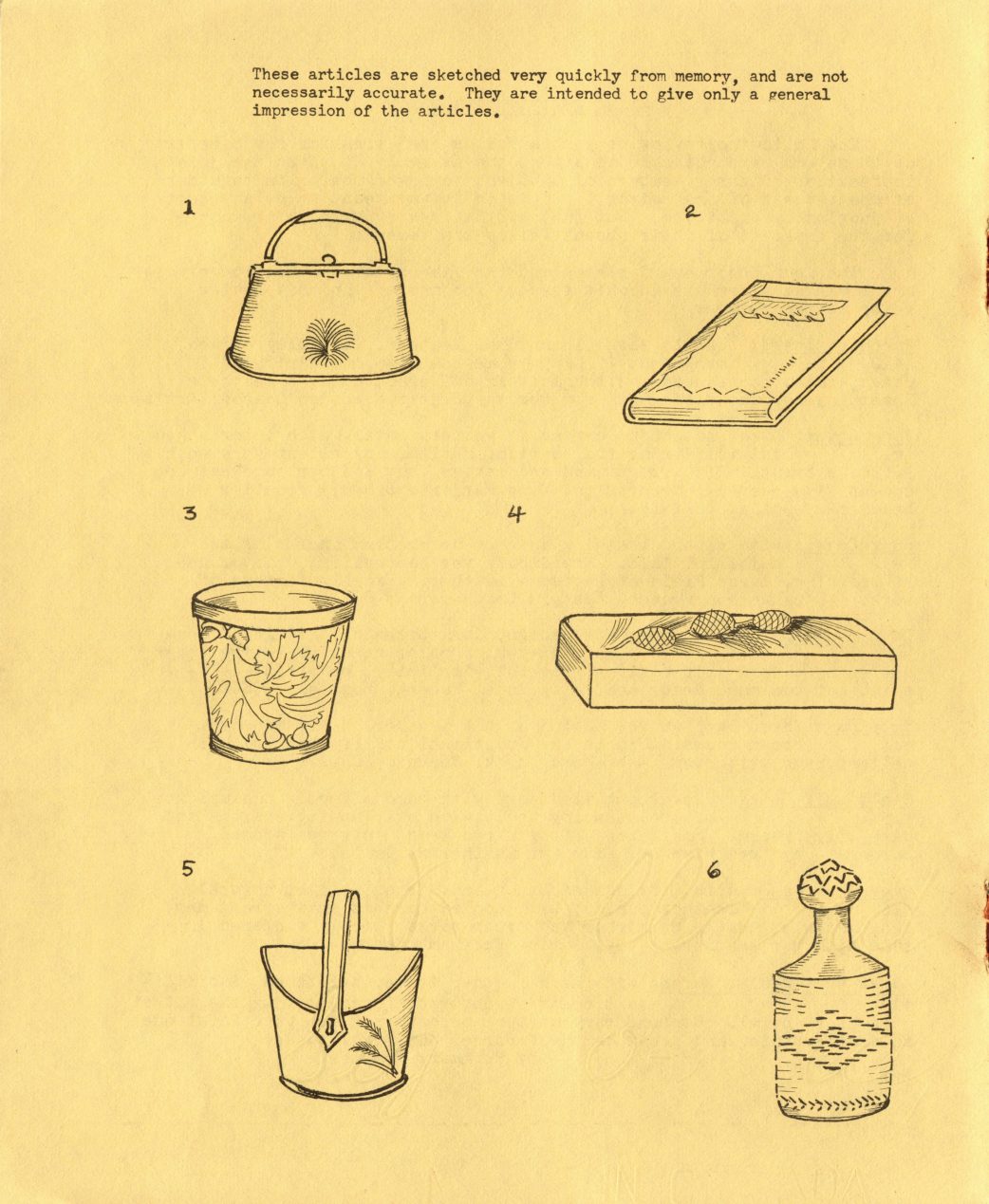
(1) Mrs. Reta Larmour, CSCL, for her small handbag, which was well finished, well proportioned, with restrained decoration and of excellent craftsmanship.
(2) Mr. Robert Muma, CSCL, for his leather binding of "Klee Wyck" with gold tooled totem pole decoration on spine and covers.
(3) Mrs. Edith Roscoe, CSCL, for her glove box, which was beautifully proportioned, well- blended colors, with pine cone decoration.
(4) Mr. Deane Russell, CSCL, for his wastepaper basket with all-over carving of tossed leaves, suitable to the nature of the article.
Five pieces were awarded Honorable Mentions, as follows:
(1) Mr. & Mrs. Richard Austin, Michigan Leather Artisans, for their Totebag of plain, functional shape in soft colors.
(2) Mr. Anthony Genco, Eastern Leathercraft Guild, for his Spirit bottle with brown braided sleeve, pineapple weave on the cork.
(3) Mr; Anthony Genco, Eastern Leathercraft Guild, for his tailored braided belt.
(4) Mrs. Melba Fisher, Detroit Leathercrafters, for her portrait of her small daughter, "Land of Make-Believe", surrounded by reproductions of the daughter's artistic impressions of the world around her.
(5) Mrs. Lara Russell, CSCL, for her saddle-type shoulder bag in dark brown tones, simple design, excellent workmanship.
The CSCL has from its inception stressed originality and high standards of craftsmanship,and it acknowledges with pride the achievement of its members who have brought distinction in this first Salon Exhibit.
Page 5 — PRIZE LIST AT CNE ALMOST DOUBLED; WORKSHOP TIPS
PRIZE LIST AT CNE ALMOST DOUBLED
This year, the Canadian Handicrafts Guild Gallery will occupy a larger and more prominent site in the new Queen Elizabeth Building at the C.N.E. A much enlarged prize list has been generously donated to celebrate the first year of this handsome new building. An entry fee of $1.00 per craftsman is being charged,and entry forms may be secured from the Canadian Handicrafts Guild, 77 Bloor Street West,Toronto 5. The following is the list of prizes offered for leathercraft:
The prize list is printed in two columns, the entry on the left and the prize and sponsor on the right, several entries running to two or three lines. Read straight across instead of column by column, the columns run together and the prizes come out attached to the wrong entries. It is set out below in the order the columns are meant to be read. One sponsor's name misprints as "Guils" for "Guild", kept here as printed.
| Best entry in show | $50 cash - F.W. Woolworth Co. Ltd. |
| Tooled or carved work | $15 credit note - Clarke & Clarke Leathers |
| Neither tooled nor carved, but any other treatment | $15 credit note - Lewiscraft |
| Handcrafted leather with no more than 20% area of decoration | $15 credit note - Ottawa Valley Leathercraft Studios |
| Leather Gloves | $15 credit note - Lewiscraft |
| Any leather article of original design, but winner must never have won a prize in any Canadian leather competition before | $35 Cash - Canadian Handicrafts Guild (Ont.) SHOP |
| Any leather article showing the best use of coloring techniques | $15 cash - Garnett Company |
| Most original entry, based upon a new approach to leathercraft in any one or more of the following features -- function, design, coloring, construction | $50 cash - Canadian Handicrafts Guils (Ont.) |
GRAND PRIZE:
An outstanding entry, particularly featuring a "Canadiana" design or motif, in any of the five crafts: Ceramics, Leather, Metal, Weaving, Wood Carving. (All entries are eligible for this award.) $100 cash - The British American Oil Company
WORKSHOP TIPS
1. A very interesting tip for an empty ballpoint pen, is to use it for a tracing tool - it doesn't cut the tracing paper.
It may also be used for stippling small background areas. Be sure the ink is completely gone, of course!
-- Mrs. Edith Roscoe, Weston.
2. The long boxes used for fluorescent lights make excellent containers for storing leathers. -- Miss Elizabeth Arnold, Kirkland Lake.
Page 6
Garnett — Craft Leather Dyes and Finishes
16 colors keyed to color originality. Choose your color or create a new one.
Six antiques for mellow aged effects: Golden Tan, Havana Brown, Mahogany, Chestnut Brown, Rouge, Forest Green.
Ten toning dyes for fine color harmonies: Yellow, Blue, Tan, Orange, Light Blue, Middle (Walnut) Brown, Scarlet, Green, Black, Dark (Chocolate) Brown.
Polish coat for satin-smooth, water-resistant finish. Edge dressing and inlay background dye for that final professional touch.
Ask for the Garnett Instruction Manual at your hobby supply store. Dealers write for information to: Garnett Company, 1 Hannaford Street - Toronto - Phone OXford 4587.
New location at the 1957 CNE
Visit our Booth in the New Women’s Building. Clarke and Clarke Leathers, Barrie, Ontario.
This page carries two advertisements, from the Garnett Company and from Clarke and Clarke Leathers, both transcribed here in full.
Page 7 — SALON EXHIBIT REVIEW
SALON EXHIBIT REVIEW
The following review is just a "birds-eye" view for the benefit of those who were not able to attend the Assembly.It gives the joint impressions of three members of CSCL,who reviewed the Salon together at the request of the Editor. It is in no way meant to be any sort of judging or criticism, but just a brief review with joint comment for the interest of their absent fellow craftsmen.
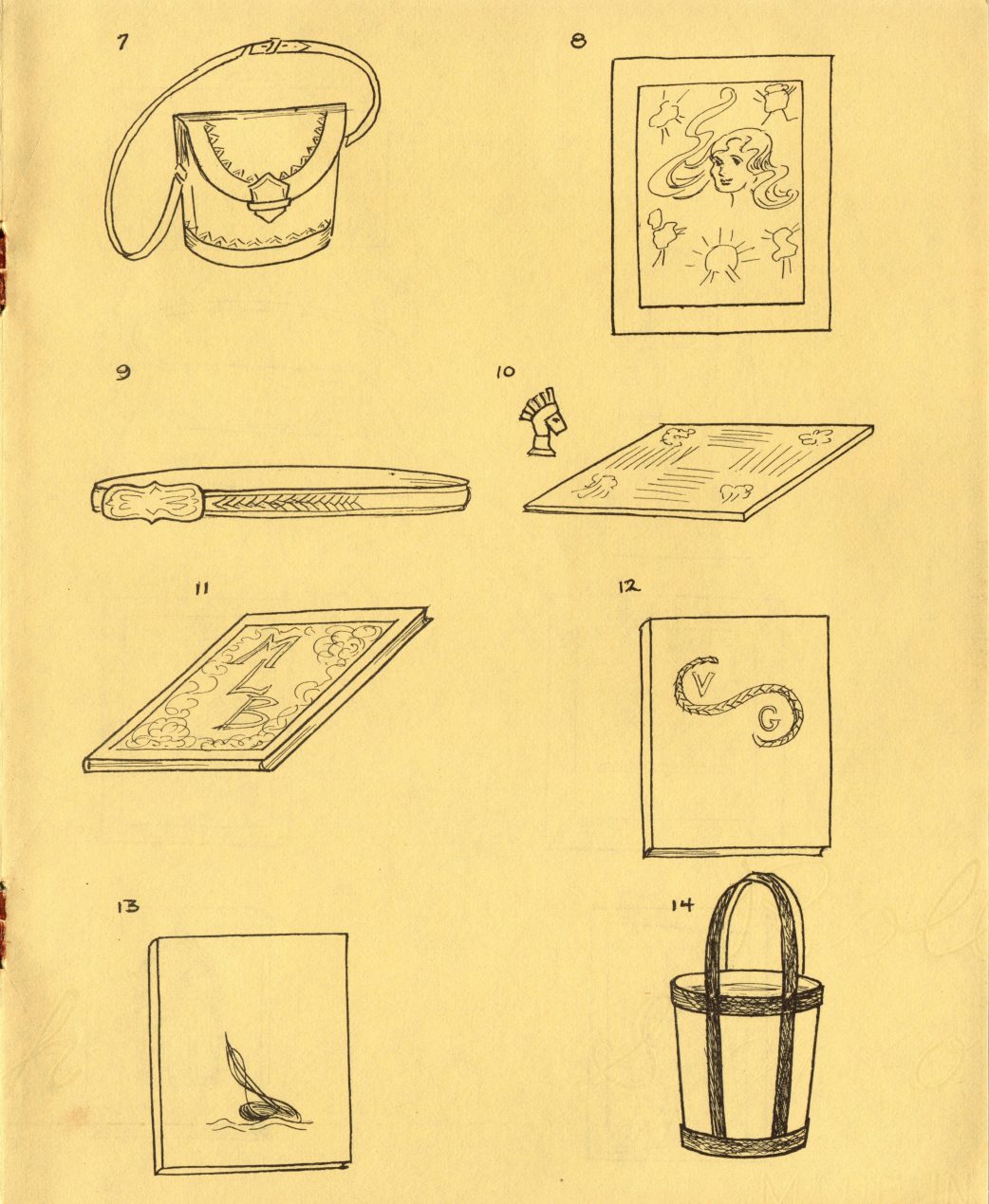
The four Honor Award pieces and the five Honorable Mention pieces are reviewed elsewhere in this issue. The numbers in this review refer to the sketches.
#10 Parchesi Board: Fairly large in natural leather, carefully carved, men about 2" high, somewhat like the "knights" in chess, small horse heads, with manes in different colored leathers. Something new and different - by Dorothy Slater,Michigan Leather Artisans.
#11 Book Cover: Large notebook, carved in western motif, with interlocked initials as central part of design. Excellent workmanship, initials beautifully wrought and decorative, but leather somewhat too cut up with over-all decoration. - by Marjorie Brown Frontier LeatherArt Guild, Buffalo.
#12 Book Cover: With raised braiding as only decoration enclosing two metal initials. Simplicity very appealing, clever use of braiding, large field of handsome leather. Excellent piece of work. - by Anthony Genco, Eastern Leathercraft Guild.
#13 Writing Case:Ship in abstract design, dark brown on a field of sea- foam green. Soft grey-blue color tones of entire cover deepening toward ship motif - graceful simplicity, beautiful calfskin, not too much decorated. - by Endel Ruberg, Montreal, CSCL.
#14 Tote Bag: "Feed Bag" shape, plain durable leather in mid and dark brown tones. Simple and functional utility bag, with excellent hand stitching. - by Nora Huyck, Toronto, CSCL.
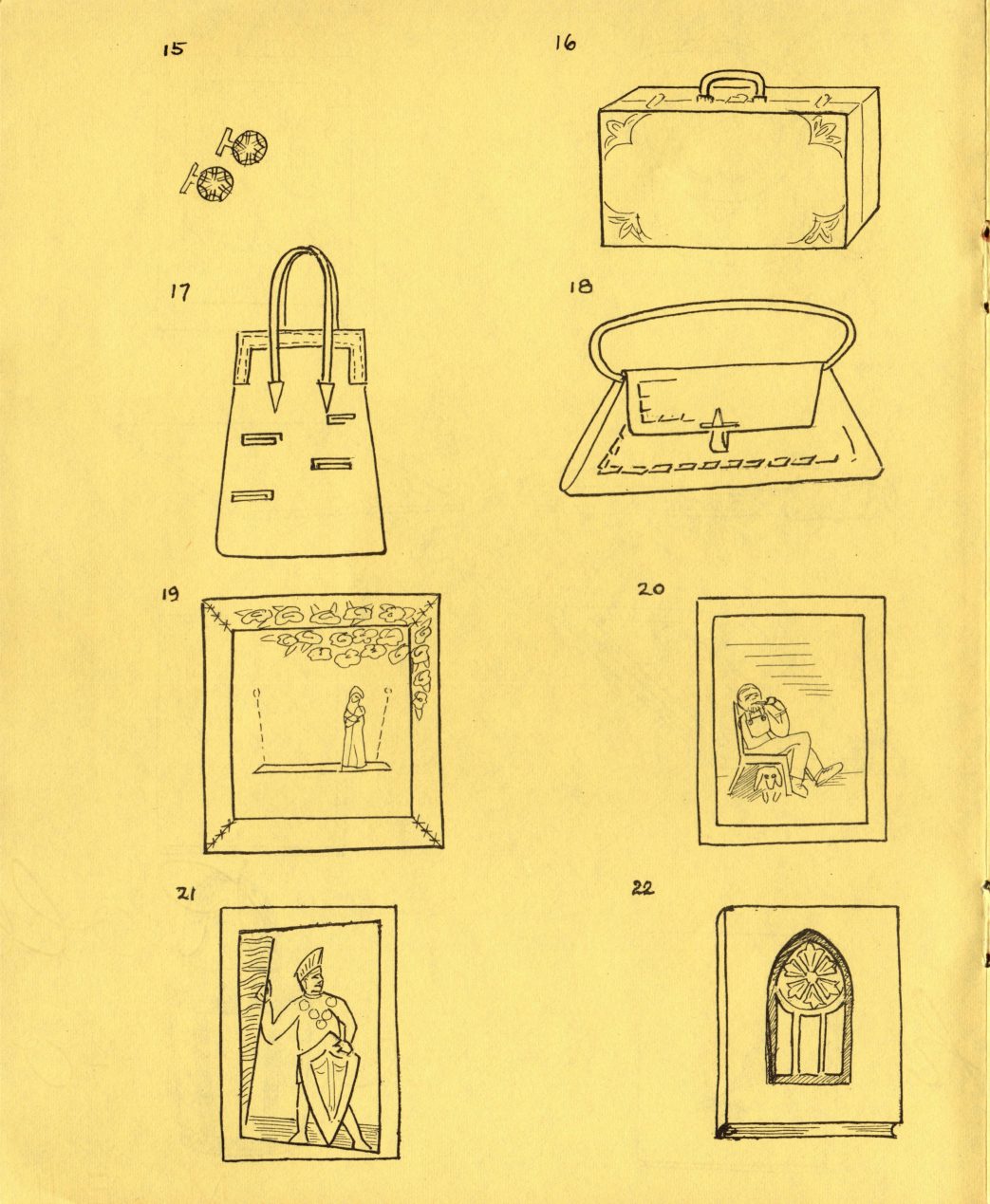
#15 Man's Cuff Links: Clever detailed work with good effect. Unusual use #15 of one stamping tool, with overlap impressions and carefully spaced. Small area of dark red lends interest around border. - by Fred Fischer, Frontier LeatherArt Guild.
#16 Overnight Case: with Fittings of Brush and Mirror - Light natural leather finish, with tooled corners in abstract design, matching design on mirror and brush backs, nicely finished inside with tan leather. - by Clarice Packham, Weston, CSCL.
#17 Large Rectangular Purse: with hard leather frame, splotches of brilliant color on abstract forms, giving the effect of copper enamel. Contemporary design, perhaps not too functional due to small opening and great depth of purse, but novel idea.
-- by Ruthmary Koegler
Page 8
7
[This page is a plate of quick sketches from the "SALON EXHIBIT REVIEW" (p. 7): p. 9 says they are "sketched very quickly from memory, and are not necessarily accurate... intended to give only a general impression." Each numbered sketch is described in the review's prose beginning p. 7. The plate carries sketches 7 to 14. Apart from those numbers the only lettering on the page is tooled into the pieces themselves: the book cover at 11 is monogrammed M L B, and the book at 12 V G. No name is printed on the page.]
Numbered sketches #7–14: a shoulder bag; a framed picture of a woman's head amid clouds and suns; a letter opener with braided handle; a tray with cloud/floral tooling; a book cover monogrammed "MLB"; a book cover monogrammed "V"/"G"; a book cover with a sailboat; a basket with a swing handle.
Page 9
These articles are sketched very quickly from memory, and are not necessarily accurate. They are intended to give only a general impression of the articles.
[This page is a plate of six pen-and-ink sketches numbered 1–6 only, illustrating the Salon Exhibit awards reviewed on p. 4: (1) Reta Larmour's handbag, (2) Robert Muma's leather binding of “Klee Wyck”, (3) Deane Russell's carved wastepaper basket, (4) Edith Roscoe's pine-cone glove box — the four Honor Awards — and (5) Richard Austin's tote bag, (6) Anthony Genco's braided-sleeve spirit bottle, the first two of the five Honorable Mentions. All six names and awards are given in full on page 4.]
Page 10
[This page is a plate of quick sketches from the "SALON EXHIBIT REVIEW" (p. 7): p. 9 says they are "sketched very quickly from memory, and are not necessarily accurate... intended to give only a general impression." Each numbered sketch is described in the review's prose beginning p. 13. The plate carries sketches 15 to 22. Apart from those numbers nothing on the page is lettered, and no name is printed on it.]
Numbered sketches #15–22: a pair of cufflinks; a small tooled suitcase or box; a tote bag with cut-out handles; a clutch purse; a framed picture of a robed figure (Madonna-like); a framed picture of a seated man reading, with a dog; a framed picture of an armoured knight with shield; a book cover with a gothic window motif.
Page 11
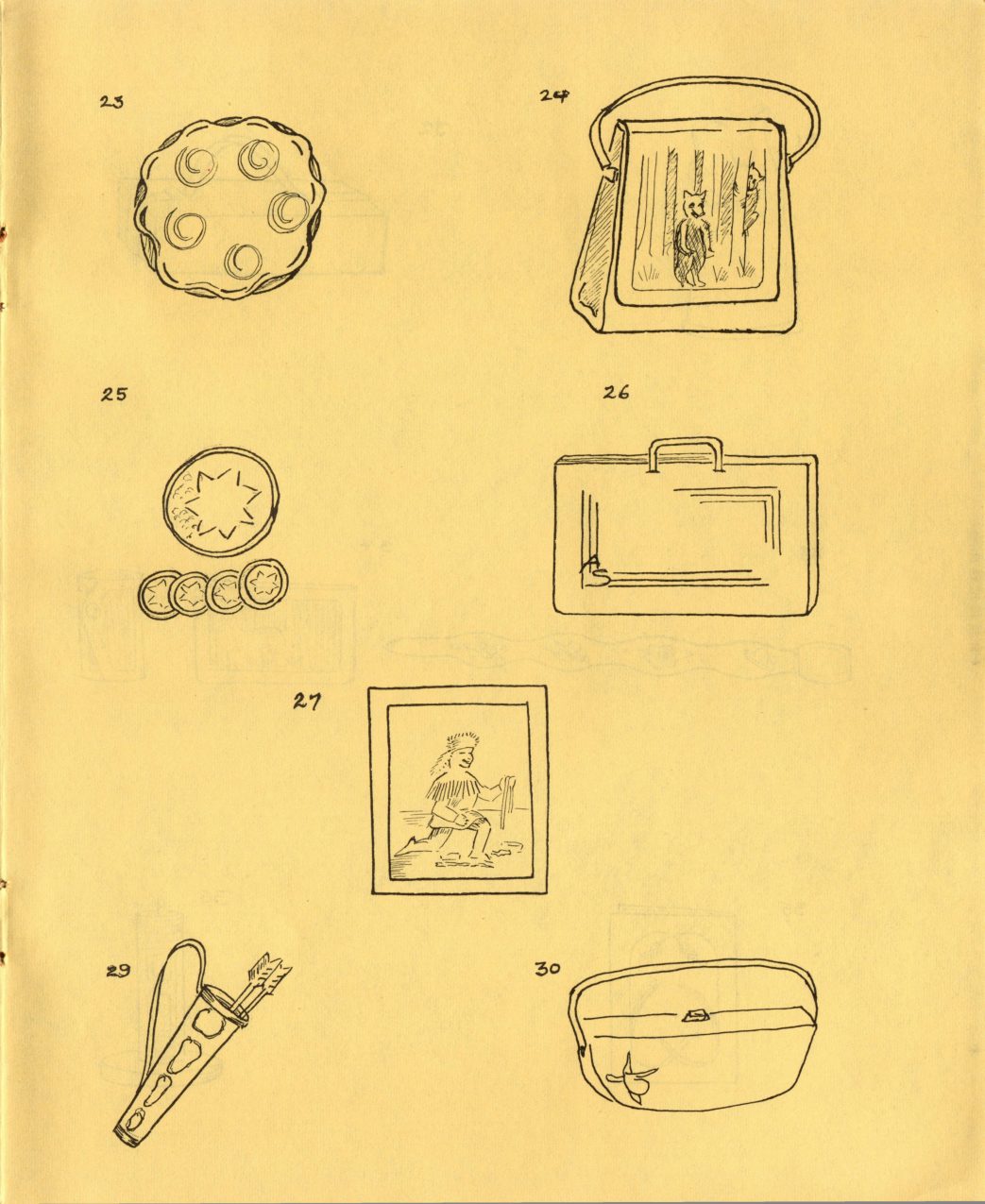
[This page is a plate of quick sketches from the "SALON EXHIBIT REVIEW" (p. 7): p. 9 says they are "sketched very quickly from memory, and are not necessarily accurate... intended to give only a general impression." Each numbered sketch is described in the review's prose beginning p. 13. The plate carries sketches 23, 24, 25, 26, 27, 29 and 30 — the sequence on this page skips 28. A small monogram is tooled into the corner of the case at 26; it is drawn too lightly to read letter by letter and is left unsettled here. No name is printed on the page.]
Numbered sketches #23–27, 29–30 (28 not sketched): a tooled disc with swirl motifs; a satchel with a fox and rabbit scene tooled inside the flap; a tooled disc with a star motif, with four coin-like discs beside it; a small case monogrammed "AS"; a framed picture of a running figure; a quiver with arrows; a rounded purse with a floral motif.
Page 12
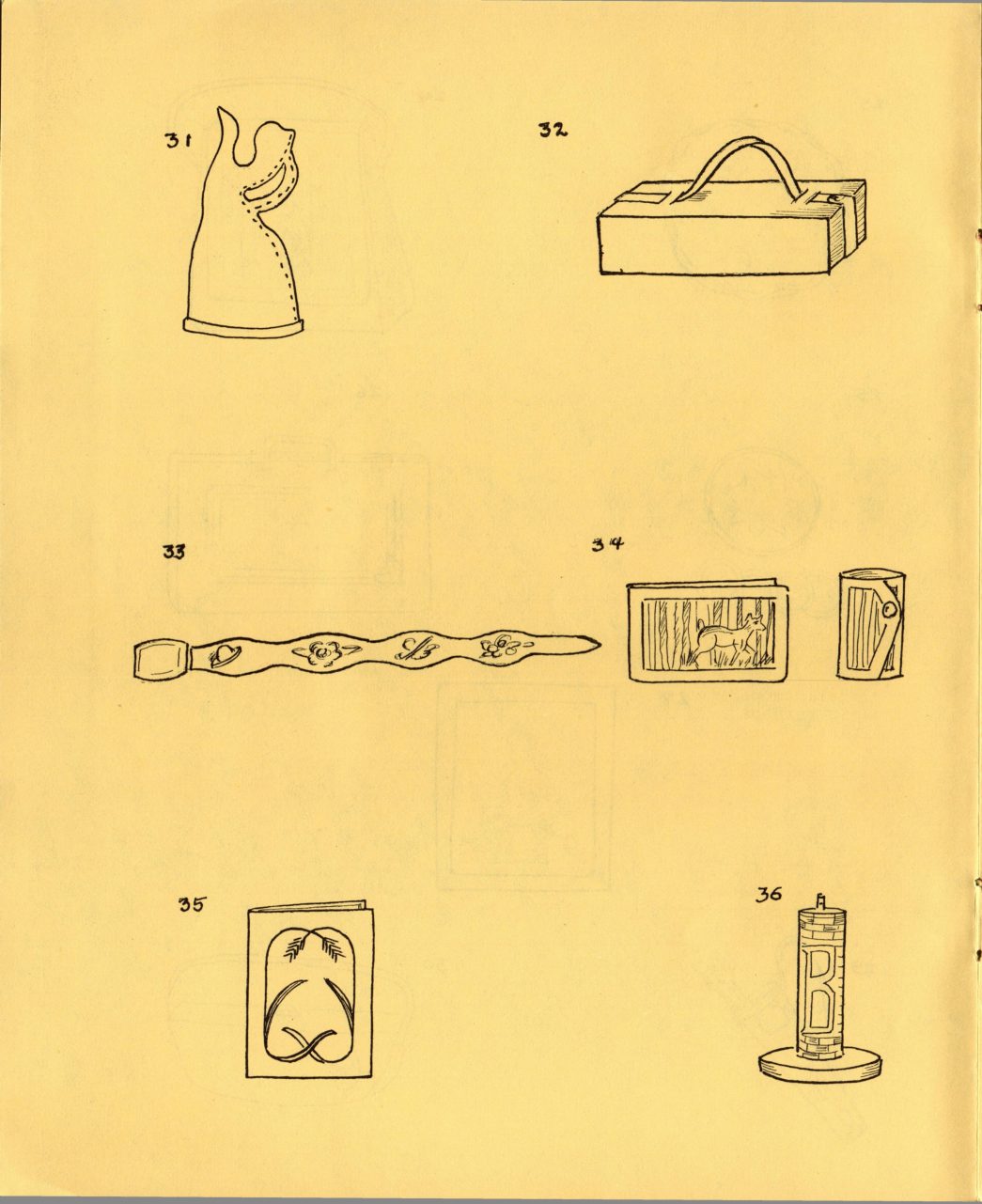
[This page is a plate of quick sketches from the "SALON EXHIBIT REVIEW" (p. 7): p. 9 says they are "sketched very quickly from memory, and are not necessarily accurate... intended to give only a general impression." Each numbered sketch is described in the review's prose beginning p. 13. The plate carries sketches 31 to 36. Apart from those numbers two of the pieces are lettered in the drawing: a script monogram along the belt at 33, too small to read letter by letter, and a bold B on the piece at 36. No name is printed on the page.]
Numbered sketches #31–36: a moulded bird or animal form; a small tooled box with a handle; a tooled bookmark or belt strip with floral motifs; a framed picture of a running deer, beside a small book with a tooled clasp; a book cover with a leaf/vine motif; a candle or vase monogrammed "B".
Page 13
#18 Handbag:Geometric motifs, unlined heavy leather, dark brown border stamping, bag in natural leather. Stamping not too even, and workmanship somewhat lacking in experience. Useful shape. - by Harvey Frick, Detroit Leathercrafters.
#19 "Madonna of the Flowers": Large Heavy Picture Frame, with profusion of brightly colored flowers, with small white plaster statue of Virgin on small shelf in centre. Fairly good workmanship and coloring, but over-decorated, and contrast of white plaster statue not so good with leather tones. A case where some other substance than leather might have been more suitable. Careful work shown in flower motifs. - by Ruby Dumanois, Flint Leathercraft Guild.
#20 Picture on Leather from Snapshot: Elderly gentleman in work clothes seated on chair, with dog beneath.
Good attempt at figure carving, but perspective might have been improved, and dark color tones surrounding dog should have been carried over into rest of background. Surface of leather perhaps too cut up and leathery quality lost. Fairly skilful use of tools apparent.
#21 Wall Plaque of "Hussar": An altogether outstanding and appealing piece of work, with strong impact, and good use of 3-dimensional relief. Color tones harmonious and beautiful, rich browns and verdigre green. Warrior stepping out of background with aggressive vigor, with feather banner blowing in the wind. Wonderful example of repousse technique, and work of master craftsman. - by Bernard Wolf, Detroit Leathercrafters.
#22 Hymn Book Cover:of black leather with filigree motif of stained glass window in Gothic design. Idea tremendously clever, but the brilliant flat colors rather too garish for the subject, and workmanship perhaps a little hurried. - by Mildred Scott, Michigan Leather artisans.
#23 Moulded Leather Tray, or wall plaque, in light leather color, with dark brown swirls, like finger-painting, as simple motif. Effective and pleasing, with edges well-finished. - by Clara Cavanagh, Barrie, Ont., CSCL.
#24 Large Dark Purse with Bear Design: The motif and dark coloring might be quite effective on a wall plaque, but not quite suitable for a handbag perhaps. Coloring is attractive and well done, but the construction perhaps a little hurried. - by Cora Barnaby, Frontier LeatherArt Guild.
#25 Coaster Set: Splatter dye technique - very pleasing green and brown harmony with natural leather motifs. Simple but effective decoration. - by Anne Hook, Toronto, CSCL.
#26 Small brief Case: in tan leather tones with initials worked into abstract design on corners, in darker brown tones,
Page 14
10
The whole effect of clever restrained simplicity, and good unbroken leather surfaces. Excellent workmanship. - by Anne Small, Toronto,CSCL
#27 Leather Picture, "The Trader": Excellent example of good figure carving - early Canadian trader dressed all in leather, presenting his trade goods. Clever color accents, and a subject very suitable to leather. Excellent in every way. Don MacKinnon, CSCL.
#28 Leather Picture, "Big Ned": Good workmanship and coloring, but perhaps somewhat out of proportion with frame. - by Bob Hartman, Detroit Leathercrafters.
#29 Hunting Quiver: Very interesting and colorful project in green and tan feather tones. Small motifs beautifully executed, with good carving technique, and interesting detail. Quite an undertaking and decidedly different. - by Harold Smith,Eastern Leathercraft.
#30 Box Handbag: with "Ladies Slipper" motif. Simple, functional good lines, easy access, good unbroken leathery surfaces, with pleasing dark color and good finish. - by Dorothy Muma, CSCL.
#31 Moulded Leather Jug: A new approach to an ancient craft. A utility article of heavy leather and careful workmanship
Moulded by hand. - by Robert Muma, CSCL
#32 Stamping Tool Box, for carrying leather tools to classes. Lightweight and convenient for its purpose. In natural leather tones, with initials cleverly executed. - by Waven Smith, Michigan.
#33 Sporting Belt: Large decorative belt, by a teenager, interesting and colorful novelty item for age group. Nicely finished and a new idea. - by Holly Patterson, Detroit Leathercrafters.
#34 Filigree Wallet and Keycase: Excellent example of careful filigree carving - muted blended color tones - perhaps question the use of so much filigree area on utility articles for wearing qualities, but an outstanding example of this type of work. - by Mrs. Alfred Wilkins, Buffalo.
#35 Guest Book, with "Wheat Motif": Simple pleasing treatment - good balanced design, soft suggested color, with clever play on artist's name "Wheaton". An excellent example of good bookbinding, and leather well used.- by Helen Wheaton, London, CSCL.
#36 Lamp Base, of "Basket Weave" decoration. Natural leather tones, with extremely large initial, which seems to overpower the lines of the lamp base. The project would perhaps have more appeal were the initial omitted- altogether, as the basket weave effect was sufficiently complicated. Workmanship good. - by Jean Brown, Eastern Leathercraft.
Page 15 — DEMONSTRATIONS AT THE ASSEMBLY; GUILD DISPLAYS AT THE ASSEMBLY
printed Page 11
DEMONSTRATIONS AT THE ASSEMBLY
Members of the Eastern Leathercraft Guild deserve great praise for the arrangements made for demonstrators and spectators. In the spacious rooms, tables were widely spaced on raised platforms and the two rows of chairs were placed for spectators. There was plenty of room for those who had to stand, so all could see in comfort.
There were 34 demonstrators, some working on Saturday and Sunday for periods of 1 to 14 hours. Feature demonstrations were given on the use of the air brush, Esthonian design and coloring, gold stamping and tooling, animal making, valise assembly, slipper making, bag designing, saddle stitching, picture frame covering, and many others. A new blue-grey color technique was shown by Endel Ruberg, using combined dilutions of Waterman's blue writing ink and ferrous sulphate. In demonstrating mocking up handbag patterns, Carol Ruflin used heavy leatherette paper, giving a perfect idea of how the finished bag would appear. New ideas for decorating leather were demonstrated by the use of linoleum and wood blocks and fancy buttons attached to wooden handles.
Paul Payne of Michigan Leather Artisans showed colored slides on the work of his students and explained his methods of teaching, chiefly by learning to "Think".
We hope that some of the demonstrations can be reviewed in the form of technical articles in later issues of "Canadian Leathercraft".
GUILD DISPLAYS AT THE ASSEMBLY
The general impression in the guild displays was more variety in articles submitted and general improvement in workmanship. Also noticeable was the increased enthusiasm.
The Eastern Leathercraft Guild display was shown in an original arrangement with pegboard on an easel and shelves with wrought iron brackets, giving a very portable display setup.
Detroit Leathercrafters' display featured a corner of a room with leather-covered chairs with needlepoint lacing on the back. Intricate use was made of drapes and tubing in a free form display.
Prairie States Floodlighted their display from behind a carved leather sign set in a frame. A number of pictures in leather dominated the setup.
Flint Leathercraft display indicated experimentation with new ideas in construction, but the overdecoration and strong colors were too much in evidence. A feature piece was a table with state flowers.
Frontier LeatherArt Guild showed a wide variety of articles in leather, from stuffed animals to a sequined fish, and table mat with crocheted edging.
CSCL this year divided its display into branch showings plus a section for members at large. This policy will be followed again in future showings.
Michigan Leather Artisans showed examples of wearing apparel such as hats, and a white leather coat.
Page 16 — GENERAL VIEW OF THE ASSEMBLY
12
GENERAL VIEW OF THE ASSEMBLY
The over-all program of the Assembly this year was such as to whet the appetites of leathercrafters present. The effect of the whole small hotel being given over to the Assembly for the weekend was one of closeness and friendliness.
Praise is due to the Eastern Leathercraft Guild for the very good arrangement and scheduling of demonstrations. Most appreciated by all present was the seating accommodation. Chairs were everywhere, and were especially welcomed in the demonstration areas, where they were placed in tiers so that everyone could have a good view of the demonstrator in comfort.
Another feature of the Assembly which added to its frinedliness was the social evening on the Friday. Guilds gathered Friday evening to set up their displays and afterwards all got together for a social time and viewing of the Salon exhibits on television.
All in all, the Assembly benefited greatly all those who were able to attend, and we look forward eagerly to the next Assembly, to be held in 1959, location to be announced later.
OUR 1957 CATALOGUE, FEATURING A COMPLETE LINE OF QUALITY LEATHERS, ACCESSORIES AND TOOLS -- PLUS A FULL RANGE OF ARTS AND CRAFTS SUPPLIES, WILL BE SENT WITHOUT CHARGE TO C.S.C.L. MEMBERS UPON REQUEST. WRITE FOR YOUR CATALOGUE TODAY: FOR HANDICRAFT IT'S LEWISCRAFT, 284 King Street, West, Toronto 2, Canada.