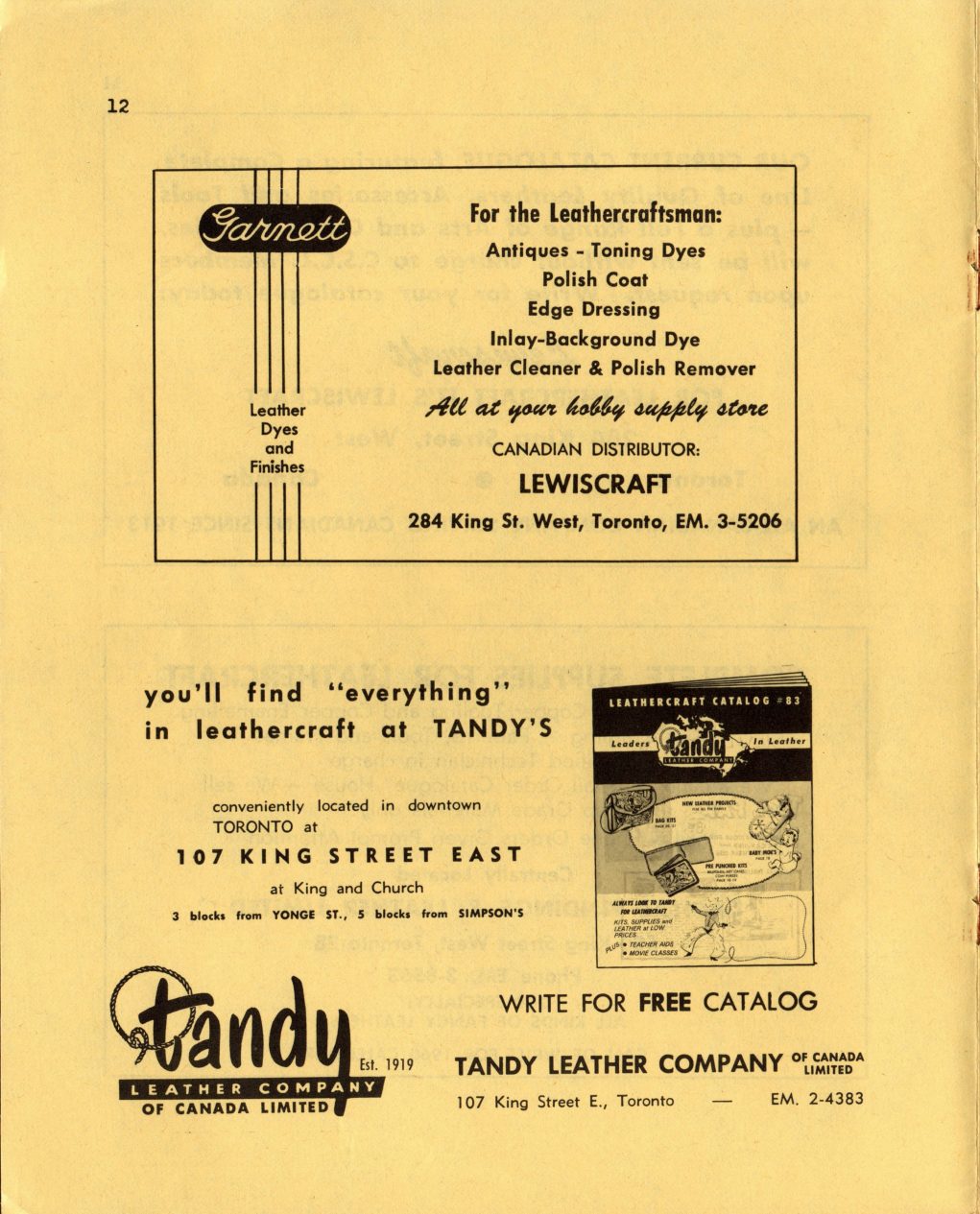
An issue of the Society’s newsletter, transcribed from the original.
(12 pages, 2.2 MB)
the full-resolution scan, 32 MB, for close research
Page 1 — HAND SEWING Part I
Canadian Leathercraft
Volume IX No. 1 Autumn, 1959
HAND SEWING
By Don MacKinnon
Part I
It is a sad commentary that we as Canadians find such a simple thing as the so-called saddle stitching such a terrific mystery. After all, it isn't so long ago that the practice of the shoemaker, cobbler and harness-maker were common knowledge and usually an awl and a wax end were part of the household equipment. However in these days of "tin-can cooks", mass produced clothing, canned music, etc., and the pressure of regimentation, such a homely virtue as doing for yourself could be lost sight of. The sturdiness of hand sewing could be thought out of place in the modern decor.
Hand stitching has a definite place in the view of the leathercrafter when at times it can be used to add just the right touch to finish off so many projects. Sizes of stitch and thread may be selected to "just suit" and add up where lacing leaves much to be desired. For the uninitiated, the following comments are offered.
Good hand sewing calls for good equipment. As in every other phase of leathercraft,there are particular tools and materials available to help give that professional touch to hand work. In this case the equipment is simple and inexpensive but very important.
SPACING OR OVERSTITCH WHEFL: Spacing wheels come in a number of sizes, each wheel making so many stitches to the inch. They range from No.4 (4 stitches to the inch) on up. To decide the most suitable number of stitches to the inch, take into account the size of the article, the weight of the leather and the weight of the thread. Larger articles as a rule require fewer stitches per inch and heavier thread. Be careful not to make your stitching holes too close together, as this weakens the leather. If you do not have a spacing wheel, holes may be marked with an awlpoint--using a ruler for measurement between holes, or with a pair of dividers, set at so many holes to the inch.
AWLS: A sabre-bladed harness-maker's awl is best for punching your stitching holes. It makes a diamond-shaped hole, and allows the
All material published in "Canadian Leathercraft" is the property of The Canadian Society of Creative Leathercraft, and may not be reprinted in any form without the written permission of the Society. Editor of "Canadian Leathercraft" is Mrs. Dorothy Muma, 118 Hazelton Avenue, Toronto 5, Ontario.
["Volume TX No.l" is set out here as "Volume IX No. 1". The "SPACING OR OVERSTITCH" heading is printed with its last word, "WHEFL:" — the Society's own slip for WHEEL, kept as printed — set out here rejoined to it rather than left with the paragraph that follows, which repeats it as "Wheel:"; set out as the one printed heading-and-sentence, "SPACING OR OVERSTITCH WHEFL: Spacing wheels...".]
Page 2
thread to lie properly, the leather to fit snugly and the hole to close up well. It comes in a variety of sizes, making holes suitable to the weight of the thread. The awl hole must always be large enough to allow the needle and thread to pass through with reasonable ease. The best awl handles may be obtained from the harness-maker's suppliers, and from some craft and shoe findings stores, or from the local harness-maker. The awl points may be gotten from some craft stores or shoe findings suppliers. Curved awls are useful to punch angled sewing edges. If the proper awl is not available, a regular awl may be used. On light weight leather, holes may be punched on a sewing machine, set for wide spacing, and hand sewn later.
NEEDLES: Harness-makers' needles, also obtainable at Harness-makers suppliers, some craft and shoe findings stores, are essential. The points are blunt, so they do not split the threads, and the eyes are constructed for easy threading..These also come in a number of sizes to suit the weight of the thread. Select a needle of a thickness slightly larger than the thread; for example, a 3-cord thread takes a needle about the thickness of a 4-cord thread.
In the past hog bristles were used in place of needles. As a substitute a thin wire bristle has been produced,which works reasonably well. These are used when both needles are put through the awl hole at the same time, and are also convenient when a curved awl has been used.
THREAD: Threads are of two types,machine thread and hand-laid thread. There is a real art in making the hand-laid thread, but the method is too difficult to describe in words and requires a number of illustrations. The technique is easily grasped in a demonstration.
Various weights of machine-made thread are available, which are made up of a certain number of cords of fine standard thread, such as 3-cord, composed of 3 strands, 4-cord, composed of 4 strands, etc.The thread is usually twisted counterclockwise,and some of it is pre-waxed. Select a thread suitable in thickness to the project to be sewn.
WAX: There are several types of wax for thread,but the most convenient and best is purified beeswax, which comes in a pressed cake form in a natural color. Threads should be well waxed before starting to sew, and also every so often while sewing,especially where the thread goes through the needle, or any other part which begins to fray.
STITCHING HORSE: Some apparatus for holding the article to be stitched is helpful. There are different types of stitching horses. Anything which can be devised to hold the article and leave the hands free for work makes for more rapid and easier manipulation. Your own knees may be found to be the handiest device.
THREADING THE NEEDLE: Even this simple operation can be improved by certain techniques. When using machine thread, fray out the ends with a blunt tool, wax well and roll to a point which will go through the eye of the needle. This is called a wax end.(See diagrams Page 11)
The needles can then be threaded in the ordinary way, but a method used by the old-time harness-makers locks the thread in the
Page 3
needle. To make this lock, slightly unravel your thread about three inches from the end. Between your thumb and forefinger, left hand, make a loop or sort of inverted U with this loosened section. The short end of the thread must be to the right. Place the point of the needle through the centre of the right hand thread,continuing through the centre of the left hand thread,closing the opening of the U. Push this U toward the eye of the needle,to about ¼" from the eye. Take the short end of the thread,put it through the eye of the needle not quite as far as it will go. Then take the needle in your left hand, the thread in your right hand, and jerk lightly to the right, pulling the two threads of the U over the eye of the needle, which will end up with the short end of the thread locked twice through the standing thread. The thread at the needle eye should be kept thoroughly waxed at all times. (See illustrations below).
1. Thread cut square
2. Fray end with dull Knife
3. Twist to point
4. Left Thumb — 2" to 2½"
5. Needle thru centre of threads. — 4¼"
6. Pointed end thru needle eye.
7. Take up Slack
8. Pull long end to Right over needle eye.
9. Double Lock completed. Pull →
The nine steps under the text are drawn and lettered by hand. The measurement beside step 5 is written 4¼" where the paragraph above it says ¼" from the eye; both are set out here as they appear.
To make clean, even stitches, special attention must be paid to the thread as the sewing progresses. Thread has a tendency to unravel, and to keep it tightly wound, develop the habit of giving the thread a half turn on the right hand needle at each stitch, in the direction in which the thread is twisted.
(Part II of this article, dealing with actual stitching and the finishing of the edges, will appear in the next issue.)
The above article is reprinted from a previous issue.
Page 4 — TRIBUTE
TRIBUTE
by Jean Newton F.C.S.C.L.
The Society wishes to recognize the meritorious service,beyond the call of duty, of its outstanding members, and it was thought fitting that this recognition should be in the form of a written tribute.
It was the happy year of 1950 when a group of leathercrafters put the Society of Creative Leathercraft into action, our founder members worked hard and long to make it a great success. We owe them deep gratitude.
Robert Louis Stevenson wrote:-
"Gratitude is but a lame sentiment, thanks, when they are expressed are often more embarrassing than welcome."
These words might have been written especially for one of our outstanding founder members, MRS. RETA LARMOUR.
Through these pages we offer to you our deep respect and appreciation for all your labours of love for the Society.
Serving as secretary during the first two years of the society's inception, then as chairman of travelling exhibitions from 1952 to 1955, and ever since as a very member of the executive.
With all her work behind the scenes it is astounding how she found the time to do all the excellent work in leathercraft, which won awards in exhibitions in Vancouver, London, Ottawa, Montreal, Toronto and Rochester, adding prestige to the Society.
At home or at public functions her warm friendliness, dignity and charm make the occasion a very pleasant one for all present.
The years of steadfast loyalty along with wise counsel is a shining example to all the members, and we look forward to many more happy years with you to guide us.
With heart and voice we toast you,
TO RETA "NULLI SECUNDUS"
DID YOU KNOW? "In the 17th Century fashionable Englishmen gave their sweethearts rings of leather cut from the fingers of heavy gloves!" (Life, June 18, 1951)
Page 5 — SCHOLARSHIP FOR ROBERT MUMA
SCHOLARSHIP FOR ROBERT MUMA
by Anne Hook F.C.S.C.L.
Sincere congratulations to Bob Muma on winning the first scholarship, value $500, awarded by the Women's Committee of the Canadian Handicrafts Guild to a craftsman.
At this committee's Annual Meeting held on October 29th 1959, the special business was the presenting of this new award. The Selection Committee was as follows -- Mr. Sydney Watson, Lady Flavelle, Mrs. Chalmers, Mrs. Weldon, Mrs. O. D. Vaughan. Five applications were received, one from each craft. It was announced that the award was won by Robert Muma, Leathercraft. At this point, the President, Mrs. Marriott electrified the meeting by stating that she had been authorized to announce that a further $500.00 had been donated anonymously, to be added to this year's scholarship, thus making the 1959 scholarship now $1,000.00 in value. She then introduced Mr. Sydney Watson, President of the Ontario College of Art, who presented the award.
In presenting the scholarship to Mr. Muma, Mr. Watson spoke of the excellent and admirable attitude of this craftsman, and of his very serious intention to avail himself of further study. His earlier work was not as important as the trend which now shows. His recent work is exciting! Most impressive are the photographs of this recent work -- two Hydro-Electric books - Cornwall -two pound books for the Queen. Other commissions include books for the Ukraine and Israel.
Mr. Muma is a Canadian, born in Coldstream Ontario; a Charter member and Fellow of C.S.C.L. His career began in taxidermy. He then got into the binding of books, and leathercraft, with variety in leathers. His interest in book-binding is serious--both hand-binding and commercial. His intention is to further his knowledge, and skill in this subject. Much difficulty has been encountered in finding a place to make this study, For financial reasons it has to be done on this side of the water. Columbia University, New York, presents the most interesting possibility for classes during April-May,1960. This is acceptable to the Committee, but a tremendous amount of detail through correspondence remains to be worked out.
Robert Muma accepted the award in his usual gracious manner. He expressed himself as completely overwhelmed by this added award. He is both humble, and proud to receive this first award of the Women's Committee. He feels that he is accepting the gift to help revive a dormant part of our culture. He congratulated the Committee on having its fingers on the pulse of the changing times and
Page 6 — WORKSHOP TIPS
recognizing that this is the opportune time to give this reviving craft a shot in the arm.
He then proceeded to give a brief history of book-binding. When man began to communicate, he started with pictures, later he advanced to words. The earliest form of books were tablets of clay, then skins, then parchment. A typical scroll was shown then a folded form. Later the fold was cut, and the pieces tied with rawhide thongs. Eventually came paper, and the printing press. Early bound books were very lavish. Later came cloth binding, and now, leather is special. Book binding is a very exclusive market, and the work the very best which the craftsman can do. Gold leaf, applied to leather, is a very difficult skill. 1 cubic inch of gold is beaten into a sheet 100 x 35 feet, and is 1/300,000 of an inch thick. The gold leaf is applied to the finished bound book with heated tools. Gold leaf on the edges of books is burnished with polished agate and bloodstone.
Books have been described as the tombs of dead men. Bob prefers to think of them as monuments to great minds. The bibliophile's enjoyment is 3-fold - besides reading the book, even the blind can enjoy, by feeling; and the appearance can be a thing of beauty. And what of the future of book-binding and books? Books are a means of communication, and preservation of ideas. The horse is out; the auto is nearly so. As one thing outlives its use something else takes over. We communicate now through telephone, telegraph, radio, television, electronic recording and microfilm. Nothing takes the place of books to revere the past. Illuminated addresses and presentations will always be an opportunity for the bookbinder. The libraries and publishers report that television has actually increased reading and a demand for books.
A display of books was on hand illustrating the cased and bound books (books are more durable, bound on cords.) In conclusion Bob assured the meeting that he will try to make the committee as happy as he is, that he got the award.
WORKSHOP TIPS
Have you tried using pipe cleaners for spreading latex leather cement? A 5¢ package provides up to 60 cement spreading tips!
Simply bend end at right angle, dip into cement and spread on leather. Clip off used ends and fresh tip will be ready for next project; good for fine cement tipping to one-inch spreading. Try pipe cleaners also for edge waxes and edge dyes.
[A stray "<" before "A 5¢ package" is left out here; it is not printed text. The rest of the page (book-binding history, workshop tips) is set out exactly as printed.]
Page 7 — C.N.E. WINNERS; CANADIAN HANDICRAFTS GUILD COMPETITIONS
C.N.E. WINNERS
CANADIAN HANDICRAFTS GUILD COMPETITIONS
The winning by Endel Ruberg of the British American Oil Company's Special Award for: Outstanding entry, featuring "Canadian" design or motif, in Ceramics, Leather, Metal, Weaving, Hooking, or Wood carving, makes it the first time this prize has been won by a leather craftsman.
SPECIAL AWARD for: — WINNER — DONOR — AWARD
Outstanding entry, featuring "Canadian" design or motif, in Ceramics, Leather, Metal, Weaving, Hooking, or Wood Carving. — Endel Ruberg, Montreal, P.Q. — British American Oil Co. Ltd. — $100.
Best Leather Entry — Mrs. Sadie Roebuck, Tor. — F.W. Woolworth Co. Ltd. — $50.
Honorable Mention — Mrs. Jean Newton, Tor.
Decorated Leather — Gunars Buss, Toronto — Clarke & Clarke Leathers — 1st $25.
Mrs. Anne Hook, Tor. — 2nd $15.
Undecorated Leather — Miss Olivia Smith, Tor. — Lewiscraft — 1st $25.
Mrs. Gladys Miles, Tor. — 2nd $15
Honorable Mention — Endel Ruberg, Montreal
Honorable Mention — Mrs. Nora Huych
Handcrafted Leather with no more than 20% area of decoration. — Mrs. Nora Huych — Women's Committee, Can. Handicrafts Guild (Ont.) — $25
Honorable Mention — Mrs. Nina Wilson
Any Leather article of original design, but winner must never have won a major Canadian prize before. — Mrs. Jean Newton — President's Prize, Can. Handicrafts Guild (Ont.) — $25.
Best use of coloring techniques. — Endel Ruberg, Montreal — Garnett Co., Tor. — $25.
Honorable Mention — Gunnar Buss, Toronto
Most original entry, new approach to Leathercraft. — Mrs. Daphne Lingwood, Caledon East, Ontario. — Anonymous — $40.
Honorable mention — Endel Ruberg, Montreal.
[This page is a four-column table — class, winner, donor, award. Two spellings on this page differ from the rest of the archive and are left as the Society printed them: Mrs. Nora Huych, who is Nora Huyck elsewhere in these pages and in the Summer 1959 issue, and Gunnar Buss in the colouring class, who is Gunars Buss in the decorated-leather class four lines above and everywhere else.]
Page 8 — CORRECTION; C.S.C.L. EXECUTIVE
CORRECTION
In the last Bulletin, the illustrations for the article on "Braiding on Belts" were inadvertently left unfinished. Herewith are the illustrations as they should have appeared:
[DIAGRAM I: two lines, each showing a row of stitching holes (dashes) beside a double line labelled "edge creaser" — the two ways of setting a hole row against the edge-creaser line. DIAGRAM II, "1 Thong": a one-thong braid, four strands (C, B, F, H) crossing to four points (A, D, E, G), shown as "Right side of Belt" and, alongside, an unmarked "Wrong side of Belt" (two plain vertical lines). DIAGRAM III, "3 Thong": a three-thong braid, six strands (numbered 1-6, headed A B C) crossing to six points (lettered a-f), again with its "Right side of Belt" braid pattern and an unmarked "Wrong side of Belt". DIAGRAM IV, "5 Thong": a five-thong braid, seven strands (numbered 1-7, headed A B C D E) crossing to seven points (lettered a-g), same pairing. These are diagrams, not text; the disconnected letters, dashes and fragments a straight reading of the page would otherwise produce (such as “Right size of Belt” for “Right side of Belt”) are replaced here with this description. The diagrams themselves are not reproduced.]
C.S.C.L. EXECUTIVE
President: Fred Brown, 9 Nashland Avenue, Islington, Ontario.
Vice President: Harold Wilson, 400 Charlton Ave. W., Hamilton.
Treasurer: Mrs. Gladys Miles, 573 Greenwood Ave., Toronto 6, Ont.
Corresponding Secretary: Miss Viola Harris, 47 Snowdon Ave., Tor.
Recording Secretary: Mrs. Dorothea Sirman, 71 Sherwood Ave., Tor.
Page 9 — WHAT IS GOOD LEATHER?
WHAT IS GOOD LEATHER?
[Printed "WHAT IS GOOD LEATHER?"; the space before "LEATHER" fused into an underscore, the same fault seen on other all-caps titles across the archive.]
In an age dominated by plastics and synthetic materials of every kind, our standards for judging traditional materials such as wood, cloth and leather can be distorted slowly but surely by the different standards of these new materials. Where once ruled the craftsman's and connoisseur's eye for warmth of texture, subtlety and blending, variety of colour and live feel, the mass produced tests of characterless uniformity, brightness and smoothness swamped everything.
The tanner had to be more and more apologetic for having blemishes and other natural variations on his leather. His line of least resistance was to follow the fashion by making his leather as much like the synthetic materials as possible. He did this by buffing off, that is sand-papering, the grain surfaces of the leather and applying a heavy coat of opaque plastic finish.
But there is a better answer to synthetic dominated taste than this defeatist one. Anyone who takes pride in making or working leather should also be proud of its natural qualities,including blemishes,and do his best to show the general public too that these are the things that make leather so distinctive and interesting to have around us in our clothing, furnishing and personal goods. Some of these natural qualities are:
1) ROUNDNESS -- Good leather has a springy, lively full feeling when you bend it in the palm of your hand.
2) MELLOWNESs -- No matter how firm leather is made, it will still have some of the stretch and flexibility which give it a mellow quality.
3) GRAIN --The hair pores which cover the grain side of unbuffed leather lend a subtle variety of texture unique in leather. 4) STRENGTH -- Natural fibres properly lubricated with leather oils will give good leather more strength after long use and age than almost any competing material.
5) "SILKY" FEEL--Gentle tanning and processing will give leather a low, even grain and hence a smooth feel even on fairly dry leather.
6) SCRATCHES -- From thorn and fence wire. Some makers of excellent quality leather goods have been wise enough to capitalize on the distinctively natural pattern of healed scratches on leather. This has been a good selling point in
Page 10 — BRANCH MEETINGS
Rawhide luggage, for instance, where manufacturers of synthetic materials have tried to duplicate the scratches, with only moderate success, by special embossing plates.
7) COLOUR VARIATION -- The very best of leather, unless it is coated with artificial sealer or finish, will have colour shadings because of the varying openness of grain in different areas of every hide. As long as this is a natural shading of colour, it can be used as another mark of distinction of good leather over substitutes.
Many of the other blemishes common to leather, such as too pronounced neck and fat wrinkles, brands and a few open cuts are more common on the best plump mellow sides from a beef breed of cattle than on a poorer hide. They should be regarded only as a loss in cutting area, and will be so graded down in price by the tanners.
(The above article was reprinted from Volume I, Number 2. Written by John Stewart of Wicket & Craig.)
BRANCH MEETINGS
LONDON - Meets 1st Friday of the month at 100 Grand Avenue. President, Mrs. D.V. Carroll, 185 Gammage St.
HAMILTON - Meets 2nd Thursday of the month at Wesley Community Centre, John & Rebecca Sts. President, Mr. Harold E. Wilson, 400 Charlton Ave. W.
TORONTO - Meets 3rd Friday of the month at WoodGreen Community
Centre, 835 Queen Street E. President, Mr. Richard Sirman, 71 Sherwood Ave. I married a wife who was filled with charm. She could cook and sew; she could even darn. Now my sox all heel-less and toe-less sit While she to a leathercraft meeting does flit. She was bit, and bit hard, by that leathercraft bug And I am just the big fat lug
Who drives her here and Gripes her there -- To judge the leathercraft at the Fair --
To meet with the President and Councillors -- To do battle in the Craftaid Wars.
You say you get paid for doodads like that? Now where's that leathercraft beginner's book at?
["poorer: hice" is set out here as "poorer hide"; "John >thwart" as "John Stewart". Branch meeting listings and closing poem are set out exactly as printed.]
Page 11
Lewiscraft
Our current catalogue, featuring a complete line of quality leathers, accessories and tools — plus a full range of arts and crafts supplies — will be sent without charge to C.S.C.L. members upon request. Write for your catalogue today: "For Leathercraft It's Lewiscraft", 284 King Street West, Toronto, Canada. An all-Canadian company serving Canadians since 1913.
Capital Findings & Leather Limited
Complete supplies for leathercraft. Aluminum etching, copper tooling and copper enamelling. Purse framing — patterns, tools and frames. Qualified technician in charge. We are not a "mail order catalogue" house — we sell top grade materials only. Mail and phone orders given prompt attention. Centrally located.
Capital Findings & Leather Limited, 580 King Street West, Toronto 2B. Phone EM. 3-8563. Our specialty: all kinds of fancy leathers. Call or write for 1960 calendar.
[Previously marked "This page carries advertisements; not transcribed." Now set out in full: two advertisements (Lewiscraft; Capital Findings & Leather Limited). No names on this page.]
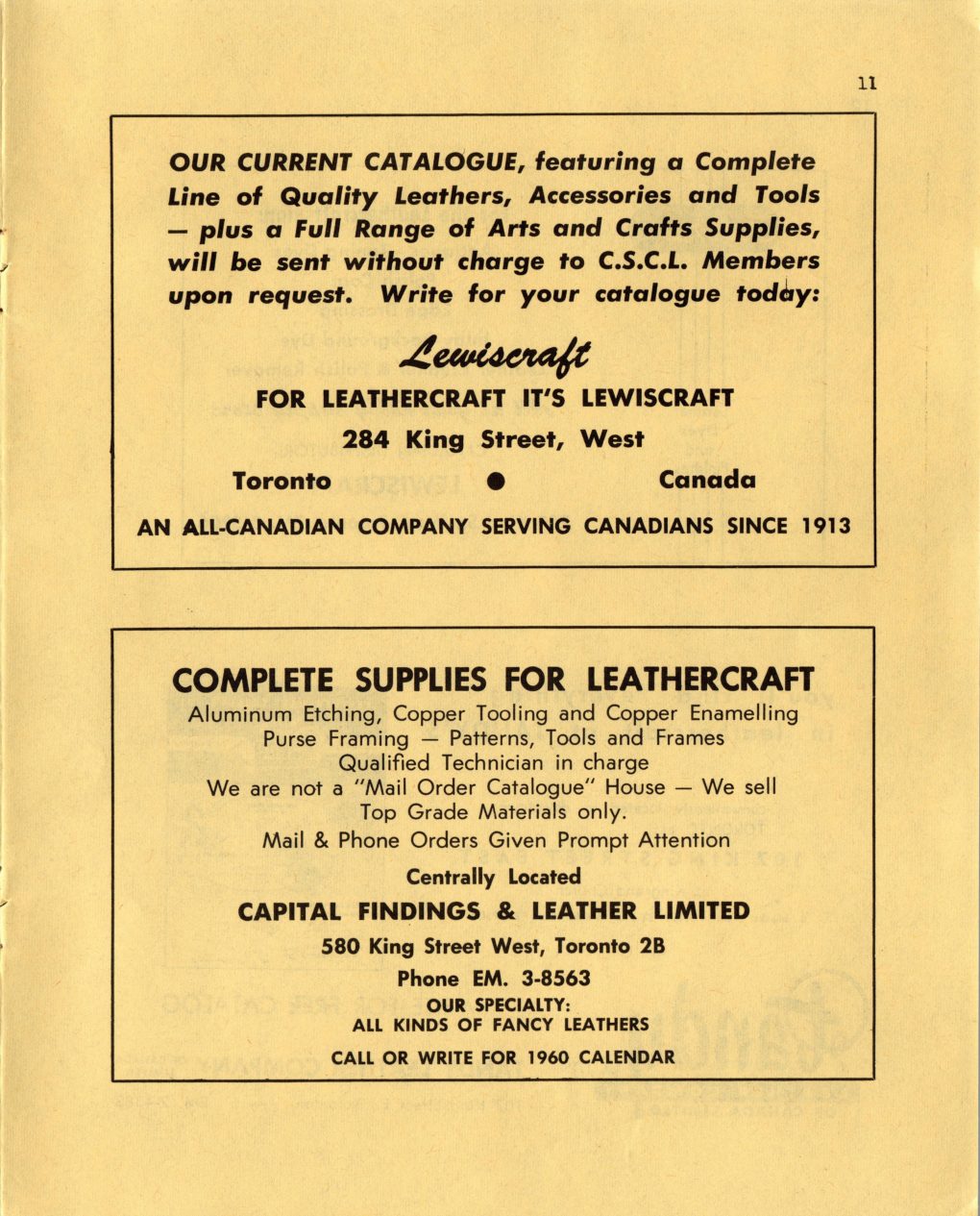
Page 12
Garnett
For the leathercraftsman: Antiques, Toning Dyes, Polish Coat, Edge Dressing, Inlay-Background Dye, Leather Cleaner & Polish Remover, Leather Dyes and Finishes — all at your hobby supply store.
Canadian distributor: Lewiscraft, 284 King St. West, Toronto, EM. 3-5206. Leathercraft Catalog $.35.
Tandy Leather Company
You'll find "everything" in leathercraft at Tandy's, conveniently located in downtown Toronto, 107 King Street East, at King and Church, 3 blocks from Yonge St., 5 blocks from Simpson's. Write for free catalog.
Est. 1919. Tandy Leather Company of Canada, 107 King Street E., Toronto — EM. 2-4383.
[Previously marked "This page carries advertisements; not transcribed." Now set out in full: two advertisements (Garnett leather dyes, distributed by Lewiscraft; Tandy Leather Company). No names on this page.]