
An issue of the Society’s newsletter, transcribed from the original.
(12 pages, 2.0 MB)
the full-resolution scan, 31 MB, for close research
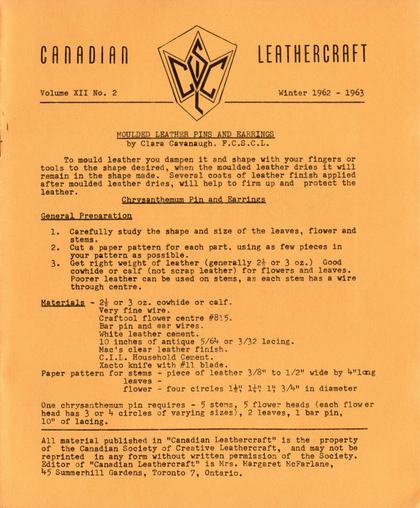
Page 1 — MOULDED LEATHER PINS AND EARRINGS
CANADIAN LEATHERCRAFT
Volume XII No. 2 Winter 1962 - 1963
MOULDED LEATHER PINS AND EARRINGS by Clara Cavanaugh. F.C.S.C.L.
To mould leather you dampen it and shape with your fingers or tools to the shape desired, when the moulded leather dries it will remain in the shape made. Several coats of leather finish applied after moulded leather dries, will help to firm up and protect the leather.
Chrysanthemum Pin and Earrings
1. Carefully study the shape and size of the leaves, flower and stems.
2. Cut a paper pattern for each part, using as few pieces in your pattern as possible.
3. Get right weight of leather (generally 2 1/2 or 3 oz.) Good cowhide or calf (not scrap leather) for flowers and leaves. Poorer leather can be used on stems, as each stem has a wire through centre.
Materials - 2 1/2 or 3 oz. cowhide or calf.
Very fine wire.
Craftool flower centre #815.
Bar pin and ear wires.
White leather cement.
10 inches of antique 5/64 or 3/32 lacing. Mac's clear leather finish.
C.I.L. Household Cement.
Xacto knife with #11 blade.
Paper pattern for stems - piece of leather 3/8" to 1/2" wide by 4" long. Leaves - flower - four circles 1 1/2" 1 1/4" 1" 3/4" in diameter
One chrysanthemum pin requires - 5 stems, 5 flower heads (each flower head has 3 or 4 circles of varying sizes), 2 leaves, 1 bar pin, 10" of Lacing.
All material published in "Canadian Leathercraft" is the property of the Canadian Society of Creative Leathercraft, and may not be reprinted in any form without written permission of the Society. Editor of "Canadian Leathercraft" is Mrs. Margaret McFarlane,
45 Summerhill Gardens, Toronto 7, Ontario.
The stems line’s measurement, 4" long., and the leaves line below it, which carries no measurement of its own, are separate lines on the page.
Page 2
One pair of chrysanthemum earrings requires - 1 flower head for each earring (each flower head has 3 circles), 1 pair ear wires. Method
2 leaves 6 circles 1 1/4" diameter
5 stems 7 circles 1" diameter
3 circles 1 1/2" diameter 7 circles 3/4" diameter
One flower head - five flower heads for corsage.
A B
12
i
A & B same
D& E same
One pair of earrings -
"Qne" is corrected to "One" — a Q/O mix-up common in this typeface. The surrounding pattern-piece lettering (A/B/C, X/W) is a diagram key that is only partly legible even close up, and is left as transcribed here, not resolved further.
X & W same
2. Skive about 1/8" of flesh side of circles.
Skive stems very thin (edges paper thin).
Page 3
3. Find centre of each circle, with this in mind cut slits to edge of circle. (On 1 1/2" circle slits should be approximately 3/16" apart (F) and on 3/4" circle slits should be approximately 1/8" apart at outside edge (G)
4, Cut the corners of each petal as in fig. 1. Circle should look like fig. 2 when all corners cut off.
5. With sharp knife make a very shallow slit down each petal as in fig. 3.
6. Dampen flower centres and pinch petals. Petals will pinch into shape easily on account of slit in centre of each petal. Stamp small circle with flower centre #815.
7. Slightly dampen stems. Put a coat of white cement on flesh side of stem, then lay a piece of wire along edge of stem and roll leather over wire, keep rolling until stem is formed. Wipe stem with damp cloth to remove any cement on outside of leather.
8. Dampen leaves, cut in veins.
9. Let all parts dry.
10. Give leaves, stems and flower circles at least 3 coats of Mac's clear.
How_to Make Flower Cluster
Sandpaper centre of circles, top and bottom, except top of 1" circles and bottom of largest circle. then cement circles together
Page 4 — ERRATUM
as in A BCD E and X and W except small circle which goes on after stem is put through flower head. Punch hole through centre of flower head.
Joining Stem to Flower Head
Make 2 slits 3/8" long in one end of stem.
Bend these 3/8" pieces open.
Pull stem down through hole in flower head. Cement 3/8" pieces (at end of stem) to flower head, then cement small circle to flower head. (Now stem and flower are joined together)
Stem (side view) slits 3/8" long
end view slits
Final Assembly
Arrange flowers to form corsage. Cement leaves to back of stems (where suitable). Cement bar pin on back of one stem. Cement one end of lacing under barpin. Wrap lacing around flower stems and bar pin. (This holds bar pin and stem together)
Trim stems to suitable lengths.
Put at least 1 or 2 coats of Mac's clear on corsage.
Earrings
Sandpaper and cement flower circles X and W together. Cement flower head X and W to ear wires with C.I.L. cement. When thoroughly dry apply 2 coats of Mac's clear.
ERRATUM
In our last bulletin. on page 3, under Prize List, Canadian Handicrafts Guild Division of the C.N.E. it was erroneously printed that the prize for Undecorated Leather was given by an anonymous donor. We regret this error. It is well known that this prize has been donated by LEWISCRAFT for many years and they have always given their help, co-operation and support to the Society. The prize should have been listed as follows:- UNDECORATED LEATHER, con- 1st $25 C.N. Mrs. Sadie Roebuck trasting leathers, lacing, (Purse) stitching, colouring, etc. 2nd $15 C.N. Miss Clarice Packham Donated by; (Gloves)
Lewiscraft, Toronto.
The instruction “Bend these 3/8" pieces open.” sits beside a hand-drawn diagram of the bent stem-end, labelled in cursive “open” and “stem”; the diagram’s labels are not transcribed. The ERRATUM table corrects the prize list in the previous, Fall 1962 issue, which had named the Undecorated Leather donor as anonymous; it was Lewiscraft.
Page 5 — EARLY HISTORY OF TANNING
EARLY HISTORY OF TANNING.
Compiled by Viola Harris A.C.S.C.L.
The wonderful tanning, taking, currying and finishing processes of the present day are the slow growth of centuries, and the production of leathers of the modern quality and variety is the culmination of years of study by practical tanners and by chemists.
Probably the original process of curing skins was that of simply cleaning and drying. Then, the use of smoke sour milk and various oils, and the brains of the animals themselves was found to improve the texture of the leather. The North American Indians prepared their skins in a liquor consisting of animal brains and water and smoked them over a fire of decayed wood, and it produced avery serviceable leather. Later it was discovered that certain astringent barks and vegetables effected permanent changes in the texture of skins, and stopped decay.
This knowledge was possessed by the ancient Egyptians for engravings on their tombs depict the process of tanning. In the Berlin Museum there is a granite carving supposed to be at least four thousand years old, which portrays Egyptian leather dressers at work. One of these men is seen employed at a tub, another taking a tiger skin from a pit while the third is working a skin at a table. At Cairo Museum is preserved the funeral tent of Queen Isi Em Kleb - 1100 B.C. - which is described as a remarkable mosaic of leather work, consisting of pieces of gazelle hide of several colours, stitched together. The British Museum includes in its egyptian collection a leather workman's apron, leather shoes and sandals of various types, and several rolls of prepared leather, all of which passed through the hands of the tanner from two thousand to three thousand years ago. Clearly the Egyptians had developed to a remarkable degree the art not only of tanning, but of finishing leather. Similarly there is evidence that tanning was well developed in most of the ancient civilizations, from Babylon in the West to China in the East, though the Egyptian artisans seem to have reached a particularly high state of efficiency and artistry.
In China specimens of leather have been discovered in company with other relics that prove them to be over three thousand years old.
To the early tanners, we have a great sense of gratitude for it was their craftmanship which provided the pages on which history is recorded, in our libraries. Almost universally stone tablets were displaced by parchment manufactured from the skins of animals, and the obvious advantages of this new writing material gave a great impetus to the recording of human thoughts and achievements. Hereodotus "The Father of History" writing in the fifth century, 5.C. pays tribute to the rolls of imported papyrus so largely used by the Ionic Greeks. Upon several of these parchments, which have been preserved
“Queen Isi Em Kleb” is printed exactly so in the Society’s own typescript — a period transliteration of the Egyptian queen usually spelled Isiemkheb today — and is left as printed.
Page 6 — C.S.C.L. ANNUAL MEETING
through the ages, we find references to the existence of the tanning and allied industries. It is recorded the ancient Libyans wore leather clothing and in the time of Alexander, the inhabitants used the hides of animals for clothing, and covered their dwellings with leather. And incredible as it may seem to us, the early ships of most of the seafaring peoples of the world were made of prepared animal hides stretched on wooden frames. The Phoenicians especially employed this type of vessel.
The Romans used leather which they tanned with oil, alum and bark. Roman Senators had two types of shoes, one for summer, and one for winter, the latter "were made of an entire black skin, or sometimes a white one, reaching up to cover the greater part of the leg, with no open space, except at the top". Obviously much was known in Rome of the technique of finishing leather or these colours could not have been produced.
The effect of the "fall of the Roman Empire" upon the art of tanning was no less calamitous than upon the arts of civilization in general, and a gap of three hundred years intervened between the "Sack of Rome", in 410 A.D. and the reappearance in Europe of a highly developed tanning industry.
C.S.C.L. ANNUAL MEETING
This is being held at Woodgreen Community Centre, $35 Queen
Street East, on Saturday, April 6th, 1963. Your Executive are anxious that members will have at least one article on display there.
What demonstrations would you particularly like to have included in the programme? Have you worked up a new item or technique you would be willing to demonstrate at this meeting. Our programme can only be as good as you help to make it. Mrs. Jean Newton, 612 Huron St., Toronto 5, Ont. is in charge of the programme and will welcome your help or suggestions.
Inter Branch Competition - The Weston Trophy, we trust, will be strongly competed for again this year. For general information, and rules and regulations, please refer to Vol. XI No. <, Page 5. we hope some of the general members are considering applying for ASSOCIATE membership and some of the Associates will be trying for FELLOWS. If you are, please write Mrs. Nora Huyck, R.R. #3, Newmarket, Ont. for application form and particulars. Requirements are fully set out in Vol.
Page 7 — CANADIAN HANDICRAFT GUILD; NINTH INTERNATIONAL ASSEMBLY OF LEATHERCRAFTSMEN
CANADIAN HANDICRAFT GUILD
The Canadian Handicraft Guild is doubling the size of its store very shortly. They will be able to stock more crafts. If you have a saleable item, preferably one which can be reproduced in quantity you might contact Mrs. Lex Hanson, Shop Manager,Canadian Handicraft Guild, 77 Bloor St. W., Toronto, 5. As they do not handle items on consignment, they will buy them outright, if suitable. Their markup is usually 50%.
The Women's Committee, once more, has available a scholarship of Five Hundred Dollars for a professional Ontario craftsman wishing to improve his, or her, technique and design through study and work in a recognized school, or studio. The applicant shall have attained professional status in his or her field, or shall give proof of intention to proceed to a professional career in their chosen craft. If no suitable applicant applies within the membership of the Affiliated Craft Organizations, this opportunity will be offered to any professional Ontario craftsman who can meet the conditions. Application forms are available from Mrs. F.G. Marriott, 195 Poplar Plains Road, Toronto 7, Ontario.
NINTH INTERNATIONAL ASSEMBLY OF LEATHERCRAFTSMEN
This is being held May 3rd to 5th at the Manger Hotel,ROCHESTER,
New York. Registration for assembly and hotel may be made by writing Mrs. Frederick M. Lutz, 1433 Long Pond Road, Rochester 15, N.Y. Forms we hope, will be available at our Annual Meeting.
What demonstrations would you like included in the programme? Your Executive feel that Canada should offer at least nine Demonstrators, and we need offers and suggestions from you. Demonstrations should last about one hour, but this is flexible. Demonstrators are to prepare themselves with the necessary materials, tools and paraphernalia for their particular demonstration. Marble pieces will be furnished where needed.
A Slide presentation on Saturday evening of previous International shows is being planned. If you have such slides and could loan them for this showing, it is suggested that one person from each group be delegated to be responsible for the collection and return of these slides. The slides need not be sent prior to International time, and will be returned to the responsible person shortly after their showing.
And do not forget to bring your very best work for this exhibition. We hope for an excellent display by Canadians in Rochester.
Page 8 — ORGANIZATION OF FELLOWS and ASSOCIATES
ORGANIZATION OF FELLOWS and ASSOCIATES
A meeting was called of the Associates and Fellows, in January,
1962 by Mrs. Nora Huyck, Chairman of the Council of Fellows, to discuss the formation of a new group, within the Canadian Society of Creative Leathercraft.
The Society, as presently organized, is on the basis of Regional Groups, members at large, and Associate and Fellows. The Constitution provides that the Fellows and Associates could form a Professional members' group. At that time there were sixteen Fellows and thirty-eight Associates from which to draw membership for such a group.
There existed in the minds of those who founded the Society the need of this specialized group within the organization, to develop the craft, share ideas in a workshop, and obtain constructive criticism of one's efforts,-all to create good workmanship. The chief aim of such a group could beto establish in Canada good leathercraft.
Too, if this unit was interesting enough, and closed to Fellows and Associates, it would be an incentive to members to work towards obtaining their professional standing.
It was agreed that such a group be formed,- to meet together a few times during the year to discuss problems of common interest, current activities, and that each member of the group should attempt to have at least one new article on display each year at the Annual Meeting. This is not a requirement of membership in the group, but amoral obligation.
There is no formal Executive, and meetings are conducted by the Chairman of the Council of Fellows. Like the Branches of C.S.C.L., it will include only those who want to belong; and like the Branches, finance its own activities. The fee set is One Dollar per member and twelve Fellows and twenty-three Associates have joined.
During the first year we have met six times, and have had an average attendance of eighteen. There is very keen interest. Meetings are lively and loquacious. Such subjects as marketing crafts;types of articles most readily saleable; workshop tips; kinds of tools available; methods of finishing edges, etc.; leather, old and new; have been discussed.
At our last meeting several members asked for opinions on the pieces they were entering in the Ontario Souvenir and Handcraft Competition and Exhibition at the National Gift Show, Feb. 18th to 21st, 1963-in Toronto. These entries are being made, not so much as to compete, as to place leather items before the Gift Trade. Construction problems, methods, and general appeal made for quite lively discussion and constructive criticism.
[A stray underscore is not part of the printed text: "much as_ to" is set out here as "much as to".]
Page 9 — MAKING A PERSONAL CLOCK
MAKING A PERSONAL CLOCK by Janis Zalitis, F.C.S.C.L.
The one important item in everybody's daily life is the precious timepiece - watch or clock. There are hundreds of shapes and sizes but very few made in leather. Here is an opportunity for leathercraftsmen to make for themselves a personal table or wall clock in leather. Why not make it a thing of beauty and a joy to see every day. First to start with is the movement, then to decide the form and size.
It could be triangle, square, hexagon, round, or any shape that suits your taste.
It is much simpler with the wall clock. The table clock needs a base. The movement could be obtained from the watchmaker or factory. The price will depend upon size and quality but in any case it will be much lower than a new clock.
The form could be cut out of wood. For the dial base a piece of plastic, aluminium or other non-rusting metal. The covering technique is the same as covering wooden or cardboard boxes. Natural light cowhide (12 0z.), goat, or English morocco can be used. The design is your personal taste and choice.
Here is my project, finished last spring.
I started with the movement from an 8 inch' electric wall clock.
The form is cut out of 3/4 inch poplar plywood and the base is maple.
Dial is with natural tooling calf (2% oz.), front and top of the base 1# oz.
natural tooling cowhide. Split cowhide for the underside of the base and the back of the clock.
Colouring was done with a Binks air brush, and white leather cement for cementing. The whole clock was then finished with Garnet Polish coat.
A small hand-drawn illustration stands beside this sentence — a row of shape sketches, including a triangle enclosing a clock face.
Page 10 — SPRAY COLOURING WITH AN AIRBRUSH
SPRAY COLOURING WITH AN AIRBRUSH
By Janis Zalitis, F.C.S.C.L.
Using an airbrush for leather colouring is much easier, safe and handier than other atomizers. I have used Binks "Wren" airbrush for a year quite successfully.
Model "A" is suitable for fine line and detail using light medium fluids and for colours thinned with alcohol or water. Complete outfit with air can, valve, 6 ft. of hose with connection and 1/4, 3/4 and 2 1/2 oz. colour bottles was $35.00. The air can supplies power to spray about 1 pint of colour. The airbrush could be easily fitted to a small air compressor and then the cost of power will be much less than using air cans.
Operating the airbrush is very simple. Hold the brush between the thumb and second finger,using the fore-finger to open and close the bypass to make the airbrush operate. The nozzle is adjustable for fine spray and opening full for covering larger areas.
Be sure to clean the airbrush thoroughly before putting it away. After colouring rinse out the colour bottles with the thinner (water or alcohol). Then put more thinner in the jar and spray through the nozzle.
ONTARIO SOUVENIR AND HANDCRAFT COMPETITION AND EXHIBITION This competition has drawn province-wide interest with more than 2,500 requests for entry forms received to date.
Thor Hansen, a leading authority on Canadiana, will chair the judging panel of five in this forthcoming competition sponsored by the Ontario Government. The panel represents industry, consumers, design and handicraft arts with Mrs. Brechin, Toronto,representing the Consumers' Association of Canada; Sid Bersudsky, President of a Toronto firm of industrial designers, and authority on quantity produced articles; C.A. Pollock, Kitchener, President of the Canadian Manufacturers Association; and Harold Burnham, Toronto, President, Canadian Handicraft Guild.
-A display of winning articles for the $1,500 in prizes will be exhibited at the National Gift Show in Toronto, February 18th to 21st.
In our social system any popular activity spawns a club. Clubs lead to Associations. Combined they serve as a framework to encompass a full exchange of ideas and provide a source of criticism, mutual appreciation and provision of standards acceptable to the craft which they serve.
Page 11 — THE CHRISTMAS SALE; BARRIE BRANCH
THE CHRISTMAS SALE
The eighth Annual Christmas Sale was held in October from noon
Wednesday October 24th, until 5:30 p.m.Saturday, October 27th, 1962, at the Canadian Handicraft Guild, 77 Bloor Street West, Toronto.
Due to the alarming world conditions, the unseasonable weather, and probably the fact that the public had not yet caught the Christmas spirit, the results of the sale were not quite as gratifying as last year. However, we were pleased to note an increase in the number of members participating. Thirty-two members submitted articles for sale or display.We missed the usual fine display from New Brunswick this year,but still had the support of our members from Nova Scotia.
It was noted that the calibre of the workmanship and the variety of articles for sale was quite good. There were many handbags and small articles but there could have been more articles in the medium size range and more unusual and original articles.
The new Entry Forms were invaluable and the convener and her committee wish to thank the participating members for their cooperation in listing and tagging their own work.
The C.S.C.L. greatly appreciates the fine cooperation given by Canadian Handicrafts Guild. Mr. MacKell and the Guild staff helped us in every way possible, including the arranging of an effective window display.
The Exhibition Convener also wishes to express sincere thanks to Miss Rita Holman and the twenty other members who assisted with the work during the Sale.
As we enter 1963, we should all remember that it is now time to start creating new leather articles of distinction for the ninth C.S.C.L. Sale next fall. Irva Ford, F.C.S.C.L.
(Exhibition, Convener)
BARRIE BRANCH
Barrie Branch is having a very active year with members displaying articles at exhibitions and fairs. The Branch now have their own identification pin choosing the shield and the rose, the rose being the chosen flower of Barrie.
Recently, the Hamilton Guild was host to the group at a buffet supper with Clara Cavanagh demonstrating lamp assembly and May Corbett demonstrating a purse-size notebook. Those attending thoroughly enjoyed the day's activities.
The 'Tuesday Nighters"are now meeting at the Central Collegiate and are taking extra instruction in figure carving.
Page 12 — THE HOCKLEY VALLEY SCHOOL OF FINE ARTS AND CRAFTS
THE HOCKLEY VALLEY SCHOOL OF FINE ARTS AND CRAFTS will hold its first summer session, for a four week period, in the summer of 1963.
Courses are planned in the following subjects:-
CERAMICS FASHION DESIGN FOLK MUSIC AND DANCING LEATHERWORK PAINTING METALWORK AND JEWELRY SCULPTURE THEATRE WEAVING
Courses in other subjects will be arranged where there is sufficient demand. Lectures in the History and Appreciation of Art will be open to students from all courses.
All courses are open to local residents, but it is expected that the majority of students will come from Toronto, Hamilton and other large cities. Accommodation for students and for class-rooms will be in ski lodges, private homes, motels, hotels and other buildings in the Valley and surrounding areas.
A brochure will be mailed shortly to organizations and persons throughout Canada and the United States. The School Calendar will be published soon and will give details of all courses.
We are pleased to have you come in and choose from our wide selection of Quality Leathers and Accessories. If not convenient, phone or write:
284 King Street West
Toronto 2B, Canada
EMpire 3-5206
AN ALL-CANADIAN COMPANY SERVING CANADIANS SINCE 1913