
An issue of the Society’s newsletter, transcribed from the original.
(12 pages, 2.2 MB)
the full-resolution scan, 34 MB, for close research
Page 1 — REMARKS BY PRESIDENT-ELECT - VIOLA HARRIS
Canadian Leathercraft
Volume XII No. 3 Spring, 1963
REMARKS BY PRESIDENT-ELECT - VIOLA HARRIS
Annual Meeting, April 6th, 1963
Ladies and Gentlemen,may I say how much I appreciate the honour you have conferred upon me. I know the presidency carries with it a great deal of responsibility, and entails considerable work. I shall accept the responsibility cheerfully, and discharge the duties willingly. I thank you for your confidence, and shall do all in my power to justify your judgment.
I wish here to express my, and I am certain your, sincere appreciation to Harold Wilson who so ably filled the Presidency the past two years. Harold carried on the last six months, when - he really was not well enough to do so. I am sure we all miss him today, and it is my sincere wish that we will still have a long and close association with him. We can always profit from his direction and advice.
And now just a word as to the coming year. You have elected a strong Executive, and I shall lean on them heavily. With the 10th International Assembly being held in Toronto, the support of every member will be sought. And you can best serve your Society by demanding a high standard of your own work. It is said "Every man is worth just so much as the things are worth with which he busies himself." Everyone has individual talent, but he can give expression to it only through initiative, enterprise and daring to try. Let us all work very hard toward an excellent show at the 10th International Assembly.
All material published in "Canadian Leathercraft" is the property of the Canadian Society of Creative Leathercraft, and may not be reprinted in any form without the written permission of the Society.
Editor of "Canadian Leathercraft" is Mrs. Margaret McFarlane, 45 Summerhill Gardens, Toronto 7, Ontario.
The heading of this address reads REMARKS BY PRESIDENT-ELECT - VIOLA HARRIS, Viola Harris being the Society's President for 1963. The copyright notice ends with the word "Society."; the line below it is a separate printed sentence naming the Editor.
Page 2 — THIRTEENTH ANNUAL MEETING; LUNCHEON SPEAKER
THIRTEENTH ANNUAL MEETING
This year the 13th Annual Meeting of the C.S.C.L. was again held at WoodGreen Community Centre, Queen Street, Toronto.
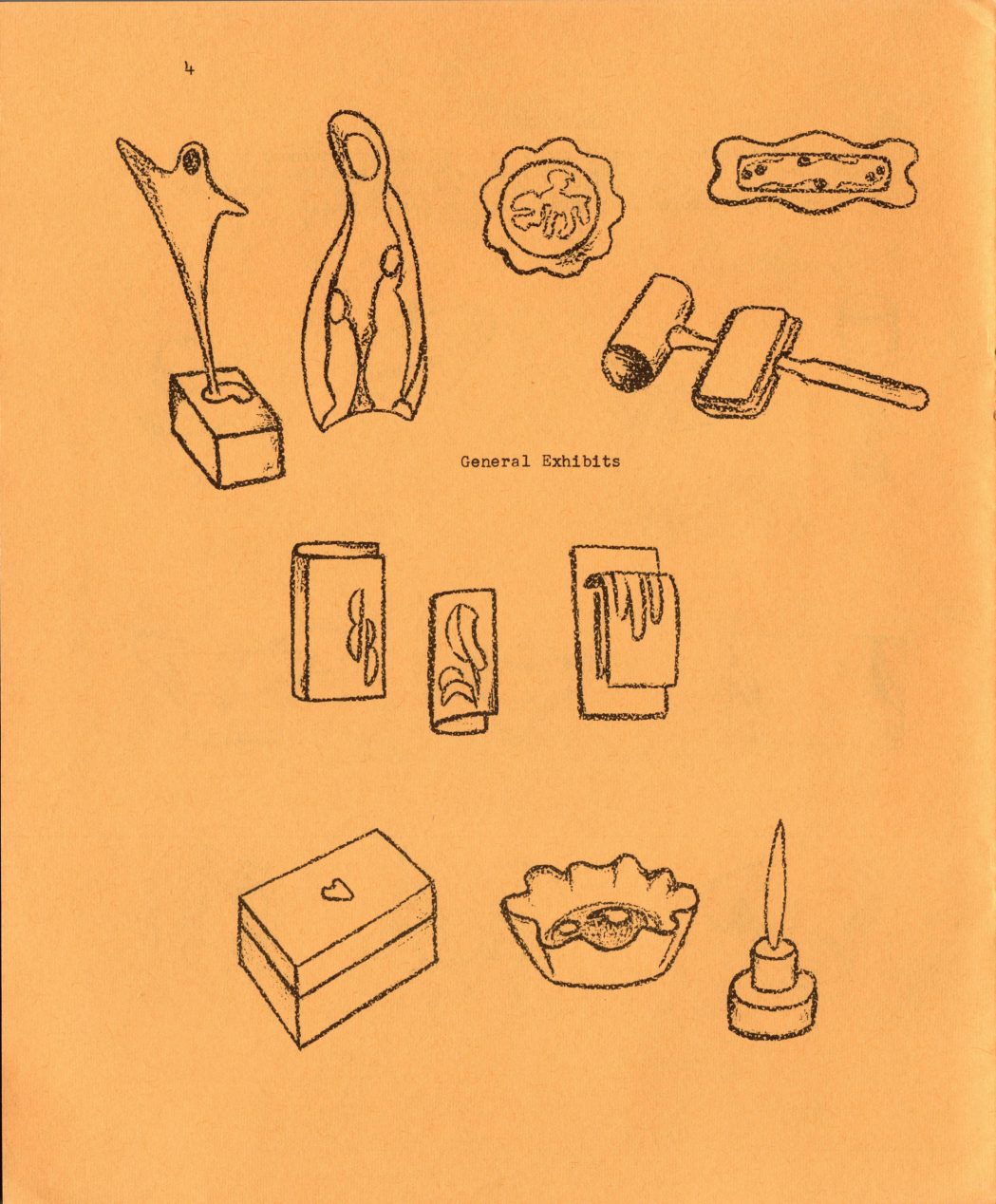
It is most encouraging to see the decided improvement each year in design and workmanship and the venturing into new items and ideas which verifies our belief in the versatility of leather. On the following pages are Anne Hook's sketches of items on display.
WESTON TROPHY: Congratulations are extended for the second successive year to BARRIE Branch who won the trophy which was presented by Dr. R.K. Larmour. Three Branches, Barrie, Hamilton and Toronto competed with all scoring higher than 85% which is very good indeed.
CANADIAN HANDICRAFTS GUILD: The Guild are again sponsoring their customany exhibition at the Stratford
Shakespearean Festival and the competition and exhibition at the CNE.
There were approximately 50,000 visitors at Stratford last year and as you know the C.N.E. had over 3,000,000 visitors, so these exhibitions and competitions are excellent places to bring the best of Canadian craftsmanship before the great number of people who come from the United States and Canada.
QUESTION BOX: This year the questions came thick and fast. From time to time they will appear in the bulletin.
LUNCHEON SPEAKER
Mr. Thor Hansen, Vice-President of the Canadian Handicrafts
Guild and well-known authority on Canadiana was our luncheon speaker this year. He told us we had improved greatly since he first spoke to us at Ryerson institute several years ago, but we still could do better.
Mr. Hansen reviewed the recent Ontario Souvenir Competition and how it was judged,and told us details and described articles decided on by the judges. We were glad to hear him state our belief too, that there was not enough time given to craftsmen to have items ready for the competition. The Government has said there may be another competition next year and we hope that with the experience of this year that it will be organized sooner.
Mr. Hansen also gave us some very interesting highlights of his visit north to Eskimo communities inPovungnetuk and Cape Dorset. He said that Eskimos are sculptors in their own right. The women do the drawings for skin prints and silk screen and the men do the work. They are a very happy people. Clocks and watches are not used for time pieces but as status symbols and they are looking for and use the white men's goods. Altogether an informative, amusing and enlightening speech.
cont'd
The heading of the trophy paragraph is set WESTON TROPHY, underlined. Thor Hansen is described as a well-known authority on Canadiana. "inPovungnetuk" (Povungnituk) and the lower-case "Ryerson institute" are printed as they stand.
Page 3 — DEMONSTRATIONS
The three branch-table sketches are captioned on one line each, the two words spread across the row of drawings ("Hamilton … Branch"). No names beyond the six demonstrators already named.
DEMONSTRATIONS
Interesting demonstrations were given in the afternoon by Clara Cavanagh on Jewellery; Jessie Little on Belts; Isobel Mair on Picture Frames; Sadie Roebuck on Desk Sets (stacked sole leather); Alvin Haig on Morocco Billfolds and Janis Zalitis on Spray Dyeing.
Barrie Branch
Toronto Branch
Hamilton Branch
Page 4
General Exhibits
[This page is a plate of pen-and-ink sketches of assorted leathercraft pieces — two carved figures, a medallion, a tray or buckle, a mallet, a wallet, a small box, a bowl and a candle holder — with "General Exhibits" set among the drawings. No individual captions or names are printed.]
Page 5 — ANNUAL BRANCH REPORTS - 1962/63
ANNUAL BRANCH REPORTS - 1962/63
BARRIE BRANCH continues to meet on the last Wednesday of each month at the residence of Mrs. May Corbett. During 1962-63 we had ten regular meetings and three executive meetings.
We have a membership of 23, with an average attendance of 14. This year the members were very grieved in the passing of Herm Tomlinson in September and Daisy Carruthers in January.
In June we again enjoyed a steak barbecue at the home of Helen Anderson, Longford Mills where the crazy hat contest and activity planned by Mrs. Barry resulted in "fun for all".
Demonstrations were given by Fred Brown, May Corbett, Nora Huyck, Hilda Darbyshire and Norma Barry. Our projects included note pads, covering boxes, leather jewellery and hats.
Five members obtained Associate Standing and we are proud to report the winning of the Weston Trophy in 1962.
The "Tuesday Nighters" transferred to the night school to take figure carving.
Three members demonstrated at the International in Detroit,and two at the C.N.E., Toronto. Five members assisted at the Canadian Handicrafts sale of leathercraft in Toronto.
Respectfully submitted - Del Jacombs, Secretary
HAMILTON BRANCH had eight regular meetings during the year with an average attendance of 28, and 6 executive meetings. Members from our group attended both the Annual Meeting in Toronto, and the International Assembly in Detroit. Two of our members demonstrated at the International. and of the six Canadians who were awarded Salon Ribbons, three of these so honoured were from the Hamilton group, namely, Mrs. Irva Ford, Mr. Frank Torry, and Alvin Haig. Our group had several articles selected for the "request display" which was sent to the Pacific National Exhibition. We sent exhibits to the Guelph Creative Arts Association in February; to Glenhyrst in Brantford from December 1st to December 27th; to the Hamilton Handicraft Guild for an exhibit at McMaster University in February and to the Alice Peck Gallery in Burlington in September.
Demonstrators from our group participated in the "Demonstration and Sale" outdoor meetings held in the summer at both Westdale and the Greater Shopping Centre in East Hamilton. A very successful
Workshop was held during the summer months. On Saturday afternoon and evening, November 3, 1962 our Branch was host to the London and Barrie Branches at a very successful Workshop. A pot luck supper served by our group was much appreciated.
Page 6 — CHRISTMAS SALE
During this past year we have given assistance to "The Special Class" at one of our local schools. Our donation of leather and some tools was gratefully received and acknowledged. Our Exhibitions Convener, Mrs. Ford, had charge of the Sale of work in Toronto, as well as the Sale of leather sponsored by the Hamilton Handicraft Guild in Hamilton. Under the kindly direction of our Chairman, Frank Torry, our Branch held regular meetings of a high calibre. Our Programme Convener, Clarence Redman, presented varied and stimulating programmes which were well received, and were most helpful to all of us.
The past year has brought us many pleasures, and the kind of instruction that should inspire us to higher standards of Craftmanship.
Respectfully submitted - Lillian Beech, Secretary.
LONDON BRANCH held five regular meetings during the year, with an average attendance of six members.
A display was set up at the Western Sports Fair in April. The group entered articles in the display of the London District Craftsmen at the Western Fair, London, Ontario.
In November we participated with Barrie in visiting the Hamilton Branch. A most interesting and enjoyable outing with demonstrations by all groups.
Articles from London Branch were displayed in the craft room at the Ontario Association of Agriculture Societies Convention, held at the King Edward Sheraton Hotel, February 20th and 21st, 1963 in Toronto, Ontario.
Respectfully submitted - Sylvia Gerster, Secretary.
TORONTO BRANCH monthly meetings were suspended for the months of September and October, 1962. However, commencing in November they have been held regularly on the first Friday of each month at the home of Mr. and Mrs. C. Roebuck. The average attendance for each meeting was 11, from a total membership of 14.
These monthly meetings have been most interesting, commencing with valuable demonstrations given by Mrs. Roebuck, Mrs. Newton and Fred Brown. They consisted of making pen holders, combination wallet and card holder, purse size pads, saddle stitching, etc, and were followed by brief business meetings and refreshments.
Respectfully submitted - Thelma Terry, Secretary.
CHRISTMAS SALE
The Sale will be held in mid November, date to be confirmed later, at Canadian Handicrafts Guild Shop, 77 Bloor St. West, Toronto. Now is the time for members to be working on suitable articles for this Annual Sale. With the expanded quarters of the Guild Shop due to be opened in September much interest will be focused on the Shop and we hope to have a larger number of items for sale than ever before.
"varied and stimae programmes" reads "varied and stimulating programmes" on the page, the word broken across a line-end. A stray colon is removed from the London Branch report's "average attendance". "Craftmanship" is printed as it stands.
Page 7 — ONTARIO SOUVENIR AND HANDCRAFT COMPETITION AND EXHIBITION
ONTARIO SOUVENIR AND HANDCRAFT COMPETITION AND EXHIBITION
Three small line drawings of the Quetico Park rock paintings sit in the right-hand half of this page, each with a two-line caption. The paragraph they sit beside is set out below, and the three captions follow it separately, in the order the page is meant to be read. The picture of the page above is the original, untouched.
Ontario's famous Indian drawings on the pre-historic rocks in Quetico Park were the subject of the grand prize winning entry submitted by Mrs. Jean G. Burke of Sault Ste. Marie. Quetico Park is renowned as the area in which the earliest evidence of human life in Ontario has been recorded. Consequently the winning item has historical and geographical significance which would appeal to the discriminating tourist. The judges were unanimous in their opinion that the excellent craftsmanship and the unique characteristics of the jewellery in relation to the Province of Ontario, plus its potential as a competitively-priced item to make it an outstanding tourist gift for the many visitors to the Province.
[Captions to the three drawings: "Deer Agawa, Lake Superior" · "Found at Lac La Croix, Quetico Prov. Park" · "At Pictured Lake, South of Fort William".]
Mrs. Burke was also the individual winner in Jewellery. Daphne Lingwood's leather pin and earrings set was amongst the Honourable Mentions in this category, and the only category leather attained.
Fourteen of our members submitted articles.They were Fred Brown, Mae Corbett, Clara Cavanagh, Winnifred Comfort, Irva Ford,Anne Hook, Nora Huyck, Lillian Neelands, Jean Newton, Clarice Packham, Sadie Roebuck, Olivia Smith, Helen Wheaton and Janis Zalitis. We commend them on their efforts to place leather before the souvenir trade. In addition to prizes and Honourable Mentions,the judges chose articles which they "Recommended" and articles they considered "Ideas". Among
[The Society corrected this count itself. The Summer 1963 Bulletin, page 3, prints: "Omission: In Volume 12 No. 3 Spring Bulletin, in the report of the Ontario Souvenir and Handcraft Competition and Exhibition, paragraph 3, it was stated that 14 members submitted articles when in fact there were 15 as Joan Carroll also submitted articles." The paragraph above stands as the Spring issue printed it; the fifteenth entrant was Joan Carroll, an Associate of the Society since 1961.]
"Recommended" were Nora
Huyck's penholder with trillium stand, and Irva
Ford's moulded tray with fluted edge.
In the "Idea" section,
Anne Hook's leather tray and a coaster with the trillium design were shown. The tray has a rolled edge, and the d sign was applied from an etched copper plate,while the coaster was a linocut. Clarice Packham's thin fine morocco wallet with trillium design was also shown in this section.
Page 8 — LEATHERCRAFT MAKES "SCENTS"
LEATHERCRAFT MAKES "SCENTS"
An appreciation of leather smells
By Robert Muma
The Japanese who have learned to appreciate the simple joys of life hold serious parties to discern the difference in the smell of burning pieces of various kinds of wood; to contemplate the many intricacies of folded paper; on a summer evening to watch the rising moon; or to listen in silence to the insect voices of night, and so on. Undoubtedly the heightened awareness of their environment cultivated by this enjoyment of pure sense perception helps to account for the great artistic sensitivity of the Japanese people.
Although much has been written about the creative satisfaction in the arts and crafts, and the sense of achievement in just making something with our hands, there is little if any literature on the delights inherent in the raw material itself.And yet leathercrafters are fortunate in having a material which they can enjoy not only creatively, but in four of the five senses while working with it:
1. Sight, in the grain, texture and colour of leather.
2. Touch, in its mellowness, smoothness and many textures.
3. Sound, as in the squeak of leather, especially goatskin.
4. Smell.
What craftsmen in any other medium are as fortunate as we?
There is romance especially in the memories evoked by the smell of leather. For instance the smell of new shoe leather instantly transports me to the little back room of the country store where we got our shoes when I was a boy. And I am left alone awhile to smell the leather and try on the shoes while the storekeeper waits on someone else out front. Or I have only to pick up a pair of horse hide mitts and I am again packing snowballs, building a snowhouse, doing chores around the barn, or pulling one end of a crosscut saw in the still and frosty woods.
One of the commonest expressions from people who come into our house is, "Mmmm, smell that leather!" A poll one time as to favourite smells gave leather top place in popularity. It is a smell often regarded as masculine in character, but its appeal is universal. And there is a deep mystery in the smell of leather; for there is no one leather smell. It is extremely diverse in character while still remaining distinctly leathery in nature. Leather weaves its way in usefulness through our entire lives from the cradle on like the warp in a cloth. The woof of its fragrance in many forms, and its thousands of associations probably account for some of the pleasure we all find in it.
The smell of leather is determined by a number of factors:
1. The animal source, e.g., cow, goat, pig, camel, fish, etc.
2. The method of tanning; the materials used in tanning and filling.
3. The materials used in dyeing and finishing.
[Both of this page’s numbered lists are printed one item to a line: the four senses, ending "4. Smell.", and the three factors, the second of which reads "2. The method of tanning; the materials used in tanning and filling." with "filling" carried to the next line.]
Page 9
One of the first leathers I worked with was a natural goatskin which I got from Donnell & Mudge Tannery. It had such a strong goat smell to it that our rooms soon began to smell like a goat stable; but it was one of the best tooling leathers I have ever used, and the leathery smell, though goat flavoured, soon established itself in my affections. Anyone who knows the smell of freshly butchered pork will recognize pigskin by its smell the instant he cuts into it with the knife. Camel is also said to have a characteristic animal odour about it which is unmistakably musky. And fishskin, no matter how it is tanned or finished has a faintly fishy smell when cut.
The most of us know chrome tanned leather only in its finished state, and so it is characterized for us mainly by the smell of the dyes and finishes used in its manufacture. On the other hand we use vegetabled tanned (tooling) leather principally in its natural or unfinished state. Our experience with it will be as diverse as the number of vegetable extracts and formulae used in the tanning or in the number of tanneries producing it. In the tanning processmost of the natural oils are washed out of the leather; and these are restored near the end of the process in the form of cod oil. This in combination with other variable factors is what gives vegetable tanned cowhide its distinctive aroma. This may come to a surprise to some because tooling leather doesn't smell particularly fishy. However, it is undoubtedly this fish oil in combination with other chemicals which contributes to the very pleasant leather smell we all know.
Domestic sole leather is a vegetable tanned leather with a very heady aroma which varies little from one tannery to another. However, I received a sample of sole leather form Lima, Peru, which was very hard and dark coloured and with a rich leathery smell that had a faint confectionery flavour to it. It was something like our luggage rawhide which is not a leather but a raw cow hide simply dehaired and stretched for drying. It would be quite unpleasant to smell except that it is filled with vanilla! And this makes it smell strongly of ice cream!
Some very primitive cultures have developed no tanning methods at all except crude methods of de-hairing and rendering the skin supple enough for use as tents, bed spreads and rough clothing, etc., but the resulting product is often quite unacceptable to our civilized nostrils.
The Esquimaux have a very successful method of preparing sealskins for use as clothing by chewing them until they are soft and pliable. But they have to be chewed all over again every time they become wet! And they always retain a very fishy odour because of the seal's diet. It is not a disagreeable smell though.
Indian buckskin is the most intriguing of primitive leathers I have found. It can be a skin from any one of the deer family which is tanned with the brains of the animal and made supple by short exposure to dense wood smoke. The result is a permanently soft leather, usually rich brown in colour, and with a pungent aroma suggestive of the wilderness and prairie living which it represents.
Page 10 — WANTED - back issues of Doodle Pages
Of modern tanning methods the sumac process is the msot pleasing I know. This is a method used in producing some of the fine bookbinding leathers. Used on goatskin it produces luxury in smell.
The vegetable tanning process employs the use of extracts which are astringent and are procured from the bark, roots, nuts, berries, etc., of trees and plants from many parts of the world. In the Orient where the cherry tree is plentiful it is to be expected that the astringent properties of this tree should be used for tanning purposes. In my collection I have a box which I have covered with English pigskin and lined with pigskin tanned in South Korea. To me this is a veritable "Pandora's Box" for when I open the lid and sniff the haunting smell of cherry wood my mind is filled with images of the far East. But the smell of cherry wood has other significance for me too. Our native Wild Black Cherry was the favourite wood used by the pioneer furniture craftsmen of Ontario and many were the pieces of old worn out and broken cherry wood furniture that went onto our buzz saw for stove wood when I was a boy and the fragrance of the hot saw dust is still fresh in my mind. So the smell of this leather not only links me with fellow beings half way round the world but back through time as well to our pioneer craftsmen who made things from cherry wood in a different way.
Unfortunately prolonged exposure to the fumes of tobacco smoke soon kills the distinctive smell of leather, just as it also desensitizes the olfactory nerves so that many people probably have some difficulty discerning the more subtle leather smells. However, the fragrance of fresh leather is so strong that no one can fail to enjoy it; and it would seem, to me at least, worth while to keep unused leather wrapped or stored so as to preserve as long as possible this unique facet in the enjoyment of our craft.
I doubt if there are any of our members who have not found this excitement of leather in some degree. By bringing into focus what may have seemed a trivial feature, I hope I may have opened the door to more meaningful pleasures with it.
Life has meaning for us only to the extent to which our faculties keep us informed of the world around us. As artists and craftsmen we unconsciously translate this meaning into all we do successfully. Thus it follows that we can give most significant meaning to our use of leather only if all its features (including smell) contribute to our total concept of it.
Smell links us emotionally with our experience more subtly than any of the other senses because it is no longer necessary for our survival. It is an auxiliary sense; it works subconsciously recalling forgotten images; and smell of the leather we are working with may directly though unknowingly influence the very design we work into it.
WANTED - back issues of Doodle Pages - Series 1 - Page 2
- Series 9 - Page 12
If anyone has copies of these Doodle Pages and are willing to part with them, please send to Mrs. Helen M. Wheaton, 100 Grand Avenue, London, Ontario.
The second wanted Doodle Page is Series 9 - Page 12 on the paper. "into focus wet may have seemed" reads "into focus what". The transposition in "the sumac process is the msot pleasing" is the Society's own typing and is left as printed.
[The line is set with wide spacing between the words and the sheet carries small marks down its right margin. The words are the page’s own.]
Page 11 — REPORT ON LEATHERCRAFT AT THE WESTERN FAIR 1962; STACKED SOLE LEATHER DESK SET
REPORT ON LEATHERCRAFT AT THE WESTERN FAIR 1962 by Helen Wheaton - Supervisor of Handicrafts and Hobbies
| Section | |
| 97 Gloves, Leather, Hand sewn | 4.00 3.00 2.00 No entries |
| 98 Handbag, Original design, Tooled | 6.00 5.00 4.00 No entries |
| 99 Handbag. Original Canadian design | |
| Carved | 6.00 5.00 4.00 |
1st - Mr. M.A. Morrish, 410 Bell St., Ingersoll, Ontario 2nd - Mrs. D.V. Carroll, 185 Gammage St., London, Ontario 3rd - (no entry)
100 Handbag, Commercial design, Tooled 6.00 5.00 4.00 No entries 101 Handbag, Commercial design, Carved 6.00 5.00 4.00
1st - Jackie Duncan, Texas, United States
2nd - Mrs. D.V. Carroll, 185 Gammage St., London, Ontario 3rd - Mr. Marcus G. Johre, 441 Piccadilly St., London, Ontario
102 Belt, tooled or stamped 3.00 2.00 1.00
1st - Mrs. D.V. Carroll, 185 Gammage St., London, Ontario 2nd - no entries
3rd - no entries
103 Belt, Carved 3.00 2.00 1.00
1st - Jackie Duncan Texas, United States 2nd - Mrs. D.V. Carroll, London, Ontario 3rd - Nathaniel H. Griggs San Diego, California, U.S.A.
104 Miscellaneous small leather article 3.00 2.00 1.00
1st - Jackie Duncan, Texas, United States 2nd - Mrs. D.V. Carroll, London, Ontario 3rd - Marcus G. Johre, London, Ontario
105 Miscellaneous large leather article 3.00 2.00 1.00 No entries
Out of nine sections, there were four with no entries, with two additional sections in which there were not enough to give three prizes.
While we, the Western Fair, seem to be known in far off places, the many leathercrafters in Ontario are unaware that our prize list offers a good coverage of the various types of leathercraft. It is my purpose in writing this report to bring our competition to your attention, and hope to hear from you in 1963. Just write for a prize list to Western Fair, Adminstration Building, Queen's Park, London, Ontario. Entry forms must be in by August 19th, 1963.
STACKED SOLE LEATHER DESK SET
by Sadie Roebuck, F.C.S.C.L.
Use light weight oak tan sole leather. It can be bought in the form of bends or cut strips either buffed or with the grain. Buffed absorbs more dye.
Cut three identical pieces to desired size. Cement two pieces, flesh side, together. Use an all purpose cement and wait until tacky before pressing together. Put in a vice or press between two pieces of smooth wood.While that is drying prepare the third piece by marking
The first prize in Section 97 is 4.00. Sections 101, 102 and 104 each print a prize scale to the right — 6.00 5.00 4.00, 3.00 2.00 1.00 and 3.00 2.00 1.00. The third prize in Section 103 is Nathaniel H. Griggs; the same man is printed Grigg, without the s, in Helen Wheaton's report on the following year's Western Fair (Spring 1964), and the archive publishes him under that form. The third prize in Section 104 is from London, Ontario. Two spellings are the Society's own and are left standing: Adminstration Building, and the full stop in "99 Handbag. Original Canadian design".
Page 12 — MEMBERSHIP FEES
spot where pen is to be. Then drill or punch a small hole to accommodate base screw tightly. When the two pieces are firmly cemented together mark spot for the pen on the surface of the double piece and gouge out enough so that the complete screw head will be counter-sunk. Before cementing on the top piece, roughen surface of the double piece, use plenty of cement and wait until it is tacky before pressing together. If there is a bulge it means the screw has not been counter-sunk enough.
Now that it has to go back in the press,drill a hole in one piece of wood to accommodate the screw shank to protect it while in the press. Leave there to dry for a couple of hours. When the three pieces are firmly cemented together the real work begins.
The secret is in the finishing. First, cement half a sheet of GARNET sandpaper to a board. Put board on table. Press down hard on the sandpaper rubbing back and forth to sand edges all around straight and smooth. Keep working until you feel it is smooth enough. Polish with piece of rough canvas to take off dust and see if it is smooth. You will likely find the edges ragged. Final sanding is done with emery cloth on a sanding block.
When satisfied edges are nice and smooth, go over entire surface with a good leather cleaner, or deglazing fluid, to remove all grease, dirt and cement spots. Give the whole a coat of golden tan antique. Edge crease top and bottom while still damp. Then bevel all around top and bottom. With edge dressing and piece of canvas or bone folder polish edges until they are smooth as you would a belt. Now is the time to work the design if one is wished then go ahead and dye your piece any shade desired, apply polish coat and buff quite hard and edges will come up very glossy.
If any gouges show up on the edge these can be filled with Shoemakers Heel Ball which comes in black, brown, tan and oxblood. Repolish with a piece of sheepskin. The friction will melt the wax into the gouge. Another way is to heat the spoon modeller and rub it over the wax spot which will smooth and melt the wax into the leather.
If you are stacking irregular shaped pieces, remember that the edges of each piece have to be smooth and polished before cementing together because once they are joined it is hard to get at the inside edges without scratching the other pieces.
Put the gold disc over the screw,then fasten the swivel base into the screw, set in your pen, and you are all ready to go.
MEMBERSHIP FEES
MEMBERSHIP FEES WERE DUE AND PAYABLE AT THE ANNUAL MEETING APRIL 6th, 1963 Members are reminded that only paid-up members will receive bulletins and notices of special meetings etc.
[A stray underscore is not part of the printed text: "half a_ sheet" is set out here as "half a sheet".]