An issue of the Society’s newsletter, transcribed from the original.
(12 pages, 2.0 MB)
the full-resolution scan, 30 MB, for close research
Page 1 — DESIGN IN LEATHERCRAFT
Canadian Leathercraft
Volume XVIII No 3 Fall, 1969
DESIGN IN LEATHERCRAFT by Ann Hook
The following article was presented by Mrs. Hook at a recent meeting of the Toronto Branch of C.S.C.L. As this subject has been discussed and questioned considerably the past year it was felt other members would be interested also.
Periodically, I am given the privilege of speaking to this Guild on some phase of our craft. Tonight's subject, for want of a better name, has been defined as DESIGN IN LEATHERCRAFT. I am considering design in the broadest sense, because I think it is very pertinent to the happenings of the present time.
We have all experienced in recent months some sense of puzzlement - even bewilderment - as to why juries choose or reject works presented for selection in various prestige exhibitions. Particularly so, since our CSCL Board of Selection may have given marks to some of the works when they formed a part of the Associate, Fellow or Weston Trophy presentations.
CSCL stresses the aim for a creative approach to the craft. But is not each craftsman his own interpreter of the meaning of the word "creative"?
As individuals, we tend to become so involved in the problems of the immediate present, that I think it is good, now and then, to get up our of the rut, and take an appraising look behind us, in order to get the road ahead into focus, and especially to get our importances in the right order. (
Did you know that one of mankind's oldest crafts is that of the TANNER? Even in Palaeolithic times, men knew how to scrape dry and oiled skins to be used for a great variety of purposes. Some thousand years before Christ, the poet Homer described in detail a process of producing leather from. skins. The Red Sea Scrolls and leather things found in Egyptian tombs are proof that these early methods worked.
All material published in "Canadian Leathercraft" is the property of the Canadian Society for Creative Leathercraft, and may not be reprinted in any form without permission of the Society.
Page 2
Besides tanning, in the Middle Ages, two other processes were very important in the making of leather:
[The first of the two processes is printed TAWING — the alum-and-mineral-salts method — set as a heading like CHAMOISING below it.]
TAWING - an alum and mineral salts process was used to get soft glove leather and leather for the tops of boots.
CHAMOISING - saturating in oils produced chamois.
In Europe, the arts and crafts were handed down through families. BOOKBINDING, which developed as a craft about 200 BC does not seem to have started to use leather until about 500 years ago. Very beautiful craft techniques have come to this continent with New Canadians in the present century.
The North American continent with only some hundreds of years of history was hard pressed to make itself habitable and necessities came first. Ground had to be broken to raise food. Winters were fierce and distances were vast. Just to stay alive was an achievement.
These were the days when the horse provided almost the only means of travelling, and the demand for horse harness alone warranted three distinct and specialized leather workers, the SADDLER, the COLLAR MAKER and the HARNESS MAKER.
In fact, until the coming of the railways, the most essential members of every rural community were the SADDLER, the BLACKSMITH, and the Wheelwright. Communications between one community and another depended almost entirely on the craftsmanship of these three trades.
With the coming of the machine age, these once essential crafts gradually faded out of importance and the TANNER'S business comes now fairly from the demands of horseback riding - a leisure activity.
LEATHER as a leisure-time craft, is a 20th century thing.
In every craft, the first creations were purely practical - to feed man, and to keep him warm and comfortable. But in performing these functions, he had begun to create in wood, leather, pottery, weaving and metal. When there was more time than was required to keep him warm and fed, then he began to beautify the things he could now create and so came competition. The first aim, however, still held. The practical things which were created had to fit the purpose for which he made them - a shelter had to keep out the weather, - a pot had to hold water.
What has all this to do with us as craftsmen, this business of looking back and finding that the things which we are doing now, were bing done thousands of years ago? This is what it had to do with us. Over the years, the process of trial and
Page 3
error has proven that some things are better than others for some purposes. It has given us finished materials to work with. In all crafts, many people have set down for those who come after the knowledge which they have acquired, and have added this to what has been handed down to them, so that now we do not have to start from scratch, as our forefathers very literally did.
We do not have to go out and kill a steer and tan the hide, before we make a purse or a pair of slippers. We do not have to cut down a tree and dry the wood before we make a table or chair. We can buy the clay for our ceramics in a shop, and get the pots fired in someone's kiln. We start to learn crafts from people, or from books written by people who know the craft and this gives us the opportunity to actually make something from our materials very early in our experience.
Then how can we work creatively, when so much comes to us already done? We can learn our craft until we are the masters of our materials and techniques and until the mechanical part becomes routine. We can aim to make each work we do, fit the purpose for which it was intended, to the very best of our ability. And we can strive for beauty in form and color, decoration and finish.
Beginners often fail through trying to be too original. It is best to work within the limits of what you actually know, particulars when preparing work for competition. This gives your work a personal quality, and identifies it with you, just as surely as your signature.
An artist is not a special kind of person, BUT every person is a special kind of artist. Nobody is born able to draw or paint, write or carve. Probably the most necessary qualification is the determination to express oneself in one medium or another. There is hardly a human being who has not some distinctive aptitude to do something better than most people.
Every great artist-craftsman has a wide and comprehensive mind, and is not exclusively interested in his owm medium The more sources from which a man nourishes his mind, with the constant practice of his techniques, the richer his work. 'rhe more he realizes the satisfaction of a thing supremely well done the more he will find that satisfaction is its own peculiar reward.
In the Royal Ontario Museum recently, the big Craft Exhibition was on view. Among the exhibits there was a table valued at $12,500.00. There was a ceramic entry - I think candlesticks valued at $2.50 each. The monetary value, obviously had nothing to do with the Judges' choice. A small thing,exquisitely made can speak for itself in any company. It is the "impact" rather than "perfection of detail" that governs the final choice of a jury.
Page 4
We are incapable of being equally moved by all works of equal merit, and some fail to move us at all. If we judge one work to be better than another, it can only be on the grounds that it causes in us a deeper psychological response.
All great works have in them something universal, beyond all limits of date or custom, but in the end, it will be the reflection of the artist-craftsman's own thoughts and feelings.
How can you know if what you are doing is good? It is much easier to tell if something is bad. To be good, it must first of all be in good taste. It must be right for what it is intended. The decoration must be a part of the whole thing, not something put on to camouflage a poor thing. Do not think of the decoration as lines or forms on a structure, but as something you want to say and are doing it here. If it says nothing to you, it will say nothing to anyone else.
And keep in mind that ORNAMENT is the design breaking into flower - the artist's final caress to his work.
What has all this got to do with DESIGN?
The Oxford Universal Dictionary defines the word DESIGN as follows:
(1) A plan or scheme conceived in the mind, of something to be done: the preliminary conception of an idea that is to be carried into effect by action.
(2) A preliminary sketch for a work of art, after which the structure or texture is to be completed.
(3) To plan and execute: to fashion with artistic skill or decorative device.
With these definitions in mind, the poem by Henry Dreyfuss gives some common-sense advice:
DESIGNING FOR PEOPLE by Henry Dreyfuss.
The object being worked on is going to be ridden in, sat upon, looked at, talked into, activated, operated, or in some way, used individually or en masse.
When the point of contact between the product and the people becomes a point of friction, you have failed. more efficient, or just plain happier, by contact with the product, you have succeeded!
Page 5 — LEATHERCRAFT at WESTERN FAIR, 1969
LEATHERCRAFT at WESTERN FAIR, 1969
We felt that our entries this year were of a good standard of craftsmanship and in only one category were there insufficent entries to award all three prizes. This is a great improvement over the past two years when most of the prize money went begging.
Winners for 1969:
Sec. 82 - Handbag, Original Canadian design
1. Mrs. Alice J. Howe, London
Sec. 83 - Handbag, Commercial design
1. Mrs. June Heatherley, London
2. Mr. Clifford Heywood, London
3. Mrs. Joan Carroll, London
Sec. 84 - Belt, Tooled, Carved or stamped
1. Mrs. Joan Carroll, London
2. Mrs. Margaret Monteith, Lambeth
3. Mr. Clifford Heywood, London
Sec. 85 - Miscellaneous Small Article
1. Mrs. Alice Howe, London
2. Mrs. Carol McLean, Woodstock
3. Mrs. Joan Carroll, London
Sec. 86 - Miscellaneous Large Article
1. Mrs. Carol McLean, Woodstock
2. Mrs. June Heatherley, London
3. Mrs. Joan Carroll, London
Sec. 87 - Leather Jewellery - Group of three
1. Mrs. Carol McLean, Woodstock
2. Mrs. Joan Carroll, London
3. Mrs. June Heatherley, London
Sec. 88 - Moulded Leather article
1. Mrs. Joan Carroll, London
2. Mrs. Carol McLean, Woodstock
3. Mrs. Margaret Monteith, Lambeth
Keep up the good work leathercrafters and we will look forward to seeing you again next year at the 1970 Western Fair.
Mrs. Helen M. Wheaton, Supervisor Home Arts Department,
Western Fair Association,
London, Ont.
[Small readings on this page, set out here as printed: "Carol Me Lean" (Sec. 86) is the same "McLean" printed without the gap everywhere else on the page; "@." as "2."; the stray quotation mark before "Monteith" (Sec. 88) is a dropped "M"; "Helen ". Wheaton" as "Helen M. Wheaton" and "Some Arts Department" as "Home Arts Department" (a standard department name at Ontario fairs, not this Society's own text); "unt." as "Ont."]
Page 6 — CSCL at 1969 C.N.E.; 1969 C.N.E. PRIZE WINNERS
CSCL at 1969 C.N.E.
The CSCL Sales Booth at the C.N.E. this year was located in the Arts, Crafts and Hobbies Building, Augl 14 to Sept. 1, 9.30 a.m. to 10.30 p.m., except Sundays when the hours were 1.30 to 10 p.m. The convener of the C.N.E. booth was Miss Olivia Smith of the Toronto Branch. The following was her report.
2245 articles were approved for the Sale. Of these, 1654 were sold, an increase of 51% in articles and 37% in money realized. This represented the work of 40 Craftsmen, all of whom sold one or more articles.
Seventy-four members assisted in setting up and staffing the Booth, with a minimum of four at all times. Branches provided demonstrators on every day but one. The demonstrations covered the following: wallet making, interiors, exteriors and assembly, construction of a pocket secretary, belt stamping, carving and edge finishing. There were five demonstrations of moulded leather and the planning of 3D technique was shown. Coasters, key cases and note pad were worked on. Various techniques of flower making and lace cutting in different thicknesses were also done. Audience response was good and C.&S.C.L. has the names of a number of possible future leathercrafters to follow up.
Seven members sold 100% of their work and while two of these had only one article in the Sale, another had 39!
Miss Smith would like to thank all the members who gave so liberally of their time during the Ex, and especially the Toronto members, some of whom had no work in the Sale, but who came in many times to help in whatever capacity they were needed.
1969 C.N.E. PRIZE WINNERS
The Special Chatelaine Magazine Award was presented to Mrs. Gladys Riddell of Toronto for her desk pen set styled in a crescent shape. The $25.00 award goes to the best in the show and congratulations goes out to Gladys.
Other prize winners were:
Any tooled leather article commercial design:
1. Mrs. C. Cavanagh, Barrie
Any tooled leather article, original design:
1. Mrs. M. McKnight, Hamilton 2. Mr. J. Zalitis, Toronto 3. Mrs. L. Monteith, Lambeth
["Sales 800th"/"staffing the 800th" is set out here as "Sales Booth"/"staffing the Booth", and "Angl 14" as "Augl 14", which is what the page prints and is kept. "another had os" is printed "another had 39!" — a real figure, not noise. "they w re needed" is set out as "were"; "toronto" as "Toronto"; the stray mark before "he $25.00" is a dropped "T".]
Page 7 — PRIZE WINNERS - CANADIAN GUILD OF CRAFTS (ONTARIO) COMPETITION
Any carved leather article, commercial design: 1. Mrs. C. Cavanagh, Barrie a 2. Mrs. E. Heacock, Sharon i 3. Mr. Joseph Cupp, Toronto
Non-tooled leather article: 1. Mrs. G. Riddell, Toronto 2. Miss Olivia Smith, Toronto 3. Mrs. J. Strain, Galt
Any carved leather article, original design: 1. Mr. J. Zalitis, Toronto 2. Mrs. G. Riddell, Toronto 3. Mrs. C. Cavanagh, Barrie Leather gloves, plain:
1. Mrs. G. Prestwick, Scarboro 2. Miss D. Proctor, Toronto 3. Mrs. P. Bricker, Toronto Leather gloves, fancy: 1. Miss D. Proctor, Toronto
PRIZE WINNERS - CANADIAN GUILD OF CRAFTS (ONTARIO) COMPETITION AT
Best leather entry in show - F.W. Woolworth Co. Ltd. award of $50 to Daphne Lingwood Caledon East - Sculpture - "Continuity" Decorated leather - Tandy Leather Co. of Canada Ltd., Barrie award of $35 to Sako Yoshitome, Toronto - Hat and bag
Undecorated leather - Lewiscraft, Toronto award of $25 to Mrs. Irva Ford, Hamilton - Multi-purpose picture frame. Moulded leather - Canadian Society for Creative Leathercraft award of $35 was not awarded.
A successful man is one who makes hay from the grass growing under other people's feet.
[The numeral 1 on this page is typed with the same character as the letter l, and it is set here as the numeral.]
Page 8 — HOW TO MAKE EXPANSION WALLET INTERIORS
HOW TO MAKE EXPANSION WALLET INTERIORS
TURNED EDGES OR CREASED & DYED EDGES by Mrs. Clara Cavanaugh
METHOD: Decide which interior you wish to make, and if you want turned edges or dyed edges. Cut your own wallet interior pattern using measurements on sketches. For turned edges use measurements sketched with dotted lines showing 1/4" extra for turnover.
Creased & dyed edges use measurements as in sketch 1,2,3,4,5,6,7,8. HOW TO FINISH EDGES: Edges can be left plain or creased and dyed with edge dye. Turned edges - on flesh side of leather, where 1/4" extra has been added, draw a line, skive leather from this line to outside edge. Skive edges until paper thin. Dampen along this line, turn over and cement down. Edge crease on grain side of leather.
PREPARING EACH PIECE FOR ASSEMBLY:
#1 - Punch a 3/4" slot 1/4" in at both ends of #1. Finish both 8" edges in either of the above method.
#2 - Finish X-Y in chosen method. Fold E to D, crease along line H. Cut 2 slits, 1" long, 1/2" apart in centre of E.H. Skive flesh side of leather, edges to be laced. Cut 2 slits each 2 3/4" long 3/4" from each side and 1/4" in from bottom and top. (These cuts are to hold window case). Don't cut if not using window case.
#3 - Same as No. 2, only don't cut window slits. #4 - Finish edges R.S. in method chosen.
(5 - Same as No. 4
#6 - Case to hold windows - Draw line 3/4" in from smaller end and 7/8" from wider end. Skive flesh side of leather at each end as indicated on sketch. Dampen lines, fold over and cement down. Edge crease and dye edges. Punch 2 holes 2" apart for window clip. Put in window clip, windows and domes.
#7 + Change purse - crease and dye top edge of change purse, skive bottom edge on flesh side where pleats are formed. Mark pleats, dampen leather and press pleated in shape.
#8 - Flap of change purse - Skive where shown on sketch (flesh side). Dampen line V.W. fold over and cement down. Crease and dye edges.
HOW TO PUT TOGETHER
A A. Cement 4 to 2 and 5 to 3 along outside lacing line only.
Slip 3/4" slot in #1 over 1/2" slit in #2. Cement EH to HD. Do other end of #1 the same way. Your wallet interior #A is ready to put on your wallet exterior now.
B. Do same as A, except leave off pocket 4 and put window case through slots in #2.
C. Place flap MN above line MN on #3 but touching each other.
Stitch together just above line MN on flap side. Stitch MY
Page 9
of change purse to MY of #3. Cement change purse to #3 around lacing edge. Bend flap to front. Put dome on. Assemble 1,2,3 as in A. Put window case in slots in #2. Piece #9 fits behind #2 and 3 on the centre bottom edge, can be cemented down or left loose.
Three wallet interiors: A - made from 5 pieces 1,2,3,4,5. B - made from 5 pieces 1,2,3,4,6. C - made from 6 pieces 1,2,3,6,7,8.
[This page continues Mrs. Clara Cavanaugh’s “How to Make Expansion Wallet Interiors” pattern from the previous page: construction diagrams for the numbered pieces and the three assembled wallet-interior variants A, B and C. Read straight through, the drawings give only a garbled table and stray characters; replaced here with the caption text alone, the diagrams themselves not reproduced. “MY of #3” in the first sentence is printed as shown and is not a name. No names on this page.]
Page 10 — LEATHER SCRAPS
LEATHER SCRAPS
You are again reminded of the Leathercraft Exhibition to be held at Toronto City Hall, February 6 to 27, 1970. In this display, CSCL will present a selection of the finest pieces created by its' members. These same pieces of leathercraft may be used by those members who are applying for their Associate or Fellowship.
The leather will be displayed in the showcases which were used for the Travelling Exhibition and will be seen during Library hours (not Saturday or Sunday). These cases will accommodate some 40 to 50 pieces. The works for exhibit will be chosen by the Board of Election and the setting up Committee will have the final word on what pieces are displayed to make a well balanced show.
There will be a Preview on Friday evening, February 6. Members are asked to attend this if at all possible, to promote the craft, and help entertain our guests and the invited Press. This is our first CSCL show open to the general public for show and hope all of you feel a personal obligation to support it.
Applications for submitting articles in the Exhibition were mailed to members. Anyone wishing more applications may contact the convener: Miss Olivia Smith, 32 Mountview Ave., Toronto 9, Ont, 769-7320 or Cecil Roebuck (address below).
Just a memory jogger to those who have forgotten to send in their membership fees - there is still time. For the out-of-towners, please include exchange if sending cheque. Treasurer is Mr. Cecil Roebuck, Apt. 309, 35 Canyon Ave., Downsview, Ont.
The ANNUAL MEETING and INTERNATIONAL ASSEMBLY will be a combined event this coming year. Plans are already underway and Toronto will be the 1970 host. It will be held at the Park Plaza Hotel, Toronto (Avenue Rd. & Bloor) on April 24, 25, 26.
[The sentence is easy to cut off at "on April"; the dates "24, 25, 26." are printed on the same line, set out here restored.]
Mrs. Dorothy Muma has been named as convenor for the Annual and International and all suggestions and assistance will be welcomed to fit all the activities from this double header into one weekend.
The Provincial Institute of the Dept. of Education, in an effort to raise the standard of adult teaching in this province offered a three year course in adult teaching with the option "Design for Craftsmen". Successful participants were presented with a diploma and the Dept. of Education hopes this diploma will be asked for when craft teachers are needed. Congratulations go out to our members Mrs. Nora Huyck, Miss Lorna Robson, Mrs. Bernice Ireland and Mr. Fred Brown for successfully completing this course.
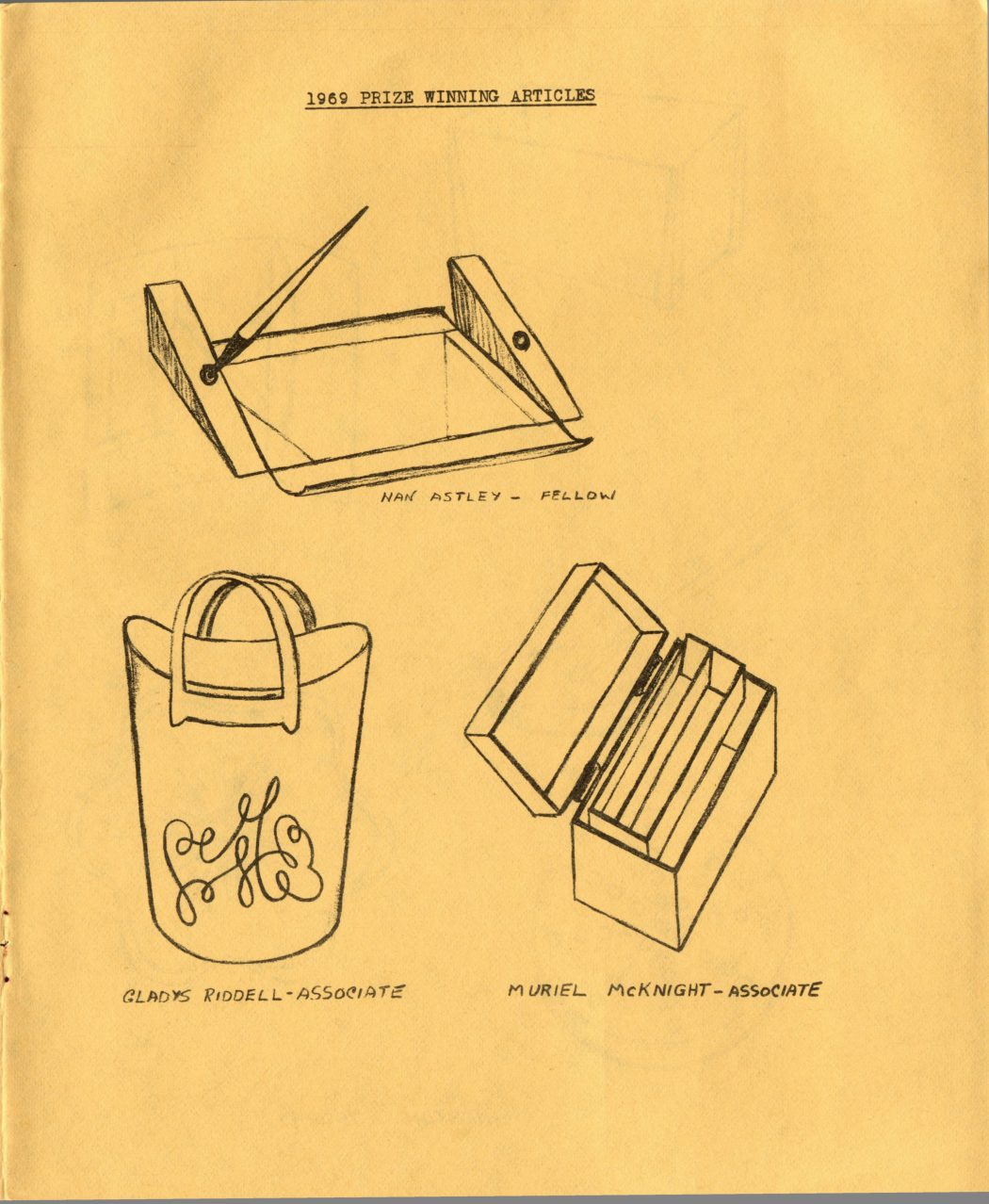
Page 11 — 1969 Prize Winning Articles
1969 Prize Winning Articles
NAN ASTLEY - FELLOW
GLADYS RIDDELL-ASSOCIATE
MURIEL McKNIGHT-ASSOCIATE
[This page is a plate of three pen-and-ink sketches, each with its hand-lettered caption below: a hinged pen tray (Nan Astley), a tote bag with a cursive monogram (Gladys Riddell) and a hinged card box (Muriel McKnight).]
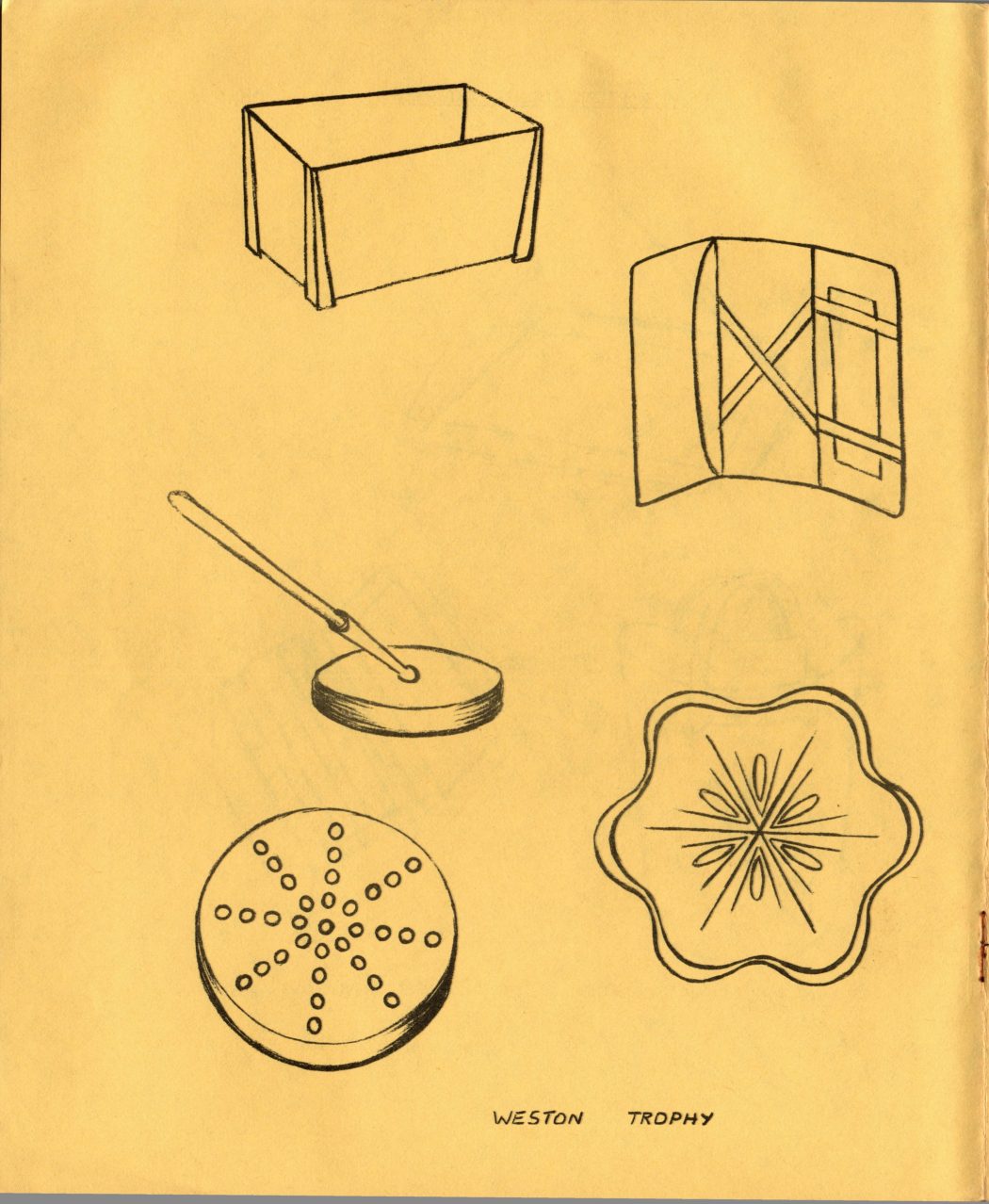
Page 12 — WESTON TROPHY
WESTON TROPHY
[This page is a plate of pen-and-ink sketches — five leathercraft pieces (an open box, a portfolio-style folder, a desk pen in a round base, a round dotted disc and a scalloped flower-shaped dish) with "WESTON TROPHY" hand-lettered at the foot of the plate. No caption or maker's name is printed with any individual sketch.]