
An issue of the Society’s newsletter, transcribed from the original.
(12 pages, 1.8 MB)
the full-resolution scan, 30 MB, for close research
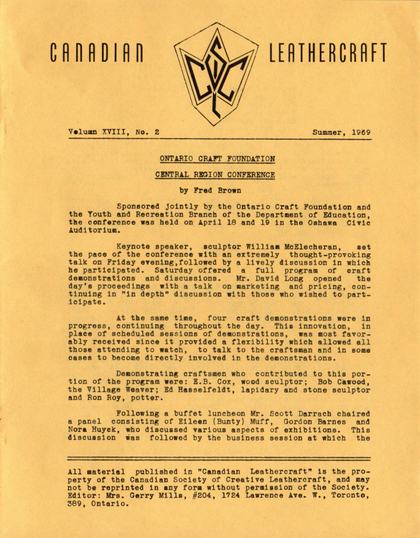
Page 1 — ONTARIO CRAFT FOUNDATION CENTRAL REGION CONFERENCE
Canadian Leathercraft
Volumn XVIII, No. 2 Summer, 1969
ONTARIO CRAFT FOUNDATION
CENTRAL REGION CONFERENCE by Fred Brown
Sponsored jointly by the Ontario Craft Foundation and the Youth and Recreation Branch of the Department of Education, the conference was held on April 18 and 19 in the Oshawa Civic Auditorium.
Keynote speaker, sculptor William McElecheran, set the pace of the conference with an extremely thought-provoking talk on Friday evening,followed by a lively discussion in which he participated. Saturday offered a full program of craft demonstrations and discussions. Mr. David Long opened the day's proceedings with a talk on marketing and pricing, continuing in "in depth" discussion with those who wished to participate.
At the same time, four craft demonstrations were in progress, continuing throughout the day. This innovation, in place of scheduled sessions of demonstrations, was most favorably received since it provided a flexibility which allowed all those attending to watch, to talk to the craftsman and in some cases to become directly involved in the demonstrations.
Demonstrating craftsmen who contributed to this portion of the program were: E.B. Cox, wood sculptor; Bob Cawood, the Village Weaver; Ed Hasselfeldt, lapidary and stone sculptor and Ron Roy, potter.
Following a buffet luncheon Mr. Scott Darrach chaired a panel consisting of Eileen (Bunty) Muff, Gordon Barnes and Nora Huyck, who discussed various aspects of exhibitions. This discussion was followed by the business session at which the
All material published in "Canadian Leathercraft" is the property of the Canadian Society of Creative Leathercraft, and may not be reprinted in any form without permission of the Society.
Editor: Mrs. Gerry Mills, #204, 1724 Lawrence Ave. W., Toronto, 389, Ontario.
Page 2 — C.N.E.
following Regional Action Committee was appointed for the ensuing year:
Mr. F.W. Brown, Regional Director Mrs. Elva Hasselfeldt, Secretary Mrs. Alice Rycroft Mrs. Martha Bastable Mrs. Ann Mortimer Mrs. Phyllis Attwell
Evaluation sheets were distributed at this conference which when collected provided much worthwhile information. It was particularly gratifying to find that the participants were well pleased with the program and found it meaningful to them. These results will be used to advantage when planning future conferences.
The Planning Committee for the conference wishes to express its gratitude, to the Youth and Recreation Branch and to the Department of Recreation of Oshawa, and to their representatives Scott Darrach and Bruce Holdsworth, for their support and cooperation.
C.N.E.
The Fall Sale having been discontinued, the Canadian National Exhibition Hobby show is our only money making project this year. Therefore, a greater effort must be made to make our booth a bigger attraction. Last year, the supply of small well-crafted articles was exhausted early. Some of the articles requested but were unable to supply were: wide sunglasses case with back clip, scratch pad holders, large belts, thin wallets, credit card cases.
Miss Olivia Smith, 32 Mountview Ave., Toronto, 165, Ont. is exhibition chairman this year. As in the past, members are asked to have articles ready for selling and to help man the booth. The branches have stated what days they will be able to take over and it is the responsibility of the Toronto branch to work evenings and weekends. Give Olivia a call at 769-7320 or Gladys Riddell at 536-2074 and let them know when you could give a helping hand.
Fifty-one (51) members are not paid up for the 1969- 1970 season. Are you?
Page 3 — FIFTEENTH INTERNATIONAL ASSEMBLY
FIFTEENTH INTERNATIONAL ASSEMBLY
MAY 2, 3 & 4
London, Ontario
Registration commenced on the Friday evening in the lobby of Hotel London while exhibits were set up. An Advisory Board meeting scheduled for 8.00 p.m. took a breather at 10.00 to join everyone for the Hospitality Hour.
An eager group of craftsmen were ready Saturday for a busy weekend of demonstrators and workshops:
Tool Sharpening - Walter Mickey Flower Making - Jessie Strain Leather Covered Bottles - May Corbett Corners & Turned Edges - Fred Brown Soft Leather Belts - Jean Newton Maple Leaves - Nan Astley Wallet Interiors - Clara Cavanagh Glove Making - Sylvia Gerster Sandals - Huldy Gutekunst Decorating with Gold - Clarence Redman Moccasins - Gladys Riddell Millboard Box Const. - Frank Torry
During the Saturday lunch hour, a tour of London was made with several places of interest shown including the art Museum where members and guests viewed "Leather Today".
Cartoonist Mr. Merle Tingley was guest speaker at the dinner in the Crystal Ball Room. His caricatures of noted and "not so noted" personalities along with his amusing "commentary" and sound effects kept the members thoroughly amused.
Mrs. Irva Ford, C.S.C.L. president welcomed the members and visitors and Mr. Charles Fuller, London president, introduced Mr. Tingley.
Door prizes and their donors:
$10.00 Credit note - Tandy Leather Co.
Liquor Service - Mr. & Mrs. Don Carroll
Correspondence Organizer - Mr. & Mrs. H. Pearson
Buckles (Set of 3) - Mr. & Mrs. F. Kehoe
Garnet Dyes - Garnet Co. - F. Brown
2 Credit Notes $5.00 each - Stephan & Son,
Food Package - Loblawa - Mrs. B. Reynolds
2 Cartoon Books - Mr. Merle Tingley
Goose-necked Lamp - Harold Wheaton
[Merle Tingley, the guest speaker, gave two copies of his own cartoon books as a door prize. London is faint on this page, as it is elsewhere in the issue.]
Page 4 — SALON AWARDS
SALON AWARDS
Mrs. Elizabeth Astley, Toronto - Awards & ribbon book — green Mrs. Sherle Bottrill, Barrie - Small tray - wine Mrs. Clara Cavanagh, Barrie - Morocco pocket Secretary - brown
- Notebook - blue
Mrs. Kay Cloughley, Barrie - Photo frame - green Mrs. Irva Ford, Hamilton - Family tree
- Pencil holder, stacked leather
- Rectangular tray - green
Mrs. Marion Gelsthorp, Belleville - Picture
Mrs. Huldy Gutekunst, FLAG - Sandals, brown & tan Mrs. Elizabeth Heacock, Barrie - Paper weight Mrs. Jacob Kolb, FLAG - Handbag with luggage handle, brown Mrs. Jessie Trew, Barrie - Belt with leather buckle Mr. John Trops, Toronto - Album
- Sexagonal box
Mr. Steve Walker, FLAG - Table Lamp of stacked leather
- Chess board
Mrs. Helen Zazaycki, FLAG - Morocco box - red
The judges for the Salon awards this year were Dr. Clair Bice, Director of the Art Gallery of London, Mrs. Huldy Gutekunst, Buffalo and Dorothy Muma, Toronto.
JUDGES REMARKS: The excellent workmanship of many of the pieces shown gave the judges wide scope for Salon selections and 18 ribbons were awarded.
Dr. Bice was unable to attend the Salon presentation but his comments on the articles chosen were passed on by Mrs. Muma.
The light green album was fresh and original, well proportioned to the cover, but its craftsmanship was lowered by the fact that the album did not open properly.
The belt was chosen mainly because of its creative handmade fastenings and this was again a factor in the choice of handbag. The sandals were beautifully executed, pleasing in design and colors. The picture of a lion shows an interesting and different technique in the use of leather and adds a touch of humor to the show.
The seven-place picture frame was simple with inventiveness and in good taste and the padded picture frame has pleasing contours and proportions. The pocket secretary was of excellent craftsmanship, flat, practical and pleasing to use.
The proportions and consistency of treatment of the stacked leather lamp gave a general elegance of appearance. The geometric design on the red box would have been improved by more exact cutting of the centre inlay.
Page 5 — BITS & PIECES
The green "awards" album is generally well-conceived and of excellent workmanship but somewhat marred by the mis-proportions of the printing on the cover. The sexagonal box was almost perfect from a construction viewpoint and the design on the top was well executed and most suitable.
An original treatment was shown in the chessboard which nevertheless did not interfere with the recognition of the spaces.
Mrs. Muma also commented in a general way on the pieces not selected for the Salon awards. The judges did not select those pieces which they felt belied the nature of leather. For instance, they rejected the rectangular penstand because it looked as if it were marble.
Another point against some pieces was the inappropriate hardware used as, for instance, the small clutchbags using commercial clasps where a concealed dome would have greatly improved appearances. The judges recognized that hardware can be a problem, but felt that commercial hardware should be avoided where possible.
In several of the boxes, the interior completely spoiled the outside effect. The judges would like to stress the necessity of careful finishing techniques. Some pieces were so poorly finished as to show glue on unlined areas and rough unlaced edges not properly polished. A very great deal of the appearance of an article rests on the finishing of all its details.
BITS & PIECES
To celebrate the Twentieth anniversary of C.S.C.L. an exhibition is to be held in 1970. A committee has been named - Miss Olivia Smith, Miss Viola Harris and Mr. Fred Brown to organize and set-up this prestige event. Members are asked to plan now to have articles to submit for this show and are advised that the same article may be entered in the Annual and International next year. For the past three years, a sterling silver maple leaf pin has been awarded to the Associate with the highest marks. These pins were donated by Janis Zalitis, Toronto. We are pleased to report Mr. Zalitis has donated another two pins for this purpose to be presented in 1970 and 1971.
Barrie Branch will represent C.S.C.L. at the Collingwood Art and Craft Show this summer.
[The same faint "o" seen through this issue reads as "e" here too ("To celebrate").]
Page 6 — CRAFTSMAN AWARDS; HELP WANTED - MALE AND FEMALE
CRAFTSMAN AWARDS
Mrs. Kay Cloughly, Barrie - tray, round fluted
- tray, Lazy Daisy, carved
Mrs. Clara Cavanagh, Barrie - secretary, brown morocco
- purse, green & black alligator
- notebook, brown morocco
- wallet
Mrs. Gladys Riddell, Toronto - pen set
Mrs. Muriel McKnight, Hamilton - purse, brown
Mrs. Sylvia Gerster, London - moccasins, deerskin
Mrs. Jessie Trew, Barrie - belt with leather buckle
- pen stand, brown
Mrs. J. Kolb, FLAG - box, black, yellow & green onlay
- pocket secretary, brown morocco
- handbag, luggage handle
Mr. Steve Walker, FLAG - table lamp, stacked leather
- chess board
Mrs. Dorothy Harwood, Belleville - men's gloves
Mrs. John Findlay, Barrie - tray, red sole leather
Mr. John Findlay, Barrie - bottle, brown & beige
Mrs. Nora Huyck, Barrie - pendant, mottled
Mrs. J.A. Coutts, Barrie - pins - maple leaves
Mrs. Elizabeth Heacock, Barrie - album - snap shot
Mrs. Joy Hutcheson, Woodstock - leather bowl
Mrs. Beula Reynolds, Woodstock - belt, plain brown
Mr. John Trops, Toronto - album
- box - sexagonal
Mrs. Nan Astley, Toronto - book - green
Mrs. Irva Ford, Hamilton - pencil holder
- pencil holder
Mr. Alvin Haig, Hamilton - wallet, brown morocco
Mrs. Joan Carroll, London - desk blotter
Mrs. Huldy Gutekunst, FLAG - bag, cowhide & bamboo calf
- sandals, brown & tan
- briefcase, thin
HELP WANTED - MALE AND FEMALE
CAPABLE PERSONS TO ASSIST CANADIAN GUILD OF CRAFTS (ONTARIO) WITH MANY EXHIBITIONS PLANNED.
Volunteers are needed in packing, unpacking, listing and staffing of these shows. This year, with the usual exhibitions plus the extremely important Craft Dimensions Canada, many groups are required for assistance in accomplishing the necessary work.
Also volunteers to staff the shows are urgently needed on Saturdays and Sundays. Anyone having some time to help please contact Mrs. Vaughn-Jones, 565 Duplex Ave., Toronto 12, Ontario Phone: 481-0658.
[“Cloughly” is printed here without the middle e. “sexagonal” for Mr. Trops’s box is the newsletter’s own spelling of “hexagonal”, kept as printed.]
Page 7 — CHIPPAWA MOCASSINS
CHIPPAWA MOCASSINS by Gladys Riddell
TO INSURE A GOOD FIT, IT IS ADVISABLE TO MAKE A CLOTH MODEL BE- FORE TRANSFERRING PATTERN TO LEATHER IN ORDER TO MAKE ADJUSTMENTS. Take a piece of paper about 12" square and fold in half. With a tape measure, measure across ball of foot (base of toes) and taking half the measurement, mark on pattern, about 1/3 down from top of pattern. See illustration I.
With tape, measure length of foot from toe to back of h. heel, that is from A to B on illustration. Shape for toe (A to D) as shown and extend line down past D to E. Mark same on other side. DO NOT CUT. When paper is opened, it should look like illustration II.
Measure from under ankle bone to bottom of foot for depth of mocassin and measure same distance all around. See illustration III. Add 1/2" or slightly more at lower edge of each side and shape from toe as shown by broken lines in illus. IV. This extension will shape mocassin to fit better at back of heel.
[The same faint "o" seen through this issue reads as "e" here too ("to E" in the illustration key).]
[The diagram key numbers its illustrations I, II, III, IV in sequence; a reference to the third had come out "LII". Corrected against the picture of the page above.]
[The Chippawa article spells the word "mocassin" throughout, on this page and the two following, and it is set here as printed; the award list earlier in the issue spells it "moccasins". Both spellings are on the paper.]
Page 8
Mark centre toe and centre heel.
Measure from L along outside edge of mocassin towards toe about 44" (M) depending on length of foot, and mark on each side of mocassin.
Start at centre toe and using two threads of #10 waxed hemp, well twisted and a glove needle, take a running stitch 1/4" apart, 1/8" in from outside edge to M. Repeat for other side of mocassin. Then pull to gather, shaping toe to fit desired foot. Fasten well on both sides.
For back of heel, bring back edges LK together with an overstitch. Then bring back up and put centre back to centre of LK and join. Start at bottom of mocassin and with running stitch, stitch in place 1/8" around.
For toe piece, cut a piece on the fold narrower than the piece ABED but only about 5" long from toe gathering to instep. Start to stitch at centre of toe with two strands of waxed hemp well twisted, matching centre of toe piece with centre of toe edge of main mocassin.
Using an awl with one flat edge, make one hole at a time under gathering stitch in each fold and space holes evenly on toe piece, saddle stitch. Repeat for other side.
Cut a strip of leather about 14" wide to measure from M, around the back to M
This strip may be left plain or fringed. Stitch in place.
[The same faint "o" seen through this issue reads as "e" twice more here ("foot", "both sides").]
Page 9
Measure across bottom of heel for heel width. Folding pattern again, mark 1/2 distance of heel measurement from fold out. That is, from B to F as in illustration V.
Draw a line from F to G parrellel to BH as in illustration V and extend the line another inch. Cut this extention going up to G and on to F.
Open pattern. Take the two bottom outside pieces of mocassin and bring together so the edges GJ overlap at centre about 3/4", Mark on both sides the centre fold. Fold back the overlap (KL on illustration VI) on each side so the bottom of the fold back measures 1/2" and the top of the fold Measures 3/4". When these folds are put together the edges of the folds should meet at the mocassin centre fold AB.
Cut off the fold-over piece at KL so that the piece KLJG is taken out on both sides. Bring side pieces together (KL's) then bring up remaining back piece and trim off even at back of heel. Open and shape this piece by rounding edges as shown in illustration VII. This paper pattern may be transferred to cardboard for future use.
[The typescript itself misspells two words on this page, "parrellel" for "parallel" and "extention" for "extension"; kept as printed.]
Page 10 — PRICING HANDMADE PRODUCTS
PRICING HANDMADE PRODUCTS
(as taken from "Leathercraft Lobby" in RA News by Deane H. Russell September 1949.)
Beginner and experienced craftsmen often visit our Studios with examples of newly-finished work and say: How much do you think I should charge for this article? We are asked this question so frequently that we have been encouraged to review our ideas for reference by others who may like to have some general guide to the solution for their problem.
While we have, on earlier occasions, endeavoured to suggest a pair of figures, between which amounts we have felt the articles might sell, we have long-since stopped mentioning any "set" figure for the guidance of our visitors. We soon perceived that whenever we did this, the craftsman seldom understood our reasons for arriving at the suggested figures:
Instead, we have been offering our views as to what we believe are the vital factors to be considered when determining "just prices for handmade articles." We now think our present plan offers a greater benefit to the craftsman - by helping him to recognize and relate important factors which should be considered when setting prices for handmade articles.
As a short article cannot possibly discuss the very many elements involved in setting prices for handmade articles, the following guide is intended simply for those who feel themselves ready as part-time homecraftsmen to offer their work for sale directly to customers.
For homecraftsmen offering products reflecting reasonably developed skills and enthusiasm for their craft, we believe careful balancing of the following factors will suggest a reasonable basis for setting prices for handcrafted products:
SKILL
recognized capacity or skill of craftsman - a beginner should not expect to command the same price as a more experienced craftsman. This is a prime factor often overlooked by enthusiastic beginners who do not realize they have produced only mediocre work which can actually do more harm than good to future sales.
MATERIAL COST
base selling price on cost of materials used in constructing article and allow something for skills displayed and time for making up article; many homecraftsmen are satisfied to receive twice the cost of materials used; others expect several times the material value of article; do not try to get immediate returns to cover cost of tools and equipment; such costs may be recovered gradually from articles sold over a long period.
[The same faint "o" seen through this issue reads as "e" here too ("to recognize").]
Page 11
TIME
value of time - unless the craftsman has had years of experience in his particular technique, the time factor becomes highly relative and subject to considerable variation between craftsmen.
An experienced craftsman may be able to produce a typical piece of work in one-quarter the time it will take a beginner to do the same work; it is not fair to the customer to expect him to pay for your period of apprenticeship in your craft.
FUNCTION
function and finish of article - does your product offer features and values not readily available through machine made products?
POTENTIAL CUSTOMER
catering to taste of potential customer - have you designed something because you like it yourself, or have you considered the tastes of your customer; is it styled in contemporary taste?
ORIGINALITY
originality of article - considering function, choice of materials, choice of decorative motif and skills displayed in construction, is article really of superior craft value, or will product appear as just another run-in-the-mill, stereotyped piece of handwork?
MARKET
ability of customer to pay the price - can you find a customer willing to pay your price? Obviously a craftsman seeking low or middle income group customers should keep his prices within the means of such customers, while special custom-designed items may be produced for more wealthy patrons.
Caution: In all cases give full value for prices charged; do not mistakenly offer slipshod work for low prices, nor over-value work for customers considered able to pay high prices.
VALUE
comparable merchandise value - perhaps the best general guide of all beginners at selling handmade products. Study values of articles available through other services; department stores, specialty shops, other handcraftsmen offering similar work.
[The same faint "o" seen through this issue reads as "e" three times on this page ("of experience", "to produce", "to taste").]
Page 12 — SUEDE LEATHER IMPROVED BY BRUSHING
Craftsmen who will take the trouble to relate the above factors to their individual selling problems should not experience difficulty in estimating reasonable values for the kind of work they are capable of producing.
SUEDE LEATHER IMPROVED BY BRUSHING
Suede, soft, smooth, silky is the fleshy side of the hide, buffed to produce a nappy surface. Suede, of course is leather and very much so.
Extremely popular for coats, suede is also used for that all-around accessory, the best.
While there are some washable suede leathers available, the majority of suede apparel should be dry-cleaned, with the attention professional care can give cuffs, collars and linings. This should not be necessary more than once a year.
Suede leather should be brushed frequently to keep dust from settling in the nap. Rubbing lightly with a soft gum eraser takes care of light dirt, too, It's a good habit to brush suede after each wearing with a rubber sponge or a clean terry towel. That is why many manufacturers enclose sponge rubber pads with their suede products.
It's remarkable how a few minutes of such daily care keeps a suede garment fresh looking. If there is discoloration in the garment, rub the discolored section against another part of the suede. Many spots and light stains that may not yield to a soft gum eraser, might be removed with an emory board lightly used, or a chalk cleaner that is available in notions departments. When suede leather gets wet or rain-spotted, let it dry away from the heat. After it is dry, brush up the nap with a sponge or towel. Press as for smooth leather.
Since leather is porous, air is good for it. Keep leather apparel in a ventilated space, never in an air-tight Plastic bag. This goes for smooth leather, also. Cover with a cloth wrapper when hanging any leather garment for an extended period.
With care and, when called for, good professional cleaning, leather garments should give good service and always look their best.
[The same faint "o" seen through this issue reads as "e" twice more on this page ("to brush") and its "a" drops out once ("with a sponge").]