An issue of the Society’s newsletter, transcribed from the original.
(12 pages, 1.7 MB)
the full-resolution scan, 34 MB, for close research
Page 1 — COMMISSIONS CAN BE CHALLENGING AND REWARDING
Canadian Leathercraft
Volume XX Noe 2 Winter 1971
COMMISSIONS CAN BE CHALLENGING AND REWARDING
Last June, our president, Irva Ford, was approached by the Council of the town of New Hamburg to make a leather cover for an old German newspaper (1868), to be presented to the mayor of the city of Hamburg, Germany. After the difficulty of getting such a fragile newspaper laminated, the leather project was begun. It was made from natural cowhide with a suede lining, with two interior pockets for holding documents. The laminated pages were laced onto a leather hinge which was saddle stitched onto the suede lining. The decoration on the cover consisted of a maple leaf border and the New Hamburg crest. The cover, 27" by 40", was then edged with thonging to match the colour in the crest.
A second commission came in August when a motor cycle enthusiast knocked on her door with a request for four leather too. boxes for the motor cycle Canadian team which was scheduled to attend the World's Six-day Championship Competitions to be held in Ireland. These boxes were 34" by 9" by 12", also made of cowhide. The only decoration was the contrasting saddle stitching, the three required clasps and the handle which held the box on the motor cycle.
When the Canadian Club of Hamilton celebrated its 60th Anniversary this fall, a book was compiled which required a special cover in the club's colours. Royal blue oasis with white kid lining was chosen for this project. The book cover was padded and the edges thonged. This too, was an interesting commission.
All material published in "Canadian Leathercraft" is the property of the Canadian Society for Creative Leathercraft, and may not be reprinted in any form without permission of the Society.
Page 2 — DECORATIVE DESIGN: Cut-outs for the Purpose
DECORATIVE DESIGN
Cut-outs for the Purpose by Anne Hook, F.C.S.C.L.
Reprinted from Canadian Leathercraft, Volume 8, No. 2
(A talk given at the November 1958 Meeting of the Toronto Guild)
In "Canadian Leathercraft", Summer 1957 issue, the following Alphabet of Line was shown:
| Continuous lines 1, | as |
| 2. | |
| Static motifs 4, | |
| 8. | (2 9. |
This is used as a warming-up, or preliminary to the putting into action, the application of this alphabet, for the purpose of making cut-outs, suitable for use as decorative design for leathercraft.
Combination of these motifs and their variations were sketched on the blackboard. Casual doodling followed, of the type usually found on the telephone pad, showing how this alphabet repeats itself involuntarily. Out of these scribblings, lines were deepened in which suggested interesting shapes and the conflicting lines erased. Geometric shapes were formed. Curves were experimented with. Leaves were drawn simply, and in outline only. Milkweed pods were on hand, to provide a model for outline drawings.
After a period of watching, the members were each given sheets of brown paper, approximately purse size, also sheets of white paper to draw on for the cut-outs.
Then, members who had arrived at motifs of suitable size to use on the purse shape, proceeded to make a cut-out of their motif. Each craftsman then proceeded to cut two more identical motifs, and grouped the three motifs in various positions on the brown paper purse shape.
The procedure from here on, is as follows:
Page 3
When a pleasing shape is arrived at, it is triplicated (or quadruplicated, or quintuplicated), and then arranged on the paper pattern of the project to be decorated. With the movable motifs, it is possible to arrive quickly at a great many different arrangements, and so be able to choose the most interesting, before drawing the decoration in its final form. Also, it eliminates the frustration of tediously making several drawings, hoping each time to get a better one.
When the craftsman has arrived at an arrangement which appeals to him, he then lays a sheet of tracing paper over this, and on the tracing paper, draws what he has arranged. (N.B...If he has cut the shapes in white paper, it is well to make the arrangement over a different colour such as the brown paper used by the group- --if laid on white paper the outlines are too difficult to see. ) It is well to try for more then one good arrangement, and keep on hand, since, if the project turns out to be special, it might be desired to do something else carrying out the same idea.
Two examples follow, the first a natural form, the second a geometric.
Example 1.
Arrangement 1.
Arrangement 2.
Page 4
Arrangement 1.
Arrangement 2 CYRRRD)
In Example 1, the motifs ere laid down, touching each other. In Example 2, the centre areas were cut out, and the motifs slit so that they could be strung together, daisy-chain fashion. This gives them a true look, when drawn, and is much easier to achieve than if they are laid on each other, without being strung.
When doing decoration, it is important to work toward getting an interesting outline, since the outline is what catches the eye. This can be done in two ways: (1) by drawing from a model when the decoration is required; (2) by keeping a clipping file on hand for possible ideas to be found ir magazines, cards, etc., (when clip- Pings cannot be made, tracings would be substituted), and going into this file for suggestions, when necessary.
It takes a very small bit of good decoration to spark an idea Suitable for adaptation to leathercraft--or any craft} 'ibrary books on ANY craft could prove helpful--it is very limiting to stay to books on leathercraft alone. Metal craft, lino printing, textile printing, books on crafts generally, are all good sources. No craft lives to itself, just as no person lives to himself.
And above all, it is well to keep in mind that the common fault of beginners is in trying to be too original. It is best to try for one good small motif, and play it to the hilt. Some day, it may be just as much a part of you as your signature.
[The numeral 1 on this page is typed with the same character as the letter l, and it is set here as the numeral.]
Page 5 — LEATHERCRAFT at WESTERN FAIR - 1971
LEATHERCRAFT at WESTERN FAIR - 1971
by Helen M. Wheaton
Supervisor - Home Arts Department
Western Fair Association
Sec. 84 - Handbag, Original Canadian Design
1st. - Mrs. G. W. (Alice) Howe, London, Ontario
2nd. - Unawarded - Lack of entries
3rd. - Unawarded - Lack of entries
Sec. 85 - Handbag, Commercial Design
1st. - Mrs. D. (Joan) Carroll, London, Ontario
2nd. - Unawarded - Lack of entries
3rd. - Unawarded - Lack of entries
Sec. 86 - Belt, Tooled, Stamped or Carved
1st. - Mrs. G. W. Howe, London, Ontario
2nd. - Mrs. D. Carroll, London, Ontario
3rd. - Mrs. Marg. Montieth, Lambeth, Ontario
Sec. 87 - Miscellaneous Small Article in Leather
1st. - Mrs. D. Carroll, London, Ontario
2nd. - Scott R. Thompson, London, Ontario
3rd. - Mrs. Marg. Monteith, Lambeth, Ontario
Sec. 88 - Miscellaneous Large Article in Leather
1st. - Mrs. D. Carroll, London, Ontario
2nd. - Mrs. M. Anderson, Willowdale, Ontario
3rd. - Mrs. Marg. Monteith, Lambeth, Ontario
Sec. 89 - Jewellery, Leather, 3 items
1st. - Mrs. Marg Monteith, Lambeth, Ontario
2nd. - Mrs. D. Carroll, London, Ontario
3rd. - Mrs. G. W. Howe, London, Ontario
Sec. 90 - Moulded Leather Article
1st. - Mrs. Carol McLean, Woodstock, Ontario
2nd. - Mrs. Marg Monteith, Lambeth, Ontario
3rd. - Mrs. D. Carroll, London, Ontario
Sec. 91 - Gloves, Leather, Handmade
1st. - Mrs. J. S. Parlance, Niagara Falls, Ontario
2nd. - Not awarded - Lack of entries
3rd. - Not awarded - Lack of entries
We always look for and hope there will be a greater number of articles in the competition each year. So hot up your knife along with your interest and we'll keep our hopes alive for another year.
Sec. 91 prints both its 2nd and 3rd placings as "Not awarded - Lack of entries". The spelling "Montieth" in Sec. 86 against "Monteith" elsewhere on the page is the newsletter's own inconsistency, kept as printed.
Page 6 — LEATHER SCULPTURED MASKS
LEATHER SCULPTURED MASKS by Carol McLean
Down through the ages, man has used masks as one of his forms of self-expression: whether for religious or decorative purposes. The method here is "free-formed" and not shaped over a base mould. Let your imagination and ingenuity flow unchecked and see the many interesting faces you can create. One other thing to keep in mind as you are working is that the leather has "a mind of its own" at times and will want to fold better one way than another. Let it assert its will to add depth and originality to your mask.
1. As in most leather work, make certain your fingernails are well clipped.
2. Use vegetable tanned 3-5oz. natural carving leather. I prefer the lighter weight because it shapes into finer detail and is much easier to handle.
3. Moisture content of the leather is important too. It is the same as for carving - not too wet or it will just flop around and not retain its shape and too dry and "springy" so it will not fold properly.
4. Work spontaneously! Create as you go! Try various combinations of folds for different effects. If the result is not the desired one -- re-moisten (if necessary) and re-shape. It is a very flexible medium with which to work. Also try different shaped "starting forms". e.g.--square, rectangle, triangle, diamond, circle or oval.
5. To figure the amount of leather needed I add 1/3 again to the desired finished width. e.g. If I want the mask to be 9" finished width I will use 12". The length is done the same--always adding 1/3 more to be taken up in folds. A lot will depend on how deep the folds are. A 12" x 22" piece of leather will condense to about 9½" x 15" as an example.
6. To start the mask, fold about 1" under at the brow line. This fold is usually about 1/3 of the way down the leather. Press down firmly.
7. Form bridge of the nose, taking up again 1/3 in the length of the leather, moulding and working from above and below to get the desired height.
8. Shape the end of the nose and the nostrils. This then necessitates folds from the nose to each of the lower outside corners-- indicated by the dotted lines. Press these in to form the curves
Page 7
around the mouth position. These folds are necessary to take up the excess leather.
9. The next step is to shape the mouth by pushing the leather to form two lips.
10. Now form the chin by folding under or by pleating from the mouth corners down and a cleft or dominant or receding chin will add interest. After the chin has been formed-- go back over all of the features and add more depth and detail.
11. The eyes are formed next by lifting and rounding the brow line a little where the eyes will be positioned. (Not all across the brow line---just above the eyes). Push the "eyeballs" out from the back, controlling their depth from the front at the same time.
[The illustrations on this page carry their own small captions, "7.+8.", "9.+10.", "11.+12.", "14." and "15.", pairing each drawing to the numbered step or steps it shows.]
12. Make the lower eyelids now by pinching the leather under the eyeball. Work to deepen the folds around the eye to give character.
13. Pupils can be marked in now with the tracer if desired. I prefer to leave the eye plain.
14. Condense the "mouth-chin width" by bringing the outside lower corners in to almost the centre point of the chin.
15. Fold under the raw edges along the top and sides of mask to give a finished look. This lets you determine the shape of the face and top of head. e.g. square and box-like or thin and pointed. You can judge which shape is necessary for the overall effect you wish to achieve. Push in the sides where the hollow of the cheek would be and also where the temples are. (marked by x)
Page 8 — TREASURER'S REPORT - C.S.C.L. SALE AT THE C.N.E. - 1971
16. The forehead and cheekbones can now be raised and contoured from underneath to give a rounded or 3-D effect to the mask. (indicated by dotted lines in drawing)
17. Lines and wrinkles can be marked in the forehead or around the eyes with a tracer--if desired.
18. Let mask dry, periodically checking to see if more shaping is necessary. I roll up a towel and place it underneath the mask to help it retain its depth and roundness as it is drying.
19. Bone edges with edge dressing.
20. On back side of the mask punch a hole in wither side of the double fold at the eye. Do not punch through to the front of the mask. Thread and tie a sturdy piece of lacing through the holes to make a hanging assembly.
21. Mask can be left natural or dyed. If mask is to be dyed, do not dye the back because the dye will "weep" through to the front and possibly ruin it. 22. After dye has dried, buff well with a soft cloth and apply polish coat. Again the rolled up towel underneath gives a good support for the damp mask. I prefer a dull matte finish to a glossy one. Determine which suits your decor or desired effect.
This same moulding technique can be used in free form leather sculpture work with heavy sole leather. The possibilities are limitless! Let your creativity determine your end result and have fun!
TREASURER'S REPORT - C.S.C.L. SALE AT THE C.N.E. - 1971 by George McPhail
The weather for the C.N.E. this year was less than ideal, and we kept our fingers crossed as to how these conditions would effect our sales, but we did remarkably well.
The value of goods sold was $4,286.91. This compares with $4,368.13 for last year, the small drop of $81.22 is quite acceptable in view of the above mentioned conditions.
Forty-three members submitted a combined total of 4,127 articles for sale, 1,502 articles were sold and 603 articles were returned to the owners
Page 9 — C. N. E. REPORT
The difference of 22 articles were not accounted for and presumably were stolen. This last figure ie the disturbing one. Tt reinforces previous warnings that we dare not turn our backs for even a moment while loose articles are within reach of the public and that display cases should be fully closed at all times. $85.85 (less 10%) was paid to the owners of the articles from the commission received at the C.N.E. and to that extent money available for other purposes has been reduced.
C. N. E. REPORT
Irva Ford, Convener
The C.S.C.L. Exhibition and Sale in the Arts, Crafts and Hobbies Building at the Canadian National Exhibition in 1971 was, without a doubt, a sucess.
Your president and executive wish to thank all who assisted with this events Ninety-two members worked in the booth, many serving more than once. There were demonstrations almost continuously for the whole nineteen days. Some demonstrators neglected to record their demonstration in our record book but the following were included; belts, carved, braided and stamped, several types of jewellery, book-marks, skiving and several kinds of wallets. Demonstrations attract the public and often attract new members.
The system of bookkeeping was greatly improved due to the suggestions and guidance of our treasurer, George McPhail. The new adding machine was a valuable asset. For the future, the committee cannot stress too strongly the importance of writing tags more clearly and accurately, earrings and pins should be tagged separately. A recommendation was proposed by Clara Cavanagh, who again balanced the sales books, to write on only one side of the tags next pear It would be helpful too, if orders were listed in a separate book» We are grateful to Gladys Riddell for her faithful attendance in the evenings and for covering the leather to protect it from the rain which leaked through the roof. Dorothy Read was always reliable and faithful in the mornings.
This year we were unable to secure a convener for the sale, so by the time your president undertook the task, the entry forms and instructions were regretfully late reaching our members. However, thanks to the wonderful co-operation of our executive and all participating members, the sale proved to be a very gratifying achievement. In the future, a Sales Convener must be appointed early in the year, before, we accept an invitation from Fred Brown to participate in the Exhibition.
Page 10 — CANADIAN NATIONAL EXHIBITION 1971 AWARD WINNERS - LEATHERCRAFT
CANADIAN NATIONAL EXHIBITION 1971 AWARD WINNERS - LEATHERCRAFT
CANADIAN GUILD OF CRAFTS:
Best leather entry in show. $60.00...F. W. Woolworth Co. LEATHER CHESS SET AND BOARD. Beverley Anne and Paul Williams Decorated leather. $50.00...Tandy Leather Co. of Canada Ltd. LEATHER CHOKER. Rex Lingwood
Best functional design. $35.00...C. S.C. L. LEATHER PIGGY BANK. Irva Ford
Undecorated Leather. $35.00... Lewiscraft Not awarded.
C.N.E.
WOMEN'S DIVISION:
217- Any tooled leather article, Commercial design (1) J. Zalitis
(2) - Not awarded
(3) J. Wallace
218 - Any tooled leather article, Original design (1) A. Hook (CHATELAINE)
(2) J. Zalitis
(3) D. Elliott
[In this page’s C.N.E. Women’s Division results table it is easy to lose four placings entirely — 219’s (1) and (2), 220’s (2), and 221’s (3) — rather than misreading them; none were garbled, they were simply missing here. Set out here as printed: 219 (1) M. Jonasson, (2) W. Battenfield; 220 (2) K. Jonasson; 221 (3) M. Jonasson. The other eleven placings on this page, and 222–223 on p11, already matched the page and are unchanged.]
219 - Any carved leather article, Commercial design (1) M. Jonasson
(2) W. Battenfield
(3) D. Elliott
220 - Any carved leather article, Original design (1) J. Zalitis
(2) K. Jonasson
(3) - Not awarded
221 - Non-tooled leather article
(1) O. Smith
(2) C. McLean
(3) M. Jonasson
Page 11
222 - Leather gloves
(1) D. Proctor
(2) G. Prestwich (3) J. S. Parlane
223 - Leather Jewellery
Not awarded. (no competition)
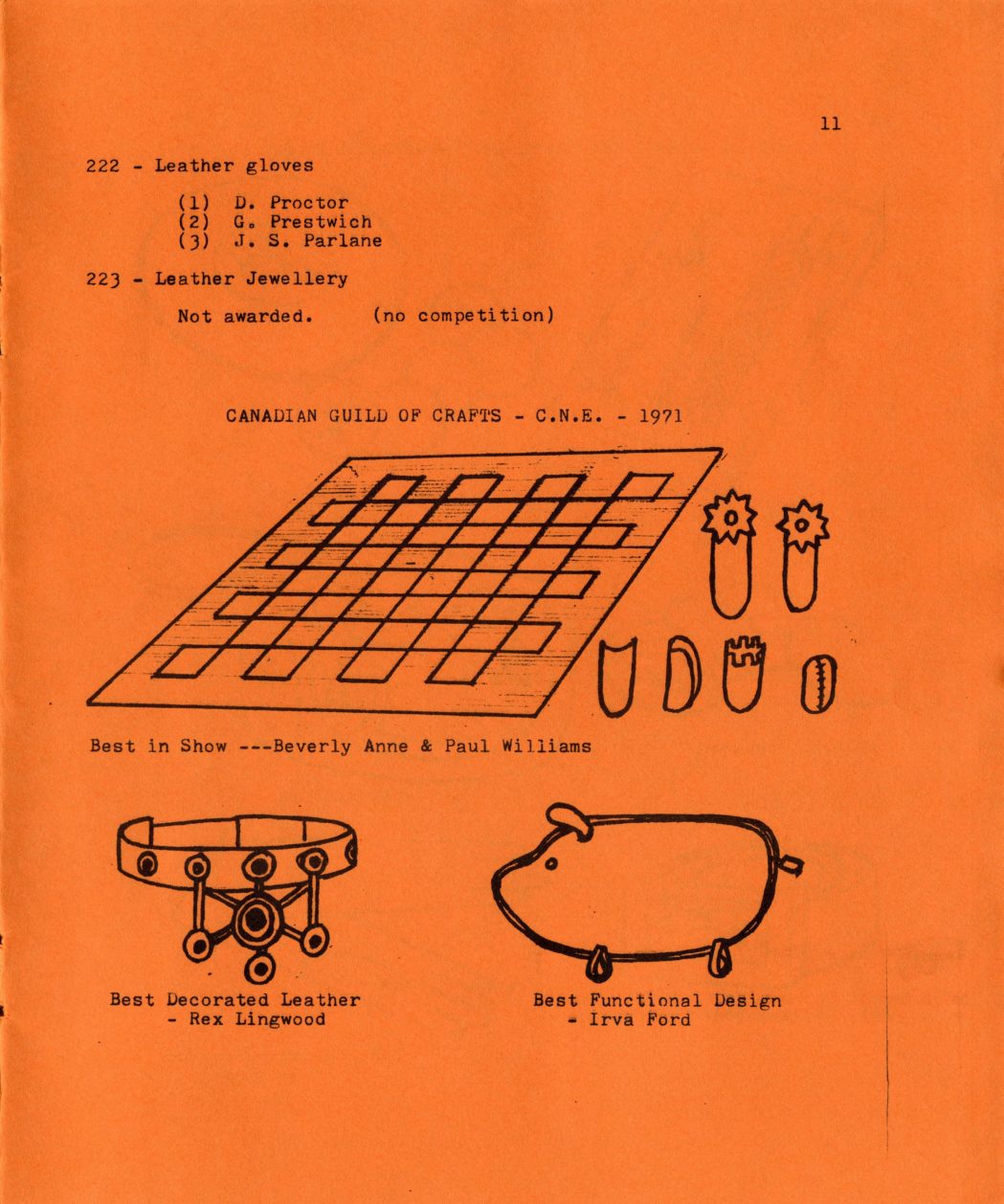
CANADIAN GUILD OF CRAFTS - C.N.E. - 1971
[The heading and the "Best in Show" line beneath the sketch of a leather game board and jewellery pieces are easy to lose; both set out here restored. The plate also carries drawings of a tooled belt/collar and a piggy-bank-shaped piece, captioned below.]
Best in Show ---Beverly Anne & Paul Williams
Best Decorated Leather
- Rex Lingwood
Best Functional Design
- Irva Ford
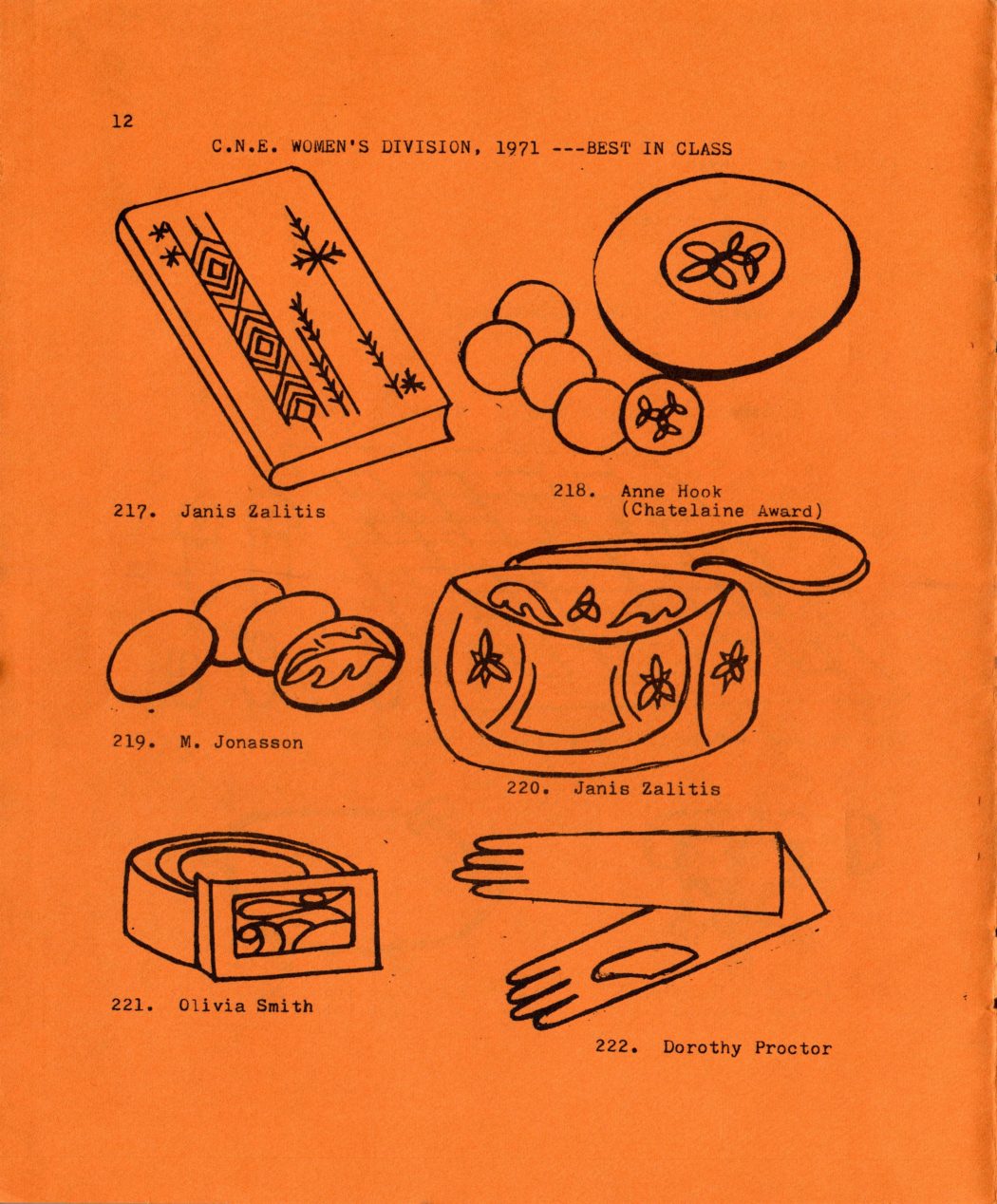
Page 12 — C.N.E. WOMEN'S DIVISION, 1971 --- BEST IN CLASS
C.N.E. WOMEN'S DIVISION, 1971 ---BEST IN CLASS
217. Janis Zalitis
218. Anne Hook (Chatelaine Award)
219. M. Jonasson
220. Janis Zalitis
221. Olivia Smith
222. Dorothy Proctor
[217 and 218 are easy to swap, moving "(Chatelaine Award)" onto Janis Zalitis's line; the parenthetical belongs to Anne Hook at 218, matching the existing record for her 1971 Chatelaine Award. This page is a sketch plate, six items each captioned only with a class number and winner's name (a book or box, a compact or tray, a cluster of egg-shaped pieces, a handbag, a belt and buckle, and a pair of long gloves); the same six first places are printed in the results on pp. 10-11.]