
An issue of the Society’s newsletter, transcribed from the original.
(12 pages, 1.6 MB)
the full-resolution scan, 22 MB, for close research
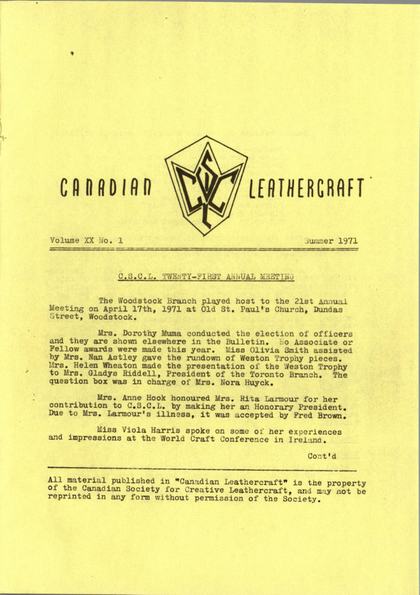
Page 1 — C.S.C.L. TWENTY-FIRST ANNUAL MEETING
Canadian Leathercraft
Volume XX No. 1 Summer 1971
C.S.C.L. TWENTY-FIRST ANNUAL Meeting
The Woodstock Branch played host to the 21st Annual
Meeting on April 17th, 1971 at Old St. Paul"s Church, Dundas Street, Woodstock.
Mrs. Dorothy Muma conducted the election of officers and they are shown elsewhere in the Bulletin. No Associate or Fellow awards were made this year. Miss Olivia Smith assisted by Mrs. Nan Astley gave the rundown of Weston Trophy pieces. Mrs. Helen Wheaton made the presentation of the Weston Trophy to Mrs. Gladys Riddell, President of the Toronto Branch. The question box was in charge of Mrs. Nora Huyck.
Mrs. Anne Hook honoured Mrs. Rita Larmour for her contribution to C.S.C.L. by making her an Honorary President. Due to Mrs. Larmour's illness, it was accepted by Fred Brown.
Miss Viola Harris spoke on some of her experiences and impressions at the World Craft Conference in Ireland,
Cont'd
All material published in "Canadian Leathercraft" is the property of the Canadian Society for Creative Leathercraft, and may not be reprinted in any form without permission of the Society.
Page 2 — WESTON TROPHY - 1971
Demonstrations during the afternoon were as follows: Dyeing = Olivia Smith
Paper Mache Boxes = Gladys Riddell Round Braiding = Jean Newton
Expandable Belts - Nan Astley Ring Note Books - Clara Cavanagh Card Cases - Jessie Strain
Lace Cutting = Alvin Haig
Pocket Secretary — Ruth Haig
Picture Frames — Nora Huyck
Butterfly Pins - Margaret Monteith After the first period of demonstrations, members relaxed with coffee and a birthday cake made by Carol McLean and were entertained by a local barbershop quartet.
Later in the afternoon, displays were open to the public for viewing. It was gratifying to see the turnout of interested citizens. Something new this year that seemed popular was the table of work done by Fellow members over the past few years.
After a delicious dinner in the banquet room, Mr. Henry Bruines, a local florist demonstrated flower arranging. His humour during the arranging and answering of questions brought a pleasant day to an end. A draw for the flower arrangements made four people happy.
WESTON TROPHY = 1971
The coveted Weston Trophy was won by the Toronto Branch with an average of 90.4%. Those submitting articles for the group were: Anne Hook, Itsuko Yasui, Olivia Smith, Nan Astley and Gladys Riddell,
Trophy Appraisal
TORONTO:
Mask: Leather work well done. A matt finish Might have been pleasanter. The background detracts from the work, Jug: Cuir Bouille method = a very attractive piece and nicely finished. The handle is a bit slim.
[The heading "TORONTO:" that opens this branch-by-branch appraisal was missing above "Mask:"; restored — the pieces appraised there are the Toronto Branch's own Weston Trophy entries. The florist's name is "Bruines," not "Bruises."]
Page 3
Coaster Set with Decanter Stand: Splatter technique, with relief decoration from Lino-cut. Decoration based on a motif from the 8th Century Armagh CHALICE, in the National Museum of Ireland, (Dublin). Leather-backed to reinforce the discs.
Belt: Handmade copper buckle with cloisonne transparent enamel enhances the leather belt, which is sponge dyed.
Purse: A good-looking well balanced purse. Interior is beautifully handstitched and the gusset planned to open well.
HAMILTON:
Black Purse: Does not sit quite level, and gussets could be wider at the top. Note that flap is cut in at the top to allow handle not to rub - a very good feature. A nice looking bag.
Piggy Bank: Cuir-bouille again, stylized. Stitched so that it may open when lock is removed, 8 oz. cowhide has been used. lock might be covered with leather. A piece to tickle the fancy.
Bottle Caddy: A good idea, and a heavy base. Join might be less conspicuous. A pleasant decoration and a beautiful dye job.
Pocket Secretary: Might be improved by finer lacing. Slight uneven in fold. Inside edges very well done. It handles nicely.
Blotting Pad: An attractive piece. It is not really necessary to stiffen inside flap. Punched holes uneven, but the lacing is well done,
BARRIE:
Utility Bag: Frame made out of a type of darex. The inside" is covered with wood-grain washable wallpaper. Outside is of a sheepskin novelty leather, Beautifully finished with handcut binding.
Covered Bottle: Workmanship very well dome. It could have been padded in some way to disguise the lettering which shows through, perhaps by inlay or onlay.
[Two readings are corrected against the printed page: the paper says the frame “Outside is of a sheepskin novelty leather”, not “Outside _ 18 of”, and the binding is “handcut”, not “handout”.]
Page 4
Moulded Tray: Nicely shaped, with pleasing decoration. The matting leaves a little bit to be desired, but is a pleasing piece.
Suede Belt: An attractive idea. Stitching could be evener, This piece is in keeping with present MOD styles.
Jewelry Box: Beautifully made and lined, with corners properly turned. <A very pleasant piece, el] hinged and of Fellowship quality.
WOODSTOCK:
Black Purse: Flap rather stiff, and purse tilts slightly. Decoration a bit busy, but will probably ada to the life of the purse. Lacing is not really necessary on a handle. Tray: Sits level, Fluting a bit uneven. Nicely finished. A dark edge would have given it a lift in colour.
Mask: Very well made and nicely finished. A good conversation piece.
Coasters in Case: A clever idea. Join in case could be smoother, and cutting of decoration is too shallow. A nice dye job. Watch Jar: An interesting idea with leather work well done.
Members awarded marks over 90% in Weston Trophy articles were:
Clare Cavanagh - Utility Bag - 95.5% Irva Ford = Piggy Bank - 99.4%
Olivia Smith - Belt - 98.8%
Anne Hook = Coaster Set - 93.2%
Itsuko Yasui - Purse - 91.9%
BRANCH AVERAGES FOR WESTON TROPHY
Toronto - 90.4
Hamilton - 85.2
Barrie - 84.1
Woodstock - 77.9
[The Branch Averages table carried only Woodstock's figure; Toronto's, Hamilton's and Barrie's are restored above it, in the order printed. The Utility Bag entry above is printed "Clare Cavanagh," though this member appears elsewhere in this issue as "Clara Cavanagh" (Ring Note Books demonstrator, and Chairman of the Council of Fellows) — both spellings are as printed.]
Page 5 — LEATHERCRAFT STANDARDS
LEATHERCRAFT STaNDARDS
These are general requirements and will be considered by the Council of Fellows in appraising works to be accepted for sales. There will be exceptions in the case of articles with a newly identified need, ingenious application of material or technology, or an original aesthetic design. Exhibition and Competition articles will be judged by higher standards.
DESIGN: a FUNCTION: The project must fit the purpose for which it has been designed.
PROPORTION AND SHAPES
Proportion means the height in relation to the width, and each shape in relation to all other shapes in the design.
MATERIALS AND FINDINGS: Materials must be suitable for the purpose for which they are used, and the findings must be in keeping and in good taste.
COLOUR AND DECORATION: The colour and decoration should be a complementary part of the whole design. HARMONIOUS APPEARANCE: This is the result of the relationship of the forms or parts, bringing them into unity.
WORKMANSHIP:
CUTTING: Accurate cutting to ensure correct fit and appearance,
DECORATION: Tooling: Clear, clean lines; any modelling must be smooth, background stippling should be regular and any flat backgrounding should be put down smoothly.
Carving: Lines should not be cut deeper than half the thickness of the leather. Except in certain places, lines should not cross each other, or go beyond the outline being cut. In many places, they should taper out.
Beveller: Must follow the cut line smoothly.
Pear Shader: Rarely is the exact impression of the pear shader correct. The tool should be moved around in the area concerned, tapering off the pressure toward the edges. Rarely should it touch the lines. Background: However the background is treated, it must not detract from the design.
“WORKMANSHIP” is underlined on the printed page
Page 6
Camouflage, veiner, mules foot, etc.: If used, they should not be overdone.
Seeder: This is used mainly for flower centres, and how it is used depends on what centre is being done and the effect desired.
Decorative cuts: If used, they generally follow the contour of the leaf or petal. They start heavy, and taper out to nothing.
Embossing: The parts to be embossed must be carefully raised. The raised portion must be well and smoothly supported. Generally, the surrounding area should be treated in such a way that the embossing is well defined.
Stamping: The impression should be regular or grade= ated and reasonably deep. When more than one tool is used, the impression should create a related design, Inlay: To fit accurately and show no tool marks.
Onlay: Prepared so the the edges are neat and firmly adhered.
Colouring: Must show that there is a knowledge of how to handle colour to get a desired effect.
Other forms of applied decoration not specifically mentioned, need the same care and attention to details as those above.
SKIVING: Sufficient to make the parts fit well, and to reduce the edges of parts being stitched or laced together to a suitable thickness, but not enough to weaken the leather where strength is needed, For turned edges, the leather must be skived enough to make a smooth, neat turnover.
FITTING AND ASSEMBLY: Edges to be flush, gussets and fasteners to be properly placed.
MOULDING: Whatever method is used, the leather must be a suitable weight for the article. If there is more than one moulded part to the article, the moulding of the various parts must form a harmonious whole, FINISHING: Lacing and stitching to be even and uniform, suitable to the article and inconspicuously joined or finished off.
Cut edges — whether laced or unlaced should present a well finished appearance.
Turned edges - the edges must be skived enough to make a smooth, neat turnover.
Page 7 — Executive Council
Glueing: Glue should be spread so that no lumps are formed. <Any excess should be removed from the visible parts of the article.
LININGS: Should be suitable for the article, neatly inserted and accurately fitted.
STACKED LEATHER: Must be securely glued, and sanded sufficiently to make a smooth edge.
BACKS: To be finished suitably for the article whether lined, dyed, polished, or left untouched,
COMBINATIONS: If the leather is combined with other materials, the leather must be the dominant part of the article, and the material must be compatible with the leather,
| Past President | Mrs. Dorothy Muma |
| President | Mrs. Irva Ford |
| Recording Secretary | Mrs. Ruth Haig |
| Corresponding Secretary | Mrs. Beula Reynolds |
| Vice Presidents | Mrs. Helen Wheaton, Mrs. May Corbett |
| Treasurer | Mr. George McPhail |
Executive Council
| Anne Hook | Fred Brown | Evelyn Burgess |
| Olivia Smith | Gel Brigden | Doris Miles |
| Sadie Roebuck | Eleanor Coutts | Edith Melchior |
| Nan Astley | Denta Coveyduck | Betty Henstridge |
| Bea Austin |
Ex-Officio
Past President Mrs. Dorothy Muma
Chairman Council of Fellows Mrs. Clara Cavanagh Historian Mr. Robert Muma
Editor Mrs. Joy Hutcheson
Branch Presidents
| Barrie | Mrs. Kay Cloughley |
| Belleville | Mr. Jack Layton |
| Hamilton | Mrs. Ruth Haig |
| London | Mrs. Sylvia Gerster |
| Toronto | Mrs. Gladys Riddell |
| Woodstock | Mrs. Carol McLean |
[The Executive Council table's last row pairs only "Bea Austin" with a name; the two cells beside her are blank on the printed page — a stray mark there had been mistaken for the word "pe," and is removed.]
Page 8 — REQUIREMENTS FOR ASSOCIATE AND FELLOW MEMBERSHIP
REQUIREMENTS FOR ASSOCIATE AND FELLOW MEMBERSHIP
ASSOCIATE MEMBERSHIP
1. Not less than 3 years satisfactory practice of leathercraft.
2. Two years of satisfactory service to the Society, e.g. helping with exhibitions, sales, writing for the Bulletin, serving on executives (local, national or international), getting new members for the Society or working in some way toward the development of leathercraft.
3. Demonstrated ability to produce work of a high standard of craftsmanship. While originality of design is not necessarily required for Associate Standing, it will receive favourable consideration. Copied designs should bear some stamp of the individuality of the craftsman and should not be an exact duplicate in every sense of the copied design.
4. Approval by the Board of Selection of submitted work as follows:
1. Handbag or other large article involving gusset construction.
2. Belt of 6 or 8 oz. leather.
3. Optional
4. Optional
Note:
Numbers 3 and 4 should be chosen to show specific techniques. Articles submitted should demonstrate knowledge of materials and various techniques and versatility in the craft, e.g. tooling, carving, colouring, construction, stitching, lacing, molding, etc.
5. Articles submitted for Associate Standing will be marked according to the Society's Point System of Judging. The minimum passing mark for each article is 75 marks. If ONE of the articles has failed to receive 75 marks, the candidate will receive credit for the three qualifying articles and a condition on the fourth, The candidate may submit another article the following year and, if it qualifies, will receive his Associate Standing and Certificate at the next Annual Meeting when all four articles must be displayed. A candidate may fail on only one article to receive this condition.
6. Work submitted must be accompanied by the signed declaration application form that the work is solely that of the candidate. Work done in a leathercraft audio may be submitted for Associate Standing provided that it is done without assistance.
[The requirements stand under two headings: "REQUIREMENTS FOR ASSOCIATE AND FELLOW MEMBERSHIP" across the page, and "ASSOCIATE MEMBERSHIP" at the left above the numbered list.]
Page 9
7. Enclose fee as set forth on application to cover examination and certificate.
FELLOW MEMBERSHIP
1. At least one year as an Associate member and three years of service to the Society.
2. Wide experience and meritorious achievement in the field of leathercraft.
3. Approval by the Board of Selection of submitted work as follows: 4 articles (2 large and 2 small) of the applicant's choice, all of different function, size and treatment, chosen to show versatility in the craft and grasp of techniques. No piece submitted for associate will be eligible.
4. Articles will be marked according to the Society's Point System of Judging. The minimum passing mark on each of the four articles is 80 marks. All four articles must qualify.
5. All work submitted must be original in design and decoration and should include, if possible, new forms and uses. Simplicity of decoration is most acceptable. Commercial or copied patterns must not be used.
6. Candidate shall submit an article, not necessarily technical, for publication in Canadian Leathercraft for the approval of the Board of Selection. An article previously published may be submitted.
7. Work submitted must be accompanied by the signed declaration on application form that the work is solely that of the candidate, done without supervision or assistance.
8. Acceptance by a two-thirds vote of the active available Fellows.
9. Enclose fee as set forth on application to cover examination and certificate.
[This page prints two numbered lists, and both lost their numbers here: the closing item of the Associate Membership requirements, "7. Enclose fee as set forth...," was reduced to the single word "Tie," and the nine Fellow Membership requirements had their numerals scattered as stray marks — "i.", "3e", "De", "Te" — separated from the sentences they belong to. Both lists are set out below in plain numbered order, matched to the printed page.]
Page 10 — DYEING OF LEATHERWORK
DYEING OF LEATHERWORK
By the late Dr. R. K. Larmour
(reprinted by request)
One of the greatest problems that confronts the amateur leathercraftsman is the final colouring and finishing of the completed object. Unless he is willing to leave his work in the natural colour of the leather, he must find some safe means for applying colour of various shades and intensities, And finally, when the colour has been achieved, he must seal the surface and polish the whole project.
Many of the dye preparations available have been made for the purpose of touching up or redyeing shoe and bag leathers, and as such they are intensely coloured. On vegetable tanned leathers, especially those in light shades, such as are used for carving and tooling, they strike too hard, and it is most difficult to avoid streaks and splotchy end effects. If applied too liberally, in an attempt to smooth out the colour, a "metallic" effect, or as is sometimes called, "burning" results.
What the amateur needs is a mild preparation which can be applied safely in successive coats until the correct colour effect is achieved. The antiques and particularly those in water medium, are by far the safest and the most satisfactory for the beginner to use,
The "antiques" are differentiated from the straight pigment dyes by the fact that they are mixtures of solid and of liquid; the solid part goes into the cuts and the background and even the grain of the leather, while the liquid dye colours the leather, The excess solid can be wiped from the smooth parts of the work, leaving the cuts, crevices and grain darkened by the solid, to yield the characteristic effect of age.
The straight dyes, on the other hand, are uniform solutions of the dyestuff in various sorts of solvent. These are used to yield uniform colour. Some Differentiation can be obtained because the cuts fill up with the solution if it is applied liberally, and one can thus obtain a colour darkening in various parts of the work, simply by different intensities of dyeing. This effect is considered by many to be inferior to the aged appearance produced by the antiques.
Nearly all good leather dyes are "Aniline" dyes. They are for the most part reasonable fast to light and age. They possess the great advantage of uniformity; that is to say, one
Page 11
Ad.
Specific dye will always be the same in colouring power and in Shade, if supplied by a reputable manufacturer. Consequently if the processor who makes the final preparation for the craftsman exercises proper precautions in formulation of the solutions or mixtures, great uniforms.y can be achieved.
Dyes are in several forms, the principal being:
Type 1 - Aqueous (water) solutions and mixture of solids and solutions
Type 2 - Spirit solutions
Type 3 - Oil solutions and mixtures
Type 4 - Oil-soluble dyes in various sorts of wax preparations either in pure solution or in mixtures of solid and solution
Type 5 - Water-soluble dyes in wax emulsions.
Most of the popular "antiques" are of Type 4. With these, the paste is rubbed over the work, allowed to stand for varying times, depending on the intensity of colour required when the excess is wiped off with a dry or a damp swab.
The Type 1 dyes are by all odds the most satisfactory and the safest for the amateur to use, because the pieces can be scarcely irretrievable spoiled. It is always possible to zo over the work a number of times to improve the colour and it is also safe to touch up various parts of the leather with other dyes to obtain unique and subtle colour effects.
The antiques of Type 1 are applied liberally with a soft brush, allowed to dry, and then the excess solid, together with some of the colour, is wiped out with a damp swab, until the desired intensity of "antiquing" and of colour is achieved, Alternatively, the dark solid may be worked into the leather with a dry cotton swab to produce various intensities of shading. Streaking, which may develope with the initial dye coat, can almost always be eliminated by wiping with a damp swab. It is important that the leather be clean and free from grease, to permit the proper absorption of the dye. Successive applications may be made as long as no waxing or another sort of protective finish is put on the leather,
Particularly with the Type 1 dyes, include a scrap of the same leather to be dyed along with the main parts, so that at the end of the process this scrap can be treated with the polish coat in order to see what the final effect is going to be. You might decide as a result of this test to put on another coat or two of dye. Remember, that the polish coat always clears and brightens the colour. It also protects the leather from damage during assembly.
"develope" for "develop" is the Society's own spelling, kept as printed.
Page 12
One of the outstanding advantages of the Type 1 finishes as compared with Types 4 and 5 is that they leave the background cuts and grain clean. Solid or paste waxes inevitably tend to clog a these areas, thus destroying much of the original contrast, from which much of the decorative effect is achieved,
Spirit and oil dyes of Types 2 and 3 are useful, and indeed almost necessary for edging, for colouring the flesh side of the leather and for inlay work. 'the low intensity Type 1 dyes do not give sufficient colour for satisfactory application here,
It should be pointed out that various natural russet craft leathers respond differently to aniline dyes, especially where the lighter hues are being sought and the dyeing is not carried to the ultimate and colour. Consequently, especially with the Type 1 dyes, the craftsman has at his disposal an almost infinite variety of shades and hues. One of the most interesting aspects of experimenting with Type 1 dyes is the unusual effects which may be obtained by each individual craftsman,
Cc. Ne. BE. i971
Again this year, C.S.C.i. will be 'manning a booth at the Arts, Crafts and Hobby Show at the Canadian National Exhibition.
The dates this year are August 19 — September 6 and we will be at the same location in the same building as last year.
Mrs. Irva Ford will be in charge of the exhibition this year and everyone is reminded how desperately we need demonstrators, sales help, cashiers and most of all, items for This is our only money making project of the year, so please help when asked. Mrs. Gladys Riddell will again be the Toronto is presentative so please call Gladys at 536-2074 or be ready to give assistance when she calls you.