An issue of the Society’s newsletter, transcribed from the original.
(12 pages, 1.7 MB)
the full-resolution scan, 32 MB, for close research
Page 1 — WHO'S WHO IN LEATHERCRAFT
Canadian Leathercraft
Volume XXII No. 2 Winter 1973 (December)
WHO'S WHO IN LEATHERCRAFT by H. Wheaton
Mrs. Hazel Quinn, our most westerly member, resides in Edmonton and is a very active worker in promoting Leathercraft.
Hazel became interested in leathercraft "away back when" in night school classes at Victoria Composite High School and leather has played an important part in her life ever since.
Hazel took a basic leadership course under Alberta Provincial Government — Cultural Activities in order to qualify for Advanced Leather Courses. Hazel was indeed fortunate in studying under Mr. Robert Muma, of Mumart Studio, Toronto, and a Fellow of Canadian Society for Creative Leathercraft. Bob taught classes at Red Deer, Alberta, for three summers 1960-61-62. For four weeks each of these years, Hazel studied the Mumart techniques of working and dyeing leather.
For several years Hazel instructed in leather for the Edmonton Parks and Recreation, did volunteer work for the Boys Club of Canada, has conducted classes at Tandys, and Volunteer work for the Community League.
All material published in"Canadian Leathercraft" is the property: of the Canadian Society for Creative Leathercraft, and may not ke reprinted in any form without permission of the Society. Editorial Committee:
Pres. Mrs. Helen Wheaton, FCSCL, 100 Grand Ave., London V. Pres. Mrs. May Corbett, ACSCL, 10 Highland Ave., Barrie V. Pres. Mrs. B. Reynolds, ACSCL, 500 Parkinson, Woodstock Co-ordinating Editor Mrs. Joy Hutcheson, R.R. # 4, Ingersoll Committee Member Mrs. Hilda Darbyshire, FCSCL, Woodstock Reporters this issue - Woodstock Branch
Page 2 — T. V. NEWS
2.
Hazel tried valiantly to establish a leather workers group that might develop into a Western branch of C.S.C.L.. However this group has now disbanded much to her sorrow.
Hazel has entered work in the Edmonton Exhibition "Klondike Days 1971" where she received 1st. prize and the Canadian Handicraft Guild award for most outstanding piece of work in the show, on Portraits of Indian people - one of Chief Dan George in 1972.
The last we heard from Hazel she was keeping busy at the Provincial Museum and Archives the summer of 1973, with Visitor participation and again won awards at "Klondike Days" on an Indian Portrait in Leather.
Congratulations Hazel Quinn and keep up the good work.
Got a patchy dye job that only shows after you have applied the polish coat?
Try applying a coat of Antique finish and rub surface gently. In all probability, this will take off the polish coat and enable you to correct the dyeing. Finish in the usual way.
T. V. NEWS
On January 28th, Carol McLean completed two one-half hour programmes to be shown on Western Cable T.V.. Carol demonstrated the moulding of a tray from shoe leather for the first programme and maple leaf pins for the second.
These are slated to be shown January 29 and 30 and February 12 and 14, each to be shown twice.
Carol was interviewed during the demonstrations by Wendy Calder, a Woodstock Alderman. Mrs. Calder is doing a series on Arts & Crafts in Oxford County; she chose this topic because she feels that there are many talented people in this field and it would also benefit citizens of the community.
Page 3 — CALENDAR OF UPCOMING EVENTS
CALENDAR OF UPCOMING EVENTS
The annual meeting is to be held on May 4, 1974 at the Holloway United Church in Belleville.
Belleville branch have been working hard to provide a very interesting and entertaining programme.
Donation of articles are requested for draw to take place during the day and the funds raised in this manner are to be used to provide us with after dinner entertainment at the annual meeting. Bring your best white elephants and give them to the convenor at the door.
All Annual reports must be sent in to Margaret
Monteith, corresponding secretary between march 15th and 31st.
Address: 51 Beattie East
Lambeth, Ontario
N5W 2P1
Weston Trophy articles must be at the Muma residence by 10 a.m. on the 29th of March.
Those wishing to try for Associate or Fellow standing, write to Clare Cavanagh
10 Duckworth Street
Barrie, Ontario
L4M 3V8
Applications and articles must be delivered to the Muma residence by 10 a.m., March 29, 1974. Address: 118 Hazelton
Toronto, Ontario
M5R 2E5
Leather '74 - June 3 to June 29 Entry forms and fees must be sent in by May 10th.
Address: Mrs. Irva Ford
30 Arkell Street
Hamilton, Ontario
L8S 1N4
Page 4
Articles with accompanying entry form must be at R. Muma residence by May 23, 1974.
Address: 118 Hazelton Ave. Toronto, Ontario
M5R 2E5
Your articles completed for the Annual meeting and the Weston Trophy competition will be available for Leather '74 or the C.N.E. exhibit.
Branch Reports Continued
WOODSTOCK The fall season opened with the September meeting, when Nora Huyck gave an admirable demonstration of filigree carving which put all the members "in the mood" for an active season.
This was followed in October by Edith Melchior, who showed us how to mould boxes from heavy leather. Edith had with her some excellent examples of her own work.
Inclement weather served to reduce our member turnout for the November meeting - however - a workshop on moccasin making was enjoyed by all.
The season terminated with a Christmas party held at the Ingersoll Inn on December 6th. All members present enjoyed good food, good company and an exchange of gifts to herald in the festive season.
In addition to the regular meetings of the group, we participated in the Tillsonburg Art and Craft Fair in October, and a workshop on Bottle Covering was held in November under the direction of Hilda Darbyshire.
Page 5 — "WHERE DO ALL OUR MAPLE LEAF PINS GO?"
"WHERE DO ALL OUR MAPLE LEAF PINS GO?"
Well, here's an interesting story of one of them.
"When I left Canada for Paris, someone in Woodstock, Ontario, had given me a beautiful coloured leather maple leaf, made by the Woodstock Handicraft Society. I took it off my dress and gave it to Madame Panier as a memento, and she happily pinned it on her sweater."
The above sentence has been extracted from an article written by Mrs. Audrey Brown, member of New St. Paul's Anglican Church, Woodstock, Ontario, in which she vividly described her trip to France in November 1972, and particularly her visit with Madame Pauline Panier, wife of the late Georges Panier, onetime Governor-General of Canada, and her son Dr. Jean Panier at Dr. Panier's Community of L'Arche at Trosly-Breuil. Much has been written about the doctor's work with retarded men and women. Mrs. Brown had arranged to visit the Community, but had not expected to meet with Madame Panier. When they did meet, however, Mrs. Brown was invited to spend the night at her home. On the following morning, Mrs. Brown gave Madame Panier the maple-leaf pin.
It must be explained that there is no "Woodstock Handicraft Society" as such. When Mrs. Beula Reynolds (also a member of New St. Paul's) spoke with Mrs. Brown it was ascertained that the pin was probably purchased at a Craft Fair held in Woodstock Library in the Fall of 1972, where the Woodstock Branch of the C.S.C.L. demonstrated and manned a booth.
Note: A copy of the complete article prepared by Mrs. Brown has been given to the Editorial Committee for their file, together with a coloured print of Madame Panier in her home, wearing the pin.
Edited by Hilda Darbyshire
Page 6
Copy of letter written by Alan Campaigne, Exhibition Chairman and printed in Craft Dimensions in answer to various and sundry letters pertaining to last years Exhibition.
Many thanks for your interesting and constructive thoughts on CNE '73. Yours was not the only letter received so if you don't mind I will make this an open letter to those who did write and to the craftsmen represented in the show. And to save space, I will present this in.point form.
DISPLAY: we know this is inadequate for the calibre of crafts represented and will take pains to improve on it next years such as budgeting for more appropriate props and possibly some professional help to assist in the actual display or planning. We will direct the jury to limit the number of pieces selected to be in accordance with the amount of space available and of the highest calibre. A display of jurors work will be eliminated in future due to limited space and designation.
CRAFTS: we realize there is no room in our concept for "hobby-crafts" and yet there should be room for crafts based on historical tradition. In fact, the jury themselves recommended such a category. We are investigating a category such as "folk-art" or "heritage crafts" for 1974. There are naturally some craft media that leave much to be desired, i.e. Leather, Wood, Mixed media. Leather entries are very few and leave much to be desired, certainly not in workmanship, but as to design. They just don't have the design calibre that exists in other media making it very difficult to relate them in con« text. The same applies to wood. Wixed-media, whether important or not, is almost non-existent. We really must leave this up to the craftsmen or specific organizations, but I should say we would definitely like to see more entries from other media.
PROMOTION: we have never budgeted for advertising or promotion money. I see no reason why this cannot be done for the future pending approval of the board. Hours and types of demonstrations could be advertised and posted with no problem.
I hope this will answer yours and other craftsmens questions. We are very pleased to receive this kind of communication as it helps us to see it from the point of view of. the craftsman - and let's face it, that's "what it is all about". The exhibition committee is very concerned and has already had one meeting to discuss and solve these problems. Be assured we will make changes in CNE '74 - a world craft year.
Page 7 — BRANCH REPORTS
Ye
BRANCH REPORTS
BARRIE On Sept. 5th the members of Barrie Branch gathered for the first of our two meetings held during the month of Septerter. By this means we try to catch up on the inactive summer months. Nora Huyck provided the demonstration by explaining and demonstrating her Filagree Pendant and showing how she made the Macrame belt and pin set. At the second meeting, the members used the evening to -work on filagree projects.
During this period our branch was greatly saddened b, the sudden passing of one of our members of long standing. Eleanor Coutts will be very greatly missed from our circle.
A highlight of the fall session has been a visit from Jessie Little who demonstrated her Dry Brush Dye technique at the October meeting. A workshop provided each member with the opportunity to try their Skill in the method. The many sample articles that Jessie brought with her to show the various applications of this type of dye work gave ample testimony to the fact that practice makes perfect.
At the November meeting one of our members, Emma Knowles held a workshop to show us how she makes her two-piece butterfly brooch. This is a method she has developed herself and it lends an added touch of reality to the lovely pins she creates.
The fall series of meetings was brought to a close with a social afternoon and Pot-luck supper held at the home of May and Clarence Corbett. As usual we used the afternoon to work on a Christmas Pixie decoration as shown by Sherle Bottrill. Following a delicious supper provided by the members we all enjoyed a friendly chat and the opportunity to wish each other the Seasons Greetings.
BELLEVILLE Meetings are held the first and third Mondays of each Month. Vera Farrara led off in the fall with a demonstration on Indian moccasins for infants.
October started the bracelet demonstration by Jack Layton. It went so well with our 21 members, that Jack followed with lovely 3D cuff links.
We closed out 1973 with a seasonal party early in December. Since the new year we are holding weekly meetings.
The plans for the Annual meeting are going well, we hope you all will keep the date open. Quinte area is beautiful in May.
Page 8
HAMILTON At our October meeting, Muriel McKnight demonstrated a boy's wallet and a decorative leather covering for a mug. Our demonstrator for the November meeting forgot his appointment with us. Accordingly Evelyn Burgess, Irva Ford and Bea Austin formed a panel to answer questions from the floor. This proved to be an interesting programme and touched on many topics.
December 13th was the Hamilton Xmas party.
During the fall, our group participated in the Artisan's sale and the craft sale at the Unitarian house.
Our branch is making a donation towards Image '74 to be held in Hamilton in June.
LONDON During July, Margaret Monteith, Joan Carroll, Alice Howe, and Marion Kehoe displayed leatherwork at the Civic Square Sale arranged by London District Arts and Crafts Association, Also in July we displayed at "Summer Fest 73" at Goderich and at "Summer Arts & Craft Sale" sponsored by the A.C.W. of St. Johns on the Lake at Grand Bend.
Helene Smith had a presentation of Leather articles at the Dorchester "Cornfest" in August.
: In September, some of our group worked at an Arts &
Crafts Sale held at the Bothwell Arena on the 22nd and 23rd. Also, we had an exhibit at the Thorndale Fair.
Members worked 72 hours demonstrating and giving out information at the London & District Arts and Crafts display at the Western Fair in London.
The Christmas Craft Market, by London & District Arts and Crafts drew over 1,400 visitors to its new site(the Progress Building - Western Fairgrounds) on October 26th and 27th. Fifty local craftspeople sold $5,000 worth of crafts. This will Become an annual event in the last week of October.
On October 9 we held a buffet supper, followed by a workshop of photo frames under the direction of Nora Huyck.
Sandy's Florists at Byron held a showing of Christmas arrangements and ideas incorporating craft displays, Joan Carroll and Alice Howe participated at this event of six evenings.
Our branch meets the second Tuesday of each month at our new location - Sir Adam Beck School, 1250 Dundas Street, Room 110 Visitors are welcome.
Page 9 — CANADIAN LEATHERCRAFT: Suggested Departments; SAGE SAYING
CANADIAN LEATHERCRAFT
Suggested Departments:
1. Editorials dealing with the importance of Creative or Original Design. Leathercraft Standards, etc.
2. Technical articles by prominent Canadian Leathercraftsmen. (A technical article is required for each issue)
3. Foreign Country News.
4. Book Reviews.
5. Special Events - exhibitions and awards. Individual Projects. Outstanding Commissions. Group Activities.
6. Who's Who in Canadian Leathercraft.
7. Workshop Tips.
8. Letters to the Editor.
9. Questions and Answer Dept. (Send enquiries to Hilda Darbyshire)
The above may be used as a guide to branches supplying material for future issues of Canadian Leathercraft.
SAGE SAYING
If you get one good design out of one hundred you are very good. Keep on doing designing.
[A numbered list, "Suggested Departments", is set out below in the order the page prints it.]
Page 10 — EASEL BACK PICTURE FRAMES
6. EASEL BACK PICTURE FRAMES by Edith Melchior, F.C.S.C.L.
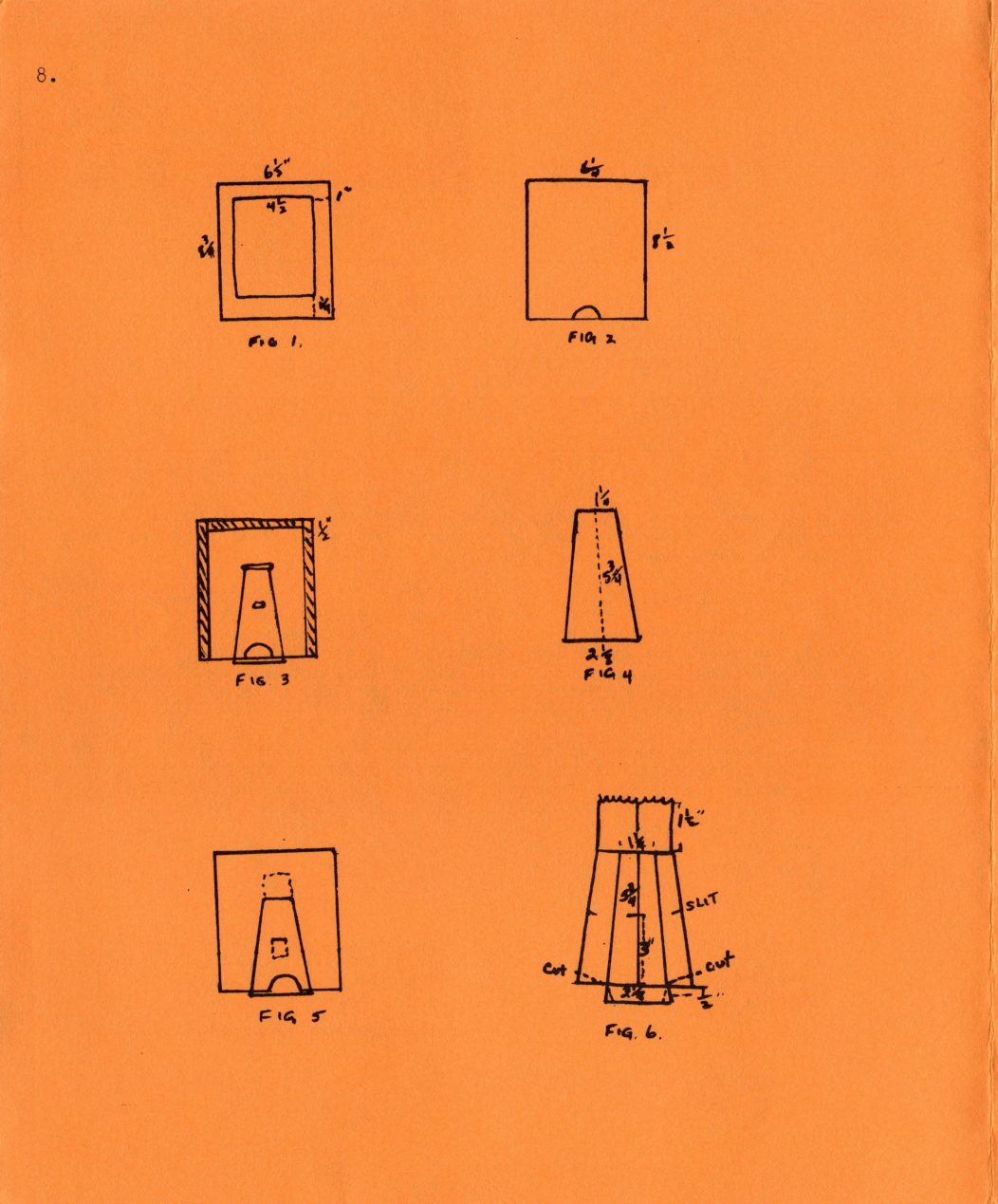
To put on an easel, you have to have a picture frame, so let's take a 5 x 7 print and start from there.
The opening for this print will be approximately 1/2" less than the size of the print... 4 1/2 x 6 1/2. The border for the frame will be 1" on 3 sides, and 1 1/4" on the bottom, giving us an overall size of 6 1/2 x 8 3/4. Fig. 1. Front Cut the millboard to the above measurements. Have the grain of the millboard on the back opposite to that on the front, to prevent warping. Smooth edges with a piece of fine sandpaper, using a piece of millboard as a block. Always rub across the edges, to prevent peeling.
Back The back is cut 1/8 inch smaller on all sides 6 1/4 x 8 1/2, and a half circle is removed on the bottom to allow for the print celluloid to be inserted. Fig. 2. Cut strips 1/2" wide to go on the back to make the space for the print, etc... These can be cut from millboard, or thin cardboard. Millboard can be split to give the desired thickness. Fig. 3. The leather for the face of the frame is cut 1/2" larger than the millboard. Skive edges, and also mark where picture frame will be, giving you a guideline for cutting the opening. Skive the inside edges also, but do not cut into the corner until ready to cement. Do the dying and any other decoration at this time. Finish with liquid wax or Polish Coat. To assemble, apply cement to leather and millboard. Place millboard on leather, which you previously marked for position. Bring up top and bottom first, then sides; making square turned corners. Be sure to press the fold in well before the final turn. Do the sare on the inside, cutting from corner of leather to corner of millboard. A small piece may be inserted under the corner, but it is not necessary, if the cut is neat. Put in press, or weight down until dry. When dry, the edge may be creased as desired.
The leather for the back should be very light weight, such as thin lamb skiver. Cut it 1/2" larger than the millboard. Use the same method for applying leather to millboard, using the square turned corners. For the curve at the bottom, slash to within 1/8" of curve, and fan out leather. This should also be trimmed to make a neat appearance.
Page 11
7. Easel The easel should be 2/3 length of frame, and 1/3 the width of frame at the bottom, and tapered at the top (5 3/4" long, 2 1/8" wide at the base tapered to 1 1/4" at top) Fig. 4. Cut this out of millboard, and lightly smooth edges. Place easel on sheet of paper and draw a line around edge. Draw a line down the center of easel which is used as a guide line. Now turn the paper up on each side of the easel, and fold over. You will see the centre line.. draw a line 1/8" on the far side of the centre line. Do the same with the other side. This is the lap over. Add 1/2" line below the bottom line, fold up, then fold in sides and mark where the angle comes at the bottom of the sides. Extend the centre line at the top and mark 1 1/2" each side, extend upward. This makes the piece for the hinge at the top. On the easel make a mark 3" up from the bottom. Put in slits 3/8" deep at this point on the pattern. This forms the opening for the spreader strip.
The spreader is made from a strip of skiver 1 1/4" x 4" folded lengthwise into three and cemented. You now have a paper pattern to use for covering the easel. Fig. 6. Now take the cardboard easel, and place it on the back..Fig. 3 and have it 1/8" below the bottom of the back, as it must be even with the front when assembled. Mark on the back the position of the 3" mark, and also draw a light line across the top. On the 3" mark, make a slot 1/8" wide and 1/2" long for the easel strap. On the top make a slot 1/8" wide and 1 1/4" long. Using the revolving punch and knife cut out these slots.
Now cover the easel with skiver using your pattern. The spreader piece is cemented to the easel, and comes out through the two slits in the sides. Cement in about 1/2". After the leather is put on, place the easel on the back, and slide the extension at the top through the large slit and turn upward. Put the spreader through the small slit, adjust it to the distance you wish, which will give you the angle the frame will sit, and cement the end in a downward position. Fig. 5. Using pieces of millboard on each side of the easel, press.
Finally the back is cemented to the front. (The easel should be even at the bottom with the front) Press over night. Cut an extra piece of thin cardboard, and a piece of celluloid, the size of your print and put in your favourite picture.
Turn page for diagrams....ceeeee
Page 12
This page is a dimensioned pattern plate, Figs. 1–6, for the picture-frame-with-easel-back project begun on the preceding page: Fig. 1, the frame front (6½" x 8¾" outer, 4½" x 6½" window, 1" border on 3 sides and 1¼" at the bottom); Fig. 2, the plain backing panel (6¼" x 8½"); Fig. 3, the backing with the easel's outline marked (½" border hatched); Fig. 4, the tapered easel strut (2⅛" base, 1¼" top, 5¾" centre line); Fig. 5, the easel positioned on the backing; and Fig. 6, the easel's lap-over strip, marked CUT at both edges and SLIT down the centre, with its own set of measurements (1⅛", 1¾", ¾", 3", 2⅛", ½"). No names.