
An issue of the Society’s newsletter, transcribed from the original.
(12 pages, 1.4 MB)
the full-resolution scan, 24 MB, for close research
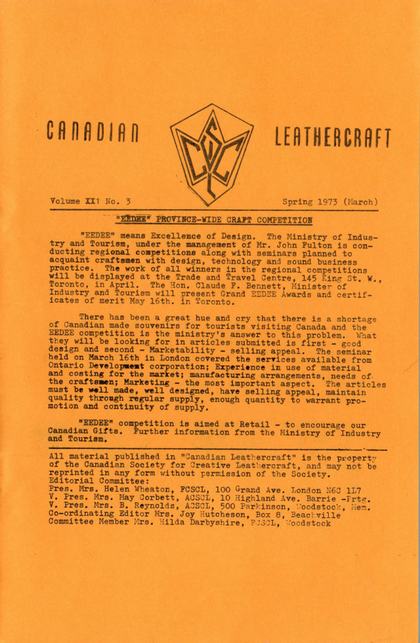
Page 1 — "EEDEE" PROVINCE-WIDE CRAFT COMPETITION
Canadian Leathercraft
Volume XXI No. 3 Spring 1973 (March)
"EEDEE" PROVINCE-WIDE CRAFT COMPETITION
"EEDEE" means Excellence of Design. The Ministry of Industry and Tourism, under the management of Mr. John Fulton is conducting regional competitions along with seminars planned to acquaint craftsmen with design, technology and sound business practice. The work of all winners in the regional competitions will be displayed at the Trade and Travel Centre, 145 King St. W., Toronto, in April. The Hon. Claude F. Bennett, Minister of Industry and Tourism will present Grand EEDEE Awards and certificates of merit May 16th. in Toronto.
There has been a great hue and cry that there is a shortage of Canadian made souvenirs for tourists visiting Canada and the EEDEE competition is the ministry's answer to this problem. What they will be looking for in articles submitted is first - good design and second - Marketability - selling appeal. The seminar held on March 16th in London covered the services available from Ontario Development corporation; Experience in use of material and costing for the market; manufacturing arrangements, needs of the craftsmen; Marketing - the most important aspect. The articles must be well made, well designed, have selling appeal, maintain quality through regular supply, enough quantity to warrant promotion and continuity of supply.
"EEDEE" competition is aimed at Retail - to encourage our Canadian Gifts. Further information from the Ministry of Industry and Tourism.
All material published in "Canadian Leathercraft" is the property of the Canadian Society for Creative Leathercraft, and may not be reprinted in any form without permission of the Society.
Editorial Committee:
Pres. Mrs. Helen Wheaton, FCSCL, 100 Grand Ave. London N6C 1L7 V. Pres. Mrs. May Corbett, ACSCL, 10 Highland Ave. Barrie -Frtg. V. Pres. Mrs. B. Reynolds, ACSCL, 500 Parkinson, Woodstock, Mem. Co-ordinating Editor Mrs. Joy Hutcheson, Box 8, Beachville
Committee Member Mrs. Hilda Darbyshire, FCSCL, Woodstock
Restored to match the page: the masthead's postal code "N6C 1L7" (not "N6¢"), "Woodstock, Mem." (not "Yoodstoc:, Mem."), and Hilda Darbyshire's line "FCSCL, Woodstock" (not "Fusil, vfoodstock"). May Corbett's role abbreviation "-Frtg." is printed exactly so — matching "Barrie-Printing" used for the same office in other issues — and is kept as printed. Also restored: a closing quote mark on the headline that had printed as an asterisk, "Hon." and "Tourism." where two commas should be periods, and a stray tilde dropped before "Marketability".
Page 2 — M6 - CANADIAN MASTER CRAFTSMEN
M6 - CANADIAN MASTER CRAFTSMEN Oct - Dec 1972
M (Master Craftsmen) 6 (6 Exhibitions) The Canadian Guild of Crafts received last spring an invitation from the Ontario Institute of Studies in Education to prepare an exhibition of crafts to run for about seven weeks opening on October 5, 1972 at OISE, 252 Bloor Street W., Toronto.
The Guild decided to honour the prize-winning craftsmen from their six most recent exhibitions - Craft Dimensions 1969, Make 1971 and Canadian National Exhibitions 1969-70-71-72. These craftsmen were invited to send their prize-winning pieces, or other articles of their own choice, and were sent a list of all invited craftsmen. While it was necessary to accept this invitation when received in the mail, it was not necessary to send in the entry forms or articles until after Labour Day. It was preferred that the work be for sale, and the entry form required that all entries be held by the Guild until July 1, 1973 for possible tour arrangements. '
The exhibition was set up in the library area on the 2nd floor. An official opening was held on the evening of Friday, October 6th, and was well attended. Refreshments were served on the 5th floor, courtesy of the Royal Trust Company.
This is a very pleasant space in which to hold such an exhibition, During the run of the show, a Guild of Crafts representative was in attendance daily. There was a small area for demonstrations which seemed to be constantly in use. With the exception of the large pieces -— leather sculpture and hangings the leather articles were in glass topped cases.
Because of the long absence of the work, not all the invited craftsmen were able to participate in this exhibition. A tour has now been arranged, and the exhibition will go from Toronto to Prince Edward Island, returning next July.
Sarah Kakfine -— Guncase with beaded stroud
Page 3
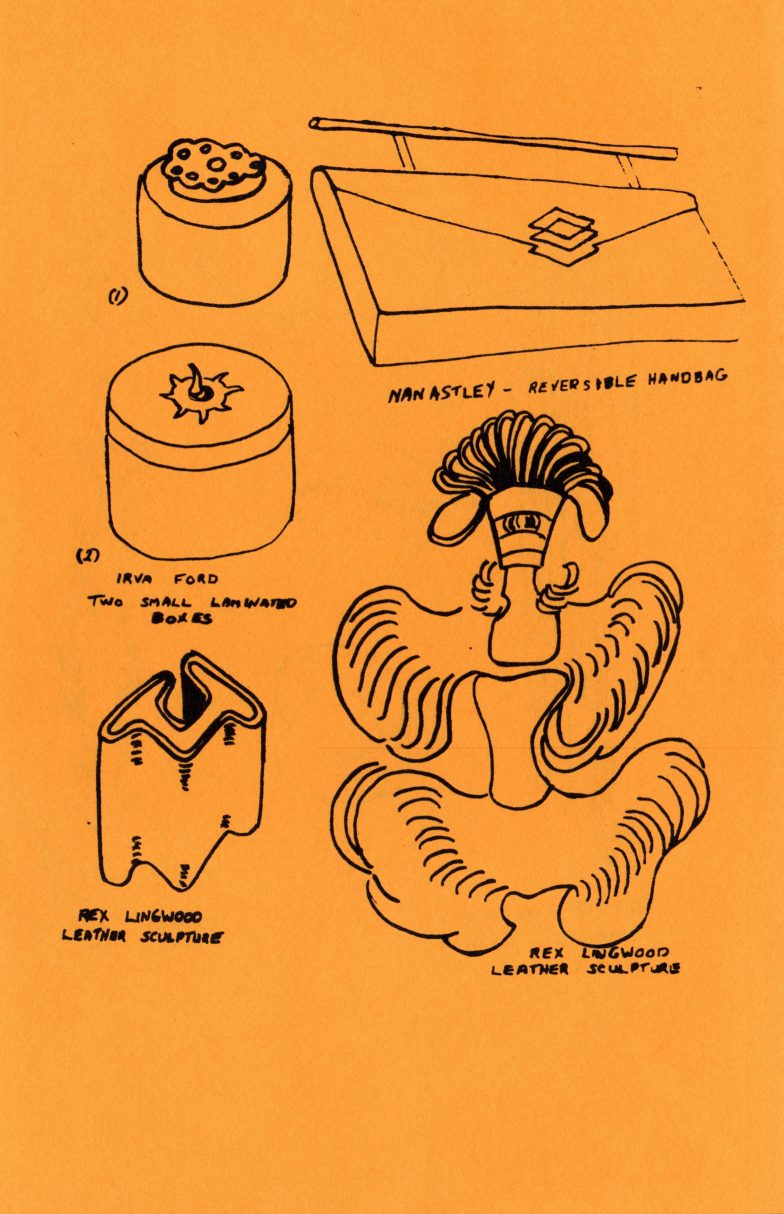
Nan Astley — Reversible Handbag
Irva Ford — Two Small Laminated Boxes
Rex Lingwood — Leather Sculpture
Rex Lingwood — Leather Sculpture
This page is a sketch plate of four leathercraft pieces, each captioned with a maker’s name and title in hand lettering. Irva Ford’s caption labels two numbered boxes drawn together as one entry; Rex Lingwood’s name appears under two separate sculptures.
Page 4
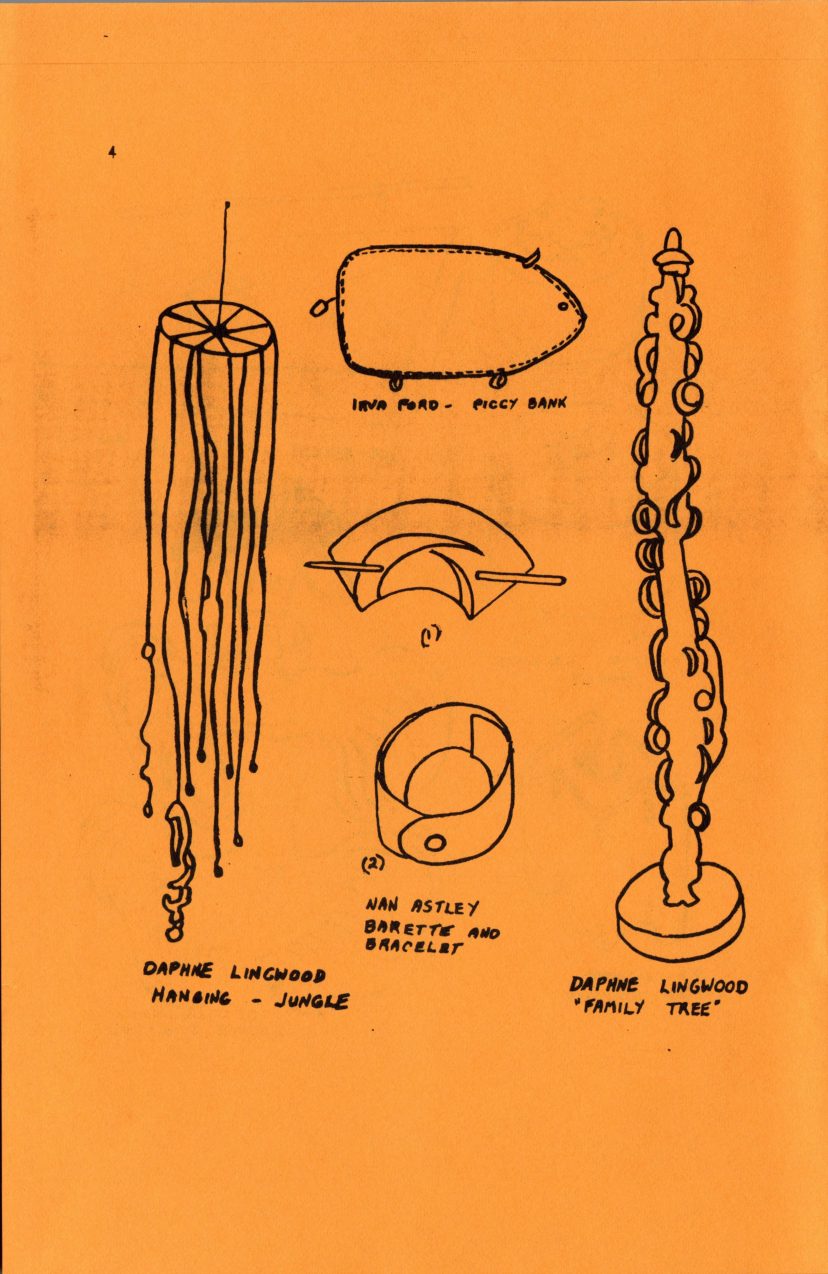
Irva Ford — Piccy Bank
Nan Astley — Barette and Bracelet
Daphne Lingwood — Hanging - Jungle
Daphne Lingwood — "Family Tree"
This page is a sketch plate continuing the M6 Canadian Master Craftsmen exhibition pieces, four pieces each captioned with a maker’s name and title in hand lettering.
Page 5
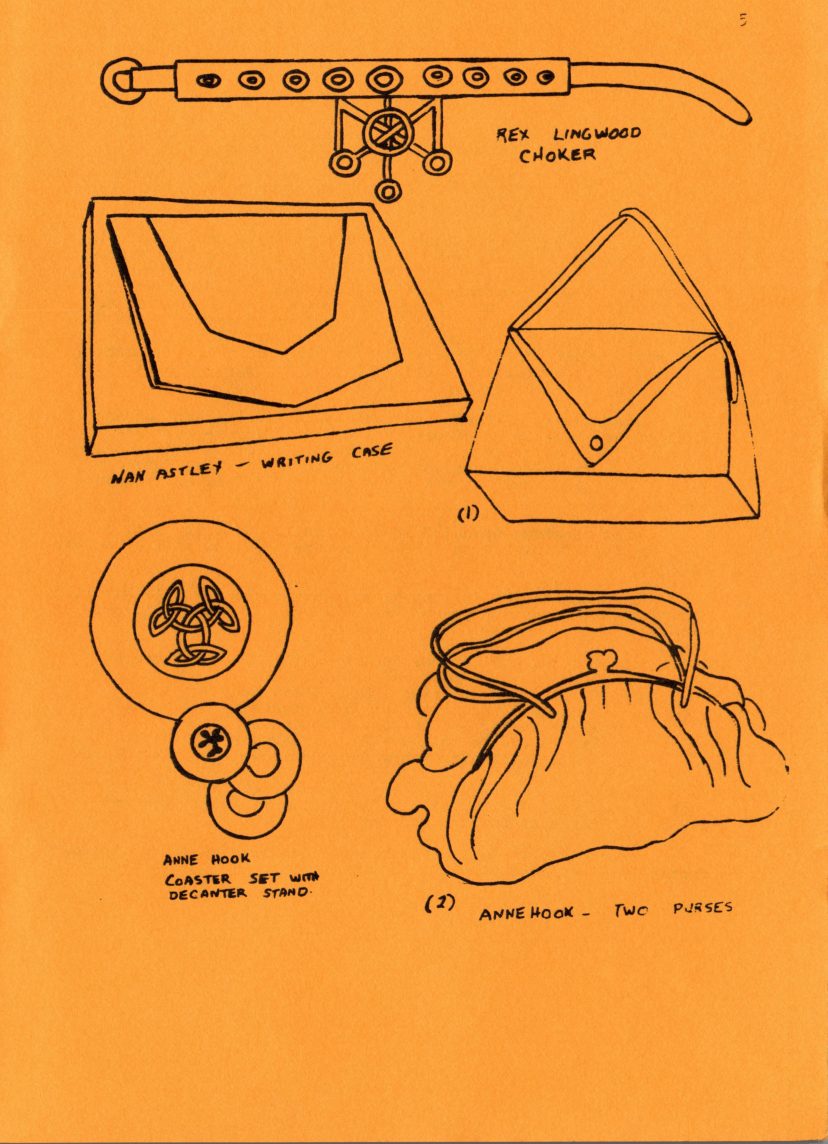
Rex Lingwood — Choker
Nan Astley — Writing Case
Anne Hook — Coaster Set with Decanter Stand
Anne Hook — Two Purses
This page is a sketch plate continuing the M6 Canadian Master Craftsmen exhibition pieces from the previous page, four pieces each captioned with a maker’s name and title in hand lettering.
Page 6 — WHO'S WHO IN CANADIAN LEATHERCRAFT
WHO'S WHO IN CANADIAN LEATHERCRAFT
Mrs. Helen M. Wheaton - London. Helen was born and received her education in London, she attended business college and worked as a secretary in personnel work.
She became interested in Arts and Crafts when she was recommended for a second year of Art instruction in high school. Helen was involved in Crafts at Y.W.C.A. Camp Orendaga in the summer of 1948, and attended an Instructors course in leather tooling under Mr. Arthur Burgess the winter of 1948-49, and received a certificate. In June 1950 she studied carving leather under the instruction of Mr. & Mrs. Jack McDougall. Helen became a charter member of the London Leather Carver's Guild and served as their first secretary. Later the London group became a Branch of the Canadian Society for Creative Leathercraft. Helen taught classes conducted by London Leather Carvers' Guild under supervision of Mrs. Margaret Jennings -— thus she gained experience in teaching Leathercraft. Also acted as chairman of the Examining Committee for the London Leather Carvers' Guild. She has served on the Executive of C.S.C.L. and London Branch.
Helen received Associate standing in C.S.C.L. in 1954, a Teaching Certificate"A" in 1957 and became a Fellow of the Society in 1965. Helen has taught in London, St. Mary's and Mitchell District High Schools; Kiwanis Boys and Girls Clubs; "Y" groups and privately.
Studied:   Tooling and General Leathercraft - Mr. A. Burgess
           Carving - Mr. Jack McDougall
           Tooling and Coloring - Mr. Robert Muma
           Leather & Design - Miss Eli Jorgenson
           Glove Making - Miss Jane Gribble
           Garnet Dye Technique - Dr. R. Larmour
           Saddle Stitching - Mr. Don MacKinnon & Mr. Ray Cherry
Helen has demonstrated these forms of Leathercraft at Annual Meetings, Fairs and exhibitions, International Assemblies and other gatherings of Leathercrafters.
She has served as Vice President for three years and is now serving as President of C.S.C.L.
Page 7 — AFFILIATES AND THE CANADIAN GUILD OF CRAFTS (ONTARIO)
AFFILIATES AND THE CANADIAN GUILD OF CRAFTS (ONTARIO)
by Paul Bennett, Executive Director, Canadian Guild of Crafts (Ontario)
For some years a number of craft organizations in the province have been affiliates of the Canadian Guild of Crafts (Ontario), because by paying membership fees they could lend support to the Guild in developing crafts in Ontario. Recently. the Executive of the Guild and the Presidents of the five affiliated organizations met to consider the future of these affiliates within the Guild. The Canadian Guild of Crafts (Ontario) is now a successful organization and in a position where it can assist with a list of benefits for the affiliates. The first is a Speakers Bureau. When an affiliate plans a meeting, and can give the Guild a month's notice of topic and date, the Guild will help to find a suitable speaker for that occasion. This Speakers Bureau will, of course, develop slowly as it's not practical to go out and find 20 or 30 suitable speakers and put them on a waiting list. We will act on an individual basis with each request. If, in turn, the affiliates have a good speaker on design or technique, etc., the Guild would appreciate being notified of this so that this individual could be placed on file for future engagements with other organizations. If a speaker is arranged through the Guild, the Guild will pay assistance to a maximum of 50% of the fee. This fund is for the fees and not for the travel and living expenses.
The next venture of the Guild will be to give prizes for design at the annual exhibitions of affiliates. This will amount to $25.00 for affiliates with 30 members or under, and up to $50.00 for affiliates with over 30 members. This prize will be given in the name of the Guild and is meant as an incentive toward good original design in any of the crafts. Each organization must apply for this prize when arranging its annual exhibition.
Next, the Guild is developing a slide library. For example, the recent exhibition "M6" at O.I.S.E. has been photographed and now a complete set of slides of that show is available. These can be borrowed by an affiliate for a $5.00 fee for the complete set of 150 slides, or a $3.00 fee for part of the exhibition relating to a specific craft such as ceramics or weaving. The slides are labelled, but there is no accompanying commentary. These slides could be part of a suitable evening programme. As other national shows come along they will be photographed and sets of slides offered to the affiliates.
The Guild's magazine, Craft Dimensions Artisanales, would welcome
One genuine figure is corrected here: the Guild's design-prize amounts are printed as "$25.00... $50.00", not the "$95.00... 350.00" read here at first. Also restored to match the page: "the province" (not "te"), "Crafts (Ontario)," (not "(Ontario:,"), "When" (not "'shen"), "the Guild will help" (not "tie Guild will kelp"), "this" (not "t»is"), "the Guild will pay" (not "tte Guild"), "in the name" (not "ir"), "can be borrowed" (not "or be borrowed"), "relating to a specific craft" (not "gelatin="), "slides offered" (not "slues"), and "Craft Dimensions Artisanales, would welcome" (not "craft... vovld").
Page 8
articles from affiliates on their activities. These could be notices of events taking place or reports on those events. Each affiliate should appoint a reporter to send this material to the Guild. It has been pointed out that many of the members of the affiliates are recreational craftsmen. The Editor will endeavour to print more articles aimed at this particular group.
The affiliates which have professional craftsmen as members, can apply for an exhibition in the Craft Gallery at 29 Prince Arthur Avenue, Toronto. These bookings are now being made about one year in advance. Normally, the Guild takes 33 1/3% on all sales from exhibitions in this gallery. However, for Guild affiliates 13 1/3% of this will be returned to the parent organization. It has to be stressed here that the Craft Gallery is attempting to present professional crafts to the public, consequently, this benefit of Guild membership is specifically aimed at the professional within the affiliate membership.
Each year the Guild has its annual meeting in April. The affiliates do send representatives. At the present time, as there are five affiliates with the Guild, each organization has its president as a member of the Board of the Canadian Guild of Crafts (Ontario). If the number of affiliates is greatly enlarged, this obviously is not a practical arrangement. It would be most suitable then to have the representatives of the affiliates at the annual meeting elect a number of members to the Board of the Guild. It is felt also that besides the annual meeting there should be a second meeting each year, perhaps in the fall, which would be specifically aimed at bringing the members of the affiliates together for a specific craft occasion. At this meeting a lecturer or demonstrator of national or international merit could present a suitable programme.
The above list of benefits has been developed to make it attractive for craft organizations in Ontario to become affiliated as groups with the Canadian Guild of Crafts (Ontario). The fee for becoming an affiliate is 50¢ per member of your organization to a maximum of $50.00. As well as the above benefits, each individual within an affiliate who wishes to become a member of the Guild can do so for $3.00 instead of $5.00.
In conclusion, why would an individual wish to become a member of the Guild? At the present time, the Guild has a membership of 1,100 people, either craftsmen or individuals interested in crafts. The Guild' s programme is as follows:
1. It produces a bi-monthly, bilingual magazine, Craft Dimensions Artisanales, which is mailed out to each individual member.
Two words are restored to match the page: "bookings" (not "boo:ings") and "In conclusion" (not "Im").
Page 9
2. The Guild has its retail sales outlet at 140 Cumberland Street in Toronto. This successful venture is 2n outlet for the professional craftsman and membership of the Guild also gives a 10% discount when purchasing items from the store.
3. The Guild recently opened its Craft Gallery at 29 Prince Arthur Avenue, and is developing a programme to put it on a par with the commercial art galleries.
4. Each year the Guild administers the only national annual juried craft competition in Canada. The results are seen at the Canadian National Exhibition in August in the Better Living Centre. A craftsman has to be a member of the Guild to enter this competition.
5. The Guild also sponsors important craft competitions for example, "Craft Dimensions Canada" at the Royal Ontario Museum in 1960, "Make" at the Ontario Science Centre in 1971, and in 1973, there will be "Entr'acte" at the O'Keefe Centre. At most of these shows the Guild hires professional craftsmen to act as demonstrators.
6. The Guild is aware of the new training possibilities for the young person wanting to become a craftsman. It encourages students in the craft schools such as Sheridan, George Brown, Seneca and Humber, offering awards and bursaries each year to worthy individuals.
7. The Guild is developing a permanent collection, and hopes eventually to have a Museum of Contemporary
Canadian Crafts. 8. The Canadian Guild of Crafts. (Ontario) has been honoured by the World Crafts Council by being given the administration of the Canadain section of the World Crafts Exhibition to be held at the Ontario Science Centre in the summer of 1974. 9. Finally, the Guild acts as a source of information for numerous individuals who write or phone asking for the names of craft teachers and the locations of courses, sources of supplies, sales outlets, etc. A large percentage of the time of the full time staff is involved in securing answers to these queries
The Canadian Guild of Crafts (Ontario) is 2 provincial branch of a non-profit national organization directly concerned with fostering and development of Canadian crafts. Over the years
"Seneca and Humber" is restored to match the page (not "'lumber" — Humber College, Toronto). "Canadain" (for Canadian, item 8) is printed exactly so, and kept as printed.
Page 10 — TIPS
the Guild has presented many programmes designed to develop crafts and encourage public appreciation. The Board of Directors of the Guild sincerely hopes that the programme it offers both to the individual member and to the affiliated groups is attractive enough that the craftsmen of Ontario will want to become members of the organization.
TIPS
When using spirit dyes - it is a good idea to soak the dye applicator in mineral oil first. Excess oil should be blotted off on scrap leather. This treatment provides a great deal more control when building up eveness in dye tones.
An untreated applicator tends to suck up unnecessary quantities of dye. When the untreated applicator first comes in contact with the leather to be dyed, the bulk of the dye is exhausted at the point of contact, leaving a heavy concentration in one spot.....Note....This tip is for oil and spirit solvent dyes only.
Dye stiffens leather, including lacing. To make lacing more flexible after dyeing rub with vaseline (petroleum jelly). It can be used as a conditioner on smooth grain leathers. The vaseline is applied with the fingers and rubbed onto the lacing, let stand for 15 to 20 minutes and then wipe off well with a soft cloth.
Don't forget the Membership fees for C.S.C.L. are due April 1, 1973. If you are a member at large, and have not already sent your fee please mail to:
167 Emerson Street
HAMILTON, Ontario L8S 2Y1
["Eveness" is printed exactly so on this page and is kept as printed.]
Page 11 — READ ANY GOOD LEATHERCRAFT BOOKS LATELY?
READ ANY GOOD LEATHERCRAFT BOOKS LATELY?
Leather Craftsmanship
Author: John W. Waterer RDI.FSI.FSIA.
Published by G. Bell & Sons Ltd., London, England
This book is more a history of leather craftsmanship, than a working textbook in leathercraft, and ranges over a period from 1780 —- 1580 B.C. to 1967 A.D. and is so fascinating that a renewal from the library is the rule rather than the exception, The author is Hon. Sec. to Museum of Leathercraft in London, Fellow of the Society of Antiquaries, designer and organizing producer of modern leather goods and has spent a lifetime in the trade.
His aim, to show how craftsmanship in leather is developed from early times:and spread into many fields of use, each with its own particular techniques requiring different skills and yet linked by a community of interest in fundamental mastery of material, methods and tools.
The reader is first given an explanation of what leather is and how it is made, followed by glossaries more comprehensive than anything so far provided in a book of this kind, of many different kinds of leather (which are also illustrated), with brief descriptions of processes and tools, the latter being pictured on a unique set of composite plates.
Then, in the major sections of the book, follow descriptions, arranged under four headings, of the principal ways in which the leather has been used, and is used to-day, illustrated with a splendid collection of pictures which are a special feature of the book.
Modern Leather Design
Author: Donald Willcox
Published by Watson-Guptill Publications,
New York, U. S. A.
In contrast with the book mentioned above, Modern Leather Design fills a need for a book on contemporary leather design. Photographs, diagrams and detailed instructions combine to show how
Page 12
to design and make everything from sandals and handbags to sculpture and furniture.
Donald Willcox is a native of Minnesota, and has exhibited his leather designs throughout the United States. His is the new concept in leather, giving the reader much food for thought in creating "something different".
The author begins by reviewing the history of leather design, and surveying the possibilities of leather as a contemporary medium. In succeeding chapters he covers the curing of pelts, tools and techniques. There is even a section of suppliers of everything from Abrasive paper to Zippers, There is a final chapter on how to open a shop and sell your leather.
This is a book to set the craftsman thinking and creating, well written and full of technical know-how. Fortunate is the craftsman who possesses copies of these two books - however, both are available through your public library, but be prepared to go on the waiting list for then.
So, put down your modeller, wash the leather dye from your hands, and curl up in your favourite chair, with either or both of these books, you won't regret it.
Sincerely,
The Woodstock Book Worm
Hilda Darbyshire
The Annual Meeting is to be held May 5, 1973 starting at 9 a.m.. This is to be hosted by the Toronto Branch at the Central United Church, corner of King and Weston Road, Weston.
This will be an opportunity to display your year's work. Our Host will be supplying a special table for our "Experiments with Leather" and "Just for Fun" articles owing to the favourable response received from our branches.
Remember to send in your problems for the question box held during the morning session.