
An issue of the Society’s newsletter, transcribed from the original.
(12 pages, 2.4 MB)
the full-resolution scan, 35 MB, for close research
Page 1 — LEATHER, NATURE'S GIFT TO MAN
Canadian Leathercraft
Volume XXI No. 4 Summer 1973 (June)
LEATHER, NATURE'S GIFT TO MAN
E. R. Burgess
Leather has been a part of men's life throughout their history. Cave men used it to clothe themselves and to protect their feet; wandering tribesmen, having found that leather
"breathes" used it to make containers to keep their water cool. Early civilizations used it as a mark of prestige; Egyptians buried their kings with their prized leather articles around them: Greeks and Romans accorded each other prestige according to the number of quality leather articles they owned. To this day a well-crafted leather piece is prized by discriminating people.
Oak bark tanning, the process used to tan our leather today, was first initiated by the early Hebrews and first introduced into Canada in 1651 by a tannery founded in Levis, Quebec. Since that time the industry has grown to the point where 2,500 Canadians are employed in tanneries and another 25,000 in related industries. Within the last year, however, difficulties have arisen in the leather industry which are increasing to threatening proportions. By 1975, it is feared, most of the jobs in this occupational field will have disappeared; the tanneries will be closed and Canadian leather will be unobtainable.
All material published in "Canadian Leathercraft" is the property of the Canadian Society for Creative Leathercraft, and may not be reprinted in any form without permission of the Society.
Editorial Committee:
Pres. Mrs. Helen Wheaton, FCSCL, 100 Grand Ave. London N6C 1L7
V. Pres. Mrs. May Corbett, ACSCL, 10 Highland Ave. Barrie - Prtg.
V. Pres. Mrs. B. Reynolds, ACSCL, 500 Parkinson, Woodstock, Mem.
Co-ordinating Editor Mrs. Joy Hutcheson, Box 8, Beachville
Committee Member Mrs. Hilda Darbyshire, FCSCL, Woodstock
Reporters this issue - Hamilton Branch
[p1: "sre" is set out here as "are".]
Page 2
What are the reasons for this? The most serious is the importation of shoes. In 1960 fifty percent of our shoes were imported; in 1972 this percentage rose to seventy five. Another is the spiralling costs of hides, caused by a general world shortage plus an artificial shortage created by the Argentine government which put a total embargo on the export of hides. The Argentine formerly supplied one quarter of the world's needs. Again, devaluation of the pound sterling has drastically raised Canadian prices to the point that we cannot compete on the world market. England's entry into the European Common Market has ended our preferential treatment there and stopped our sale of duty free hides and leather goods.
We must ask the government to help now. Foreign shoes are made in countries where the cost is subsidised and wages are low. Even new machinery is provided by the governments and the best production procedures are employed. Hence imported shoes are cheaper. Imports in two years time will grow to 41 million pairs of footwear, reducing Canadian made shoes to 18 million .
In addition to these practical considerations, we must consider the creative talents of the artisans. Are they to be lost? At the present time the Canadian government is stressing the importance of Canadian Culture which is indeed enhanced by in leisure time. Canadian souvenirs not made in a foreign country are difficult to find. Should we not encourage craftsmen to develop this media with a Canadian flair? Also, as machine made articles flood our markets, should we not be stressing the artistic value of hand made creative art? When our government is discussing and contemplating instituting the shorter work week, why is creative craftsmanship being discouraged?
It behoves all of us to bring pressure to bear on the governments both federal and provincial to preserve the leather industry before it is too late. Even now it is difficult to purchase good leather. If we do not act now, one of Canada's basic resources, founded in 1651 will be obsolete by 1975.
What must Canadian Leathercrafters do? Write both your provincial and federal members of parliament immediately and ask them to use their influence to preserve the leather industry. Persuade your friends to write too. More mail means more action in parliament - where action counts!
....Source of facts: The Tanner's Association Report of 1972....
The printed page carries small marks in its left margin, one of them beside “lost?” and one beside “them” in the closing paragraph
Page 3 — LEATHER GARMENTS
LEATHER GARMENTS
Irva Ford F.C.S.C.L.
In 1971 the Artisans' Guild of Hamilton was given permission to adopt our General Leathercraft Standards drawn up by our Standards Committee for C.S.C.L.. Recently the Artisans' Guild drew up standards for Leather Garments which C.S.C.L. asked their permission to copy. You will find these standards published in this issue of "Canadian Leathercraft". In the following article on Garment Making you may find some helpful information which will enable you, when making leather garments, to comply with the standards.
A garment is simply any article of clothing worn as a covering. Leather garments include the whole spectrum of apparel: Skirts, Jackets, coats, jerkins, ponchos, capes, hats and whatever else can be defined as a garment. Garments are not restricted to any one type of person; leather is worn by men and women, teenagers and children of all ages; by short people, tall people, thin people and fat people, by anyone who wears clothes. At the present time leather is IN. For years leathercraft was devoted to stamping, carving and tooling. Contemporary design has changed this image.
With the endless array of styles to-day, it would be impossible to present a thorough outline of clothing in terms of leather styling, assembling and sewing, therefore, only basic procedures and techniques which can be applied to almost any pattern will be presented. Because leather isn't as pliable as weave fabric, it therefore lends itself more successfully to garments that hang loosely or that do not "tuck in" like blouses or shirts. Leather adapts itself to simple construction and simple patterns. Avoid as many seams, darts, puckers and gathers as possible.
Many pattern companies like Simplicity, now have developed styles that can be made from either woven fabric or leathers. "Sewing with Leather" is an excellent little book which can be purchased at Tandy's or Lewiscraft for only 50¢. For in depth detail, there's Krohn and Schwebke's book "How to Sew Leather, Suede, Fur." It is recommended that you buy e commercial pattern tut remember a pattern is only a general style in a specific size. There's no rule to say it cannot be changed. So don't abandon your own ideas just because you can't find them duplicated in a ready-made pattern. Restyle and adapt that pattern to fit the design innovation you originally had in mind. In this way the garment design will still be uniquely your own.
The basic requirements for garment leather is that it is soft and pliable. Goat, calf, cow, horse, deer, elk, buckskin,
Page 4
antelope and others are readily available. Suede is a good choice for beginners. Most garments require two to three ounces leather but outdoor garments can be three to five ounces weight depending on whether they are lined or not. Imperfections in skins should be avoided. Weak spots may be reinforced if necessary. Buy all the leather at one time from the same tannage to assure uniform colour.
Leather is measured in square feet, but cloth is figured in yards. The converting factor is nine if the footage is calculated from 36" fabric requirements. But if the footage is based on a pattern using 54" fabric, the converting factor is thirteen.
Then add 15% for large skins and 20% for small skins. Example: To convert 3 yards of 36" fabric, multiply 3 x 9 = 27. Then add 15% (or 20% if skins are small) 15% of 27 equals 4.05. The sume of. 27 and 4.05 = 31.05. The footage of leather required is 31.05 square feet or 3 yards of 36" fabric. If converting 54" fabric multiply by 13 instead of 9 and proceed as above. Then if you are still in doubt about the footage of leather to buy, take your pattern with you when you purchase your leather and place the pattern on the leather. Skins have grain that runs lengthwise from head to tail. Pattern pieces placed 'WITH the grain usually drape more satisfactorily and have less stretch. Collars and trim pieces are the exception. Trim may be glued or sewn to solid pieces of leather as opposed to being cut from the original length. In this way you have less waste. When working with suede be sure the nap of the grain is matched, giving an all over even shading for the entire garment. The most uniform skins should be used for the sleeves and fronts. Do not fold the leather; flip your pattern or cut a second pattern and place the two patterns side by side. Reverse pattern when cutting sleeves and fronts. Trace around the pattern with chalk or pens, use weights to hold pattern in place, pin pattern in the seam allowance or use tape. If desired extend bottom of pattern to allow for fringe. Ordinary sharp household scissors, a pair of leather shears, razor blade or knife may be used for cutting leather. Cut ample length for sleeves because they cannot be let out as cement and needle holes will show. Leather has a delightful quality of adapting itself to the contour and movement of the wearer.
: Garments may be sewn by hand, by machine, or laced. Silk thread is most highly recommended for fine sewing but polyester dacron may be used. Nylon thread is not as good because it picks up lint. Heavy waxed linen thread is also good for hand sewing heavier leather. <A thimble may be made out of leather. Always start stitching and sewing from the top of the garment and work down. When using a machine, use a longer stitch. Usually the presser foot needs to be released slightly. Needles for sewing leather may be purchased wherever regular needles are available.
[p4: eight readings set out here as printed: "antelope" (leather types list), "Most garments" (not "West"), "Buy all the leather" (not "c. leather"), "based on a pattern using 54\" fabric" (not "2a pe"), "To convert 3 yards" (not "t« convert"), "working with suede" (not "waking"), "Trace around the pattern" (not "wound"). "take your pattern with you" is completed by context — the line's right margin is cut off in print (several line-ends on this page lose their last character or two the same way), so "pattern" is filled in from the unambiguous sense of the sentence, not read off the page.]
Page 5
If the leather is very stretchy, it may be necessary to cut seam tape the exact length of the seam, clip it to the seam and then sew. Seams and darts should be pounded open with a rubber mallet or pressed open with a creaser. Skive the seams to reduce bulk. Seams lie flatter if they are cemented down, pounded open and then lifted up again. They then fall into place with less tension and pull. Use only rubber cement as it remains flexible and avoid excess cement. Tie threads at the end of the line. Do not back stitch. On curved seams, cut edge to allow seam to lie flat. Light weight leather can have either machine or hand bound button holes. Never hand sew hems. Skirt bottoms may be left unturned if edges are finished. For hems, fold over and press hem. Cement the upper half only and pound flat. If skirt is flared, cut slits every 6" to 8" along the hem excess in order to keep it flat when it is cemented down. Where the sleeve is normally basted, it can be cemented. Once fitted, it can be machine sewn. Leather garments may be pressed with a warm iron providing a press cloth, brown paper or tissue paper are used over the leather.
Interfacings of canvas or non-woven fabrics like pelon are desirable for light weight leather garments to shape retention. Leather against bare skin or against some materials has a tendency to cling to jackets, trousers and coats are better lined. Colour fast satin, taffeta or rayon twill are most commonly used.
Many excellent conditioners and cleaners can be found on the market to-day. Conditioners soften, nourish, resist scuffing and colour fade. Do not use a conditioner that leaves a residue. Goddards Saddlers Wax and Meltonian shoe cream are two products that are used widely by.leathercraftsmen. Saddle Soap is used for cleaning smooth grained leather. Silicone Suede Saver, which is sold ingram cans, makes suede more spot resistant and water repellant. A glue ball is useful for removing rubber cement. To make one, pour a little rubber cement on a piece of glass or marble. After it dries, roll it into a ball. Then use the ball as an eraser. This is particularly good for removing cement from zippers! Art gum or sandpaper and then a brush are good for suedes. 'Two other suggestions which were offered at the C.S.C.L. Annual meeting were cornmeal and Fuller's earth. <A damp sponge is also good. Commercial spot removers are inclined to remove the colour as well as the spot so it is better to cover the whole area and be prepared to redye the article if colour fades. Deerskin, buckskin and elk may be washed with mild soap and warm water in an automatic washer, but to avoid wrinkles, do not spin dry. Hang garment on a wooden hanger and drip dry. Do not squeeze or wring if wrinkles are to be avoided.
Elk and buckskin are more stretchy than other leathers. Before making your garment, soak hide in water, tack to wall or board and stretch tightly as you tack.
Page 6 — Standards for Leather Garments
Leather is the strongest fabric in the clothing industry. It goes through the tanning process, tumbled in drums, soaked in chemicals, stretched, dyed and resoaked. If you make a leather garment then relax; you are wearing the next best thing to an iron shield.
Standards for Leather Garments
Design 1. The design must originate with the craftsman.
2. Commercial clothing patterns may be used if distinctly altered in detail.
3. Design and materials must be suitable to the stated purpose of the piece.
Construction 1. The leather must be pliable. Uniformity in weight and colour is desirable.
2. Weak spots and holes in the leather are not acceptable.
3. Matching skins must be used unless an integral part of the design.
4. Garments must be cut with the grain.
5. Nap must run in the same direction unless an integral part of the design.
6. Seams are to be strong, smooth, flat, not bulky, and neatly executed.
7. Closings are to be neatly finished and should function correctly, e.g..buttonholes must be the correct size for the buttons, zippers must operate without catching.
Finishing 1. Proper and suitable finishing of the garment.
2. Hems are desirable if suited to the design, but may be left for later completion.
3. Edges of leather garment must be finished, e.g. seams, hem edges.
4. Lining, if used, to be of suitable quality, and properly fitted.
5. The best available quality of findings, suitable to the article, ae to be used.
6. Glue, where used, must not show.
7. Outdoor garment leather should be weather proofed by the craftsman, e.g. smooth surface to be waxed suede to be siliconed.
8. Instructions for the proper care of leather, included with the garment, is desirable.
Page 7 — LEATHER '74
LEATHER '74
The Third Exhibition of the Canadian Society for Creative
Leathercraft will be held during the whole month of June in 1974 at the Forest Hill Learning Resources Centre, 666 Eglinton Avenue West, Toronto 10, Ontario. This show will be held in conduction with the World Craft Exhibition for Western Ontario, sponsored by the Hamilton Artisans' Guild, to be held at Hamilton Place, and many other craft shows.
Thousands of visitors will come to Toronto to attend the World Craft Conference and to see the exhibits from 72 countries. Many delegates and visitors from that conference are expected to visit our Exhibition while they are in the city.
Leathercraftsmen should start now to plan their exhibits for this important event. Exhibitors for Leather '74 will receive ribbons. The show will be juried and prizes will be awarded. You will receive entry forms early next year.
We have exactly one year in which to create some fine crafted original entries. When June 1974 arrives, let us be ready. Make Leather '74 an Exhibition of which we, the members of C.S.C.L., may justly feel proud.
Irva Ford
Exhibitions Chairman.
On April 12th, the President and Vice President attended the Annual Meeting of the Canadian Guild of Crafts held at Canada Life Building. A very successful year was reported. Grants were given to six young Canadian craftsmen. An award winner from past years told about work and studies in Europe. The special speaker of the evening was the Secretary General of World Craft Council, Mr. James Plant.
On the 12th of May, the President, Vice President and Secretary attended the Annual Meeting of Ontario Craft Foundation at the Ontario Trades and Tourism Centre, Toronto. In the afternoon, a seminar was conducted by the Ministry of Trades and Tourism. Following dinner, the EEDEE awards were presented and our own Irva Ford was one of the top four winners. Irva submitted a belt for which she was awarded a beautiful trophy accompanied by a sizeable cheque.
Page 8 — 1973 ANNUAL
1973 ANNUAL
Toronto Branch hosted a very successful Annual Meeting on Ribbons were presented to the exhibitors participating in the juried exhibitions held in Toronto 1970 and in Woodstock 1972.
The Weston Trophy was awarded to the Toronto Branch with a mark of 83.65.
Two members attained their Associate standing, Itsuko Yasui of Toronto and Marion Bridge of Hamilton. Itsuko was awarded the Zalitis pin for the highest marks for 1973.
Lunch was served at noon. The afternoon session of interesting demonstrations began at 1:30. The demonstrations consisted of Filigree Carving, Dyeing, Explanations of Garment Standards, Sewing Slipper Kit, Picture frames with easel backs and an Information centre manned by the Fellows.
At 6 p.m. a delicious smorgasbord was served by the ladies of the church. After dinner speaker was Mr. Paul Bennett, Executive Director of the Canadian Guild of Crafts who brought to our attention the great number of activities that are going on in Canada in preparation for the World Craft Cowneil. This will be held in York University, Toronto during June 1974. A suitable gift was given to Mr. Bennett by Norbert Steffan in appreciation of his very pertinent remarks regarding the status of crafts in Canada, The Toronto Branch then presented a programme of Highland dancing by "Gladys Forrester" School of Dancing accompanied by a Piper.
During the day, draws were made for the many interesting articles donated by members of the Guild. i
Leather in belts -— Narrow now —- and in design simplicity is elegance.. Leather buckles, leather ties, colour is the name of the game.
Leather in hats - Leather hats with large floppy brims and decorative braid that ends in streamers down the back.
Leather in ties - For the men if the women don't find them first. Choose your own width and texture. Create your own design by tooling, carving, even weaving.
Page 9 — WESTON TROPHY COMPETITION 1973
WESTON TROPHY COMPETITION 1973
BARRIE 79.75
| Bottle | Very pleasing. Wise judgement in using the raised lettering to advantage. It is questionable whether the leather should have been carried to top of bottle neck. |
| Wallet | Very pleasant to look at. More care could have been taken in spacing the punch holes and edge creasing the interior. |
| Calendar Holder | Useful article with pleasant design. The turned edge could have been skived to better advantage. |
| Passport Folder | Well tooled design, very neatly constructed. Has a professional look. It is unfortunate that the dome is off centre, throwing the closed article off balance. |
| Jewel Box | An elegant piece of work. The built up construction of brown paper and animal glue was built up around a wooden form to the desired thickness that would give rigidity to the article after the form was removed. This technique has been demonstrated at our Annual Meeting. This was covered with Mission grain, which was dyed after the box was constructed. |
HAMILTON 78.38
| Handbag | Pleasant looking bag, very carefully antiqued, leaving the undecorated portion clean looking. Excellent carving except decorated cuts. Handle very well finished. |
| Belt | Excellent piece of work. Ingenious fastening. A good example of what can be achieved with a piece of belting leather. |
| Clutch Purse | Well proportioned clutch purse, but clasp should have been closer to edge of flap to prevent edge from curling. Creases could have been avoided by placing design to either side instead of centre. |
| Tray | Outstanding sturdy tray. Well moulded, and a good colour job. |
| Mask | Technique well executed. More originality could be desired. |
LONDON 76.13
| Holster | Very pleasant article to handle. Colour and contrasting textures are appealing to the eye. A handsome piece of work. |
[p9: this whole page is a two-column table (item name, judge's critique); read straight across instead of column by column, the Jewel Box/Handbag/Belt paragraph and the branch score headings weld into the critique text. Set out below row by row, following the branch order BARRIE 79.75 / HAMILTON 78.38 / LONDON 76.13 printed on the page. Two small readings also set right: "Wore care could have beer taken" as "More care could have been taken" (Wallet), "Wore originality" as "More originality" (Mask).]
Page 10
| Tray | Well balanced tray. Flower rather overpowering for dimensions of tray. Edges are very well finished. |
| Wallet & Key Case | Interesting set. Lacing well spaced and neatly done. If this is to be a matched set, the decoration on each should be the same. |
| Pocket Secretary | A nice slim well crafted article. Would have been improved if the ticket and window pockets had followed the same line as the rest of the interior. |
| Mobile | A new idea in leather. Very colourful and well balanced. Some variation in length and shading might have proved interesting. |
TORONTO 83.65
| Purse | A perfect dye job. A classic style of framed handbag, both dressy and tailored. Opens well with comfortable handle. Lining of handle is generally finished over, not underneath, the tab ends. |
| Letter Holder | A beautiful dye job. Leaves should have been rigid. This could have been achieved by counter sinking through first layer. |
| Box | A perfect box, with a beautifully fitted lid. |
| Gloves | A very attractive pair of gloves. There appeared to be some difficulty in inserting the thumb in right hand, and also the small finger fourchette. |
| Tray | Fine example of what can be done with light weight sole leather for small trays. The contrast in dye job and texture make it very interesting. |
WOODSTOCK 79.51
| Portfolio | Excellent workmanship. Saddle stitching well done, but inside stitching should have been countersunk to avoid wearing. |
| 3 Candle Holders | Very fine workmanship with striking design. Skiving at top of each is superb. |
| 2 Candle Holders | Very well done, but would be dangerous to carry by handle only. |
| Butterfly Letter Holder | Colorful piece of work. Might be improved by having a heavier base. Edges are beautifully skived, but might be fragile for constant use. |
| Pendant & earring set | A difficult design to execute perfectly. Very good colour job. Plain piece of thonging might perhaps look better on this piece than the braided. |
[p10: continues the WESTON TROPHY COMPETITION 1973 table from p9 (LONDON, then TORONTO 83.65, then WOODSTOCK 79.51), set out below row by row on the same pattern as p9; "fray" is set out as "Tray" at the top of the London section.]
Page 11
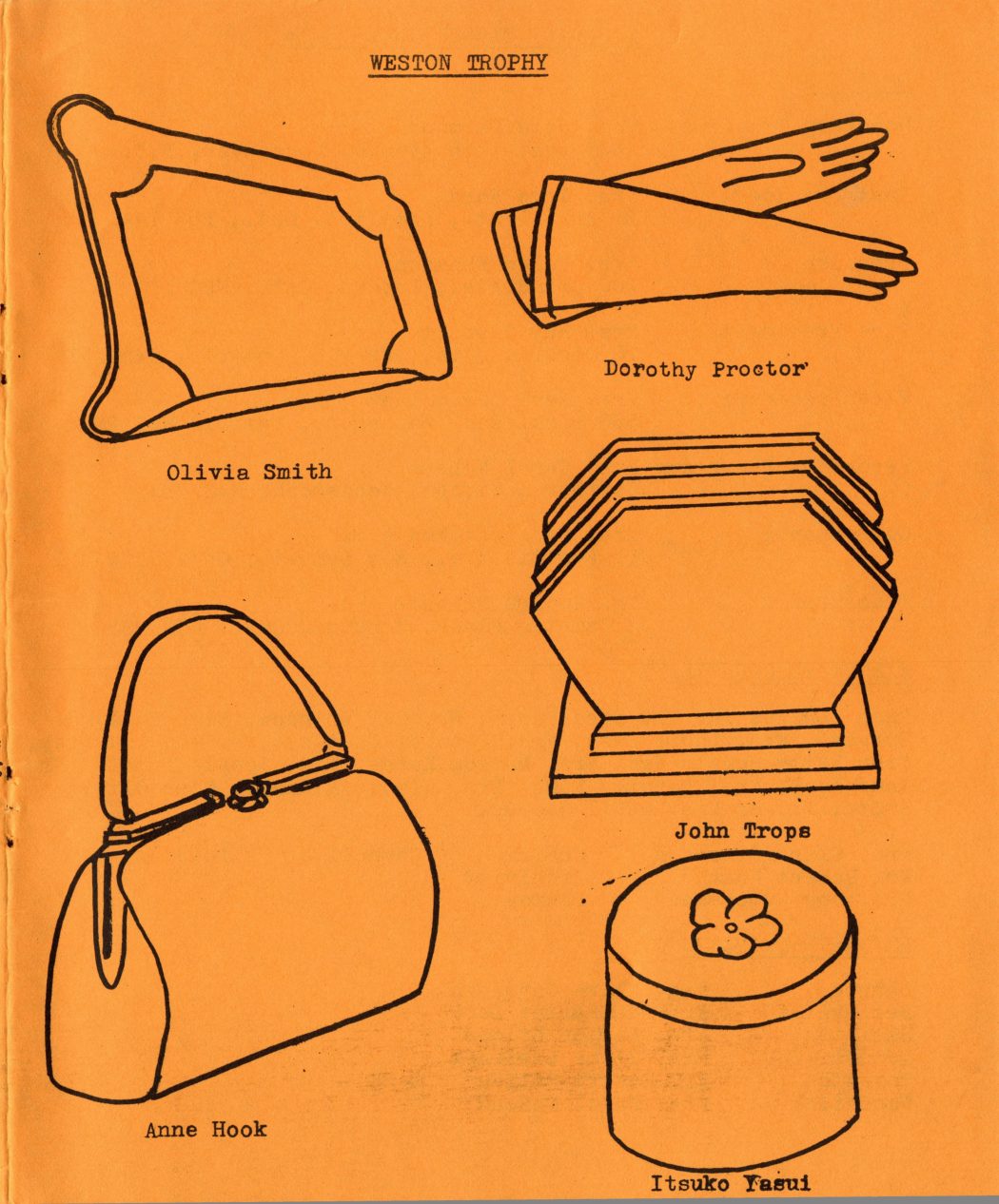
Weston Trophy
Itsuko Yasui
[This page is a sketch plate of five Weston Trophy pieces, each captioned with a maker’s name and no further description. Olivia Smith and John Trops are easy to miss entirely; both are added here. "John Trops" prints exactly so on the page.]
Page 12 — C.S.C.L. EXECUTIVE 1973-74
C.S.C.L. EXECUTIVE 1973-74 OFFICERS -
Honorary President Mrs. Reta Larmour
1645 West 14th Avenue, Vancouver, B.C.
| Past President | Mrs. Irva Ford |
| 30 Arkell St., Hamilton, Ont., L8S 1N4 | |
| President | Mrs. Helen Wheaton |
| 100 Grand Ave., London, Ont., N6C 1L7 | |
| Vice President | Mrs. May Corbett |
| 10 Highland Ave., Barrie, Ontario, L4M 1N1 | |
| Vice President | Re. Beula Reynolds |
500 Parkinson, Woodstock, Ontario N4S 2N6
Recording Secretary Mrs. Carol Mclean
555 Huron Street, Woodstock, N4S 7B1
Corresponding Secretary Mrs. Margaret Monteith
51 Beattie Ave., E., Lambeth, Ont., N5W 2P1
Treasurer Vr. George McPhail
3 Lambton Place, Toronto, Ont., M5N 2B2
EXECUTIVE COUNCIL
Miss Bea Austin, Nr. Fred Brown, Wr. Gel Brigden, Miss Evelyn Burgess, Mrs. Laura Bush, Mrs. Eleanor Coutts, Mrs. Kay Coughley, Miss Betty Henstridge, Mrs. Marion Kehoe, Mrs. Jessie Little, Mrs., Anne Hook, Mrs. Dorothy Muma, Mrs. Gladys Riddell, Miss Olivia Smith, Mr. or Mrs. Cecil Roebuck. "
| \rs. Clara Cavanagh | Chairman of Council of Fellows |
| Nr. Robert Muma | Archivist |
| Mrs. Joy Hutcheson | Editor |
Branch PRESIDENTS
| Barrie | Mrs. Clara Cavanagh |
| Belleville | Mrs. Katharine Lough |
| Hamilton | Mrs. Marion Bridge |
| London | Mrs. Ilene Lawrence |
| Toronto | Nr. Robert Sutton |
| Woodstock | Mrs. Carol Mclean |
[The Executive Council list prints "Kay Coughley" (no "l" after the C) — a different spelling from the well-established "Kay Cloughley" the Society prints elsewhere; each page keeps the spelling it prints.]