
An issue of the Society’s newsletter, transcribed from the original.
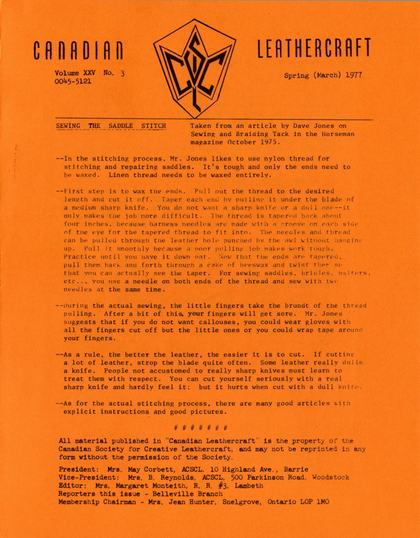
(8 pages, 1.2 MB)
the full-resolution scan, 21 MB, for close research
Page 1 — SEWING THE SADDLE STITCH
Canadian Leathercraft
Volume XXV No. 3 Spring (March) 1977
0045-5121
SEWING THE SADDLE STITCH
Taken from an article by Dave Jones on Sewing and Braiding Tack in the Horseman magazine October 1975.
--In the stitching process, Mr. Jones likes to use nylon thread for stitching and repairing saddles. It's tough and only the ends need to be waxed. Linen thread needs to be waxed entirely.
--First step is to wax the ends. Pull out the thread to the desired length and cut it off. Taper each end by pulling it under the blade of a medium sharp knife. You do not want a sharp knife or a dull one--it only makes the job more difficult. The thread is tapered back about four inches, because harness needles are made with a groove on each side of the eye for the tapered thread to fit into. The needles and thread can be pulled through the leather hole punched by the awl without banging up. Pull it smoothly because a poor pulling job makes work tough. Practice until you have it down pat. Now that the ends are tapered, pull them back and forth through a cake of beeswax and twist them so that you can actually see the taper. For sewing saddles, bridles, halters. etc.., you use a needle on both ends of the thread and sew with two needles at the same time.
--During the actual sewing, the little fingers take the brunt of the thread pulling. After a bit of this, your fingers will get sore. Mr. Jones suggests that if you do not want callouses, you could wear gloves with all the fingers cut off but the little ones or you could wrap tape around your fingers.
--As a rule, the better the leather, the easier it is to cut. If cutting a lot of leather, strop the blade quite often. Some leather really dulls a knife. People not accustomed to really sharp knives must learn to treat them with respect. You can cut yourself seriously with a real sharp knife and hardly feel it; but it hurts when cut with a dull knife.
--As for the actual stitching process, there are many good articles with explicit instructions and good pictures.
All material published in "Canadian Leathercraft' is the property of the Canadian Society for Creative Leathercraft, and may not be reprinted in any form without the permission of the Society.
President: Mrs. May Corbett, ACSCL, 10 Highland Ave., Barrie
Vice-President: Mrs. B. Reynolds, ACSCL, 500 Parkinson Road. Woodstock
Editor: Mrs. Margaret Monteith, R. R. #3, Lambeth
Reporters this issue - Belleville Branch
Membership Chairman - Mrs. Jean Hunter, Snelgrove, Ontario L0P 1M0
Page 2 — ONTARIO CRAFT COUNCIL AFFILIATES' BENEFITS
ONTARIO CRAFT COUNCIL AFFILIATES' BENEFITS. November 1976
1. $50 Prize for Design
A prize of $50 as an incentive towards good design is available to each affiliate to be awarded at the affiliate's annual exhibition. The amount may be divided into three prizes at the discretion of the affiliate. The prize is to be given in the name of the Ontario Crafts Council, Request for prize money must be made prior to the exhibition. 2. Financial Assistance for Meetings
The Council will give $25 towards the fee of a recognized professional authority as a demonstrator or speaker for a meeting. An affiliate may ask for this assistance three times a year. 3. Assistance from Craft Resource Centre
Affiliates may apply to the Craft Resource Centre for information relating to crafts activity in Ontario, The Centre's files include lists of people interested in teaching, directories of supply houses, lists of coming exhibitions, portfolios of craftsmen. Slide programs are also available. There is a minimum fee for some of the above services.
4, Three Copies of the OCC Publications
Craftsman, a 16-page magazine, alternates monthly with Craft News, a newsletter. Each year the Council plans to devote an issue of its magazine to the programs of the affiliated organizations. Affiliates are urged to submit material to the publications in order to learn about each other's activities through a column called 'Among the Affiliates'. Three copies of Craftsman and Craft News will be sent to each affiliate for circulation among interested members. 5. Opportunity to Exhibit
An affiliate may apply for an exhibition of high quality work in the OCC's Craft Gallery. The gallery is booked on an average of a year ahead. The OCC's exhibition committee holds a special meeting twice yearly to consider requests for shows, Of the commission taken by the Council, 13-1/3% of the sales price is given to the affiliated organization. 6. Reduced Fees
A reduced fee of $7.50 instead of the regular $10 fee for individual members belonging to an affiliate of the Council. 7. Representation on Board of Directors
The affiliates are invited each year to attend their regional conference, At these six conferences, held throughout the province, the delegates will elect an affiliate representative to the affiliate and regional development committee of the Council. The chairman of this committee is a member of the Council's board of directors
Page 3 — COURSE OUTLINES FOR GEORGIAN COLLEGE WORKSHOPS
8. Communications Weekend
Each year during the winter, the Council holds a weekend conference to which a delegate from each affiliate and cooperating institution is invited with expenses paid by the Council. The delegates meet with the Council's board of directors and staff and observers invited from government and allied arts organizations. This weekend allows members from all over Ontario to meet, discuss the Council's and their mutual programs, and evaluate the ongoing services of the Council
9. Speakers Bureau
The Council will assist an affiliate in finding a speaker for a meeting. The Council requires a month's notice of topic and date. Affiliates are requested to complete a Council evaluation form,
10. Lecture and Slide Show by Paul Bennett
The executive director of the Council, Paul Bennett, can give a program of three-quarters of an hour to an hour and a half for an evening meeting. He would be happy to explain the programs of the Council and has prepared a lecture in which he shows a set of slides (10 slides for each of 15 contemporary craftsmen), There is no cost for this service.
11. Regional Competitions
Affiliates' members, who are individual members of the OCC, may enter the regional competitions for the annual Ontario Crafts provincial exhibition.
COURSE OUTLINES FOR GEORGIAN COLLEGE WORKSHOPS - REX LINGWOOD
Leather in Three Dimension I - July
This workshop deals with colouring and shaping techniques, and design. These elements are explored through a series of exercises designed to acquaint participants with the material and to illustrate basic design principles. Projects evolving out of these initial exercises can be functional or non-functional depending on the inclination of the participant. There will be slides of both traditional and contemporary leatherwork as well as an illustrated lecture on design. The structure of this workshop makes it suitable for both beginners and more advanced students.
Leather in Three Dimensions II - August
This workshop is designed for intermediate and advanced leatherworkers. It will consist of a series of specific design problems which will require the participants to explore fully, specific aspects of three dimensional leatherworking and colouring techniques. Stress will be placed on the analysis of the design problems in an effort to give greater fluency in the use of design techniques. The last part of this workshop will deal with problems arising out of the participants own work. Participants should bring work or ideas that have caused them problems in the past, or work which they would like to develop further. There will be slides of traditional and contemporary leatherwork as well as slides illustrating possible approaches to design problems.
Page 4 — LEATHERCRAFT MAKES "SCENTS"
LEATHERCRAFT MAKES ''SCENTS'' - An appreciation of leather smells by Robert Muma
(Reprinted by request from Spring 1963)
The Japanese who have learned to appreciate the simple joys of life hold serious parties to discern the difference in the smell of burning pieces of various kinds of wood; to contemplate the many intricacies of folded paper, on a summer evening to watch the rising moon; or to listen in silence to the insect voices of night, and so on. Undoubtedly the heightened awareness of their environment cultivated by this enjoyment of pure sense perception helps to account for the great artistic sensitivity of the Japanese people.
Although much has been written about the creative satisfaction in the arts and crafts, and the sense of achievement in just making something with our hands, there is little if any literature on the delights inherent in the raw material itself. And yet leathercrafters are fortunate in having a material which they can enjoy not only creatively, but in four of the five senses while working with it:
1. Sight, in the grain, texture and colour of leather.
2. Touch, in its mellowness, smoothness and many textures.
3. Sound, as in the squeak of leather. especially goatskin.
4. Smell.
What craftsmen in any other medium are as fortunate as we?
There is romance especially in the memories evoked by the smell of leather. For instance the smell of new shoe leather instantly transports me to the little back room of the country store where we got our shoes when I was a boy. And I am left alone awhile to smell the leather and try on the shoes while the storekeeper waits on someone else out front. Or I have only to pick up a pair of horse hide mitts and I am again packing snowballs, building a snowhouse, doing chores around the barn, or pulling one end of a crosscut saw in the still and frosty woods.
One of the commonest expressions from people who come into our house is, "Mumm, smell that leather:'' A poll one time as to favourite smells gave leather top place in popularity. It is a smell often regarded as masculine in character, but its appeal is universal. And there is a deep mystery in the smell of leather: for there is no one leather smell. It is extremely diverse in character while still remaining distinctly leathery in nature. Leather weaves its way in usefulness through our entire lives from the cradle on like the warp in a cloth. The woof of its fragrance in many forms, and its thousands of associations probably account for some of the pleasure we all find in it.
The smell of leather is determined by a number of factors:
1. The animal source, e.g. cow, goat, pig, camel fish, etc.
2. The method of tanning: the materials used in tanning and filling.
3. The materials used in dyeing and finishing.
One of the first leathers I worked with was a natural goatskin which I got from Donnell & Mudge Tannery. It had such a strong goat smell to it that our rooms soon began to smell like a goat stable; but it was one of the best tooling leathers I have ever used, and the leathery smell, though goat
Page 5
flavoured soon established itself in my affections. Anyone who knows the smell of freshly butchered pork will recognize pigskin by its smell the instant he cuts into it with the knife. Camel is also said to have a characteristic animal odour about it which is unmistakably musky. And fishskin no matter how it is tanned or finished has a faintly fishy smell when cut.
The most of us know chrome tanned leather only in its finished state, and so it is characterized for us mainly by the smell of the dyes and finishes used in its manufacture. On the other hand we use vegetable tanned (tooling) leather principally in its natural or unfinished state. Our experience with it will be as diverse as the number of vegetable extracts and formulae used in the tanning or in the number of tanneries producing it. In the tanning process most of the natural oils are washed out of the leather: and these are restored near the end of the process in the form of cod oil. This in combination with other variable factors is what gives vegetable tanned cowhide its distinctive aroma. This may come as a surprise to some because tooling leather doesn't smell particularly fishy. However, it is undoubtedly this fish oil in combination with other chemicals which contributes to the very pleasant leather smell we all know.
Domestic sole leather is a vegetable tanned leather with a very heady aroma which varies little from one tannery to another. However, I received a sample of sole leather from Lima Peru which was very hard and dark coloured and with a rich leathery smell that had a faint confectionery flavour to it. It was something like our luggage rawhide which is not a leather but a raw cow hide simply dehaired and stretched for drying. It would be quite unpleasant to smell except that it is filled with vanilla: And this makes it smell strongly of ice cream!
Some very primitive cultures have developed no tanning methods at all except crude methods of de-hairing and rendering the skin supple enough for use as tents, bed spreads and rough clothing, etc., but the resulting product is often unacceptable to our civilized nostrils.
The Esquimaux have a very successful method of preparing sealskins for use as clothing by chewing them until they are soft and pliable. But they have to be chewed all over again every time they become wet: And they always retain a very fishy odour because of the seal's diet. It is not a disagreeable smell though.
Indian buckskin is the most intriguing of primitive leathers I have found. It can be a skin from any one of the deer family which is tanned with the brains of the animal and made supple by short exposure to dense wood smoke. The result is a permanently soft leather, usually rich brown in colour. and with a pungent aroma suggestive of the wilderness and prairie living which it represents.
Of modern tanning methods the sumac process is the most pleasing I know. This is a method used in producing some of the fine bookbinding leathers. Used on goatskin it produces a luxury in smell.
Page 6 — WORKSHOP TIPS
The vegetable tanning process employs the use of extracts which are astringent and are procured from the bark, roots, nuts, berries, etc., of trees and plants from many parts of the world. In the Orient where the cherry tree is plentiful it is to be expected that the astringent properties of this tree should be used for tanning purposes. In my collection I have a box which I have covered with English pigskin and lined with pigskin tanned in South Korea. To me this is a veritable "Pandora's Box" for when I open the lid and sniff the haunting smell of cherry wood my mind is filled with images of the far East. But the smell of cherry wood has other significance for me too. Our native Wild Black Cherry was the favourite wood used by the pioneer furniture craftsmen of Ontario and many were the pieces of old worn out and broken cherry wood furniture that went onto our buzz saw for stove wood when I was a boy and the fragrance of the hot saw dust is still fresh in my mind. So the smell of this leather not only links me with fellow beings half way round the world but back through time as well to our pioneer craftsmen who made things from cherry wood in a different way.
Unfortunately prolonged exposure to the fumes of tobacco smoke soon kills the distinctive smell of leather, just as it also desensitizes the olfactory nerves so that many people probably have some difficulty discerning the more subtle leather smells. However, the fragrance of fresh leather is so strong that no one can fail to enjoy it; and it would seem to me at least, worth while to keep unused leather wrapped or stored so as to preserve as long as possible this unique facet in the enjoyment of our craft.
I doubt if there are any of our members who have not found this excitement of leather in some degree. By bringing into focus what may have seemed a trivial feature, I hope I may have opened the door to more meaningful pleasures with it.
Life has meaning for us only to the extent to which our faculties keep us informed of the world around us. As artists and craftsmen we unconsciously translate this meaning into all we do successfully, Thus it follows that we can give most significant meaning to our use of leather only if all its features (including smell) contribute to our total concept of it.
Smell links us emotionally with our experience more subtly than any of the other senses because it is no longer necessary for our survival. It is an auxiliary sense; it works subconsciously recalling forgotten images; and smell of the leather we are working with may directly though unknowingly influence the very design we work into it.
WORKSHOP TIPS:
A guard to protect your swivel knife blade--use a rubber bulb from an eye dropper or an eraser that fits over the end of a pencil.
Try using your nail clippers for rounding corners on light weight leather and toe-nail clippers for heavier weights.
Neat Lac the edges of your cardboard patterns and they will be easier to trace around and last longer.
To stop round handled tools from rolling off the table--file a flat surface on the handle.
Page 7 — WHEN SHOES PINCH; CARVING HINTS; THE ORDER TO USE TOOLS WHEN CARVING
WHEN SHOES PINCH by Vera Farrara
If your shoes pinch the top of your foot, here's a helpful solution-- make a slit 1/2'' to 1"" long down from top centre. This opens up a "'V". Cut a matching V-shape of split and cement into place as a filler. Now cut a tab about the shape of a bow tie, of matching colour or contrast. from morocco or soft leather. You could dye a piece if desired. Fold half under and the other half over the "V", polish and clip down until dry.
(It would be a good idea to practice on an old pair.)
CARVING HINTS
When carving a large project, try to complete larger areas first, if it does not present any problems to carving the smaller ones. This way. if you have only a short time to work and the leather becomes too dry. the smaller areas are more easily ''spot" cased.
Carving Grass--Craftools F916, F917 and F918 were meant for this purpose.
The page names F916, F917 and F918 here and gives each of the three its use in the lines below.
F917 should be used for grass in the distance
F918 is used for most of the main area
F916 is used for accent areas to break the monotony.
Use smooth bevelers with anything that comes in contact with water in your design and checked bevelers elsewhere.
THE ORDER TO USE TOOLS WHEN CARVING
Case, trace, and swivel cut.
Cam, shade, and bevel,
Vein, seed and mulefoot,
Background like the devil,
Last the fancy swivel cuts,
But do be very cautious
These should be the crowning touch, One slip can make you fuss.
Poem by Dolores Rossi, Marion, Ohio. Taken from an old Craftsman.
Page 8
BUTTERFLY WALL PLAQUES
Enlarge your favourite butterfly pattern for wall plaques, making one butterfly larger than the other.
Material required: 3 oz. leather (or heavier) for butterfly and body part fine wire for antennae light weight leather to cover wire for antennae white glue desired type of finish
Cut butterfly of desired size out of leather. Cut the shaded areas out with a sharp knife.
Shape butterfly making the body stand up slightly.
To make antennae: -cover the wire with skiver or a very thin leather.
-roll the ends of wire around a round tooth pick to get a nice circle or curve on them.
Glue antennae in hollow on back of butterfly body. Check butterfly body part--that it is the correct size to fit back of butterfly over antennae ends.
Make leather hanger and glud it in desired position. Remember that the angle of the hanger will determine the angle at which the plaque will hang.
Plaque can be finished as desired--natural colour sprayed with clear lacquer, sprayed with several light coats of brass or copper paint. Allow butterfly to dry throughly between coats. The lacquer and/or paint help to stiffen the leather.
hole
Construct second butterfly in the same manner.
glue
Hanger
WORKSHOP TIPS:
Marks caused by metal furniture glides on linoleum, vinyl and asphalt flooring can be avoided by replacing glides with leather patches to fit leg tips. Apply paste wax and fasten to legs with contact cement.
If leather is wrinkled--wet it and roll out wrinkles with rolling pin.
When working at a project, use a tray to hold all the pieces. patterns hardware, etc., which can be easily stored away and all together to work on later.