
An issue of the Society’s newsletter, transcribed from the original.
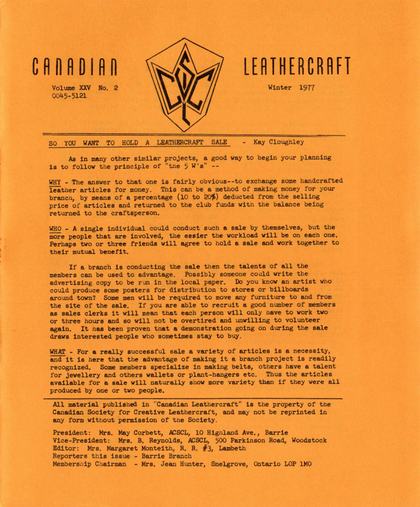
(8 pages, 1.1 MB)
the full-resolution scan, 21 MB, for close research
Page 1 — SO YOU WANT TO HOLD A LEATHERCRAFT SALE
CANADIAN LEATHERCRAFT
Volume XXV No. 2
0045-5121
Winter 1977
SO YOU WANT TO HOLD A LEATHERCRAFT SALE - Kay Cloughley
As in many other similar projects, a good way to begin your planning is to follow the principle of "the 5 W's" --
WHY - The answer to that one is fairly obvious--to exchange some handcrafted leather articles for money. This can be a method of making money for your branch, by means of a percentage (10 to 20%) deducted from the selling price of articles and returned to the club funds with the balance being returned to the craftsperson.
WHO - A single individual could conduct such a sale by themselves, but the more people that are involved, the easier the workload will be on each one, Perhaps two or three friends will agree to hold a sale and work together to their mutual benefit.
If a branch is conducting the sale then the talents of all the members can be used to advantage. Possibly someone could write the advertising copy to be run in the local paper. Do you know an artist who could produce some posters for distribution to stores or billboards around town? Some men will be required to move any furniture to and from the site of the sale. If you are able to recruit a good number of members as sales clerks it will mean that each person will only have to work two or three hours and so will not be overtired and unwilling to volunteer again, It has been proven that a demonstration going on during the sale draws interested people who sometimes stay to buy.
WHAT - For a really successful sale a variety of articles is a necessity, and it is here that the advantage of making it a branch project is readily recognized, Some members specialize in making belts, others have a talent for jewellery and others wallets or plant-hangers etc. Thus the articles available for a sale will naturally show more variety than if they were all produced by one or two people.
All material published in "Canadian Leathercraft" is the property of the Canadian Society for Creative Leathercraft, and may not be reprinted in any form without permission of the Society.
President: Mrs. May Corbett, ACSCL, 10 Highland Ave,, Barrie
Vice-President: Mrs. B. Reynolds, ACSCL, 500 Parkinson Road, Woodstock
Editor: Mrs. Margaret Monteith, R. R. #3, Lambeth
Reporters this issue - Barrie Branch
Membership Chairman - Mrs. Jean Hunter, Snelgrove, Ontario L0P 1M0
Page 2
As this becomes an annual event for your club, you will keep records from year to year that will form a SLIGHT guideline as to what articles are most readily sold. Remember there is no accounting for tastes and style trends, and that what sold last year may move more Slowly this season, This is the time to clean out those cupboards holding the articles that were not quite prize winning calibre. You may be surprised by the leatherwork that comes "out of the woodwork" at an occasion such as this.
Be organized, use an entry form with two copies being submitted along with the articles (so that one can be returned with the craftsman's cheque). You would have a hard time designing a better entry form than the one used by CSCL for the sale at the C.N.E, each year. However, as long as it has details of each article with the craftsman's code number, description, individual price and group price, and has space to check off the articles sold it should be adequate.
The articles should be assembled in one place prior to the sale if possible so that the price tags or tickets can be checked against the entry forms. Any screening of articles for quality can be done at this time also, WHERE - There are many more opportunities to hold craft sales now that the public has become more aware of the value of handcrafted articles. Does your local church hold a spring or fall craft bazaar? Many towns and cities have an open air craft fair at which space can be rented at a nominal fee. In some cases only the rental is charged and no discount on sales is taken.
Sometimes arrangements can be made at local stores or malls to have a space that can be made available for a sale such as this, at no charge. In all cases arrangements must ve made WELL in advance of the sale date. Your sale should be advertised in local papers, radio or local cable TV (if free spots are available) and by means of posters etc
WHEN - Choose your time carefully. Consider the weekend following the first or fifteenth of the month (pay days for a large number of people). In the fall, just before Christmas, is a good time for gift items. Once a date has been set and advertised you are morally obligated to hold the sale and not to let your customers down.
Don t forget to apply for a Special Occasion Provincial Tax license from your nearest Provincial Tax office as soon as reasonable after the date has been set, This license is used only on the day or days of the sale and the tax deducted is remitted immediately after the sale and the license subsequently cancelled.
Now that your preliminary plans have been made, it only remains to wait until the appointed time arrives. Of course you will be busy producing leather articles like mad while you wait. Meanwhile, start a checklist of essential items needed on sale day. For instance--
Tables and chairs - or are they provided by the owner /renter of the space?
Cash box and sufficient change to enable you to make change for your customers,
Page 3 — C.S.C.L. ANNUAL MEETING, APRIL 1977
Sales books - with at least two pages so your customer can receive a receipt for the purchase. If you are able to write an name and address at the top you may be contacted again for return business.
Covers for the tables to enhance the appearance of the leather, perhaps a white or coloured sheet
Bags and tissue paper to wrap articles--a new plain bag is preferable, of course, but in these times of high prices for paper products some bags could be carefully saved through the year and recycled at an annual sale.
A few extra tickets in case a price tag gets lost (now you see the value of a master copy of the entry form).
Now the great day has arrived, so get in there and demonstrate and sell and enjoy talking with your customers and the interested passerby and GOOD LUCK'
C.S.C.L. ANNUAL MEETING, APRIL 1977
The Annual Meeting will be held at the Victorian Inn, Stratford, Friday, April 22 (set-up) Saturday, April 23, annual meeting, demonstrations, after dinner entertainment and speaker, David Darbyshire on Indonesia. # (Sunday, possibly a tour of Festival Theatre and other points of interest.)
There will be a table for different WALLET INTERIORS--either made-up into a wallet or just the interior; it could also be a good pattern, with accompanying craftsman's name if they will share it with others.
There will be time to get-together with the Librarian throughout the weekend to learn proper repair of C.S.C.L. books while on loan to Branches. Branch Librarians and representatives plan to save a bit of time for this.
Donations will be needed for the "draw" table.
It is being planned to have a table on HANDBAGS--past and present-- a review of the progression of handbags from then until now. Bring your handbags for a full display.
Any suggestions you have re visual, audio, demonstration or presentation ideas should be sent to me.
Carol McLean, F.C.S.C.L.
Annual Chairman,
55 Huron Street,
Woodstock, Ontario,
N4S 7B1.
Page 4 — RING BINDER
RING BINDER - Clara Cavanagh
The following article, on ring binder, is designed to hold our CSCL bulletins. The same method can be used to make a larger or smaller binder by adjusting your pattern to size of refil and ring metal. It is constructed by using 2½ oz. (or less) exterior leather, skived and moulded over millboard, then lined.
Requirements
Refil (which is our bulletin) size 6 7/8" x 3½"
Back plate of ring metal, length 9"
width 1¾"
Outer leather - 1 piece
Lining leather - 1 piece
Millboard - 2 pieces
Paste or cement
Press board
Length and Width of Millboard
Length - exact length of back plate 9"
Width - (a) Measure length of refil page 3½ long. Length of millboard is 9" which is ½ more than refil page or ¼" top and bottom when divided evenly. In order to have equal distance top, bottom and side, you must add ¼" to width also.
(b) Place refil page in rings. Hold metal ring in your hand, let the page hang down. Measure by starting at ring metal to outside of page, which is 7½" add ¼" = 7¾" Width of millboard will be 7¾".
Size of exterior leather
Allow 3/16" for each hinge
½" for turn over on edges
Length of millboard 9"
Width of millboard 7¾"
Width of spine (back plate) 1¾"
Width of exterior leather is
½" + 7¾" + 3/16" + 1¾" + 3/16" + 7¾" + ½" = 18 5/8"
Length of exterior leather
½" + 9" + ½" = 10"
[Two hand-drawn diagrams sit beside this text. The first, beside part (b), shows the ring metal 9" across with the refil page hanging from it against a ruler, marked 7½" from the metal to the foot of the page and 8½" overall. The second, beside the exterior-leather measurements, is the flat pattern: two boards each 9" x 7¾", a spine 9" x 1¾" between them, a hinge of 3/16" each side and a ½" turn-over all round. The measurements they carry are the ones typed above. "Refil" is the page's own spelling throughout.]
Page 5
Size of lining leather
Lining is set in from edge of millboard, by the widths and lengths given on the diagram above.
Size of Press board
Length of press board is the same as the pressed paper used in ring binders.
Width: enough to prevent metal rings from marking the binder.
Preparing for Construction
1. Cut millboard, exterior leather, lining and press board to correct size.
2. Design, or dyeing of leather, should be done before binder is assembled.
3. Lay exterior leather out flat, grain side down. Find centre and mark it. Centre back plate (spine) on centre mark. Draw a line both sides of back plate. Draw another line on both sides of the back-plate line. (This is hinge space.)
4. Place millboard on leather next to hinge line, in from top, bottom and side by the margin given on the diagram. Draw a line around millboard. Skive from marked line to edge of leather. Make sure corners are skived paper thin.
5. Round two outside corners of each millboard.
6. If edges of lining need skiving, do it.
7. Cut holes in lining and press board, from top and bottom, for installing back plate. Lining leather and press board goes between back plate and ring metal. Cut 2 holes from top and bottom out of the cloth, lining leather and press board so back plate can be installed.
Page 6 — PLACES TO LEARN MORE ABOUT LEATHER
Construction
1. Cement or paste millboard in place on exterior leather (flesh side).
2. Cement back plate in proper place between millboards on exterior leather. Use C.I.L. cement.
3. Put cement or paste on skived edges and millboard. Turn skived leather over millboard and paste down. Do sides and ends first, then corners.
4. To prevent warping, paste thin brown paper on millboards. Grain of paper must go same as grain of millboard.
5. Re-check lining for correct size. Cement in lining.
6. Put press board and ring metal in place.
7. Put pin in top and bottom ends.
8. Polish exterior leather.
PLACES TO LEARN MORE ABOUT LEATHER
MOHAWK COLLEGE WORKSHOP WEEKEND
The notice runs straight down a single column, the workshop announcement and the line of biography for its instructor carrying on in the same paragraph; it is set out below as the page prints it. The street is Mohawk College's own, Fennell Ave. W.
A workshop will be held May 14 and 15 at Mohawk College on Molded Leather, and some aspects of dyeing. This workshop will be conducted by Irva Ford who is a well known leathercrafter in Ontario. She has exhibited in Canada and U.S.A. and has won many prizes and awards for her fine work.
It is expected that two or three projects could be completed over the weekend. For further information contact Lauren Chapman, Workshop Co-ordinator; 135 Fennell Ave. W., Hamilton L8N 3T2 Telephone: 416-389-4461 Ext. 209
GEORGIAN COLLEGE SUMMER WORKSHOPS
Rex Lingwood will conduct two workshops at Georgian College this summer, July 25 - 29 and August 1 - 5. More information about the workshops will be available in the near future.
Page 7 — LEAVES FROM THE BRANCHES
LEAVES FROM THE BRANCHES
The fall and winter seasons have been busy ones as indicated by the activities carried on in the branches:
BARRIE -
The activities of the fall began with a workshop conducted by Carol McLean on covering a bottle. Several friends from the Belleville branch visited for the day and joined in the pot-luck supper held in the evening. The October meeting featured a demonstration by Kay Naftel of an Owl Mobile from her original design.
Barrie branch held their third annual Christmas Leathercraft Sale on a Saturday during November at a local Mall. This event, which calis for a concerted effort from all the members, has proven more successful each year as we gained experience.
At the regular November meeting Clara Cavanagh explained the construction method for making a leather covered ring binder. We will follow-up with a workshop so that each member can complete their project. At an early January meeting Gary Walsh gave a demonstration on making a case to fit a camera.
A workshop on making gloves and a program on bookends are planned for the winter and spring sessions,
In October the Belleville membership enjoyed a workshop on Oak Leaf Pins conducted by Dave Elliott of Toronto. At the November meeting we made cases to hold slippers under Vera Farrara's instruction, On November 6 and 7 three of our members were pleased to attend the workshop on Box Covering conducted by Clara Cavanagh for the Woodstock branch, The timely project for the month of December was a poinsetta brooch,
We normally hold two meetings a month, one demonstration or workshop and another to conduct the business of the branch, At present we are in the process of locating a new place to hold our meetings, however, we are planning a workshop on dyeing for the near future,
HAMILTON -
The October meeting featured a demonstration of a two-piece purse by Hope Drysdale. The November meeting was a workshop on corn husk dolls conducted by Beula Reynolds and Carol McLean of Woodstock--a fun time for everyone, From time to time we hold a "finish your project night" which is quite successful with everyone gaining new ideas,
The December meeting closed with a delightful film on Silversmithing and a delicious buffet lunch.
A workshop on Desk Pads is projected for February and this event will take place at Smithville.
Page 8 — SUMMARY OF C.N.E. SALE 1976; C.N.E. DISPLAY, AUGUST 1977
TORONTO -
The first meeting of the fall season took place in October with the business meeting being followed by a shower to wish happiness to a long time member, Gerry Mills, on her forthcoming marriage.
At the November meeting everyone participated in a workshop to construct Corn Husk Dolls lead by Carol McLean of Woodstock.
WOODSTOCK -
At the June picnic plans were given out by Edith Melchior to the members for a "Mystery Project". At the September meeting final instructions for completing this article were issued--watch for a write up on this article in a bulletin soon.
The October meeting had a demonstration by John Marsden of the Barrie branch on pictorial carving. During November a two day workshop was held with Clara Cavanagh of Barrie teaching Box Covering, Friends from the Belleville branch and the London area shared in this project.
The Woodstock Branch is hosting the Annual Meeting this year which will be held April 22 and 23, The Victoria Inn at Stratford has been reserved for this occasion and we look forward to meeting all our CSCL friends there--so mark your calendar now and make plans to attend,
-#####-
SUMMARY OF C.N.E. SALE 1976
Thirty-three people sent 2,137 articles for sale. 1,649 of these articles were sold.
Total sales 5,750.90 (less tax)
Commission to C,S.C.L. 1,150.18
Amount due leathercrafters 4, 600. 72 Value of missing article $1.75 Clara Cavanagh
C.N.E. DISPLAY, AUGUST 1977
If you have any suggestions re promoting a livelier display presentation at the C.N.E. this August, please send them to me.
Carol McLean, F.C.S.C.L.
555 Huron Street,
Woodstock, Ontario,
N4S 7B1.