
An issue of the Society’s newsletter, transcribed from the original.
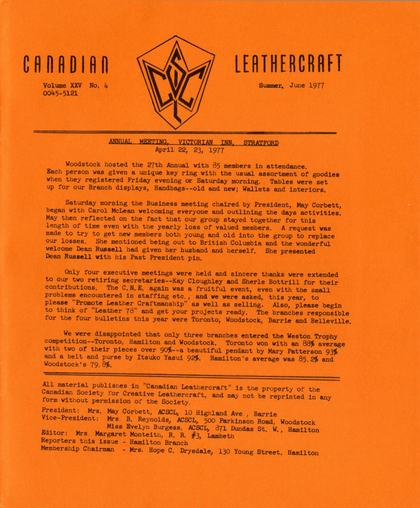
(12 pages, 1.5 MB)
the full-resolution scan, 30 MB, for close research
Page 1 — Annual Meeting, Victorian Inn, Stratford
Canadian Leathercraft
Volume XXV No. 4 Summer, June 1977
0045-5121
Annual Meeting, Victorian Inn, Stratford
April 22, 23, 1977
The masthead is followed by the Society’s own headline for the weekend — “Annual Meeting, Victorian Inn, Stratford,” April 22–23, 1977.
Woodstock hosted the 27th Annual with 85 members in attendance,
Each person was given a unique key ring with the usual assortment of goodies when they registered Friday evening or Saturday morning. Tables were set up for our Branch displays, Handbags--old and new; Wallets and interiors.
Saturday morning the Business meeting chaired by President, May Corbett, began with Carol McLean welcoming everyone and outlining the days activities, May then reflected on the fact that our group stayed together for this length of time even with the yearly loss of valued members. A request was made to try to get new members both young and old into the group to replace our losses, She mentioned being out to British Columbia and the wonderful welcome Dean Russell had given her husband and herself, She presented Dean Russell with his Past President pin,
Only four executive meetings were held and sincere thanks were extended to our two retiring secretaries--Kay Cloughley and Sherle Bottrill for their contributions, The C.N,E, again was a fruitful event, even with the small problems encountered in staffing etc., and we were asked, this year, to Please "Promote Leather Craftmanship" as well as selling, Also, please begin to think of "Leather 78" and get your projects ready, The branches responsible for the four bulletins this year were Toronto, Woodstock, Barrie and Belleville,
We were disappointed that only three branches entered the Weston Trophy competition--Toronto, Hamilton and Woodstock. Toronto won with an 88% average with two of their pieces over 90%--a beautiful pendant by Mary Patterson 93% and a belt and purse by Itsuko Yasui 92%. Hamilton's average was 85. 2% and Woodstock's 79. 8%.
All material publishes in "Canadian Leathercraft" is the property of the Canadian Society for Creative Leathercraft, and may not be reprinted in any form without permission of the Society.
President: Mrs. May Corbett, ACSCL, 10 Highland Ave., Barrie Vice-President: Mrs. B. Reynolds, ACSCL, 500 Parkinson Road, Woodstock
Miss Evelyn Burgess. ACSCL, 871 Dundas St. W., Hamilton
Editor: Mrs. Margaret Monteith, R. R. #3, Lambeth
Reporters this issue - Hamilton Branch
Membership Chairman - Mrs. Hope C. Drysdale, 130 Young Street, Hamilton
Page 2 — The new executive
The new executive is as follows:
| Past President | Helen Wheaton |
| President | May Corbett |
| 1st Vice President | Beula Reynolds |
| 2nd Vice President | Evelyn Burgess |
| Recording Secretary | Joy Finlay |
| Corresponding Secretary | Pamela Frith |
| Chairman of the Fellows | Anne Hook |
| Archivist and Teaching Standards | Robert Muma |
| Editor | Margaret Monteith |
Executive Council (limit 15)
| Bea Austin | Jack Meharg |
| Gel Brigden | Muriel McKnight |
| Fred Brown | Carol McLean |
| Clara Cavanagh | George McPhail |
| Hope Drysdale | Madeline Mitchell |
| Jean Hunter | Margaret Monteith |
| Jack Layton | Olivia Smith |
| Jessie Little |
Branch Presidents
| Barrie | Emma Knowles |
| Belleville | Laura Bush |
| Hamilton | Irva Ford |
| Toronto | Gladys Riddell |
| Woodstock | Beula Reynolds |
Jessie Little, Librarian, mentioned that only one Branch had returned the books in proper order and asked all members to help by returning their books to their Librarians so this did not happen again, It is very difficult to catch the books up to their correct boxes and some books are still missing. If you have the missing books please return them as soon as possible,
Gladys Riddell, President of Toronto Branch, invited the group to Toronto for the 1978 Annual.
Carol McLean then introduced Helen Wheaton, Fred Brown and Anne Hook for a lesson in judging, this was a big success. Briefly this is how the judging is done:
Category               Design   Workmanship   Passing
Fellow                 13       7             80% on each article, no condition
Associate              7        13            75% condition on one article

General Competition    10       10            Possible 200 divided by 2
                                               add bonus if any
Bonus can only be given on competition.
Judging is done by the fellows--5. However, they may use 7 or more for the 5 fellows since the fellows cannot judge their own branch, The fellows judge--then comments are made and the marks may be changed because one may notice something someone else has missed, The marks are then averaged and this is how they arrive at the percentage for the article.
Page 3
Lunch was served and some draw numbers called.
The afternoon began with demonstrations by:
| Clara Cavanagh | Loose Leaf Binders |
| Fred Brown | Removable Covers |
| Gladys Riddell | Picture Frames |
| Jack Meharg | Gun Holsters |
Break for coffee and draws.
| Irva Ford | Hand Bag Patterns |
| Kay Cloughley | Dyeing Techniques |
| Norton Tools | Products and Tool Sharpening |
| Joan Carroll and Alice Howe | Small Projects |
| Kay Naftel | Owl Mobile |
| Clarice Packham | Gloves |
| Jessie Little | Finishing Techniques |
| Walter Mickey | Tool Sharpening |
| Muriel McKnight | Moulded Trays |
The demonstration list also names Joan Carroll and Alice Howe, giving Small Projects; the two names had dropped out and are restored above.
All demonstrations were excellent, many tips and hints were picked up from them, My own complaint was there were just too many in a short period of time and one could not do justice to all the different things plus the last demonstrators seemed to be short changed for time. All in all, however, it was really great.
On to a delicious dinner and the much awaited presentation of Craftsman and Salon Ribbons, Thirty one Craftsman ribbons were awarded to eighteen different people as follows:
The Craftsman ribbon tally is printed in two side-by-side columns, Barrie, Belleville and Hamilton complete in the left and Toronto and Woodstock complete in the right; no branch runs from one column into the other. Read straight across instead of down each column, names had been shuffled between branches. It is set out below by branch, matching the printed total of thirty-one ribbons to eighteen people.
Barrie        Clara Cavanagh      5
              Emma Knowles        1

Belleville    Laura Bush          3
              Helen Ray           1

Hamilton      Bea Austin          1
              Hope Drysdale       1
              Irva Ford           3
              Ruth Haig           2
              Dan Hannington      1
              Art Morris          1

Toronto       Fred Brown          1
              Jean Hunter         1
              Jessie Little       1
              Mary Patterson      1
              Itsuko Yasui        3

Woodstock     Noel Bee            1
              Carol McLean        3
              Edith Melchior      1
We were disappointed that there were no Salon Ribbons. Our Judges,
Helen Wheaton and Paul Payne felt there was nothing really with that special oomph to warrant a ribbon, Technically there were many excellent pieces but. there was just nothing outstanding this year, Many beautiful door prizes were given out and after dinner we were led in a fun and games sing song by Dr. Warren Pheagan at the piano, Terry and Dr. Norman Burt-Gerrans leading us in the song games. We then settled down to most interesting slides on Indonesia by David Derbyshire.
The slide-show speaker’s surname is printed Derbyshire, not Darbyshire. Corrected above.
Tired but happy many gathered up their things and left at this point. Those that remained were treated Sunday morning to a guided tour of Stratford and shown many beautiful old buildings in and around the Stratford area followed by dinner at the Ponderosa. Thus another Annual drew to a close, Thank you Woodstock for all your planning and hard work.
Hope C. Drysdale
Page 4 — MOLDED PURSE
MOLDED PURSE - by Bea Austin
You will require 6 oz. Cowhide or 7 oz. Nature Hand Leather
1 piece 15" x 29"
1 piece 1" x 38"
1 piece 3/4" x 3 1/2" These three pieces can be cut from 2 pieces 6 1/2" x 3 1/2" the sides of the piece 15" x 29
Barge glue
Split rivets 3/4 and 1"
This purse is unlined--no stitching--no lacing. When you are starting to make this purse--please make sure all your measurements are correct and true--precision is a must--it is very important.
The pattern diagram here (a cutting layout, not a table) had its labels and dimensions read out of position into several garbled tables and paragraphs. Set out as a description instead: an upper row of three 8"-tall panels — "End Panel" (1 3/4" wide), "Bag Face" (10" wide), "End Panel or Part of Gusset" (1 3/4" wide) — over a horizontal "Bottom" strip ("10" Less 2 - 1/8""), over a mirroring lower row of three more 8"-tall panels — "End Panel", "Back" (10" wide), "End Panel" — over a "Cover Top" band (3 1/2" marked at each end) and a scalloped "Cover Face or Flap" panel (13 1/2" across the bottom). Annotations on the diagram read: "Skive all 4 end panels at the bottom -- the shaded area"; "Skive the 4 corners about the size of a 25¢ piece or a little more"; "Cut 1/8" past the 1 3/4" of the sides at the bottom of end panel"; and "Add 1/2" on each end of top piece - This can be cut smaller after purse is assembled if desired". A small numeral mark beside the Cover Face or Flap panel is not legible enough to set out here.
It is better to make a pattern first - Do not use a gouge,
Page 5
After your purse is cut out--you can dye, antique or leave natural. Before starting to assemble--have all your skiving finished, your edges polished, To assemble: You start by marking the 2 pieces 6½" x 3½" (end supports) an 3" down the centre--either with a pencil or bent part of your tracer. It is necessary to be able to see this End line. It helps to place the end panels (or gusset sides in proper place.
Supports
When you have completed skiving the four corners and the end panels (or gusset sides) cement only one end panel to end tag.
End
Panel When glue is goes exactly on from the end helps to keep gusset side) and (or gusset side) exactly on the this is completed--do Pee: Now do the other support and end Attach strap Make sure your On both ends of ae Even ee ones o oat ce
Make sure your end panels are skived there at the bottom-- this makes a neat finish to the bottom of your end piece (or gusset) also the corners are neat. I like to mark a line down the centre of the end tag End tag save as end supports tacky--put one end panel to half of end tag--making sure it the line. I like to make a dot mark on the end tag 14"in centred FL t find a piece of wax paper over part of glue parts from grabbing. Now glue remaining part of end panel (or one half of end support--when glue is tacky put end panel to line of end support. It is important that they go lines--otherwise, your purse may be slightly crooked, When the other side exactly the same, ii End Support End. Tag A side of the purse the same way--cement end panels to end tag. Your purse will now be taking shape. handle to bag strap handle is boned and polished like you would a belt. 1" x 38" skive 2" like sketch below: Put split rivet close to end of 1" -it makes it easier to install. The 2" that is skived should be thin on =i the turn and end--punch a hole close to the end and put rivet through--cement--
Cover rivet with loop when tacky--fold back--so it will look
This rivet is installed 1" from like sketch. top of gusset
Page 6
At the bottom of purse side LJ measure up 1" and punch a hole for strap and rivet--measure the distance on your strap handle and where you punch the hole in your purse--they should both be about 1 inch. The strap should come even with the end panels,
Loop cover rivet
i about 1" from top Strap is then 7 for hole punch riveted and and rivet loop cemented to end of bag
Do both sides " "
the same " i *
Bag bottom
rivet head
€— skived and formed loop is placed over rivet f
It can be either glued or placed a through slots
I prefer just gluing and placing skived ends under strap J
To attach strap for closing
Polish and bone 1" x 10" - finish like a belt - skive one end 2" like end of strap handle-round the other end
On the middle of cover top - grain side - punch a hole in center--insert rivet that has been cemented in strap end, and flatten rivet on flesh side. A flat screw driver is excellent for flattening rivets.
This rivet will not show on the grain side
Cut a piece out of cover face (flap) about 1 1/3" x 7/8" depending on thickness of leather for the tongue (closing strap) to go through molded piece.
Now form the 3/4" x 33" to make loop for the tongue to go through se glue on flesh side of face bag
Place 2 slots below on the front of bag face--try your flap with the piece cut out first before marking and cutting slots.
For slots - punch a-hole top and bottom the size you will require for length of slot and cut down from punch holes ut on each side, (\
Bag Face
Page 7
Your purse should look
something like this Wherever you see these marks — - ---- - -- don't score or gouge on your leather it just indicates a fold.
Blocks of wood to fit inside when you are punching holes through gusset top and bottom are necessary to attach handle to side of gusset--using a #3 or #4 drive punch.
If feet are required for bottom of purse - punch 3 rounds of 6 oz. or 7 oz. leather for each foot--using a 5/8" or 3/4" punch; 3 squares of leather for each foot could also be used, Glue together with barge--dye--sand and polish edges--then glue on 4 corners.
I punch out rounds of thin split leather large enough to cover rivets on the inside--skive edges--1 round is all that is needed for each rivet,
Page 8 — When and Where Should I Sell My Leather
When and Where Should I Sell My Leather - Irva Ford, FCSCL
After studying and practising leathercraft for a period of time, many precious articles of leather are accumulated. You have supplied your friends and relatives with gifts of leather, you have plenty for yourself, but still have pieces to spare so you decide to sell them,
How does a new craftsman, unrecognized and unknown sell his work? Because of this question and lack of information on it, maybe a few guidelines will be helpful,
Before you think of selling you must first satisfy yourself as to whether you should be selling at all. By this, we mean, are you ready to sell? This problem is difficult &s not everyone has the ability to be self critical and objectives Years ago craftsmen served an apprenticeship, and a few still do, and when they finished the quality was there, To-day, too many craftsmen take only a few lessons, some take no lessons, and start selling or even teaching without a good background in their media, This is not the way to become recognized as a good craftsman and opportunities will be rare until you acquire a lasting quality of work which reaches standards, The task is further complicated by the subjective partisan comments of well-meaning relatives and friends. Nor is it enough to say "But people buy it". The dangers are, you may get to rely on your buyer's taste and dictate your own standards or the buyer may never buy any more. If the quality is there the customer will not only come back himself but will advertise your craftwork to his friends.
One of the most beneficial ways of gauging nether or not you have reached a proper level of quality is to enter competitions or juried shows, There you will learn the necessity of good design, fine workmanship and proper finishing and how you compare with your contemporaries. Of course, the benefit you derive is related to the quality of the judges and if you can determine where the fault lies. Good places to start are the Canadian National Exhibition competitions and the C,S,C.L. Sale at the C.N.E, If your articles are not accepted or if your articles do not sell well ask yourself "why?" Compare your work with pieces that do sell and again ask yourself "does my work measure up to the standard of quality? Are my prices right?".
While the above course may be recommended, some craftsmen approach galleries and sales outlets directly. If this is the objective, one should make a list of high quality shops and approach them with samples or pictures. But beware of supplying articles on consignment.
One can also have private sales or enter organized sales with other artists. Then display enters into the picture. Leather displayed artistically sells better. The allotted space should not appear over-crowded by displaying several pieces exactly alike. Pricing should be done beforehand.
How do you price your leather? Consider the following factors: 1. Do you incorporate the price of your material, the time you have spent and the commission charged, into your prices?
2. Do you price lower in order to sell more, whereby getting your work into the public eyes?
Page 9 — Book Review
3. Do you feel your quality is superior and therefore will be recognized as such and the price can be higher?
4, Do you compare your work with that of your contemporaries and use their prices as a guide?
After you have considered these questions and looked at the quality of your work and feel you are ready to sell, then you must decide when and where to present your work to the public for sale. Above all, never be surprised or discouraged by sales. The weather, location, attendance and competing events all have their affect.
Let us remember the old adage, "If at first you don't succeed, try, try, try again",
Book Review by Audrey A. Gorton
LEATHER CRAFT FOR TODAY - by Dorothee Koechlin-Schwartz-Bizemont.
The reviewed book’s author is printed Dorothee Koechlin-Schwartz-Bizemont; her first name is corrected above from Dorothea.
Last Christmas I was given a gift of what seemed a small but informative book on modern leather craft, but upon perusing same, I found what we today think are modern techniques actually date back many hundreds of years, It reveals that the background of leather craft came predominately from the middle east where these techniques are still employed today in such places as North Africa, India, Muslim Soviet Union as well as Spain (which has come under Moslem influence during the "Conquest"),
The writer, a noted historian and archeologist, as well as being an art expert studied in Europe and travelled to Africa where she became highly interested in the beautiful leather handcrafts which she had purchased in Morocco,
While the traditionalists may feel that some of the patterns presented are too "busy" or not their concept of what handcrafted leather articles should look like, the author has suggested that one could look over the various patterns and with their own imagination create an object suitable to their own liking.
As well as displaying several articles using leather and suede, she adds other dimensions such as beads, pieces of mirror, etc. and gives in detail the techniques to follow in order to accomplish the same. Together with these articles she also gives one a comprehensive review of equipment and their use and methods used as well as a detailed background of the different techniques employed by craftsmen which have been handed down from one generation to another where it is not considered a hobby, but rather a way of life and a means of making a living.
The author's introduction to the book sums up quite well the purpose for which it was intended--"It is therefore a material from the past and, at the same time, modern on which we're going to work". Her love of the finished product and the fact that she feels leather is not passe and will not in future be replaced by synthetics is felt as one continues to delve deeper into this small but rather interesting book,
Page 10 — WESTON TROPHY ENTRIES 1977
WESTON THROPHY ENTRIES 1977
HAMILTON: 85.2%
Desk Pad - This is made from pre-dyed chrome leather. Felt backing not quite even, but a good-looking piece which would look well on a mahogany desk,
Mirror - Design makes it feel a bit top-heavy. Backing fill-in would have improved the appearance. Interesting hanger, and a lovely finish.
Book Cover - The title of the book becomes the theme of the design--map of Bruce County. Cover is slightly wide, slightly long. Beautiful workmanship.
Basket - A beautiful exercise in moulded leather. The handle might have been re-inforced slightly more to take the weight of the base. A little more depth of colour toning would have enhanced it.
Bowl - Rocks slightly. A beautiful colour job. The outside complements the inner colour.
TORONTO: 88%
Book Cover - laced with handcut lacing dyed to match the cover. Good sponge dyeing in which a minimum of red shows through, enhancing the red of the design. Lacing slits should have been dyed on the inside.
Belt and Purse - Excellent example of a purse permitting both hands to be free, Dainty and beautiful. Exquisite saddle stitching.
Desk Pad - Desk pad, of unusual length, giving it a special elegance. Two corners beautifully done--the other two might have been better skived. Also it might have been improved by edge creasing.
Container for nesting cups - This was made from scratch. Millboard base and lid. Sides re-inforced with darex, 3D technique was used.
Pendant - A beautiful piece of workmanship, showing excellent use of mixed media.
Page 11
WOODSTOCK: 79.8%
Belt - A nice rugged manly belt. Fold-back could have been thinned, which would have allowed for evener stitching. Braiding well done. Back could have been gouged to allow the lacing to be flatter.
Book Ends - A pleasing design for the shape of the metal ends; a better quality of leather would have made it possible to define the edges of the design.
Desk Pad - It doesn't lie flat. We wonder if the book board were used across the grain on one side. Backing paper would have helped to disguise the turnover on the back. Pleasing all-over effect. Secretary -A colourful dye job. Interesting pockets. Edges a bit overworked.
Photo Folder - A pleasing piece of mission grain, with re-inforced spine. Effect would have been better if saddle stitching had been countersunk on both sides.
Toronto Branch - Weston Trophy articles
Page 12
DO YOU KNOW, that -
Evelyn R. Burgess
In America alone, over 20 million cattle, 14 million calves, 50 million goats, 35 million sheep, 2 million horses, plus large numbers of deer, elk. alligators, lizards, snakes, seals, ostriches and sharks are needed each year for the tanning industry,
Seal skins make a soft durable leather the finest of which is "pin grain", This finish is often
Simulated on calf and sheepskins. The genuine pin seal is more supple than the simulated. This applies to true morocco and other "special" skins.
One man, an English scientist made a great contribution to the improvement of tanning at the end of the eighteenth century. Sir Humphrey Davy, he discovered whilst Oak had the tannin so widely used for curing Skins, Hemlock and Chestnut also could be used.
At that time this was most important to the "New World" as they had many of these species of trees.
The most revolutionary discovery of the nineteenth century was the development of chrome tannin. This was a faster way but went through many changes as it left the hides hard. Alum and chromium salts were the basic ingredients. A young tanner Robert Foerderer learned how to use soap and oil to make the skins more pliable and the tanning industry was away to a great start. No man made product can match leather for beauty, strength or durability and we "craftsmen" must try to use our skills in design and craftsmanship so that we can transmit this cultural heritage to the future generations.