
An issue of the Society’s newsletter, transcribed from the original.
(8 pages, 1.2 MB)
the full-resolution scan, 22 MB, for close research
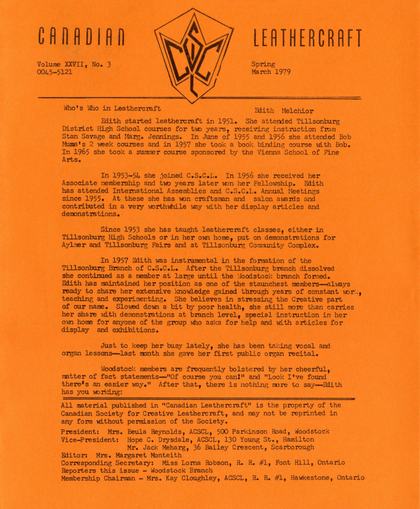
Page 1 — Who's Who in Leathercraft: Edith Melchior
CANADIAN LEATHERCRAFT
Volume XXVII, No. 3
0045-5121
Spring
March 1979
Who's Who in Leathercraft Edith Melchior
Edith started leathercraft in 1951. She attended Tillsonburg District High School courses for two years, receiving instruction from Stan Savage and Marg. Jennings. In June of 1955 and 1956 she attended Bob Muma's 2 week courses and in 1957 she took a book binding course with Bob. In 1965 she took a summer course sponsored by the Vienna School of Fine Arts.
In 1953—54 she joined C.S.C.L. In 1956 she received her Associate membership and two years later won her Fellowship. Edith has attended International Assemblies and C.S.C.l.. Annual Meetings since 1955. At these she has won craftsman and salon awards and contributed in a very worthwhile way with her display articles and demonstrations.
Since 1953 she has taught leathercraft classes, either in Tillsonburg High Schools or in her own home, put on demonstrations for Aylmer and Tillsonburg Fairs and at Tillsonburg Community Complex.
In 1957 Edith was instrumental in the formation of the Tillsonburg Branch of C.S.C.L. After the Tillsonburg branch dissolved she continued as a member at large until the Woodstock branch formed. Edith has maintained her position as one of the staunchest members—always ready to share her extensive knowledge gained through years of constant work, teaching and experimenting. She believes in stressing the Creative part of our name. Slowed down a bit by poor health, she still more than carries her share with demonstrations at branch level, special instruction in her own home for anyone of the group who asks for help and with articles for display and exhibitions. Just to keep her busy lately, she has been taking vocal and organ lessons—last month she gave her first public organ recital.
Woodstock members are frequently bolstered by her cheerful, matter of fact statements—"Of course you can!" and "Look I've found there's an easier way." After that, there is nothing more to say—Edith has you working!
All material published in "Canadian Leathercraft" is the property of the Canadian Society for Creative Leathercraft, and may not be reprinted in any form without permission of the Society.
President: Mrs. Beula Reynolds, ACSCL, 500 Parkinson Road, Woodstock Vice-President: Hope C. Drysdale, ACSCL, 130 Young St., Hamilton
Mr. Jack Meharg, 36 Bailey Crescent, Scarborough
Editor: Mrs. Margaret Monteith
Corresponding
Secretary: Miss Lorna Robson, Re R. #1, Fonthill, Ontario Reporters this issue — Woodstock Branch
Membership Chairman — Mrs. Kay Cloughley, ACSCL, R. Re #1, Hawkestone, Ontario
Page 2 — PERSONALIZING YOUR STATIONERY WITH LEATHER
PERSONALIZING YOUR STATIONERY WITH LEATHER
What more appropriate decoration could a leather craftsman use for their writing paper than leather?
At my night school classes I'm usually saying "don't throw away your bits of leather" The advanced class finally said, "what can we do with all this"? What developed was an entire evening devoted to using up "bits and pieces". This was one of the projects incorporated into that evening's lesson. We had fun and I hope you do too.
I hesitate to call small pieces "scrap" leather because these bits cost exactly the same amount per square foot as did the larger pieces cut out of the same hide. Also I have noticed that when scrap material is mentioned the immediate reaction is a "cheap article" for the customer. I prefer not to convey this meaning because also included in your product is workmanship which is not "scrap calibre". You are also drawing upon your creative ingenuity, using specialized tools, dyes, finishes and techniques. Therefore even if it is a small article, do not sell it short. It too can be a "little masterpiece".
Many ideas present themselves in our everyday natural surroundings such as mushrooms and toadstools, owls, leaves, turtles, butterflies and flowers.
One can cut out and stamp or dye an initial—thereby monogramming your stationery. Also an entire name can be cut out in individual letters. Check books on alphabets for ideas also embroidery patterns.
Another idea is to cut out a small rectangle of leather (2-3 oz. vegetable tanned) mark a small border around it, then monogramme or print a name or name and address on it. Small flowers or a star can be added or use a decorative stamping tool.
You could use a varied number of designs to portray many interests such as crosses, praying hands, flowers, musical instruments, seasons, holidays, such as a snowman, pumpkin face, a rabbit for Easter, heart for Valentine's, a Shamrock, an hour glass with the current year beside it, a christmas tree decorated with small circle punch outs and a poinsettia to mention some possibilities.
Design sources are available to the observant, in greeting cards, wrapping paper, catalogues, colouring books and clothing.
Trace the desired pattern on to a piece of stiff bristol board and transfer this patter to the back of the desired piece of leather. Cut out with Sharp knife or scissors. Finish edges, dye and finish coat if necessary. Adhere to the writing paper with any good cement—I use Mac's white leather cement.
I have found that a very fine indelible marker is just perfect for adding detail when a small brush is too large.
Page 3
Another possibility is to use emblems or club insignia such as the Masonic emblem.
I'm sure you have seen Jessie Little's lovely maple leaf decorated stationery. What a cheerful sight they would be to the receiver of your letter. There is an added bonus in that a small pinback can be glued on to the back of the leather item after the paper is used.
Almost all-kinds of leather can be used as long as they are not too bulky (3-4 oz. or less). Small pieces of lacing can be used as flower stems or butterfly antenna etc. These are just a few "food for thought" idea starters. Let them be the beginning of a whole new area of decoration and most of all—Have Fun
I'm including some sketches for you to get started. I would be most happy to receive your ideas on the subject to add to these thoughts. I know there must be hundreds of good ideas out there and would love to hear from you. Drop me a line—on your decorated stationery!
THE Rom [-
Page 4 — LEATHERCRAFT STANDARDS
LEATHERCRAFT STANDARDS
Through this article and the membership requirements further on (pp5, 7-8) the word "must" prints clearly every time. The one "most" that stands, in "Simplicity of decoration is most acceptable" on p8, is the page's own word. The heading of the background paragraph below reads "Background:".
These are general requirements and will be considered by the Council of Fellows in appraising works to be accepted for Sales. There will be exceptions in the case of articles with a newly identified need, ingenious application of material or technology, or an original aesthetic design. Exhibition and Competition articles will be judged by higher standards.
DESIGN:
Function: The project must fit the purpose for which it has been designed. Proportion and Shape: Proportion means the height in relation to the width, and each shape in relation to all other shapes in the design. Materials and Findings: Materials must be suitable for the purpose for which they are used, and the findings must be in keeping and good taste.
Colour and Decoration: The colour and decoration should be a complementary part of the whole design.
Harmonious Appearance: This is the result of the relationship of the forms or parts, bringing them into unity.
WORKMANSHIP:
Cutting: Accurate cutting to ensure correct fit and appearance. Decoration: Tooling: Clear, clean lines; any modelling must be smooth, background stippling should be regular and any flat backgrounding should be put down smoothly.
Carving: Lines should not be cut deeper than half the thickness of the leather. Except in certain places, lines should not cross each other, or go beyond the outline being cut. In many cases, they should taper out.
Beveller: Must follow the cut line smoothly.
Pear Shader: Rarely is the exact impression of the pear shader correct. The tool should be moved around in the area concerned, tapering off the pressure toward the edges. Rarely should it touch the lines. Background: However the background is treated, it must not detract from the design.
Camouflage, veiner, mulesfoot, etch: If used, they should not be overdone
Seeders: These are used mainly for flower centres, and how it is used depends on what centre is being done and the effect desired.
Decorative Cuts: If used, they generally follow the contour of the leaf or petals They start heavy, and taper out to nothing.
Embossing: The parts to be embossed must be carefully raised. The raised portion must be well and smoothly supported. Generally, the surrounding area should be treated in such a way that the embossing is well defined.
Page 5
Stamping: The impression should be regular or graduated and reasonably deep. When more than one tool is used, the impression should create a related design.
Inlays To fit accurately and show no tool marks.
Onlay: Prepared so that the edges are neat and firmly adhered, Colouring: Must show that there is a knowledge of how to handle colour to get the desired effect.
Other forms of applied decoration not specifically mentioned, need the same care and attention to details as those above.
Skiving: Sufficient to make the parts fit well, and to reduce the edges of parts being stitched or laced together to a suitable thickness, but not enough to weaken the leather where strength is needed. For turn-edges, the leather must be skived enough to make a smooth, neat turnover.
Fitting and Assembly: Edges to be flush, gussets and fasteners to be properly placed.
Moulding: Whatever method is used, the leather must be a suitable weight for the article. If there is more than one moulded part to the article, the moulding of the various parts must form a harmonious whole.
Finishing: Lacing and stitching to be even and uniform, suitable to the article and inconspicuously joined or finished off.
Cut_edges: whether laced or unlaced should present a well finished appearance.
Turned edges: the edges must be skived enough to make a smooth, neat turnover.
Glueings Glue should be spread so that no lumps are formed, Any excess should be removed from the visible parts of the article,
Linings: Should be suitable for the article, neatly inserted and accurately fitted. stacked Leather; Must be securely glued, and sanded sufficiently to make a smooth edge.
Backs: To be finished suitably for the article whether lined, dyed, polished, or left untouched.
Combinations: If the leather is combined with other materials, the leather must be the dominant part of the article, and the material must be compatable with the leather.
Page 6 — LEATHER AS ART AND CRAFT by Thelma R. Newman
LEATHER AS ART AND CRAFT by Thelma R. Newman; 1973 Crown Publications Inc. The subtitle to this book is "Traditional Methods and Modern
Designs", and the author amply fulfills this title. Tracing the history of leather, with museum pieces from around the world, alerts the reader to the great versatility and consequent uses of leather.
Traditional methods of classification of leather follows, which is generally common to amoy similar books. Tools are pictured and discussed, as well as a few of the machine tools used in commercial leather production.
The heart of the book comes after the very descriptive, and well-photographed, techniques used for simple projects-—suddenly leather the craft has become leather the art.
The colour pictures personify the art. Leather becomes a limitless media, which the artist may mold, fold, sew, bead, embroider, colour or polish. The unique beauty of leather comes through in many of these pictures. As one who enjoys leather as leather, I was pleased by the author's attention to simplicity of design.
"Leather as Art and Craft" is not a leather-crafters manual in the true sense. There are descriptions of processes and tools, but the author is probably not a craftsman herself. But, as a source of reference to the unique and historical applications of leather, this book is useful; ideas pop into one's mind while turning the pages. Clothing, furniture, jewellery, wall—hangings, sculptures, footwear are just some of the ways the author has found leather used.
For the leather worker who aspires to create art from leather, this book would truly inspire. The contents project vividly the versatility and universitility of leather.
Book reviewed by Madeleine Mitchell.
Set-up date is Tuesday, August 14th. If you are not planning on coming in for set-up day, and aren't in touch with anyone that is coming, please send your sale articles to: R. Muma, 118 Hazelton Ave., Toronto, Ontario M5R 2E5, by August the 10th. If you have not received entry forms for your sales articles, please let us know.
Leather Standams for Sales Articles have been included in this bulletin.
Workers are needed for weekends, especially Labour Day weekend. If you can help out please let us know as soon as possible.
Contact Beula Reynolds, 500 Parkinson Road, Woodstock, Ontario N4S 2N6. TeLephone 519=—539=3251e
Page 7 — REQUIREMENTS FOR ASSOCIATE AND FELLOW MEMBERSHIP
REQUIREMENTS FOR ASSOCIATE AND FELLOW MEMBERSHIP ASSOCIATE MEMBERSHIP:
1. Not less than 3 years satisfactory practice of leathercraft. ae Two years of satisfactory service to the Society, e.g. helping with exhibitions, sales, writing for the Bulletin, serving on executives (local, national or international), getting new members for the Society or working in some way toward the development of leathercraft. 3- Demonstrated ability to produce work of a high standard of craftsmanship. While originality of design is not necessarily required for Associate Standing, it will receive favourable consideration. Copied designs should bear some stamp of the individuality of the craftsman and should not be an exact duplicate in every sense of the copied design. 4. Approval by the Board of Selection of submitted work as follows: 1. Handbag or other large article involving gusset construction. 2 Belt of 6 or 8 oz leather.
3e Optional. 4. Optional.
Note; Numbers 3 and 4 should be chosen to show specific techniques. Articles submitted should demonstrate knowledge of materials and various techniques and versatility in the craft, e.t. tooling, carving, colouring, construction, stitching, lacing, molding, etc. 5. Articles submitted for Associate Standing will be marked according to the Society's Point System of Judging. The minimum passing mark for each article is 75 marks. If ONE of the articles has failed to receive 75 marks, the candidate will receive credit for the three qualifying articles and a condition on the fourth. The candidate may submit another article the following year and, if it qualifies, will receive his Associate Standing and Certificate at the next Annual Meeting when all four articles must be displayed. A candidate may fail on only one article to receive this condition. 6. Work submitted must be accompanied by the signed declaration application form that the work is solely that of the candidate. Work done in a leathercraft studio may be submitted for Associate standing provided that it is done without assistance.
7s Enclose fee as set forth on application to cover examination and certificate. *
[The machine this page was typed on has no key for the digit 1; the typist struck a lower-case l for the numeral, and it is set here as the numeral.]
Page 8 — IMAGINATION
FELLOW MEMBERSHIP:
1. At least one year as an Associate member and three years of service to the Society.
2. Wide experience and meritorious achievement in the field of leathercraft.
3. Approval by the Board of Selection of submitted work as follows: 4 articles (2 large and 2 small) of the applicant's choice, all of different function, size and treatment, chosen to show versatility in the craft and grasp of techniques. No piece submitted for Associate will be eligible.
4. Articles will be marked according to the Society's Point System of Judging. The minimum passing mark on each of the four articles is 80 marks. All four articles must qualify.
5. All work submitted must be original in design and decoration and should include, if possible, new forms and uses. Simplicity of decoration is most acceptable. Commercial or copied patterns must not be used.
6. Candidate shall submit an article, not necessarily technical, for publication in Canadian Leathercraft for the approval of the Board of selection. An article previously published may be submitted.
7. Work submitted must be accompanied by the signed declaration on application form that the work is solely that of the candidate, done without supervision or assistance.
8. Acceptance by a two-thirds vote of the active available Fellows.
9. Enclose fee as set forth on application to cover examination and certificate.
IMAGINATION by Sid Taylor
In-order to explain this heading, I must involve a certain local leathercraft teacher from this locality who made a point of impressing upon her students the value of using their imagination to produce an original designs Some people are gifted in this mental process. I must be very obtuse in this area because I haven't yet come up with a brilliant design, inspired by the sight of some common everyday contour, elegant leaf or abstract sketch. However, one day came the inspiration of using a copper tooling technique to obtain a "Leather Cameo" aroma lid of a certain brand of facial cream. Using English natural skiver dampened to a degree of wetness, I placed the appropriate size of leather into the inside of the lid, flesh side up, and using a modeling tool, eraser, and anything else in order to bring out the impression. I used blotting paper when I found the leather to be too wet to hold its shape. I left the leather in the mould until it was dry. Then in order to keep the shape of the cameo I put white glue into the depressions.
Later when the glue had set and leather dry, I filled in the back with cotton wool and glued the cameo to a backing piece of leather.
Later I found a plastic mould of an Indian head with headdress. This came up beautifully but, and I'm ashamed to admit, I used acrylic paint to obtain colour effects.
Obviously I have omitted, purposely, some details and other projects along the same lines. This is in order that anyone interested will be encouraged to use their own imagination.