
An issue of the Society’s newsletter, transcribed from the original.
(8 pages, 1.1 MB)
the full-resolution scan, 19 MB, for close research
Page 1
CANADIAN LEATHERCRAFT Volume XXVII, No 2 December-January 1979 0045-5121
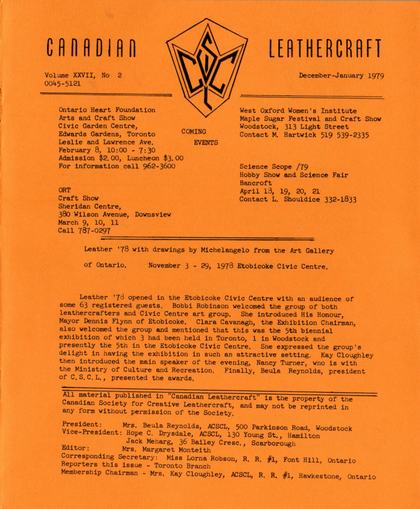
This page prints a "COMING EVENTS" heading between two side-by-side columns of separate show announcements — the Ontario Heart Foundation show and the ORT Craft Show at the left, the West Oxford Women's Institute and Science Scope '79 shows at the right
             COMING
             EVENTS

Ontario Heart Foundation          West Oxford Women's Institute
Arts and Craft Show               Maple Sugar Festival and Craft Show
Civic Garden Centre,              Woodstock, 313 Light Street
Edwards Gardens, Toronto          Contact M. Hartwick 519 539-2335
Leslie and Lawrence Ave.
February 8, 10:00 - 7:30
Admission $2.00, Luncheon $3.00   Science Scope /79
For information call 962-3600     Hobby Show and Science Fair
                                  Bancroft
ORT                               April 18, 19, 20, 21
Craft Show                        Contact L. Shouldice 332-1833
Sheridan Centre,
380 Wilson Avenue, Downsview
March 9, 10, 11
Call 787-0297
Sheridan Centre,
380 Wilson Avenue, Downsview March
Call 787-0297
Leather '78 with drawings by Michelangelo from the Art Gallery of Ontario. November 3 - 29, 1978 Etobicoke Civic Centre.
Leather '73 opened in the Etobicoke Civic Centre with an audience of some 63 registered guests. Bobbi Robinson welcomed the group of both leathercrafters and Civic Centre art group. She introduced His Honour, Mayor Dennis Flynn of Etobicoke, Clara Cavanagh, the Exhibition Chairman, also welcomed the group and mentioned that this was the 5th biennial exhibition of which 3 had been held in Toronto, 1 in Woodstock and presently the 5th in the Etobicoke Civic Centre. Sne expressed the group's delight in having the exhibition in such an attractive setting. Kay Cloughley then introduced the main speaker of the evening, Nancy Turner, who is with the Ministry of Culture and Recreation, Finally, Beula Reynolds, president of C,S.C.L,, presented the awards,
All material published in "Canadian Leathercraft" is the property of the Canadian Society for Creative Leathercraft, and may not be reprinted in any form without permission of the Society,
President: Mrs. Beula Reynolds, ACSCL, 500 Parkinson Road, Woodstock Vice-President: Hope C, Drysdale, ACSCL, 130 Young St., Hamilton
Jack Meharg, 36 Bailey Cresc., Scarborough
Editor: Mrs. Margaret Monteith
Corresponding
Secretary: Miss Lorna Robson, R. R. #1, Font Hill, Ontario Reporters this issue - Toronto Branch
Membership Chairman - Mrs. Kay Cloughley, ACSCL, R. R. #1, Hawkestone, Ontario
[The masthead title reads “CANADIAN LEATHERCRAFT”, either side of the Society's crest. President Beula Reynolds’s address here is “500 Parkinson Road”; p3’s own workshop notice, in the same issue, prints “550 Parkinson Road” for the same address — the Society’s own inconsistency, both kept as printed.]
Page 2 — AWARDS
[The captions were interleaved between Anne Hook's and Jean Hunter's items and have been set out in the order they belong. Anne Hook's vase is her only item; the napkin-holder set is Jean Hunter's.]
AWARDS
Most Original Design
Ontario Crafts Council $50.00 to Anne Hook
Brown vase with ring design
Most Original Entry
Artisan Guild $35.00 to Jean Hunter
Set of 4 napkin holders, tan leather with red pattern
Best Craftsmanship
C.S.C.L. $25.00 to Bea Austin
Black shoe horn
Page 3 — WORKSHOP AT HARBOUR FRONT MEETING ROOM - TORONTO
Best Functional Design C.S.C.L. Executive $25.00 to Anne Hook
Purple suede bag with gold trim
Memorial Award Anonymous Donor $25.00 to Carol McLean
Checkerboard and checkers
Masonite covered with sciver lining with a top layer of belting leather
[The issue spells it "sciver" — here, and again in the stock list on p5; kept as printed both times.]
Monochromatic and brown shades
Honourable Mention:
| Basket - Bea Austin | Insect Pendant | Daphne Lingwood |
| Round Box - Anne Hook | Pen Holder | Gladys Riddell |
| Spring Binder - Bella Iro | Pendant with Stone | Olivia Smith |
URGENT
WORKSHOP AT HARBOUR FRONT MEETING ROOM - TORONTO
= Do you want a one day or a weekend workshop? "ay
Suggestions for the workshop are to be sent to Mrs. Beula Reynolds, 550 Parkinson Road, Woodstock, immediately so arrangements can be made and announced at the annual meeting.
Page 4 — Black Jacks and Leather Bottells, Part 1
Part 1 of a summary from the book "Black Jacks and Leather Bottells". This book was donated to the Larmour Memorial Library by Deane Russell.
by Jessie Little
The art of preparing leather is as old as civilization itself. Vessels of hide and skin have been used in various parts of the world from remote ages for carrying water and wine.
We read of wine bottles in the Bible. Joshua saw "wine bottles old and rent and bound up." The Psalmist says, "For I am become like a bottle in the smoke."
The English excelled in the making of leather drinking vessels. These had the characteristics of strength and solidarity and were made from tanned ox-hide. Foreign vessels were made from lighter thinner leathers tanned to remain flexible.
It would seem that the English were ahead of the French in the manufacture of leather vessels. A group of French visitors to England reported that, "Englishmen used to drinke out of their bootes".
As early as the 14th Century each of the leather-working crafts had a guild of its own. One of these was known as the fraternity of bottlemakers or Botellars. Documents were drawn up containing the ordinances of the Guild. Each Guild had its ow crest or logo, even their own songs and dances. The court decided that every bottle—maker should put his mark on the vessels which he had made. This not only gave recognition to the craftsman but it made it easy to trace poor workmanship. So we see that the company of Bottle-Makers was an organization of expert craftsmen of that industry who combined for its protection and regulation.
Perhaps at this time it would be helpful to give a brief description of the leather vessels most commonly used.
(a) The Bought - This consisted of a pair of watertight bags joined by the neck. The rouges is classified as a drinking vessel. (b) The Leather Bottel - This article has continued to be used until comparatively modern times. They were manufactured until near the end of the eighteenth century.
(c) The Black Jack - This was a mg or pitcher of leather and went by many different names. In modern times it is sometimes erroneously called a leather bottle, to which it bears no resemblance.
(d) The Bombard — Although the black jack was often of considerable size the bombard was more enormous. Earthenware and metal vessels of the same size were very heavy, whether full or empty, so bombards were in favour and often held 6-8 gallons.
Page 5 — NOTICE TO ALL C.S.C.L. MEMBERS
It would seem that C.S.C.L. folk have a definite link with the past:
(a) Local Guilds
(b) Crests or Logos
(c) Standards of Workmanship
(d) Marking of work to show excellent workmanship.
"Then when this Bottel it doth grow old, and will good liquor no longer hold, Out of the side you may take a clout Will mend your shoes when they are out; Else take it and hang it upon a pin
It will serve to put many odd trifle in, As Hinges, Aules, and Candle ends
For young beginners must have such things Then I wish in Heaven his soul may dwel, That first devised the Leather Bottel.
NOTICE TO ALL C.S.C.L. MEMBERS
The Toronto leather crafters group received a grant whose purpose was to help individual craft persons to secure materials for their own use at the lowest possible cost. Individuals could originally buy direct from the wholesaler, but with volume purchases, we were able to do so and pass the savings on to the members.
At present, we have a considerable stock of Morocco in various colours. We also have a stock of sciver, natural calf sides, and russet sides in weights of 2$ to 3 oz, and 33 to 4.0z. In addition, we have a limited stock of findings such as domes, rivets, eyelets, wallet insert pins, and window inserts. We also have a complete stock of all Garnet dyes, edge dressing and polish coat,
For further information, call Gladys Riddell (416) 762-7466 or write to Apt, 204, 65 South Port-St., Toronto M6S 3N6.
TO MEMBERS AT LARGE
Requests for demonstrations and offers to demonstrate for the next annual should be sent to Mrs. Emma Knowles, 104 Drury Lane, Barrie L4M 3C8 by January 26th,
Members are reminded that an award will be made at the Annual to the person submitting an article which in the judgement of the Council of Fellows shows the most originality especially in design.
Application forms for Associate and Fellow are available from: Mrs. Helen Wheaton, 100 Grand Ave., London,
[Three readings are corrected against the printed page. The verse reads “As Hinges, Aules, and Candle ends / For young beginners must have such things” — “Aules” is the old spelling of awls and is the page’s own, and the line is “must”, not “mist”. A stray character after “ends” is also removed. The Society’s own spellings “Bottel” and “dwel” are kept as printed.]
Page 6 — Tool Holder
Tool Holder by Dave Elliott
Holds up to 70 tools
14 iy t hoy Foe tf '
Made of 2 thicknesses of felt: Criss cross stitch together 3 strips of felt 33/4", 43" & 4" wide for holding tools These widths can be varied according to the size of tools Attach ribbon to back for tying (See below)
Fold line
Fold line
Sew along 3 edges of felt strips leaving top open for dropping in tools.
Mark off different widths along felt strips to accommodate different sized tools. Sew down.
Felt can be obtained at most dressmaker's supplies.stores
Page 7 — ANNE HOOK — IN MEMORIUM
ANNE HOOK — IN MEMORIUM
Anne Hook was born in Ireland and came to Canada in 1922. She was interested in drawing from a very early age, but the desire to do some— thing beyond this came when she attended high school. Although she received guidance from the art staff at Central Technical School in Toronto and much co-operation from the public libraries in the securing of information, she was largely self-taught. Some scholarships followed, one from London, England, one from the United States, and one from Toronto. Of greatest influence on her work were the teachers at Central Technical School who introduced her to colour. She worked in many mediums such as oil, watercolour, Tempera and leather. Also trying printmaking, she made Lino=block prints, woodcuts, silk screen prints (Serigraphs), etchings, aquatints, lithographs, drypoint, and Impasto relief. A major project was the "Presentation Print" for the Canadian Painter-Etchers and Engravers in 1960. The Demonstration Case of this print "Gentian", a nine-block lino—cut, was donated to the Art Gallery of Hamilton.
Museums she was represented in were: Hart House, Toronto; Edmonton Art Gallery; University of Maine (Carnegie Hall); Windsor Art Gallery; Melbourne Museum in Australia; London Art Museum. She also exhibited her work in private collections in Norther Ireland, Erie and England.
Anne became a Fellow of the Canadian Society for Creative Leathercraft in 1958 after having studied with Reta Larmour. She was three times winner of the award for the most original entry at the C.N.E. with the Canadian Guild of Crafts, including the Best in Show with her lidded jar in 1974. Other awards included the Chatelaine Award in 1971, awards in the Weston Fair in London, Ontario, and the Pacific National Exhibition in Vancouver, B.C. She was three times winner of the award for the Best Functional Design in the C.S.C.L. biennial Exhibition. In addition to being awarded this award in Leather '78, she also received the Ontario Crafts Council award for the Most Outstanding Piece in the Show.
Her special skills included purse designing and framing; colouring; designing and decoration; printing from lino-block; tooling and pattern making.
This superior craftsman gave mich of her time and shared her talent. She was Chairman of the Council of Fellows for a time and she willingly gave many demonstrations both in Canada and the United States. She also gave instruction to advanced students. For her many selfless contributions, she was mich admired and loved by all her friends and fellow craftsmen and will be greatly missed.
Page 8 — Leather Carving
Leather Carving by Dave Elliott
Leather carving is another way to decorate leather. It is a very slow process and extreme car has to be taken, but it is well worth the effort. The results you achieve depend on what you do with the tools you have.
The blades of your swivel knife can be either slate or ruby. Neither is preferred and either can serve you once you get used to it. It is important to start with a sharp blade for clean cuts and to keep it sharp while working. To keep it sharpened, a rouge stick can be used. This stick has a fine jeweller's rouge on it which is not too abrasive to ruin the knife. Apply the rouge to only the flesh side of the leather that you will be using as a strove, then strove your knife on the flesh side first and then on the finished side of the stick. After carving for 5 or 10 minutes, stroke the knife again on the rouge stick and continue the procedure while working. If no rouge stick is available, a fine emery paper which has been spent can also be used.
To prepare the leather for carving, moisten on both sides. It should not be too wet as it may stretch. Leather is ready for working when it starts returning to its natural colour.
Practice carving on scrap leather first. Take your time especially when working with expensive leather. Hold the knife upright and tipped slightly forward and cut about halfway through the leather applying an even pressure. Follow the lines diligently drawing the knife towards you and concentrate as you cannot always disguise mistakes. Always turn the work and rotate the knife not the hand. If you don't slant the knife correctly, you score the leather and it can be forced up on one side giving it a ragged appearance. Do not cross over lines or go over them a second time.
A belt can take up to a week to complete, and carving is only half of the finished product. Bevellers are used to fill in the background and to emphasize the design. You can alternate carving and bevelling. Bevellers range in width and all work differently. When using any of them, always bevel the outside 'first and then fill in the background. First go from right to left and retrace the line by going from left to right.
Carving can dress up many projects ranging from coasters to purses. With practice each carver will develop his own style and technique.
In Memoriam
It is with regret that we announce the death of Mrs. Edith Roscoe who was formerly with the Weston Leathercraft Guild. She subsequently moved to Xenia, Ohio where she passed away after a lengthy illness.