
An issue of the Society’s newsletter, transcribed from the original.
(12 pages, 2.2 MB)
the full-resolution scan, 30 MB, for close research
Page 1
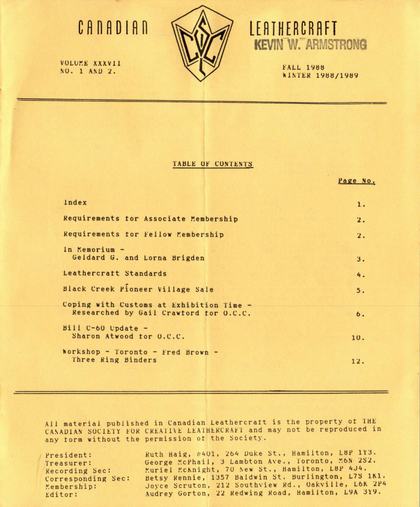
CANADIAN LEATHERCRAFT
VOLUME XXXVII, NO. 1 AND 2.
FALL 1988
WINTER 1988/1989
This is a double issue, numbered and dated for both Fall 1988 and Winter 1988/1989 on the cover.
TABLE OF CONTENTS
Page No.
The contents list is printed in two columns, the item on the left and its page number on the right. Read straight across instead of column by column, the titles run together and most of the page numbers drop out. It is set out below in the order the columns are meant to be read. The In Memorium notice is titled that way on the page itself, not "In Memoriam".
| Index | 1 |
| Requirements for Associate Membership | 2 |
| Requirements for Fellow Membership | 2 |
| In Memorium - Geldard G. and Lorna Brigden | 3 |
| Leathercraft Standards | 4 |
| Black Creek Pioneer Village Sale | 5 |
| Coping with Customs at Exhibition Time - Researched by Gail Crawford for O.C.C. | 6 |
| Bill C-60 Update - Sharon Atwood for O.C.C. | 10 |
| Workshop - Toronto - Fred Brown - Three Ring Binders | 12 |
All material published in Canadian Leathercraft is the property of THE CANADIAN SOCIETY FOR CREATIVE LEATHERCRAFT and may not be reproduced in any form without the permission of the Society.
| President: | Ruth Haig, #401, 264 Duke St., Hamilton, L8P 1Y3. |
| Treasurer: | George McPhail, 3 Lambton Ave., Toronto, M6N 2S2. |
| Recording Sec: | Muriel McKnight, 70 New St., Hamilton, L8P 4J4. |
| Corresponding Sec: | Betsy Rennie, 1357 Baldwin St. Burlington, L7S 1K1. |
| Membership: | Joyce Scruton, 212 Southview Rd., Oakville, L6K 2P4. |
| Editor: | Audrey Gorton, 22 Redwing Road, Hamilton, L9A 3Y9. |
Page 2 — Requirements for Associate Membership; Requirements for Fellow Membership
REQUIREMENTS FOR ASSOCIATE MEMBERSHIP
This page and the In Memorium notice were typed on a machine whose "f" struck as a "t" throughout, turning ordinary words to nonsense ("leathercraft" as "leathercratt," "of" as "ot," "if" as "it") — the reprinted articles elsewhere in this issue do not share the fault. Spelled out here as the words are plainly meant.
Not less than 3 years satisfactory practice of leathercraft. Two years of satisfactory service to the Society, e.g., helping with exhibitions, sales, writing for the Bulletin, serving on executives (local or national), getting new members for the Society or working in some way toward the development of leathercraft. Demonstrated ability to produce work of a high standard of craftsmanship. While originality of design is not necessarily required for Associate Standing, it will receive favourable mention. Copied designs should bear some stamp of the individuality of the craftsman and should NOT be an exact duplicate in every sense of the copied design.
Approval by the Board of Selection of submitted work as follows:
( i) Handbag or other large articles involving gusset construction.
( ii) Belt of 6 or 8 oz. leather.
(iii) Optional.
( iv) Optional.
NOTE!- Numbers 3 & 4 should be chosen to show specific techniques.
Articles submitted should demonstrate knowledge of materials and various techniques and versatility in the craft, e.g. tooling, carving, colouring, construction, stitching, lacing, moulding, etc. Articles submitted for Associate Standing will be marked according to the Society's Point System of Judging. The minimum passing mark for each article is 75 marks. If ONE of the articles has failed to receive 75 marks, the candidate will receive credit for the three qualifying articles and a condition on the fourth. 'The candidate may submit another article the following year, and if it qualifies, will receive his Associate Standing and Certificate at the next Annual Meeting when all four articles must be displayed. A candidate may fail on only one article to receive this condition. Work submitted must be accompanied by the signed declaration on application form that the work is solely that of the candidate. Work done in a leathercraft studio may be submitted for Associate Standing provided that it is done without assistance.
Enclose tee as set forth on the application to cover examination and certificate.
REQUIREMENTS FOR FELLOW MEMBERSHIP
At least one year as an Associate member and three years of service to the Society. Wide experience and meritorious achievement in the field of leathercraft.
Approval by the Board of Selection of submitted work as follows:
4 articles (2 large and 2 small) of the applicant's choice, all of different function, size and treatment, chosen to show versatility in the craft and grasp of techniques. NO piece submitted for Associate will be eligible.
Articles will be marked according to the Society's Point System of Judging. The minimum passing mark on each of the four articles is 80 marks. All four articles must qualify.
Page 3 — In Memorium - Geldard G. and Lorna Brigden
9. All work submitted must be original in design and decoration and should include, if possible, new forms and uses. Simplicity of decoration is most acceptable. Commercial or copied patterns must not be used.
6. Candidates shall submit an article, not necessarily technical, for publication in Canadian Leathercraft for the approval by the Board of Selection. An article previously published may be submitted.
7. Work submitted must be accompanied by the signed delcaration on application form that the work is solely that of the candidate, done without supervision or assistance.
The original prints "delcaration", kept exactly as printed.
8. Acceptance by a two-thirds vote of the active available Fellows. Y. Enclose tee as set forth on application to cover examination and certificate.
IN MEMORIUM
GELDARD G. AND LORNA BRIGDEN
It was with great regret that we learned of the passing of both Gel and Lorna Brigden. The craft scene in Ontario has lost great friends and strong supporters. Lorna passed away on November 13, 1988 and Gel on December 20, 1988. They were both in their 91st year and had celebrated their 60th wedding anniversary last March.
The page itself spells the family name "Bridgen" here, once, though the heading above and the rest of the notice spell it "Brigden."
An ardent craftsman, Gel was not only a member of C.S.C.L. for all of its 39 years, but was also a member of several other Guilds. As well as working in leather, he had also been involved in weaving, silversmithing, pottery and woodcarving and was indeed an all round craft enthusiast. During his many years on the C.S.C.L. Executive, many of the meetings were held in the Bridgen's Forest Hill home.
During Gel's long term as a member of the C.N.E. Board of Directors, he used his well known persuasive ability to convince the Board and Administration to set up the Arts, Crafts, Hobbies Show. From a small start it proved to be immensely popular and eventually took over a complete building which became known as the Arts, Craft, Hobbies Building. This was his pride and joy and he was a very well known figure wandering about the Show spending time with many craft friends. A man with a great sense of humour, a very infectious laugh, a fine optimistic view of life and a willingness to share is the way in which he shall be remembered.
Both Lorna and Gel were Life Members of C.S.C.L. Lorna, a lawyer, was very actively engaged during her lifetime in the work of various organizations and was a Past International President of the Alpha Gamma Delta Fraternity and Past President of the University College Alumnae Association. Our Constitution and By-Laws are a fine example of her sound legal expertise combined with an extensive first hand knowledge of organizational requirements. We have alway felt very grateful to Lorna for our well-set up Constitution and By-Laws.
Lorna and Gel have left our presence but will long be fondly remembered by so many of us.
-- Fred Brown.
Page 4 — Leathercraft Standards
LEATHERCRAFT STANDARDS
These are the general requirements and will be considered by the Council of Fellows in appraising works to be accepted for Sales. There will be exceptions in the case of articles with a newly identified need, ingenious application of material or technology, or an original aesthetic design. Exhibition and Competition articles will be judged by higher standards.
DESIGN:
Function: The project must fit the purpose for which it has been designed.
Proportion and Shape: Proportion means the height in relation to the width, and each shape in relation to all other shapes in the design.
Materials and Findings: Materials must be suitable for the purpose for which they are used, and the findings must be in keeping and good taste.
Harmonious Appearance: This is the result of the relationship of the forms or parts, bringing them into unity.
WORKMANSHIP:
Cutting: Accurate cutting to ensure correct fit and appearance. Decoration: Tooling - Clear cut lines; any modelling must be smooth, background stippling should be regular and any flat backgrounding should be put down smoothly Carving - Lines should not be cut deeper than half the thickness of the leather. Except in certain places, lines should not cross each other, or go beyond the outline being cut. In many cases, they should taper out.
Beveller: Must follow the cut line smoothly.
Pear Shader: Rarely is the exact impression of the pear shader correct. The tool should be moved around in the area concerned, tapering off the pressure toward the edges. Rarely should it touch these lines.
Background: However the background is treated, it must not detract from the design.
Camoflauge, Veiner, Mulesfoot, etc.: If used, they should not be overdone.
Seeders: These are used mainly for flower centres, and how it is. used depends on what centre is being done and the effect desired.
Decorative Cuts: If used, they generally follow the contour of the leaf or petal. They start heavy, and taper out to nothing.
Embossing: The parts to be embossed must be carefully raised. The raised portion must be well and smoothly supported. Generally, the surrounding area should be treated in such a way that the embossing is well defined.
Stamping: The impression should be regular or graduated and reasonably deep. When more than one tool is used, the impression should create a related design.
Page 5 — Black Creek Pioneer Village Sale
LEATHERCRAFT STANDARDS
Inlay: To fit accurately and show no tool marks.
Onlay: Prepared so that the edges are neat and firmly adhered.
Colouring: Must show that there is a knowledge of how to handle colour to get the desired effect.
Other forms of applied decoration not specifically mentioned, need the same care and attention to details as those above. Skiving: Sufficient to make the parts fit well, and to reduce the edges of parts being stitched or laced together to a suitable thickness, but not enough to weaken the leather where strength is needed. For turn-edges, the leather must be skived enough to make a smooth, neat turnover.
Fitting and Assembly: Edges to be flush, gussets and fasteners to be properly placed.
Moulding: Whatever method is used, the leather must be a suitable weight for the article. If there is more than one moulded part to the article, the moulding of the various parts must form a harmonious whole.
Finishing: Lacing and stitching to be even and uniform, suitable to the article and inconspicuously joined or finished off. Cut Edges: Whether laced or unlaced should present a well finished appearance.
Turned Edges: The edges must be skived enough to make a smooth neat turnover.
Glueing: Glue should be spread so that no lumps are formed. Any excess should be removed from the visible parts of the article.
Linings: Should be suitable for the article, neatly inserted and accurately fitted.
Stacked Leather: Must be securely glued, and sanded sufficiently to make a smooth edge.
Backs: To be finished suitably for the article whether lined, dyed, polished or left untouched.
Combinations: If the leather is combined with other materials, the leather must be the dominant part of the article, and the material must be compatable with the leather.
Reprinted from Volume XXVII, No. 3 - Spring, March 1979.
BLACK CREEK PIONEER VILLAGE SALE
Individuals are to man their own tables and be responsible for their own sales and money. Also please bring your own tablecloths for the 8' tables that are available.
Black Creek is asking for 15% of sales and the C.S.C.L. requires 5%. Please price your articles accordingly to help cover these fees. There is a cafeteria available at Black Creek.
DON'T FORGET - THE DATES ARE SATURDAY, MAY 13 & SUNDAY, MAY 14, 1989
Page 6 — Coping with Customs at Exhibition Time - Researched by Gail Crawford for O.C.C.
COPING WITH CUSTOMS AT EXHIBITION TIME
When Toronto artists Line Dufour and Gabrielle Sutt learned that an international jury had chosen two tapestries from each of them for a current New York exhibition, they shared a problem. How could they ship their work out of the country, and yet ensure its safety, satisfy both Canadian and American customs officials, and incur a Minimum of expense?
Conversely, if you are a craftsperson or curator who is not shipping out of the country, but bringing in or organizing an exhibition of work by artists who live outside the country, making arrangements with Canadian customs well in advance could eliminate nail-biting delays, frustrations, and eventual headaches.
The free trade agreement with the United States, by the way, is not expected to have an initial impact on existing procedures or on crafts. Peter Weinrich, executive director of the Canadian Crafts Council and long-time student of customs regulations, says that any tariffs on craft and craft products under free trade would be removed very gradually over a 10-year period.
We might notice a more immediate change, Weinrich says, on tariffs applied to craft materials. Since two-thirds of supplies come from or move through the United States, he suggests free trade might eventually benefit craftspeople importing materials. Canada's existing federal sales tax would continue to be applied at the 12 per cent rate.
FORMAL REQUIREMENTS.
If you, or the organization you are associated with, wish to send craft items out of the country temporarily for exhibition but NOT for sale, Canada Customs has two basic requirements. It needs to see the goods ahead of time, and the appropriate form(s) filled out in triplicate at time of export. All goods returning to Canada require and E-15 (Identification of Goods Exported or Destroyed), and goods with a total value over $900 also require a B-13 (Export Declaration). Any customs office can supply these forms.
A copy of the completed form(s) accompanies craft pieces when they leave the country, and at a later date -- or someone operating on your behalf -- will need to provide Customs with a stamped copy of the form(s) so you can get your work back without penalty or charge. To prove to officials that craft work is handcrafted and unique, Weinrich advises craftspeople when creating work to identify it with. a personal mark, stamp, or signature, and to state country of origin.
If your craft object is intended for SALE in another country, and is valued over $900, Canada Customs needs only a B-13 (Export Declaration). If under $900 in value, our customs needs neither. Duties could be applied on such work by another country, of course U.S. Customs, for example, has no uniform tax scale for crafts, and rates are variable for glass, clay, wood, and so one. Textiles are particularly tariff sensitive and are subject to extra scrutiny. In
Page 7
COPING WITH CUSTOMS AT EXHIBITION TIME
Dufour's and Sutt's case, their tapestries were not for sale, met all the criteria in their classification, and were admissable with no duty.
The original prints "admissable", kept exactly as printed.
DESCRIPTIVE REQUIREMENTS.
Two words misprint further down this page: "so the purchaser is fully aware that the piece same from Canada" for "came from Canada," and further on, "however, it items were to be sold" for "if items were to be sold." Both are kept here as printed.
In addition to these basic customs procedures, you must also prepare five copies of a letter or commercial type of invoice. These go in an envelope labelled customs papers' which is attached securely to the outside of your package. How much detail you need to provide depends on the value of your work and the particular requirements of each country. Err on the safe side; put down as much information as you can.
The general rule of thumb is that your letter or invoice should be dated, provide name and address of shipper and receiver, and state why work is being shipped (if for exhibition only or for sale, etc.). It should also describe the goods (number of pieces, value of each, size of each, and total value), indicate number of packages in the parcel, and the total weight. Many countries insist that country of origin be clearly marked. If Canadians send crafts goods to the U.S. for example, the words 'Made in Canada' must be applied on an adhesive label or tag so the purchaser is fully aware that te piece same from Canada. The U.S. is very fussy about this last detail, especially on craft items being offered for sale in the States.
BRINGING CRAFT WORK TO CANADA.
If yours is a Canadian organization holding an event involving work from another country, you must send a letter ahead of time to Canada Customs describing the event, its nature, date, and location. When exhibition goods arrive, form E29B (Temporary Admission Permit), is filled out for Customs and a security deposit paid representing 35 per cent of the value of the work. This guarantees the Canadian government that goods will return to their country of origin; once they do, the deposit is refunded. Susan Montgomery, superintendent of exhibitions and conventions in the Toronto Customs and Excise office, says that under free trade the amount of this security deposit may be reduced somewhat. -It's unlikely the federal sales tax would be altered, however, it items were to be sold.
The good news for some of you is that if the organization holding a show is sponsored by any level or government this security deposit is automatically waived. Museums, universities, libraries, and art galleries are exempt, for instance. If any other organization can produce a letter stating that a domestic or foreign government agency such as Canada Council or the British Council is a sponsor, the security deposit is not applied, Montgomery says.
Larger organizations with more resources at their disposal may prefer to use CARNET, an international travel document that replaces and E29B. CARNET applications are administered for a fee by chambers of commerce. They provide a bonded service and eliminate
Page 8
COPING WITH CUSTOMS AT EXHIBITION TIME
pesky security deposits. Because it takes 30 months to have a bond refunded under the regulations governing CARNET, Montgomery says this alternative is not as attractive for small organizations -- which most craft groups would be '-- because they cannot afford to have funds tied up for that period of time.
HOW TO SHIP.
Once the paperwork is in place, the next hurdle facing you is how to ship work in or out of the country. Canada Customs recommends sending items by mail since postal officials can also provide the customs service of validating completed forms. The post office can also supply U.S. declaration forms for out-bound goods under $1,000 in value. Shipping by post is suitable only for parcels that are one metre long maximum (3.3 feet), and when length and girth are added together, their total must not exceed two metres (6.6 feet).
Allow a month if you decide to ship goods to and from the country by the post office. Although more expensive than regular mails, Priority Post is another alternative worth considering. Any post office outlet can give you details.
AS in Canada, United States customs officials can also function within a post office setting. American regulations are convoluted, however, and you may want to research ahead of time. In international customs nomenclature, crafts exits in a grey zone so that regulations governing them fall somewhere between those applied to art and commercial objects. Most craft items seem to qualify as duty-free items when being exhibited, but you can't always be sure. You are usually trouble free with work under $1,000 in value; if over, American customs at Buffalo advise that a formal entry procedure is necessary, which only a customs broker can execute.
Revenue Canada Customs and Excise says that customs officials everywhere are quite prepared to assist and advise when they can, but, in the end, hiring a customs broker may be a more satisfactory alternative than trying to cope on your own.
Brokers are familiar with customs requirements and technicalities, can prepare documentation, and post security deposits or bonds on your behalf. Fees are usually based on a pro rata schedule, and depend on the number of pieces to be moved, their value and size, and labour involved. Brokers will not absorb shipping charges for this fee, but are usually prepared to pay them up front and be reimbursed at a later date.
Many commercial craft galleries in Toronto prefer to use international courier services such as United Parcel Service Canada Ltd. (UPS), especially for shipments to the United States. This organization can act as broker for goods coming into Canada from the U.S., but not for goods leaving Canada. If you use this alternative, you would need to select a broker ahead of time to assist your parcel going into the States. Parcels for courier are restricted to those whose length and girth add up to 3.3 metres (11
Page 9
COPING WITH CUSTOMS AT EXHIBITION TIME
feet) and that weigh no more than 32 kilos (70 pounds).
If your preference is to ship by air freight, you might contact Federal Express customer service. Its fees are determined by weight and the value of the work being shipping. Like UPS it can function one way as a customs broker, and it provides door-to-door service. Goods to be shipped in this manner must not exceed 1.9 metres long (76 inches) and 3.3 metres (11 feet) if length and girth are combined.
If our customs procedures seem terribly complicated, take heart, The world of customs and excise is considerably streamlined from what it was a year ago. On January 1, 1988, Canada joined all the world's major trading nations (except the United States, which will join later this year) in a 'harmonized-system' of product description. Under this system, there are over 10,000 classifications -- triple the number than before -- that provide more precise descriptions and conform to a standardized global numbering system. Prior to this, every country had its own numbering system which had to be cross-referenced. Gradually, confusion and costly delays are being eliminated and the work of our customs officials has been streamlined.
(The OCC's resource centre has available for perusal copies of current Ontario and U.S. regulations applicable to craftspeople). To reach Customs and Excise directly for a ruling or for advice, Ontario residents should contact district representative:
Susan Montgomery,
Superintendent,
Exhibitions and Convention Unit, Revenue Canada Customs & Excise, 1 Front Street West,
Box 10 - Station "A",
Toronto, Ont., M5W 1A3. Telephone: 1-416-973-8007.
The United States Customs are at:
11 West Huron Street,
Buffalo, New York, U.S.A. 14202. Telephone: 1-716-846-4351.
Researched by Gail Crawford.
NOTES
Ruth Haig received permission from Mrs. Joan Foster, Executive Director of O.C.C. to reprint these articles which appeared in the CRAFTNEWS - Volume 14, Number 2 - February 1989.
Page 10 — Bill C-60 Update - Sharon Atwood for O.C.C.
BILL C-60 UPDATE
At the Ontario Association of Art Galleries' (OAAG) general meeting last October, in St. Thomas, the main topic of discussion turned out to be Bill C-60, the Copyright Act passed by the House of Commons on June 8, 1988. This act has received much attention from the arts community as a positive step for protecting creators' rights. However, the impact of the first of its two stages is only just now being understood.
Under the new law, artists still hold the copyright to their work for life plus fifty years, regardless of who owns the work itself. The copyright and the reproduction rights can still be bought or transferred to the purchaser of the work. What the copyright reform has provided are much stiffer infringement penalties, particularly against commercial violators in the recording industries.
The artist also holds the moral rights of his or her work, and these have been extended to life plus fifty years like copyright. They, however, cannot be sold or transferred. Moral rights allow the artist to be credited and to remove a work or take legal action if their artwork has been distorted, mutilated or used in a context or within an organization disagreeable to the artist. The new law lifts the onus from the artist to prove 'damage to honour and reputation' before a court will judge that moral rights have been infringed upon. This will save the artist both time and grief, not to mention expense if he or she has to take legal action.
Perhaps the greatest benefit artists will receive from the revised Copyright Act is their new exhibition right. This allows artists to charge a fee for the exhibition of their work and to control the use of it where the intent of the show is not to promote sale or rental. Exhibition rights apply to work made after June 8, 1988.
The revised act clearly indicates 'works of artistic craftmanship'. As before, however, the Copyright Act only applies to craftspeople doing one-of-a-kind objects and editions of up to fifty copies. Those people working in multiples over fifty are not protected and can register their designs as industrial designs. The Canadian Crafts Council is preparing protection of those craftspeople doing multiples over fifty when the Industrial Design Protection Act is revised.
The OAAG discussion highlighted the possible impact that Bill C-60 may have on the art gallery community. Because the Act is not yet well tested and does not clearly define the difference between public display and an exhibition, it will take some time and few precedents before standard contracts between galleries and artists can be worked out.
Many questions still have to be answered, for example, can an exhibition take place in a non-gallery setting? Do exhibition fees apply to displays of artwork in public areas of buildings or lobbies of galleries or museums? Since the OAAG general meeting, the Professional. Art Dealers Association of Canada (PADAC) has'. been working on the definitions of public display versus public
Page 11
printed Page 11
BILL C-60 UPDATE
exhibition and have been developing guidelines from those definitions. Art galleries, such as the Art Gallery of Ontario, are trying to develop a uniform type of agreement to be negotiated with the artist at the time of purchase. Until such contracts are devised, some galleries are choosing not to acquire works of art made after June 8, 1988.
Although artists deserve the right to receive fees for the exhibition of their work, galleries want to maintain as many rights and freedoms as possible. The increased involvement of the artist in the organization of an exhibition may infringe on curatorial freedoms. Still, fees are not standardized and are negotiable between the gallery and artist. Artists may choose to join collectives such as Canadian Artists Representation Ontario (CARO), Canadian Artists' Representation/Le Front des Artistes Canadiens (CAR/FAC) or Vis-Art; they are empowered to assign the administering of artists' rights. A Copyright Board has been established to oversee rates of payment and to resolve disagreements between collectives and user groups. While artist advocacy groups work to educate artists about their rights, they also help user groups (such as libraries, galleries, curators, and education institutions) track down the artists who require payment.
The long-range impact of Bill C-60 on galleries and museums may centre on permanent collecting and the exhibition of these collections. Now it will be necessary to establish what is acquired when artwork is purchased and how to deal with paying exhibition fees for displaying works from permanent collections. More time and energy will be spent in tracing and securing exhibition rights, and in the future, negotiating with the families of creators to follow through with exhibition rights of deceased artists. Thirty or forty years from now, the exhibition of an artist's work may carry multiple conditions.
Phase two of Bill C-60 will deal with several issues of refining exhibition rights: allowing work in a gallery's permanent collection to be exempt from artist fees when exhibition on the institution's premises; library and educational uses; home taping; sound recording and record-rental rights; revised provisions for damages; customs enforcement; and several items relating to moral rights.
Sharon Atwood.
NOTE;-
Ruth Haig received permission from Mrs. Joan Foster, Executive Director of O.C.C. to reprint these articles which appeared in the CRAFTNEWS - Volume 14, Number 2 - February 1989.
Page 12 — Workshop - Toronto - Fred Brown - Three Ring Binders
WORKSHOP
Date: Saturday, May 27, 1989. Time: 9:30 a.m. to 4:00 p.m.
Place: St. Martin's-In-The-Field Anglican Church, Toronto Fee: $15.00
Demonstrator: Fred Brown, Toronto Branch Project: Covered Small Ring Binder
PLEASE BRING;
Scissors and skiving knife Ruler and square
Pencil and drawing paper
White cement
Rivets
Mallet
Tooler and Modeler
Stiffener - such as x-ray film, fine splits, lightweight derex, etc. Thin skiver for lining
Morocco or 2/3 oz. cowhide
Dyes if required
Thin cardboard, etc. for optional 3-D
PLEASE NOTE!!!! - Since there is a possibility that Fred will supply the hardware for a fee, it is necessary to let him know far enough in advance if you are coming to this workshop.
The other option is to bring your own hardware.
BRING YOUR LUNCH - Coffee and tea will be provided. SUPPORT YOUR C.S.C.L. BY PLANNING TO ATTEND THIS WORTH- WHILE WORKSHOP.
TORONTO, ONTARIO
Both headings on this page are printed as decorative stencilled lettering rather than plain type.