
An issue of the Society’s newsletter, transcribed from the original.
(12 pages, 2.0 MB)
the full-resolution scan, 31 MB, for close research
Page 1
Canadian Leathercraft
Volums XXXVI No. 4 Summer 1988 0045-5121
TABLE OF CONTENTS
Page No.
Index 1.
Angelfish Mobile - Edith Melchior Hawkins - Woodstock Branch 2.
The Craftsman's Creed - Edith Melchior Hawkins - Woodstock Branch 2.
Applying Alphacolour Pastels to Leather - Betsy Rennie - Hamilton Branch 4.
Editor's Corner 5.
Leather, Always in Style - Madeleine Mitchell - Woodstock Branch 6.
A Bit of History - The Mary Rose - Beula Reynolds - Woodstock Branch 8.
These Men Help Give Horsemen Deluxe Ride - London Free Press - submitted by Woodstock 9.
If You Smell Smoke in Moosonee, It's A Cree Creation - London Free Press - submitted by Woodstock 10.
Workshop - Hamilton Branch - Ruth Haig - Ranger Belts 12.
This contents list is printed one item to a line with its page number at the right. It is set out above in that form, matching the page's own order and numbers.
All material published in Canadian Leathercraft is the property of THE CANADIAN SOCIETY OF CREATIVE LEATHERCRAFT and may not be reproduced in any form without the permission of the Society.
| President: | Ruth Haig, #401, 264 Duke St., Hamilton, Ont., L8P 1Y3. |
| Treasurer: | George McPhail, 3 Lambton Ave., Toronto, Ont., M6N 2S2. |
| Recording Sec: | Muriel McKnight, 70 New St., Hamilton, Ont., L8P 4J4. |
| Corresponding Sec: | Betsy Rennie, 1357 Baldwin St., Burlington, Ont., L7S 1K1. |
| Membership: | Joyce Scruton, 212 Southview Rd., Oakville, Ont., L6K 2P4. |
| Editor: | Audrey Gorton, 22 Redwing Rd., Hamilton, Ont., L9A 3Y9. |
Page 2 — Angelfish Mobile - Edith Melchior Hawkins - Woodstock Branch; The Craftsman's Creed - Edith Melchior Hawkins - Woodstock Branch
ANGELFISH MOBILE
Suggested Leather -- Rawhide, 1-1/4 oz. cowhide, or a similar light weight leather.
From your leather, cut 2 circles 5" in diameter. Draw a line from the centre of the circumference, and measure 1-1/2" from this line, along the circumference and draw another line to the centre. This wedge is to be removed, and gives dimension to the fish. (Cutout A).
See Figure 1 -- Cut out solid lines for mouth, and the piece removed (Cutout B) is used by cutting along the dotted line as fins. Cut one tail piece - Figure 2. Make sure you reverse one circle so that the grain side is out for the body, and that the same side is showing on fins and tail. Cut two eyes from suitable black leather scraps. Cut two thin pieces of leather similar to the thickness of lacing about 8" long for the whiskers.
Skive along edges of Cutout A and cement together lapping about 1/8". On one circle attach fins and tail on flesh side, and glue. Punch holes Figure 1(c) and put in whiskers. Tie a knot in inside. Glue on eyes. When glue is dry, attach other circle. When complete attach some monofilament fishline to the top of the fish and hang up. Several different sizes may be made for a multi-fish mobile.
Edith Melchior-Hawkins, F.C.S.C.L.
THE CRAFTSMAN'S CREED
I hold with none who think not work a boon Vouchsafed to man that he may aid his kind With offerings from his chisel, wheel and loom Fashioned with loving heart and loving mind. All of the fine tradition and the skill
Come through my elders through the long line down Are mine to use to raise our crafts renown And mine to teach again with reverent will. Thus do I live to serve though least for pay With fingers which are masters of the tool My eyes are light to see the pattern play As it unfolds obedient to each rule of our dear ART. So all my craft is praise to God - at once part homage and part song.
My work's my prayer
I sing the whole day long as Faith and Beauty shape the forms I raise.
AUTHOR UNKNOWN
Donated by Edith Melchior Hawkins.
Page 3
ANGELFISH MOBILE
[This page is a hand-drawn pattern diagram; its handwritten labels are set out below, in place of the drawing itself.]
FIG I: Cut 2 5" circles, one for each side of fish. Cut out (a); attach fin here; when closed, attach tail here. Cut out (b) for mouth, solid line. EYE, cut 2. Attach fin here.
FIG II: Tail, cut 1.
FIG III: whiskers.
Page 4 — Applying Alphacolour Pastels to Leather - Betsy Rennie - Hamilton Branch
APPLYING ALPHACOLOUR PASTELS TO LEATHER
The Alphacolour pastels blend easily into light and dark values. These pastels are rich in pigment with a smooth responsiveness and velvety textures.
First off, dampen the leather. Then with a stiff, dry brush -- white bristle No. 6 to 8 -- loosen the pigment and load the brush with the dry powders that you have created.
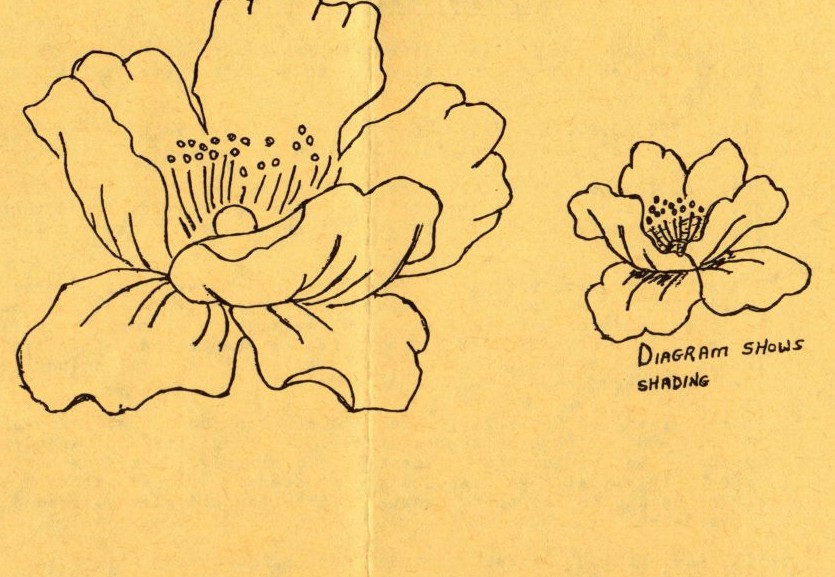
My example is a poppy. Using dark purple, place your shading in the heart of the flower and also where the petals go down. Keep in mind that light colours will bring your petals forward and the dark colours will make your petals appear as if they are behind.
Then loosen the pigment of the yellow pastel and load the powders into the brush. Do the whole poppy, even over the purple.
Upon experimenting, I find that if you gently push the brush back and forth around the outside edges first, you push the powders into the grain of the leather and this also helps to prevent the powders from going outside the petals. Then stroke toward the centre of the flower. The powders will go toward the centre. When you have excess powders on your work, you blow them off.
Now, loosen the pigment on the bright red and do the whole flower covering all the yellow. This gives the appearance of orange. Now go over the whole flower with the darkest red that you have.
Using the reds in this fashion makes the flower a darker red than if you had just used the dark red. You will also find that the colours blend easily giving it more than one hue.
Now, go back to the yellow and brush it over the pear shaded areas. The centre of the flower is black. Loosen the pigment and apply to the stamen area.
With a soft brush -- No. 1 or 2 -- dip the brush into water and then wet the black pastel. Now you can paint on the stamen lines to make them stand out. You may have to go over them two or three times.
When your flower is complete, spray the article with saddle-lac. This prevents the colours from rubbing off.
Page 5 — Editor's Corner
APPLYING ALPHACOLOUR PASTELS TO LEATHER
EDITOR'S CORNER
Due to illness and some lack of material, I have been unable to publish two bulletins on time. The fall issue will follow in a very short time and of course the winter issued will come out hopefully near the end of February. I AGAIN RESPECTFULLY REQUEST THAT THE MEMBERSHIP SUBMIT ARTICLES FOR THE WINTER AND ENSUING ISSUES. Going over my past bulletins I notice that every once in a while this has created a problem. As you can see from this issue, the responsibility of the Woodstock Branch, that all the articles are not technical. Some of them are of varying interest but they still include leather as part of their theme. Therefore you can see that many types of articles are acceptable for publication.
Also I would like to apologize for not including GLENN NELSON's name in the last bulletin as a demonstrator at the 1988 Annual hosted by the Norland Branch. Glenn demonstrated his techniques for designing and creating a wall clock. By the way, Glenn won a ribbon for one of his clocks at this Annual.
[The Editor's Corner itself prints "the winter issued will come out", not "issue"; kept as printed.]
Page 6 — Leather, Always in Style - Madeleine Mitchell - Woodstock Branch
LEATHER, ALWAYS IN STYLE
In leather art, as in many things, there are styles some favoured by the masses and others esoteric and private. Few styles can be said to be original. Since 1950, C.S.C.L. members have striven to reflect various styles in one of man's most beautiful and versatile mediums, "LEATHER". However, leather styles well preceded the establishment of C.S.C.L., and this discussion is about the diversity of styles found through history to present day, and their influence on man's use and love of leather.
Classicism in architecture, furniture and furnishings represents absolutes -- clean lines, symmetry, proportion and elegance. Leather pieces can instill the same feelings -- strong clean lines as found in a desk blotter, symmetrical presentations as in picture frames and book-ends, and the tailoring of a well-proportioned leather covered box.
At the time for Louis XIV, French decor took on purely decorative aspects and extravagant embellishments. Fragility and indulgence invaded the aristocratic lifestyle. Similarly, some leather' can exude a whimsical, garnished style as seen in floral embossed wall coverings and in the soft, sensual 18-button kid gloves, beaded and embroidered.
With the opening of Eastern trade routes, European styles gave way to simplicity and exoticism of the Oriental. "Less" became "more" and in leather art, beauty came from the leather material. With nominal intrusion of the leather surface, artists sought to release its mysticism. Yin/Yang concepts influenced leather design as this strong material was moulded, fluted, smoothed into bowls and trays. Colours become subtle but penetrating, and the piece worked because of the leather itself.
Unabashed escapism and ornamentation describe the romantic style of decorating. On a leather-topped desk, intricate gold leaf delicately encompasses the work surfaces. Embossed Bibles. and elaborate book covers reflect the personality of the artist and his time.
At the time of Queen Victoria, decors had transcended to richly patterned and densely coloured styles. In leather, hat boxes, toilettry cases and massive trunks were handsome, functional, heavily patterned, and rather dark. -During the era of Edward, Victoria's son, there seemed to be a comfortable masculinity about decors, and also in leathers. Sports accoutrements, riding boots and crops, shaving kits, were rich, elegant and confident.
While British and European styles displayed elegant and indulgent styles, the New World offered pioneers a more rustic palette. Country life in the Americas was fresh, simple and rather quaint. Sturdy leather aprons for the blacksmiths, rugged footwear and carrying cases proved leather's age-old strength and
[A dropped space had run two words together, "amore" for "a more"; restored against the picture of the page above.]
Page 7
[This page opens with the word “functionalability.”, completing the sentence from the foot of the previous page, “...proved leather's age-old strength and”; the two words are printed run together as one, entirely on this page — the Society's own printed typing, not an artifact of the page break — and are kept as printed.]
functionalability. Native influence was evident in soft buckskin clothing and beaded moccassins. Later, as the settlers established themselves, the Puritan lifestyle gave way to a hominess and familiarity. Chairs and furnishing combined leather with other natural materials, like wood and bone.
Western designs and methods of colouring leather with vegetable dyes allowed the depiction of victories, festivals and favourite nature themes. Wall hangings, coverings and saddles were not only personalized but provided nostalgic decoration to portray man's fresh, natural world.
The modern day leathercrafter is at a time in history unlike any before him. Colourings, methods of application, tools and even the leather today is a result of thousands of years of experimentation, ornamentation and adoration of one of nature's most malleable, unique and handsome natural materials. Untethered by convention and isolation, today's leather artists benefit from the contribution of master craftsmen of the past.
In conclusion, I offer C.S.C.L. members a challenge to continue the creative process using leather as the medium, and to portray their talents, interest and individuality.
Madeleine Mitchell.
Page 8 — A Bit of History - The Mary Rose - Beula Reynolds - Woodstock Branch
A BIT OF HISTORY
The keel for the ship named the Mary Rose was laid in Portsmouth in 1509. On Sunday, July 19, 1545, she set sail again after being rebuilt and her armament increased with heavy bronze guns. In addition to her normal crew of 415 men, the ship carried 285 heavily armed soldiers -- many of them longbowmen.
While King Henry VIII and many of his court watched from the shore at Portsmouth, the ship suddenly rolled over and sank. Out of the 700 men aboard about 30 survived.
The bottom of the Solent where the ship sank consists of banks of sand, fine mud and silt constantly stirred by tidal action.
In 1971, over 400 years later, the wreck was located and in 1979 divers began the work of excavating the inside of the ship.
Virtually everything that went down with the ship remained in a remarkably good state of preservation -- this included weapons, tools, clothes and even normally perishable. stores. A barber surgeon's chest was so completely preserved that ointment in one of the small wooden jars still bore the surgeon's finger marks from his last use. Wooden planes, a ruler marked in inches, 3 magnetic steering compasses suspended on gimbals in their wooden cases and small wooden pocket sundials were among the more than 17,000 artifacts recovered.
There were 139 of the 6 foot long yew bows and 2,500 arrows. Many of the longbows were in good enough condition to be restrung and shot. These were claimed to be accurate within 300 yards. Also recovered were leather spacers used as ammunition clips for 24 steel tipped arrows -- using these an archer could shoot about 12 rounds a minute. The leather braces for the archers' wrists were either plain or lightly carved. Leather mittens were found packed in a wooden box among longbows and arrows. These were used by archers to protect their left hands when shooting fire arrows. Among the other leather articles were sturdy seamen's shoes and book covers. The very ornate embossing on the book covers suggests they had been on prayer books or bibles -- no trace of the pages that had once been enclosed were found.
Not many of us will have a chance to visit the museum in England where most of these artifacts are housed, but there is a travelling exhibition -- we had the thrill of seeing this at Patriots Point in the U.S. some time ago. Just recently, while visiting the Royal Ontario Museum, we came across 2 leather shoes made hundreds of years ago -- it brings home the fact that there is not much new under the sun.
Beula Reynolds.
Page 9 — These Men Help Give Horsemen Deluxe Ride - London Free Press - submitted by Woodstock
THESE-MEN HELP GIVE HORSEMEN DELUXE RIDE
A riding saddle of solid gold or crocodile skin isn't to every man's taste, but then customers of John Goodwin's products aren't your average horse lovers.
Goodwin, from Wassal, England, is a master saddlemaker who crafts elaborate riding equipment for the clients willing to pay prices most people associate with large household appliances and cars.
For example, there's the $22,000, all-gold saddle he rigged for the sultan of Brunei, reputed to be the world's richest man. Or the white doeskin saddle made for a member of Kuwait's royal family.
Then there's the reptile-skin saddle prepared for a Swiss client.
"Apparently the man had a thing for crocodile," says Goodwin, who also counts among his clientelle Oman's crown prince, former Beatle Paul McCartney, Princess Anne and 40 police forces from cities that include Houston, West Berlin and Sydney, Australia.
The reprinted newspaper article prints "clientelle", kept exactly as printed.
Goodwin was exhibiting his wares at the Horse International trade fair at the University of Guelph on the weekend.
He was joined by Jochen Schleese, who expressed his own vision of what the well-dressed horse is wearing these days -- custom-built saddles of beechwood and leather and water-buffalo hide and serge.
"Some people are willing to pay more and are willing to pay for the best," says Schleese, who explains he uses leather from German and Italian tanneries to sculpt a glove-like fit for horse and rider.
The average import saddle, from Argentina or Pakistan, perhaps, costs $250.00, he says. On the other hand, his water-buffalo and serge creation goes for $2,900, while a hand-made leather saddle with a weaved texture sells for around $3,500.
An ordinary hand-made riding saddle costs an average of $2,000 and takes 40 hours to make, he says.
German-born Schleese, 25, wants to see saddlery become a registered trade in Canada and is currently training two apprentices in European saddlery methods at his operation in Cedar Valley, near Newmarket, north of Toronto.
He served three years as an apprentice and worked another' three years at a London saddlery which supplies the royal family before being the youngest master saddler in Germany at 22.
The London Free Press - May 1988.
Page 10 — If You Smell Smoke in Moosonee, It's A Cree Creation - London Free Press - submitted by Woodstock
IF YOU SMELL SMOKE IN MOOSONEE, IT'S A CREE CREATION
MOOSONEE -- Visitors to this James Bay village bring back memories of giant canoes that serve as water taxis, dirt roads, cars without licence plates (no need for plates where there are no provincial roads) and a slight tang of salt in the Ontario air.
The actual souvenirs of a visit to Moosonee, however, are likely to be Cree crafts -- moccasins, vests or gloves made of golden-brown smoky leather and decorated with intricate beadwork.
When the Polar Bear Express, a popular summertime excursion for city folk, pulls in, craftsman meet the train offering their wares. Several stores in Moosonee specialize in Cree crafts and, on the nearby island of Moose Factory, visitors can buy their souvenirs directly from the natives who keep the crafts alive.
Many of the hand-sewn moccasins and mitts actually originate far to the north, from seldom-visited villages scattered along the Ontario shore of Hudson Bay. There, where winter lasts more than half the year, the crafts are an important source of income. Cree craftsmen start with the rawest of raw material, an untanned hide with its hair still on. Some still use the legbone of a large animal to scrape away the hair, but the actual tanning is no longer done by rubbing the animal's brains on the hide. Instead, there are substitutes, including motor oil.
But the craftsman still dry and stretch the hide. The last step in the process is smoking.
They curl the hide into a tepee shape and build a small, very smoky fire under it. This turns the leather a golden brown and permeates the hide with a smoky odor that will always remain with it. Your nose will tell you when you have a genuine Cree item in your hands; you can smell the smoke.
The resulting product is ideal for the cold, dry winters of the Far North. There's no salt used in the tanning; that would cause the snow to melt where mitts or boots touch it and cause dampness. It's also an item of beauty, with the intricate beadwork that takes hours to apply.
There is an odd twist, however. Most of the pieces aren't made from the hides of the moose and the caribou that inhabit these northern climes. Much of the leather is actually deerhide, from white-tail deer that may have come from thousands of kilometres south from the shore of Lake Erie or the bottom edge of central Ontario.
Craftsmen prefer deerhide to moose or caribou because it is easier to work. Moose and bull caribou have thick hides difficult to handle and tough to drive a needle through.
The deerhide arrives from the south every December by aircraft. The Ontario Ministry of Natural Resources runs a program in which southern Ontario hunters can trade in their deerhide, which they would not normally use. These hides go to support native craft programs in all areas of the province.
Page 11
Hides destined for Hudson Bay-James Bay Cree communities are quick frozen. When the hunting season winds down at the end of November, the hides are shipped to Moosonee, then flown to villages along the coast. Craftsmen meet the aircraft, choose the hides they want, then take them home to turn into next year's income.
The Cree Cultural Centre on the island of Moose Factory has been instrumental in keeping the craft programs going. A few years ago, when the ancient crafts were in danger of dying out, a number of elder Cree began teaching the traditional arts to a new generation.
WHEN YOU GO
Despite its seemingly remote location, Moosonee is easy to reach in summer on the Polar Bear Express, which has excursions running from one to five days.
The train runs daily, except Friday, from June 25 to Sept.. 5. There is less-frequent service in winter months.
(Don't let the train's name fool you; polar bears live much farther north.)
One-day excursions are $34 adults; $17 for seniors and children 5-12; children under five are free. There's a maximum $88 fare for families.
The train pulls out of Cochrane at 8:30 a.m. and returns at 9:20 p.m., giving visitors roughly four hours to visit Moosonee.
Overnight packages, which leave from Toronto or North Bay, range from $267 (three days, double occupancy) to $381 (five days).
For more information, contact the ONTARIO NORTHLAND RAILWAY,
PASSENGER SERVICE DEPARTMENT,
510 MAIN STREET EAST,
NORTH BAY, P1B 8L3.
The London Free Press - April 23/88.
[Three small punctuation slips in the opening paragraph are set right against the picture of the page above: "quick frozen" (a stray period had split it in two), the comma after "shipped to Moosonee" (misplaced before it), and "the coast" (a stray colon and period removed).]
[The sheet carries small marks in its left margin. The words are the page’s own.]
Page 12 — Workshop - Hamilton Branch - Ruth Haig - Ranger Belts
DATE: SATURDAY, FEBRUARY 11, 1989 TIME: 9:30 A.M. TO 4:00 P.M.
PLACE: ST, MARGARET'S CHURCH HALL, EMERSON AND ROYAL PROJECT: RANGER BELT BY RUTH HAIG
COST: $15.00
YOU WILL BE REQUIRED TO BRING THE FOLLOWING:
1, 1-1/4" BELT BLANK (8 0Z,) - 4-1/2" LONGER THAN ACTUAL
WAIST SIZE.
2, 2/3" BELT BLANK (5/6 0Z, OR 6/7 OZ.) - 20" LONG, 3, 3/4" BUCKLE,
&, 1/2" STRIP FOR 2 KEEPERS. ROTARY PUNCH,
5. TAPE MEASURE OR RULER AND STRAP CUTTER, EDGE BEVEL. 6, SKIVING AND CUTTING KNIVES, CUTTING BOARD, WATER, SPONGE, 7, EDGE CREASER AND #5 OR #6 STITCHING WHEEL.
8, BONE FOLDER, DIAMOND AWL, POINTY NOSE PLIERS,
9, RIVETS AND SETTER, MALLET, SMALL AMOUNT OF WHITE CEMENT, 10, WAXED LINED THREAD AND #2 SADDLERS HARNESS NEEDLES, 11, NEWSPAPER, DYE AND POLISH. DENIM TO FINISH EDGE,
THIS WILL BE A BASIC WORKSHOP FOR A PLAIN OR EDGE CREASED BELT. IF DESIRED, A LINE GOUGE MAY BE USED DOWN EACH SIDE OF THE BELT AND THE OVER STITCHER RUN DOWN THESE LINES TO GIVE A STITCHED EFFECT, WHEN, IN FACT, IT IS NOT STITCHED AT ALL.
PLEASE SEE THAT YOUR GUILD IS NOTIFIED.
CONTACT RUTH HAIG, 1-416-525-0780 IF YOU ARE PLANNING, TO ATTEND,
BRING YOUR LUNCH OR DINE OUT - COFFEE & TEA WILL BE PROVIDED. (PLEASE SEE PREVIOUS BULLETINS FOR MAP DIRECTIONS),
HAMILTON, ONTARIO
[The project line and the contact line below both print the workshop leader's name correctly as RUTH HAIG; there is no misprint here.]