
An issue of the Society’s newsletter, transcribed from the original.
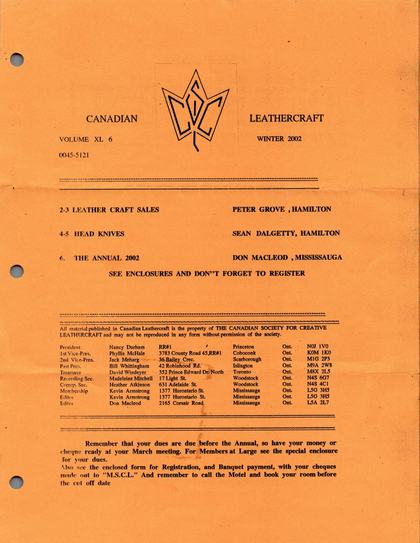
(6 pages, 1.3 MB)
the full-resolution scan, 22 MB, for close research
Page 1
CANADIAN LEATHERCRAFT
VOLUME XL 6 — WINTER 2002
0045-5121
2-3    LEATHER CRAFT SALES               PETER GROVE, HAMILTON
4-5    HEAD KNIVES                       SEAN DALGETTY, HAMILTON
6.     THE ANNUAL 2002                   DON MACLEOD, MISSISSAUGA
       SEE ENCLOSURES AND DON''T FORGET TO REGISTER
[The masthead reads "VOLUME XL 6", following the preceding issue’s "VOLUME XL 5" (Winter 2001); printed exactly so. Issued about January–March 2002: it speaks of business through the fall of 2001 and refers members to an enclosed registration for the Annual Meeting, whose dates it does not print.]
All material published in Canadian Leathercraft is the property of THE CANADIAN SOCIETY FOR CREATIVE LEATHERCRAFT and may not be reproduced in any form without permission of the society.
President:      Nancy Durham        R.R.#1                        Princeton     Ont. N0J 1V0
1st Vice-Pres.: Phyllis McHale      3783 County Road 45, RR#1     Coboconk      Ont. K0M 1K0
2nd Vice-Pres.: Jack Meharg         36 Bailey Crec.                Scarborough   Ont. M1G 2P3
Past Pres.:     Bill Whittingham    42 Robinhood Rd.               Islington     Ont. M9A 2W8
Treasurer:      David Windeyer      352 Prince Edward Dr. North    Toronto       Ont. M8X 2L5
Recording Sec:  Madeleine Mitchell  17 Light St.                   Woodstock     Ont. N4S 6G7
Correp. Sec.    Heather Atkinson    631 Adelaide St.                Woodstock     Ont. N4S 4C1
Membership:     Kevin Armstrong     1377 Hurontario St.            Mississauga   Ont. L5G 3H5
Editor:         Kevin Armstrong     1377 Hurontario St.            Mississauga   Ont. L5G 3H5
Editor:         Don Macleod         2165 Corsair Road              Mississauga   Ont. L5A 2L7
Remember that your dues are due before the Annual, so have your money or cheque ready at your March meeting. For Members at Large see the special enclosure for your dues.
Also see the enclosed form for Registration, and Banquet payment, with your cheques made out to "M.S.C.L." And remember to call the Motel and book your room before the cutoff date.
Page 2 — Leather Craft Sales
Leather Craft Sales
We have all been hearing news stories about the "recession", how business has been bad through the fall of 2001 and is not looking better for the first half of 2002. Having a retail shop of my own, I am always trying to keep up — and I am aware of the problems crafters face trying to market their products. Here are some thoughts that may help all of us sell more products, keep our customers happy and loyal, and maybe even grow through otherwise slow times.
Back in my days with Tandy Leather Company, their C.E.O. was Mr. Ken Gregson. Ken was an old dog and pony show type of salesman. He always believed nothing happened without a salesman starting the ball rolling, and we are all salesmen. A quote Ken used with us was "There ain't hardly no business been got here that ain't been went after." Sitting back waiting for customers just is not going to cut it. You must be out there selling your wares. Ken also used to stress that old stock was like a dead horse. After a while it begins to stink — get rid of it. You need to sell what your customers want, not always what you want. If you keep taking the same stock to show after show you need to do something about it. Mark it down and move it out, even if you only get your cost back. Turn that money into something that will sell. I have a hard time discounting my own work, but it has to be done. Dead stock costs you money, it does not make any.
The price you charge for your work is not the only thing customers look at. Are you a friendly person to talk to? Do you dress in a clean professional manner? Your customer needs to be comfortable with you. Are you marketing yourself and your products well? Your table or booth needs to be decorated well. Do not just have your goods laid out flat on a bare table. A leather hide or colourful tablecloth is a start. Make up areas of different heights to better display products of similar groups in different parts of your area. Large and well printed signs are better than illegible notes on the lip of an old cardboard box. We must look and be as professional as possible.
I have found over years of doing shows that activity breeds activity. Sitting behind your table reading a book will tell everyone that you do not want to be disturbed. Stand up. Acknowledge all who come by with a smile and a hello. Try to be working on something. Even lacing a wallet will entice folks to stop and see what you are doing. I almost always had a marble slab and some tools handy. Pounding leather is something few people can avoid watching. I have sold more key fobs and wrist bands this way than I could count. While other vendors were not selling anything I was selling $5.00 wristbands all day long.
Page 3
Have a ready supply of business cards or brochures handy. These need to have more than your name and address on them. Describe what you do. Customers are a forgetful lot and need reminding of what you do and where you are. A descriptive or interesting card is kept longer than just a name and address. I still have customers coming into my shop, with leather cards I gave out 20 years ago.
Try to keep some sort of mailing list. Folks that spend over ‘x’ amount of dollars could be sent a small note at the beginning of next year's show season reminding them which shows you will be attending and the dates. Local address customers could be sent an invitation to an open house for Christmas sales in November. Maybe an open house during the summer holidays when everyone is out and about.
We have all seen crafters that do mediocre work but seem to sell lots of it. What do they know that you do not? None of these ideas need to be extravagant or expensive. They just need to be clean and professional. Always be positive in word and manner. Enthusiasm for your own work will rub off on others.
Here's to good selling in 2002!
Respectfully submitted, Peter Grove
Page 4 — Head Knives
Head Knives
The use of Head Knives (or Round Knives) as a tool for the modern leatherworker is something that seems to be fast disappearing. Saddlers and harness-makers seem to be the only ones left who use these versatile knives on a regular basis.
Until about five years ago, I personally thought that the best way to cut heavy leather into odd shapes was with a good razor knife with a new blade. Head knives were hardly used then and how could a hand-stropped blade be sharper than a factory razor edge? Boy, was I wrong! After getting over my initial uneasiness (fear) with such a nasty looking tool, and realizing that if I was careful and took no risks with it, I wouldn't lose any fingers, I ordered one from Tundra and set about sharpening it to a proper edge. I've used it almost exclusively ever since.
The documented use of head knives (and round knives) goes as far back as 3000 BC with paintings in an ancient Egyptian tomb of sandal-makers at work. The knife pictured bears an uncanny resemblance to modern head knives. It also shows it being used in the correct manner. G. Krempp's Catalogue of Leather Tools c.1900 shows at least nineteen varieties of head, round and bridle knives.
In modern times, there seems to only be a few choices of design. One knife in our shop has a distinctly triangular shape that I've been told (by a knowledgeable expert) is probably of Australian origin. This design is more favoured there for some reason.
Generally speaking, the head knife — which is straight across from tip to tip — is used for cutting out heavy leather. The Round Knife, with its more backswept points and longer curved edge, is more useful for skiving edges and straps. Both can be employed for either use. Each knife excels in the previously stated jobs.
[A diagram beneath the text illustrates the two blade shapes described above; its labels are hand-lettered capitals, ROUND KNIFE at the left and HEAD KNIFE at the right.]
Page 5
Some head knives I've seen have been ground down to mere spikes on each side. Some have only one point, being termed a head knife, or lead knife, and the more common variant being referred to as a double head knife. They are often termed moon knife, half moon knife, head or round knives. The term "lead knife" comes from using a single head knife for cutting and trimming the lead for stained glass windows. For a while, we were selling lead knives at Tundra. The cost was only $16.95 compared to around $80.00 for an Osborne Head Knife. Most toolmakers seem to only offer the double variation today. If the first edge used becomes dull, a quick flip will bring a new cutting edge to bear. That saves a lot of time as these knives — like swivel knives — tend to need regular stropping. At the shop, I've constructed a "dedicated" strop board for head knives only. To maintain that razor edge, we constantly try to keep from contaminating the strop with dirt or grit.
I'd have to say that the best reference work on the use of these knives has to be Leathercraft Tools by Al Stohlman. He gives great instruction on the use and sharpening of these most unique tools and provides excellent illustrations on "Do's and Don'ts". Well worth reading if you like your fingers their natural length.
It should be noted that a ¼" white plastic sheet (polyethylene) should be used under the leather being cut. It lasts far longer than pine and is reasonably cheap. An extra large cutting board will work in a pinch, provided that it's at least ¼" thick.
A sheet of masonite, with the rough, or checkered, side up, can also be used. It tends to grip the leather being cut, but the papery substance of masonite is hard on the knife and they dull quickly. A sheet of masonite will also wear out rapidly with regular use.
For skiving, a sheet of glass or a smooth marble slab is best employed under the leather. The knife slides smoothly across it without damaging the edge.
In conclusion, please give these old-fashioned tools a try. With some practice and care, you'll find them to be indispensable for all kinds of leathercraft jobs. Don't be afraid of a good tool.
Respectfully submitted, Sean Dalgetty
Page 6 — The Annual 2002; "MINT"
[The page prints "The 2001 Annual", the Society's own slip: the table of contents on page 1 calls this item "THE ANNUAL 2002", and the text asks members to register for an Annual still to come. Kept as printed.]
The 2001 Annual ----SEE THE ENCLOSURER'S FOR ALL THE DETAILS ALSO REMEMBER THAT YOU HAVE TO REGISTER WITH THE MOTEL FOR YOUR ROOM BEFORE THE CUTOFF DATE.
Quotes Remembered to Remember
Volunteers are not paid, because they are not worthless, but because they are Priceless!!
You can tell you're getting old, when you bend down to tie your shoe laces and stop to think is there anything else I have to do while I'm down here!!
Snow flakes are one of nature's most fragile things, but just look at what they can do when they stick together!!
"MINT"
I "MINT" but my time was in demand.
I "MINT" to say "I love you",
But I knew you'd understand.
I "MINT" to send you flowers,
But they cost so much, you know.
I "MINT" to pray for you this morn,
But I had someplace to go.
I "MINT" to say "Forgive Me",
But that's so hard to do.
I heard the Lord say,
"Bless You, Child",
I hope He "MINT" me too.