
An issue of the Society’s newsletter, transcribed from the original.
(8 pages, 1.5 MB)
the full-resolution scan, 22 MB, for close research
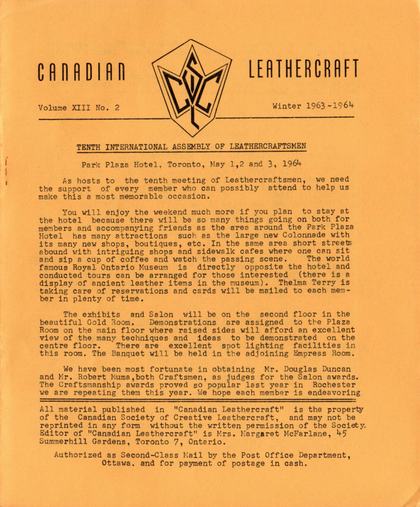
Page 1 — TENTH INTERNATIONAL ASSEMBLY OF LEATHERCRAFTSMEN
Canadian Leathercraft
Volume XIII No. 2 Winter 1963-1964
TENTH INTERNATIONAL ASSEMBLY OF LEATHERCRAFTSMEN Park Plaza Hotel, Toronto, May 1,2 and 3, 1964 As hosts to the tenth meeting of Leathercraftsmen, we need the support of every member who can possibly attend to help us make this a most memorable occasion.
You will enjoy the weekend much more if you plan to stay at the hotel because there will be so many things going on both for members and accompanying friends as the area around the Park Plaza Hotel has many attractions such as the large new Colonnade with its many new shops, boutiques, etc. In the same area short streets abound with intriguing shops and sidewalk cafes where one can sit and sip a cup of coffee and watch the passing scene. The world famous Royal Ontario Museum is directly opposite the hotel and conducted tours can be arranged for those interested (there is a display of ancient leather items in the museum). Thelma Terry is taking care of reservations and cards will be mailed to each member in plenty of time.
The exhibits and Salon will be on the second floor in the beautiful Gold Room. Demonstrations are assigned to the Plaza Room on the main floor where raised sides will afford an excellent view of the many techniques and ideas to be demonstrated on the centre floor. There are excellent spot lighting facilities in this room. The Banquet will be held in the adjoining Empress Room.
We have been most fortunate in obtaining Mr. Douglas Duncan and Mr. Robert Muma,both Craftsmen, as judges for the Salon awards. The Craftsmanship awards proved so popular last year in Rochester we are repeating them this year. We hope each member is endeavoring
All material published in "Canadian Leathercraft" is the property of the Canadian Society of Creative Leathercraft, and may not be reprinted in any form without the written permission of the Society. Editor of "Canadian Leathercraft" is Mrs. Margaret McFarlane, 45 Summerhill Gardens, Toronto 7, Ontario.
Authorized as Second-Class Mail by the Post Office Department, Ottawa, and for payment of postage in cash.
[p1: masthead date restored to "Winter 1963-1964" (not "Winter 1963 -1°64" with a stray backslash and degree sign).]
Page 2 — C.S.C.L. ANNUAL MEETING; ONTARIO SOUVENIR INDUSTRY EXHIBITION
to bring their best work. If you have not yet started work you should start immediately as we are hoping for new ideas and excellent techniques to be displayed.
A workshop is being planned for Sunday morning, so that you can take home with you an almost finished article as a lasting memento of the Tenth International Assembly.
C.S.C.L. ANNUAL MEETING
The Annual Meeting is being held at Central United Church,
Barrie, Ontario, on Saturday April 4,1964 at 9 a.m. Reports will again be mimeographed to make the business meeting as brief as possible. It is hoped to have a good display from each branch and that many members will try for their Associate or Fellowship standing. Those wishing to qualify for these higher standings must have their articles in before March 23rd. For application forms and further information write to Nora Huyck,R.R.3, Newmarket, Ont.
Entries for the Weston Trophy Competition will also have to be in before March 23rd. Rules and Regulations for this competition are the same as previous years. These are set out in Volume XI No. 2, Winter,
The question box will again be featured and there will be a Branch meeting. Demonstrations of varied interest will be going on all afternoon. For our Toronto members the return bus fare to Barrie is $3.45 and the first bus from Toronto bus terminal is 8.35 a.m. arriving in Barrie 10.15 a.m. This is an express bus.
ONTARIO SOUVENIR INDUSTRY EXHIBITION
The Ontario Souvenir Promotion Committee are holding an exhibition of handcraft and cottage-industry souvenirs. The first showing will take place at the Canadian National Sportsmen's Show, March 13 to March 21. This will not be a competition. However,. there will be a panel of judges to select a number of the best items and awards totalling $1,500 will be made at the conclusion of the Show. For further information and entry forms write direct to Ontario Souvenir Promotion Committee, Room 405,67 College Street, Toronto 2, Ontario.
Our Bulletin is now listed in "Canadian" under publications of Canadian interest noted by the National Library of Canada in Ottawa. "Canadian" is distributed to libraries throughout Canada and abroad and serves as a buying guide.
Page 3 — CHRISTMAS SALE
CHRISTMAS SALE 1963
The ninth Annual Sale of leather articles made by CSCL members was held November 20 - 23 in the "Upstairs" of the recently remodelled Canadian Handicrafts Guild Shop at 77 Bloor St. West, Toronto.
Letters were mailed in September to all members, asking them to have their articles ready for the sale, send them in, and help with the sale. Invitations were sent out, and the sale was given very good publicity with accompanying pictures in the Globe & Mail and was also mentioned in the Telegram. 36 members submitted articles; 34 had articles sold and 25 people worked on the sale. Gross receipts were $1,256.78. Cheques to members for articles sold
$976.80. Expenses, including insurance and Provincial Sales Tax, etc., $237.63. Balance on hand $42.35. It must be remembered that this non-profit sale is a service to our members and is only possible by the voluntary services of many of our members re s¢lying, unpacking, and packing and the many jobs in connection with such an undertaking.
This 1963 Sale was a very successful one in every way and as we predicted the interest focussed on the beautiful new interior of the Guild Shop helped greatly. In fact sales would probably have been at least one third more but business came to an almost complete stand-still on the afternoon and evening of the tragic and stunning news of President Kennedy's assassination.
There was a good selection of both large and small articles which ranged from fair to excellent in workmanship and design, and there were a few new items this year. Of course we always hope for more unusual and original articles in the medium price range which we know would sell readily. The only articles rejected were a few belts, not rejected on workmanship but because they were laced with plastic. An innovation this year was a section for a few articles sold at a "sale" price (these were not poorly made articles, but well made articles that had some small misfortune,or blemish which appeared after article was finished, etc.)
Thank you letters were mailed and we especially thank Mr. MacKell, the Canadian Handicrafts Guild for the use of their "Upstairs",the display window, and the ladies of the Guild Shop who so patiently waited after hours until we were ready to leave.
I would like to express my sincere thanks to all members who helped in any way with the sale. I feel the success of our 1963 Sale was mainly due to the willingness and cooperation of all participating members.
Clara Cavanagh, Convener
Page 4 — HANDBAG HANDBOOK
HANDBAG HANDBOOK
BY Robert Muma
This was to be the name of what has remained an unpublished book of handbag construction methods. Up until about 1953 the author had collected over 200 ideas on this subject from many sources. These ideas were being organized in a series of plates which would be largely self-explanatory and arranged so that the craftsman might use it as a guide in designing and constructing his own original handbag.
Only a dozen of these plates were completed before the larger independent market for such a book suddenly collapsed. These plates are being made available now to members of C.S.C.L. through the pages of Canadian Leathercraft in the hope they may still be of some value. One will be published in each succeeding issue.
This collection of ideas does not attempt to describe the right wa to make a handbag; for there is no one right way. In the first place there are many, many different styles of handbags, each with many possible variations in the design and construction of its component parts. There are also dozens of books and patterns on the market offering as many different combinations of methods which the author or designer considers right, or at least best for that particular case.
Moreover, nearly every craftsman or teacher of leathercraft has his or her favourite methods of construction. These may be the first or only methods they have ever tried or really mastered. By assembling here for comparison as many of these methods as possible, the individual craftsman has an opportunity to select what seems best for him or for each separate project.
In arranging these ideas, an attempt has been made first of all to simplify the understanding of handbag construction by reducing all styles of handbags to four basic types (shown in this issue). This will be followed by Methods of Closing, Types of Flap Fastening and variations, Interiors, Strap and Handle construction, etc. Copyright of these plates is retained by the author.
Page 5
ALL HANDBAGS FALL INTO ONE OF THESE FOUR BASIC TYPES
1. Envelope — 1 piece with end gussets. Clutch, under-arm, hand, shoulder.
2. Conventional — 2 pieces with 1 gusset. Shoulder, hand or clutch. Front and back, two separate pieces of leather.
3. Box (basically cube) — 1–5 pieces, round or oval base. Hand or shoulder.
4. Cylinder — round or oval base, no definite number of pieces. Hand, pouch & tote.
Page 6 — BRANCH REPORTS
BRANCH REPORTS
BARRIE: Meetings are being held at the home of the President,Mrs. May Corbett, Highland Avenue. Problems relating to dyeing of leather articles have been discussed and of course the most successful Annual Sale in Toronto which was convened by Mrs. C. Cavanagh of Barrie. Some of the items pictured in the Toronto Globe and Mail were crafted by Barrie members. Orders have been received for some of the articles and Mrs.R.E. Tuck received a letter and order for one of her trillium pens from Mrs.J.H. Fraser,retiring librarian of the Legislative Library, Parliament Buildings, Toronto. The pen to be given as a gift to the new Librarian.
At another meeting Mr. D. Trew gave a very interesting demonstration on making leather table centres. These are made of carved or tooled leather covered with glass and finished round the edges.
Plans are being made for the Annual CSCL Meeting which is to be held this year in Central United Church in Barrie on April 4th. HAMILTON: Hamilton have had several very good meetings but the Christmas party was most interesting.Our versatile member, Mr. Frank Torry, made christmas trees of green cardboard with domes at each point. Scraps of leather were given to each person to make a tree ornament and attach the other part of the dome. This brought out the creativeness and ingenuity of the crowd and soon the trees were all trimmed with the greatest variety of "ornaments" ever seen. Everybody had a wonderful time and many went home with new ideas for using leather.
Harold Wilson demonstrated plug embossing at the January meeting and at the meeting in February, Alvin Haig will demonstrate wallet interiors - new and old.
LONDON: Mrs. Sylvia Gerster of the London Branch had the honour of working with the well known London artist,Mr. Phillip Aziz who is quite famous for design in religious art.
Mr. Aziz designed and created furniture for the west chapel of Timothy Eaton Memorial Church, Toronto. Wrought iron chairs were designed by Mr. Aziz with leather covered backs and seats, also leather covered footstools. Mrs. Gerster worked the leather from Mr. Aziz's designs. Cowhide was used with 8 - 9 oz. in the chairs and 4 - 5 oz. in the footstools with the finished leather pieces being saddle stitched in place. Our Toronto members may care to visit the West Chapel and see this most interesting work.
TORONTO: Meetings are being held at the home of Mrs.Sadie Roebuck.
Fred Brown has demonstrated skiving methods, Clarice Packham on making personalized glove patterns and Viola Harris on using small pieces of leather. The next meeting, February 28th, will feature Mr. Oscar giving a demonstration on making your own patterns for handbags and leather articles.
Page 7 — NEWS OF INTEREST FOR MEMBERS
NEWS OF INTEREST FOR MEMBERS
For some time, Mr. Fred Brown, our Vice-President and a Director of the Canadian Handicrafts Guild,has been endeavouring to persuade the Guild to carry a small stock of leather articles handcrafted by our members. The Guild has finally agreed to give it a try - starting with a stock valued at two hundred dollars.
The articles that are accepted by the Guild are not put in on consignment but are bought outright from the individual craftsman, with this reservation: that if the article accepted does not sell, the craftsman will take it back and substitute a more saleable item. The members of the Executive felt it was advisable to agree to this. It would not be good for the reputation of the CSCL to have a supply of unsaleable leather goods taking up precious space in the Guild Shop.
Mr. Brown received this news at the time of the Christmas Sale. The Guild wanted some articles in time for the Christmas trade and asked that the craftsman supplying them be prepared to supply in quantity if necessary. The craftsman will also have to become a member of the Guild since the Guild only stock articles craft ed by its members. The fee is two dollars and this also entitles a member to buy at a discount from the Guild Shop.
On such short notice, it was impossible to contact the entire membership. Mr. Brown was assisted by some of the Toronto members in picking out some articles from the Christmas Sale. A few other members were contacted through the branches and at the Executive meeting on December 4th. At that meeting a Marketing Committee with Mr. Brown as Chairman was set up to handle the job.
Any member who is interested in selling leathercraft at the Canadian Handicrafts Guild Shop is asked to contact Mr. Fred Brown, 9 Nashland Avenue, Islington, for further details.
The names of our roster of QUALIFIED TEACHERS and which have been given to Miss Muff appear below.
| Mrs. Jean Agnew | Mrs. Anne Hook |
| Miss Helen Anderson | Mrs. Nora Huyck |
| Mr. Fred Brown | Mr. Don MacKinnon |
| Mrs. Joan Carroll | Mrs. E. Melchior |
| Mrs. Clara Cavanagh | Mr. Bob Muma |
| Miss W. Comfort | Mrs. F. Schooley |
| Mrs. A.F. Ford | Mrs. H. Schram |
| Mrs. S. Gerster | Mrs. A.C. Wheatley |
| Mr. Alvin Haig | Mrs. H.M. Wheaton |
[Small marks run down the left margin of the printed page. The words are the page’s own.]
Page 8 — CRAFTSMANSHIP
CRAFTSMANSHIP by Viola Harris
Craftsmanship means doing habitually well whatever it is you have to do.
Efficiency combines the quantity of work you produce,measured by time, and the quality of your work,measured by its expertness.
Enterprise is the ability to think and invent new things. The secret is to put your ideas to work. Learn first the method applicable; add your own interpretation of what you consider good design - not forgetting good design is the most direct and practical approach, both structural and functional.
You are only as good as your work proves that you are. Every thing you do will not be a masterpiece. But what you do should be workmanlike, the best that you can do at the time you do it. To be content only with what you do well is to deprive yourself of the joys of discovery. We have to exert ourselves - reach out for new techniques and designs.
When an article is thoroughly well done it often has the air of being "Art". There is no miracle about good craftsmanship - just plain hard work. It is doing every step as perfectly as is possible; being patient that each consecutive step is complete before proceeding to the next; fitting everything precisely.
In short, most successes in craftsmanship can be explained by expertness, seasoned by lively imagination and warmed by the joy of creating.
Question - How do you finish the flesh side of leather if you are not lining a handbag?
Answer - Use Treating Compound. Feibing's Bag Cote or Tandy resin.
Try and select a skin with not too rough an interior. Treat all the flesh side. Bag Cote gives leather smoothness. Apply a little water before Bag Cote. If you want a hard finish, and it is still rough, go over with bone folder to lay the fibres flat. The function of resin is to help prevent dyes going through. After treating, dye. A dark dye will cover imperfections. Then use a wax, or perhaps lacquer for a very hard finish.