
An issue of the Society’s newsletter, transcribed from the original.
(12 pages, 2.1 MB)
the full-resolution scan, 33 MB, for close research
Page 1 — ONTARIO CRAFTS CONFERENCE
Canadian Leathercraft
Volume XIV No. 2 Winter 1964 - 1965
ONTARIO CRAFTS CONFERENCE
Education Minister William Davis will open Ontario's first
Crafts Conference at Geneva Park, Lake Couchiching, on Friday, April 23rd, through Sunday, April 25th, 1965. The purpose is to identify the needs of Ontario craftsmen and to recommend ways of developing crafts in Ontario. It has been arranged by the Community Programmes Division and the Council for the Arts within the Department of Education.
The accommodation at Geneva Park limits participation at the Conference. Delegates will be invited, and crafts represented will be Pottery, Metalcraft, Weaving and Spinning, Leathercraft, Sculpture, Ceramics, Rug Hooking, Indian Handicrafts and Lapidary (Minerals). Our Society will be represented by Dorothy Muma, Fred Brown, and Viola Harris.
To make the Conference productive, background information was required as to: number of people involved in crafts work in Ontario; the kinds of crafts in which they were involved; the quality of leadership available; the adequacy of the facilities; the number selling all or part of their output; the state of organization of crafts interests in community and in the province; -and indication of the factors regarding greater crafts development and involvement.
Your President has had the privilege of sitting on the Planning Committee, and in conjunction with all Crafts organizations, mailed our members a questionnaire. Thirty-six per cent of our members answered, and from these a report will be given at a ee session of the Conference re the problems affecting our craft.
All material published in "Canadian Leathercraft" is the property of the Canadian Society of Creative Leathercraft, and may not be reprinted in any form without written permission of the Society.
Editor is Mrs. Margaret McFarlane, 151 Glenvale Blvd., Toronto 17, Ontario.
Authorized as Second-Class Mail by the Post Office Department Ottawa, and for payment of postage in cash.
Page 2 — CHRISTMAS SALE 1964
Discussion groups will be the "meat" of the Conference. All resource people invited are chosen because of their ability to contribute to more than one aspect of the program.
Mr. Cyril Wood, Director of the Crafts Council of Great Britain, Mr. Vanderbilt Webb, President of the American Crafts Council, and representatives from the Province of Quebec have been invited.
Four Workshops will be held and the subjects of these are:-
1. The Development of Craft Skills
2. Craft Instructor Training
3. Marketing the Product
4. What do we need?
CHRISTMAS SALE 1964
The: Gallery of the Canadian Handicrafts Guild Shop, 77 Bloor
Street West,Toronto was the scene of the tenth annual leather gods sale of CSCL members, November 18 - 21. Early in October a letter was sent to all members reminding them of the sale and giving full particulars. Entry forms and tags were supplied to members having articles in the sale. Printed invitations were distributed, and publicity was given the sale by the Globe and Mail and the Telegram.
All articles were checked the day before and setup the naming of the sale. The window display by Betty Smith of the Guild Shop was particularly effective. 37 members submitted articles, and all members but two had articles sold. 25 members worked voluntarily on the sale. 436 articles were sold. Gross receipts were $1,071.94.
There was a good variety of small and large articles. The workmanship and design of most articles was fair to excellent,with only a few items below standard. No large articles were sold, but more in the medium to lower price range were sold this year than last year. Articles from the "Sale" table sold fairly well.
At the close of the sale everyone adjourned to the Roebuck's where welcome refreshments were served by Sadie. Then all articles were sorted, carefully packed and returned to the owner by mail er by branch representative.
We had the misfortune to have $22.50 worth of articles disappear. The amount is covered by insurance but this loss has prompted us to believe we should set up the sale in a different manner so that articles could be under constant surveillance.
We all feel the 1964 sale was a success. Here I would like to express my sincere thanks to all members who made articles, and to #11 who worked many hours willingly for the sale.
Clara Cavanagh, Convener
Page 3 — BRAIDING
BRAIDING by Anthony Genco
One of the most fascinating and simplest of all crafts, requiring a minimum of tools, is braidwork. Few crafts develop such a complete coordination of mental and manual activity, where the rewards for a small amount of work bring much satisfaction and gratifying results.
Braidwork is not new, but truly an ancient art, and once the basic principles and procedures are mastered, their applications to articles for strength, decoration, or as a supplement to another craft, offer great challenges to the ingenuity of the individual.
As we are concerned primarily with leathercraft, efforts will be concentrated on leather, although braidwork is applicable to any flexible material.
A Dictionary definition of braiding could read as follows -- to weave, to interlace, or entwine together three or more strands into one, executed by maintaining a consistently uniform tension.
Of the few tools required, a sharp knife is important. Dividers and ruler for equal measurements; a strip ease or draw gauge tool for cutting belts or thongs, the space marking wheels used most— ly in the applique braids, a drive punch with various interchangeable sized tubes and preferably with a movable guide for precision type punching and slitting required in applique braidwork, lacing needles where leather lacings are used, a fid for enlarging holes, and a small home type vise as a means of anchoring your work, and the strip when being used, and thus leaving both hands free to execute the braids. As one progresses in braidwork, additional tools may be added to simplify one's work.
In this modern age of mechanization, thong cutting is reduced to a minimum for braidwork, as leather lacings are available in various widths from 1/16 to 1/2 inch in calf, goat, steerhide, and various imported leathers and in a wide range of colors, -- and thus making the basic material most economical for the beginner. This leaves the phase of thong cutting to the beginner as he slowly progresses, and invariably decides to cut his own thongs fitting his particular purposes.
By way of explanation here, a thong or strand refers to a strip of leather of a width suitable for braiding.
To classify braidwork, it may be rightly put into four categories: First, we have the flat braids that can be done from one thong to any number, either odd or even, but reaching a point of practicability. Second, we have the solid braids, as the round, square, spiral, and reverses, accomplished either with our without some form of core foundation. Third, we have the applique braids and knots, again done
Page 4
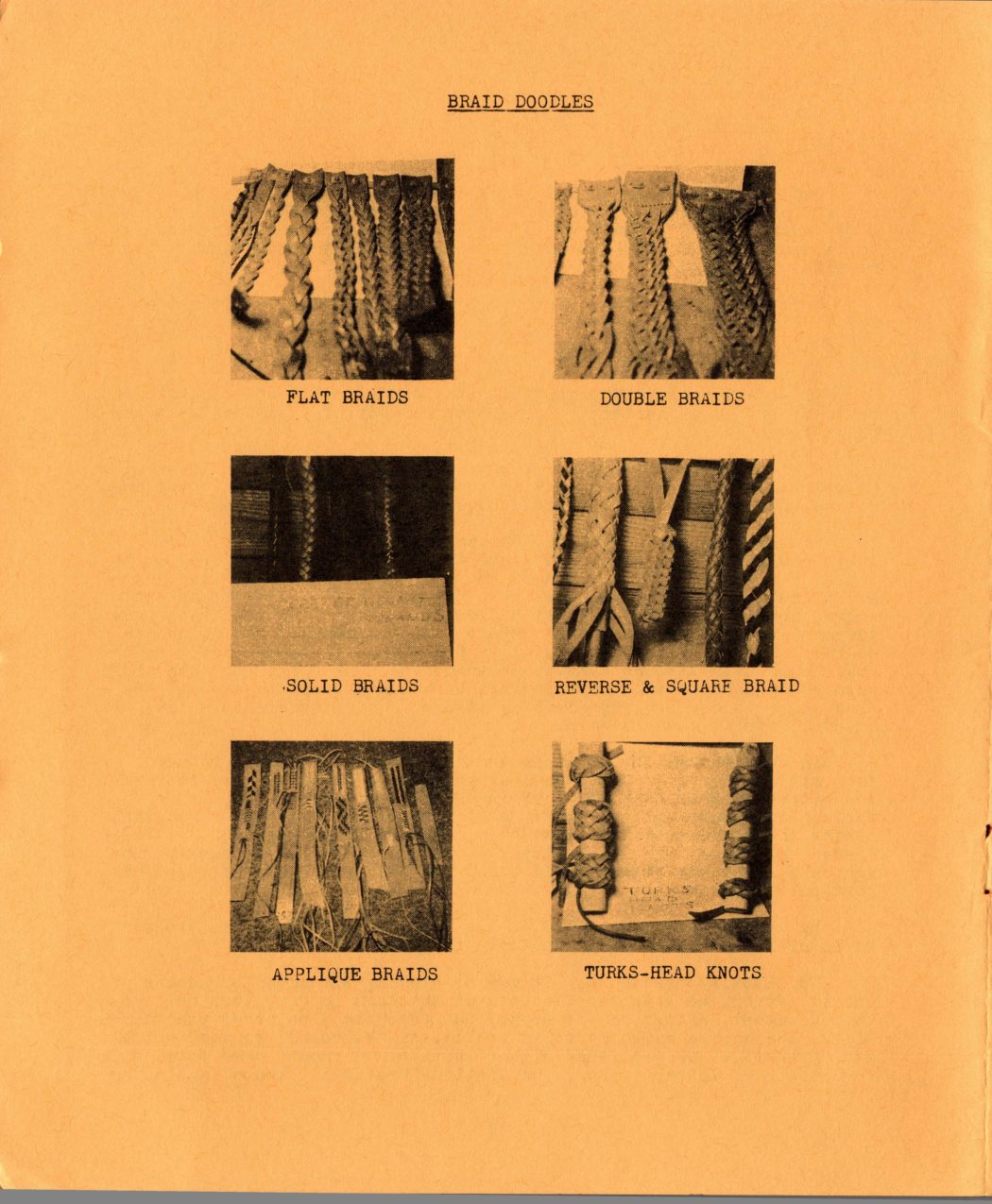
BRAID DOODLES
[This page is a photo-plate titled "Braid Doodles", six captioned technique photographs of braided leather thongs: Flat Braids, Double Braids, Solid Braids, Reverse & Square Braid, Applique Braids, and Turks-Head Knots. No names appear.]
Page 5
with odd or even number of strands, but here worked completely upon grain or surface side of leather with joining or decorative purpose in mind. Fourth, and last but not least, are the knots, which by their sequence form a braided ring completely symmetrical, but achieved with one continuous thong, with the simple turks head knot being the foundation for more elaborate and beautifully woven knots.
To retract on each category and generalize on procedures, the flat braiding consists of working alternately with uppermost left and right thong toward center in a sequence determined by the number of thongs used. On braiding with an odd number of thongs, the alternating procedure from each side toward center is the same,but on braiding with an even number of strands where the procedure starts with a sequence over on one side,it will start with an under sequence on the opposite side.
As more strands are used in a braid,the sequence can be predetermined, thus giving variations in patterns obtainable. To cite one example, with five strands there are about ten ways the five strands can be braided, each having a procedure and definite pattern by itself and unlike the others, but still employing five strands.
From six or more thongs, the braidwork can be elaborated upon, by working what is known as double braids, accomplished by alternating procedure and sequence on each side--where your uppermost thong is over the first time, the next pass on the same size will be under, and the same alternating procedure holds true to each side. This double braiding actually narrows a braid,but a double thickness braid is achieved, unlike the other flat braids.
Along the flat braid lines, reference can be made here of the trick braids, where thongs are split from a single blank,but with no loose ends. These trick braids can be done with three, five, or seven thongs, or in multiples of two and three of these numbers. For example, six thongs with no loose ends can be braided as a three thong trick braid by pairing them to three thongs of two each,and likewise for the five and seven strand trick braids. The finished braid is a mystery to the beginner, but its simplified procedure is but one of the fascinations of braidwork.
A point of importance should be noted here on braiding,which is that of thong shrinkage. Thongs of one length, upon braiding, will shrink back some depending on the braid and number of thongs used and the tension maintained by the individual. A foot of thong will not yield a foot of finished brain, and therefore the doodling idea is a good policy before application to a project to determine the length of thongs to finished braid.A few inches of doodling can save much time and effort, and two craftsmen, both good, have yet to produce exact duplicates of like projects.
In solid braiding, the braidwork is achieved by alternating thongs being brought to the rear to a definite sequence instead of
Page 6 — BRAIDED BELTS
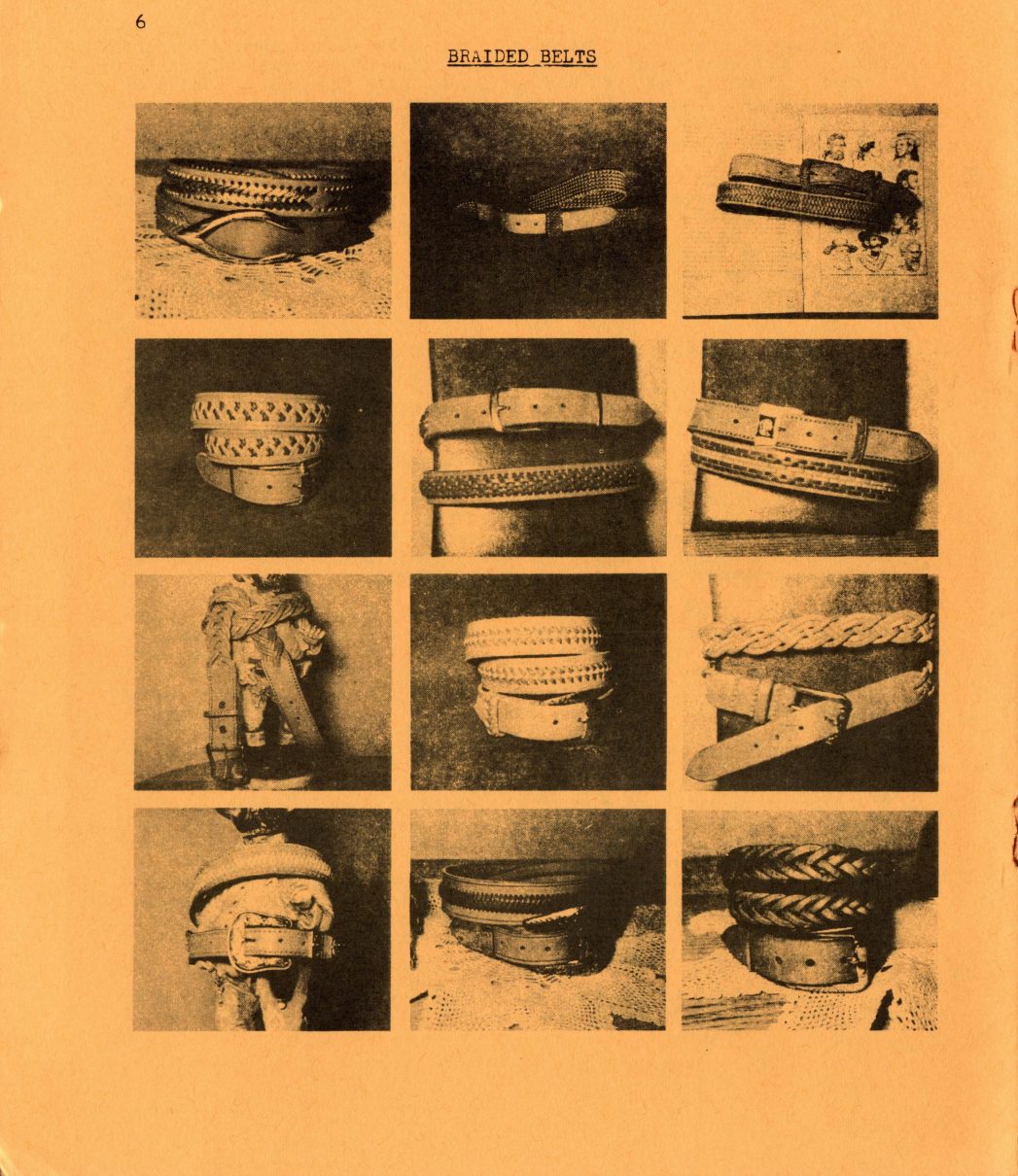
BRAIDED BELTS
[Photo-plate of twelve uncaptioned photographs of braided leather belts, under the heading "BRAIDED BELTS". No names or captions printed.]
Page 7
across as in flat braids.The solid braids can be done with four,six, eight,twelve, or sixteen thongs, and again variation can be achieved by changing sequences,or employing various colored thongs. The solid braiding is often referred to as plait round.
The square braids and their variations of spirals and twists are actually crown knots, and their procedure is building crown knot upon crown knot to the desired length and to a definite sequence to get the square, the spiral, and the twist braids.
Many beautiful examples of solid braidwork can be found in local saddle shops by way of quirts, riding crops, bull whips, dog leashes and such.
The horse gear in saddle shops such as bosals,romals, hackamores, reatas, and hobbles, are the ultimates of braidwork coupled with the intricate woven knots, and done with rawhide thongs. Rawhide braidwork is an art by itself,and though casual mention is made of it here,proud should be the too few remaining who are well versed on the mechanics of rawhide braidwork, for here is an important part of our western heritage.
Next, we have the applique braids and rightly named as they are completely formed on the surface or grain side of the leather,and perform the dual purpose of decoration and of joining together pieces of leather. Here the formation of a bed of evenly punched holes or slits on the surface of the leather is necessary,and the spacing and punching both dependent on the width and number of strands to be used. The procedure in general is working the thong or thongs through the bed formation of holes from rear to face of leather in a manner forming the various different applique braids. As the procedure is repeated from rear to the front and vice versa through the punched holes or slits, the braid forms on the surface to make what is a most pleasing and decorative braid. Variations as to patterns obtainable by changing or alternating colors and thong widths is an open field equal only to the imagination and ingenuity of the individual.
As one becomes adept at braidwork, by acquiring the basic procedures and the ability to visualize sequences,initiative in original applications of braids seems a natural course.
As to the turks-head knots and woven ring knots, their purposes are many--as sliding knots,as ornamentation,and as adjustable fastenings,and are used mostly with the plaited round brainwork,found mostly in horse gear articles and riding equipment.
As the knot is formed of one thong, a mandrel, or section of broom handle or core is needed which is rotated as a definite procedure and sequence is followed in the formation of the knot.A loose leather collar built around the mandrel or core helps greatly in the more elaborate woven knots, as the edges of the collar give an edge which holds the thong during the formation of the knot.
Page 8 — Annual Meeting
Once you are familiar with the structure of the turks-head knot and the definite relationship between the loops and parts, truly one could become a turks-head addict and have knots unlimited, and lacking time for the construction of others, with no two alike.
This completes a brief generalization of braidwork, and as time and space do not permit actual step by step procedures of the braidwork mentioned, the accompanying illustrations of braidwork doodles by the author are printed with the hopes of making the braidwork written about easier to visualize and picture.
The belts were featured at the 3rd International Assembly of Leathercraftsmen at Detroit, with the theme of braiding as applied to belt making.
This being a first venture in journalism, if my efforts will stimulate an interest in braidwork, I will feel amply rewarded, but to those who are more confused than they were before reading the article, there are books on braiding whose authors have ably put into words the procedures and methods simplifying this fascinating craft.
About the Author: Anthony Genco is an active member of the Eastern
Leathercraft Guild of Rochester, N.Y., and demonstrated braiding at the last International Assembly. Over the past few years he has been busy compiling a "Leatherworkers! Directory" containing names and addresses of craftsmen, teachers and dealers in both Canada and the United States. The first edition of this directory made its appearance at the 1956 Assembly and is now available at a cost of 50¢ from the publisher Craftsman Supply House, Scottsville, N.¥., or Anthony Genco, 74 Fulton Ave., Rochester, N.Y.
Reprinted by special request
Annual Meeting: Our 15th Annual Meeting is being held at WoodGreen
United Church, Toronto at 9 a.m. Free parking is available courtesy of Colgate-Palmolive Limited on their lot at Logan Avenue. Members are reminded that fees are due at this meeting or remit to the Treasurer, Mr. Cecil Roebuck,22 Khedive Street,Tor. International Assembly of Leather Craftsmen: The Flint Guild have gone all out to have an enjoyable and instructive weekend for members and guests at this Eleventh Annual Assembly. There will be something for everyone. The downtown shopping is only minutes from the hotel. The Assembly starts Friday,May 6th to Sunday May 9th. Hope to see you there. Question: What will prevent Rose Marie skiver from splitting between punch holes when lacing a purse?
Answer: Don't use it.
Gummed Backing Cloth, on the straight, may be ironed on along the edge to strenghten it, before cementing lining to the edge.
[This page is the Society's own reprint of the close of Anthony Genco's 1957 braiding article — the page prints "Reprinted by special request" — not a duplication; the same text appears at its original home in the Winter 1957 issue, page 8.]
Page 9 — TYPES of FLAP FASTENERS
TYPES of FLAP FASTENERS
1 TUCK-IN
2 BUCKLE
3 BOLT & HASP
4 BUTTON
5 COMBINATION
6 TUCK-IN SNAP
7 LIFT LOCK
8 SNAP FASTENER
9 WEIGHTED FLAP
Robert Muma, 1957
[This page is a hand-lettered instructional plate by Robert Muma (signed and dated 1957), sketching nine numbered types of flap fastener on an envelope-style bag flap. Set out below in full; read straight through it gives only fragments.]
Page 10 — CANADIAN DESIGN '67
CANADIAN DESIGN '67
Awards for the best products for building,souvenirs and giftware,are offered by the Department of Industry through the National Design Council to stimulate design and manufacture; and to draw attention te the best products, not only for '67, but in the long term interest of developing Canadian industry through better design.
The program is aimed at helping Canadian businessmen to take advantage of the excellent business and promotional opportunities generated by our centennial celebrations and EXPO '67. It offers Canadian designers and manufacturers greater opportunities to provide the thousands of new or unique products required to construct, furnish and equip the many buildings for our centennial projects and for EXPO '67 as well as the souvenirs and giftware for the millions ef visitors he will be visiting Canada during 1967.
It has been estimated by Tourism and information that three Billion dollars is what the total tourist spending in Ontario could reach in the Centennial Year. It is anticipated ever $250 million will be spent on products for Centennial and EXPO '67 projects; and over $100 million on souvenirs and giftware in 1967.
Canadian Design '67 has two main targets - Architects, Concessionaires and other buyers must be made aware of existing well-designed Canadian products. Designers and manufacturers must be encouraged and helped by market information to produce new products worthy of '67.
At a meeting of industrial and trade association representatives sponsored by the Ontario Department of Economics and Develepment, at the Park Plaza Hotel, Toronto, March 22, 1965, Mr. B. G. Barrow, Assistant Deputy Minister, Department of Industry, Ottawa, outlined how the Canadian Design 167 program operates and how you can participate.
He said, "The key to the success of this program is the identification of the types and volume of products required for Centennial year activities and EXPO '67, so that this information can be passed on to potential Canadian designers and manufacturers to enable them to meet these needs".
The first stage is the promotion of participation in the program. The second stage will begin during April with an evaluation of products and designs submitted by designers and manufacturers te fulfill Centennial and EXPO '67 requirements.
After a preliminary review, selected products and designs will be evaluated by committees appointed by the National Design Council In Ontario this will take place in Toronto and the Chairman will be Mr. Doug Kaill, Manager of the Design Centre, located at 131
Page 11
Bloor Street West. Evaluation committees will comprise persons directly concerned with the planning and purchasing of products for Centennial building projects and the buyers for souvenirs and giftware concessionnaires and retail outlets.
The third stage, beginning in May, will consist of matching products and designs. Products approved as being of good design will be photographed and along with descriptive information, reproduced individually in the form of catalogue tear sheets. Stage four in January, 1966 will be the publication of the Canadian
Design '67 Catalogue and the holding of a Canadian Design '67 Mart.
A selection of the best designed products from the catalogue as well as a selection of new product designs will be collected for display at the Design Centre in Toronto. In conjunction with the displays at the Design Centre and the publication of the Catasegue, Canadian Design '67 Awards will be presented. The outstanding products and new product designs shown at the Canadian Design '67 Mart will be granted special awards. The awards will take two forms - outstanding products will be honoured with awards for design achievment: and the manufacturers of these products will receive special labelling and publicity privileges.
A select number of outstanding new product designs will be granted financial awards to help defray the cost of development. The National Design Council and the Department of Industry are establishing a fund towards this purpose. However, other groups are invited to co-sponsor awards with this fund.
Canadian Design '67 Displays will be mounted during 1966,1967 and afterwards at centres across Canada. As a climax to the program, a Canadian Design '67 Conference will be held during the summer of 1967.
New oe for souvenirs or giftware must be submitted by November 1, 1965. Items suggested, under Category 8. "General
Souvenirs and Giftware" are Domestic Decorative Accessories; costume jewellery, travelling accessories, office accessories, desk sets, date pads, writing sets.
If you are interested in entering a design, full details and entry forms are available from Canadian Design '67, National Design Branch, Department of Industry, Macdonald Building, Ottawa, Ontario.
Items bearing the Centennial Symbol must comply with regulations. Information on use of the Centennial symbol is obtainable from, Symbol, Centennial Commission, P.O. Box 1967, Station B., Ottawa, Canada. The EXPO '67 Emblem or other licensable rights can only be used with the express written permission of the Corporation. For information address Director of Licensing, The Canadian Corp. for the 1967 World Exhibition, Place Villa Marie, Montreal, Quebec.
Page 12 — WESTERN FAIR 1964 - WINNERS IN LEATHER WORK
[Set out below in the order the page prints, each section heading with its placings beneath it. Section 99 prints three placings — 1st Mrs. Joan Carroll, 2nd Mr. David Elliott, 3rd Mr. C. L. Heywood. The column head is Sec.; the “CES)” at the foot of the page is a printer’s flourish, not text.]
WESTERN FAIR 1964 - WINNERS IN LEATHER WORK
Helen M. Wheaton
Supervisor - Home Arts Department
Sec.
92 Gloves, leather, Hand Sewn - 1st Mrs. Sylvia Gerster
- 2nd Miss Dorothy Proctor
- 3rd No entry
93 Handbag, Original Canadian Design, Carved
1st Mr. David Elliott
2nd Mrs. Joan Carroll
3rd Mrs. Janina Saar
94 Handbag, Original Canadian Design, Tooled
No entries
95 Handbag, Commercial Design, Tooled
1st Mr. C. L. Heywood
(no other entries)
96 Handbag, Commercial Design, Carved
1st Mr. C. L. Heywood
2nd Mrs. Joan Carroll
3rd Mrs. Janina Saar
97 Belt - Tooled or Stamped
1st Mrs. Marion Kehoe
2nd Mr. C. L. Heywood
3rd Mr. J.D. Hunter, Stoney Mt.,Manitoba
98 Belt, Carved
1st Mr. C. L. Heywood
2nd Mrs. Joan Carroll
3rd Mrs. Sylvia Gerster
99 Miscellaneous Small Article in Leather
1st Mrs. Joan Carroll
2nd Mr. David Elliott
3rd Mr. C. L. Heywood
100 Miscellaneous Large Article in Leather
1st Mr. J. D. Hunter
2nd Mrs. Joan Carroll
3rd No entry
I wish to thank all those who took the time and effort to participate in this competition, and look forward to seeing your work again next Fair time.