
An issue of the Society’s newsletter, transcribed from the original.
(8 pages, 1.4 MB)
the full-resolution scan, 23 MB, for close research
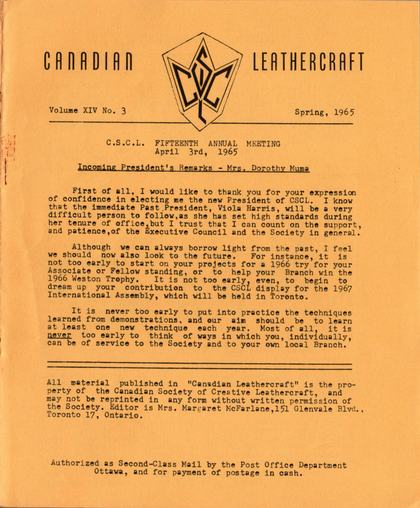
Page 1 — C.S.C.L. FIFTEENTH ANNUAL MEETING; President's Remarks
Canadian Leathercraft
Volume XIV No. 3 Spring, 1965
C.S.C.L. FIFTEENTH ANNUAL MEETING
President's Remarks - Mrs. Dorothy Muma
First of all, I would like to thank you for your expression of confidence in electing me the new President of CSCL. I know that the immediate Past President, Viola Harris, will be a very difficult person to follow,as she has set high standards during her tenure of office,but I trust that I can count on the support, and patience,of the Executive Council and the Society in general.
Although we can always borrow light from the past, I feel we should now also look to the future. For instance, it is not too early to start on your projects for a 1966 try for your Associate or Fellow standing, or to help your Branch win the 1966 Weston Trophy. It is not too early, even, to begin to dream up your contribution to the CSCL display for the 1967 International Assembly, which will be held in Toronto.
It is never too early to put into practice the techniques learned from demonstrations, and our aim should be to learn at least one new technique each year. Most of all, it is never too early to think of ways in which you, individually, can be of service to the Society and to your own local Branch.
All material published in "Canadian Leathercraft" is the property of the Canadian Society of Creative Leathercraft, and may not be reprinted in any form without written permission of the Society.
Editor is Mrs. Margaret McFarlane,151 Glenvale Blvd., Toronto 17, Ontario.
Authorized as Second-Class Mail by the Post Office Department
Ottawa, and for payment of postage in cash.
Page 2 — BELLEVILLE BRANCH INAUGURATION; BRANCH REPORTS
BELLEVILLE BRANCH INAUGURATION
No matter how enthusiastic a leathercraftsman we may be on our own,we need the stimulus of discussing and working with others of like mind. This applies both to groups and individuals.
We are always happy to have new members join the CSCL, and when we receive an application from a group of people for Branch affiliation, we are particularly pleased as this brings in several members at once, as well as a new Branch. Mrs. Dorothy Harwood, 83 Octavia Street, Belleville, is President.We welcome this new Belleville Branch and hope its members find their association with the Society of great benefit.
The 15th Annual Meeting was held at WoodGreen Centre,Toronto. There were 104 members registered and a few guests were present. There is a slow but steady improvement each year both in design and quality of workmanship in articles displayed.
The Weston Trophy, presented by Clarice Packham, was won by the Hamilton Branch - no small achievement - as no Branch received less than 90%.As usual the Branches were well represented at the meeting and friendships renewed with those kindred members we meet at these Annual Meetings.
A highlight of the Meeting was the presenting of an Honorary Life Fellow Membership to Reta Larmour by Jean Newton. Jean stressed the work that was put into the founding of our Society, and the tireless efforts, well beyond the call of duty, by Reta Larmour. Congratulations Reta!
The luncheon speaker, Miss Muff of the Community Programmes Branch, gave a most interesting and informative talk on the Program on Crafts by the Ontario Government and outlined for us the first Ontario Crafts Conference at Geneva Park,April 23-25. At last there seems to be an earnest desire by the Government to help guide the many craft groups of our Province. Our delegates to this Conference are Viola Harris, Dorothy Muma, Fred Brown.
The afternoon consisted of interesting demonstrations and the time was all too short to take in everything one would have liked to see. Demonstrations: Unlaced Bookends, Clara Cavanagh; Box Covering, Irva Ford; Design and Appraisal, Anne Hook;Colouring, Lillian Neelands; Small Articles, Gel Brigden;Table Centre Piece, Dwayne Trew.
BRANCH REPORTS
Barrie: With few exceptions, Barrie Branch met on the last Wednesday of each month at the home of our President, Mrs. May Corbett. There was an average attendance of fourteen out of nineteen members at-each of our ten meetings. A bang-up Bar-B-Q at Helen Anderson's, Longford Mills, preceded the summer recess after which we began the fall season with renewed energy.
Page 3
Our meetings took various forms; demonstrations given by our members and Toronto members, workshops and socials.An interesting demonstration on bottle covering was given by Jean Newton.Another enjoyable evening was spent at Miss Clarice Packham's cottage, where she instructed us in Glove Making. From our own group we had demonstrations on: Decorating Without Tools, Sherle Bottrill; Ornamental Cuts, Garn Pratt; Desk Set, Clara Cavanagh. One lovely evening in early November we were guests of Hamilton Branch where Dwayne Trew demonstrated his Table Centre Piece.
At last year's Annual Meeting held in Barrie we were pleased to have another member, Mrs. Kay Cloughley, receive her Associate standing. Also to have the honour of winning the Weston Trophy again.
Two members demonstrated at the International in Toronto and one at the CNE, All in all we feel that we have had a very worthwhile year. Joy Findlay,Secretary
Belleville: The Belleville Branch was inaugurated at the Annual
Meeting. Members of this Branch have worked with leather since 1958. After visiting our 1964 Annual Meeting they were so enthused that four members attended the 10th International Assembly in Toronto last May. These four in turn spread such enthusiasm that it was decided to apply for Branch affiliation with the CSCL. We look forward to news and reports of the activities of our new Branch.
Hamilton: The Hamilton Branch held nine regular meetings at the West Pavilion of the Hamilton Sanatarium, on the second Thursday of each month.Executive meetings were held at the Chairman's home. On November 5 our Branch was host to Barrie Branch with Dwayne Trew of Barrie demonstrating. Mrs. Janet Smith was awarded Associate Standing in April, 1964, and at the International in May Mrs. Ford was awarded a Salon Ribbon and Craftsmen's Ribbons were awarded to Miss Bea Austin. Mrs. Ford, and Mrs. Janet Smith.
Several members assisted at the Christmas Sale in Toronto. On occasion, workshops were held. Members attending these worked on projects which had been demonstrated at the previous regular meeting.
The Branch is deeply grateful to our Chairman, Mrs. Nina Wilson for the splendid direction given to us in the past year. Mrs. Wilson's faithful work, and the capable guidance of our Programme Convenor, Mr. Wilson, gives us reason to look back on a most rewarding year.
Lillian Beech, Secretary
London: There were six regular meetings of the London Branch held during the year, with ten paid-up members and an average of four attending meetings.
Each meeting consisted of a short business meeting followed by working on a different leather project such as; Spray Dyeing, Saddle Stitching on Coasters, then putting on a design as desired,
Page 4 — ASSOCIATE AND FELLOW AWARDS
Wax Resist technique, Free Hand Swivel Cuts, and making trays.
Two of our members entered articles in the Western Fair and won prizes. Three members teach leather classes connected with the Department of Education.
Sylvia Gerster, Secretary
Toronto: Monthly meetings of the Toronto Branch have been held on the third Friday of each month, and since November, they have been at the home of Mr. Gel Brigden, averaging an attendance of nine from a total membership of fifteen. Since the first of the year (1965) we have had an average of four visitors at each meeting.
The business meetings were followed by very interesting and informative demonstrations. Viola Harris demonstrated making a wallet which required very little stitching and no lacing. Jean Newton demonstrated making belts and buckles, also various fasteners which could be used on purses. Jessie Little gave a demonstration on her technique of dyeing leather.
Our meetings and demonstrations concluded with the serving of refreshments. We were very sorry indeed to lose the inspiring leadership of our Chairman, Jean Newton who has moved out of town. All our best wishes go to her. Dorothy Proctor has ably acted as Chairman since March.
Thelma Terry, Secretary
ASSOCIATE AND FELLOW AWARDS
The Board of Selection were pleased to announce that three members have qualified as Associates and one member as Fellow:
Fellow: Mrs. Helen Wheaton, London
Associate: Miss Bea Austin, Hamilton
Mrs. Hilda Darbyshire, Barrie
Miss Reta Holman, Guelph
EXCERPT FROM RETIRING PRESIDENT'S REMARKS "This is the Fifteenth Annual Meeting of CSCL - another milestone in our Society. On our Tenth Anniversary Robert Muma reviewed our history. In the last five years, in some respects, we have not made as great an advancement.
"What we are battling is where the manufacturer has' taken over with ready made "cut-outs", and devices whereby designs are so easily impressed on damp leather. These devices kill initiative. A member does not get great satisfaction from paying dues, but does get great satisfaction from sharing ideas and working with others. Giving service is the distinguishing feature of a good member of a Society. Whatever we possess in the way of skill is enhanced by sharing it with others. Only as we learn the joy of creating do we fully realize the main objective of our Society - to encourage originality in design."
Page 5 — SUNDRY POCKETS
This page reprints a 1957 Robert Muma instructional plate, "Sundry Pockets." Four of its sub-designs carry only initials (E.M., N.H., C.L.P., I.S.) — too little to identify by name, so they were not added to the register.
SUNDRY POCKETS
Mirror Pocket — skive, turn under and cement one edge; skive, turn down and cement the opposite edge, 1/2–1" wider; fold back and trim off; finished width 4 1/4". (E.M.)
Pen & pencil pockets inside front of bag. (N.H.)
One pocket stitched over another. (C.L.P.)
[Pocket] with tab for un-snapping. (I.S.)
Cut leather this shape, elastic top.
Robert Muma, 1957
Page 6 — AN EXPANDING POCKET
AN EXPANDING POCKET —
Fig. 1 Closed pocket
Fig. 2 Open pocket
Fig. 3 Variation — a popular variation of an expanding pocket with gusset but no pleating, therefore more limited capacity.
Fig. 4
Cut top of "A" 3 inches longer than zipper. Cut "B" 4 inches longer than "A". Pleat slightly along zipper but leave sufficient fold to open wide. (See Fig. 2) Triangular piece "C" holds ends of "A" & "B" together.
Make width & depth of pocket to fit size of purse.
A previous reading of this page turned its hand-lettered captions into unreadable noise, including a spurious empty table. This has been corrected to the figure captions and instructions as printed; the diagram itself is not otherwise described here.
Page 7 — ONTARIO CRAFTS CONFERENCE
ONTARIO CRAFTS CONFERENCE
Geneva Park, April 23-25, 1965
SPEAKERS ' COMMENTS
Mr. R.E. Secord, Conference Chairman, set out the purpose of the Conference in his opening speech.This purpose was to discuss crafts in aspects such as training, development, exhibiting, jurying, supplying and marketing.
The Hon. J. Keillor MacKay,Chairman of the Province of Ontario Council for the Arts, said that "A working knowledge of the arts and crafts is a vital and important element in the promotion of cultural excellence,and the happiness of mind." In speaking of education, he went on to say "Education, in the performance of its proper function, should enable each new age to enter into the fullness of its cultural heritage." Mr. MacKay urged us to stimulate and encourage our capability to a high degree and said further "In this great task busy and useful you are, happy you should be,because being busy and useful opens the door which reveals the great secret that happiness lies in that work, in that vocation or avocation which elevates the mind and satisfies the soul." In closing he encouraged us to "Continue the pursuit of perfection."
The Hon. William G. Davis, Minister of Education,in welcoming Conference delegates on behalf of the Ontario Government, said "The public today needs crafts more than ever before and in this incredibly automated age there is a rebirth of respect for the work of the human hand... the work of today's craftsmen will be tomorrow's treasured possessions." He felt that the designercraftsman should play an essential role in the artistic life of modern society; his creative work will enrich both art and industry... A strong body of craftsmen - professional, semi-professional, and amateur - can give vitality to the life of the Province." In conclusion, he said "The revival of true craftsmanship of the highest calibre is a vital necessity to our culture and economy... It is a tremendous challenge, but one which will bring great satisfaction to the craftsman and could ultimately place Ontario in the forefront of the worldwide craft movement."
Mrs. Vanderbilt Webb, Chairman of the Board of the American Craftsman's Council, spoke of her experiences recently as she visited craftsmen in their shops in Asia.She expressed the hope that "Some day we will all be brothers and sisters in the crafts."
Mr. Cyril Wood, Director of the Craft Council of Great Britain and Treasurer of the World Craft Council,had been invited to attend and share his Council experience with us. He stressed the importance of crafts today and expressed his joy at finding the Government willing to help craftsmen here, as contrasted with the attitude of the English Government.Mr. Wood emphasized that crafts should be shown in the context of the 20th century and
Page 8
that the most important thing is the acceptance only of high standards. "We should look on the human being as a person who has three brains: the brain of the intellect, the brain of the emotions, and the manual brain. Today our life is geared to the intellectual and because of this the manual brain has been almost forgotten."
In a dialogue between Mrs. Webb and Mr. Wood, it was stated that first class craftsmen arrive by way of native genius and first class teachers, and we must have a top professional standard to influence all other levels. There should not be any dissonance between the amateur and professional as long as the amateur is making an effort, but no hard and fast line can be drawn between the two levels. The physical facilities in which the craftsman works are not important; what really matters is what the craftsman brings to his tools. To produce a good product, six aspects must be in line: design, appeal, function, technique, understanding, appropriate pricing. We must prove why handcrafted articles are superior to machine-made articles.
Discussing the problems of marketing, Mr. Murray Wilson of the Canadian Handicrafts Guild, said that five factors were involved in successful selling of crafts: top quality merchandise; highly artistic or very useful work; fair price; the craftsman must keep faith with the customer; prize-winning articles should be for sale to encourage the public to recognize that fine crafts are available.
Mr. Frank McEachern, Vice-Chairman of the Ontario Council for the Arts, gave the closing address of the Conference, urging us to achieve our creative potential through the crafts. "In a sense, departments of government... are tools of the craftsman... the craftsman is the master and must dictate what the tools will do... he ceases to be a craftsman when he allows the tools to tell him what to do."
DESIGNING FOR PEOPLE - by Henry Drayfuss
The object being worked on is going to be ridden in, sat upon, looked at, talked into, activated, operated, or in some way, used individually, or en masse.
When the point of contact between the product and the people becomes a point of friction, you have failed.
If people are made safer, more comfortable, more eager to purchase, more efficient, or just plain happier, by contact with the product, you have succeeded:
CREATION - by Hal Stebbins
There is no magic about originality. You simply take what you have seen, read, heard, and then add yourself.