
An issue of the Society’s newsletter, transcribed from the original.
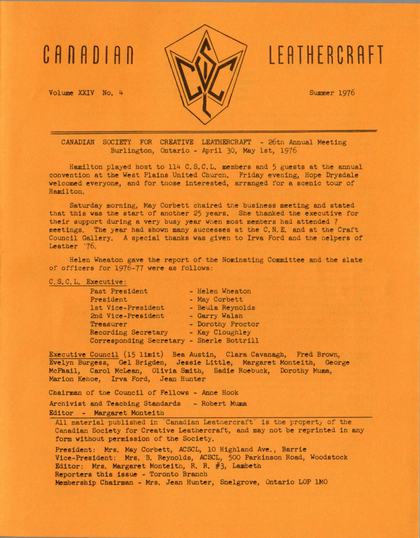
(12 pages, 1.9 MB)
the full-resolution scan, 32 MB, for close research
Page 1 — CANADIAN SOCIETY FOR CREATIVE LEATHERCRAFT - 26th Annual Meeting
Canadian Leathercraft
Volume XXIV No, 4 Summer 1976
CANADIAN SOCIETY FOR CREATIVE LEATHERCRAFT - 26th Annual Meeting Burlington, Ontario - April
Hamilton played host to 114 C,S,C.L. members and 5 guests at the annual convention at the West Plains United Church. Friday evening, Hope Drysdale welcomed everyone, and for those interested, arranged for a scenic tour of Hamilton,
Saturday morning, May Corbett chaired the business meeting and stated that this was the start of another 25 years. She thanked the executive for their support during a very busy year when most members had attended 7 meetings. The year had shown many successes at the C.N.E, and at the Craft Council Gallery. A special thanks was given to Irva Ford and the helpers of Leather '76.
Helen Wheaton gave the report of the Nominating Committee and the slate of officers for 1976-77 were as follows:
C.S,C.L, Executive:
| Past President | Helen Wheaton |
| President | May Corbett |
| 1st Vice-President | Beula Reynolds |
| 2nd Vice-President | Garry Walsh |
| Treasurer | Dorothy Proctor |
Recording Secretary - Kay Cloughley
Corresponding Secretary - Sherle Bottrill
Executive Council (15 limit) Bea Austin, Clara Cavanagh, Fred Brown, Evelyn Burgess, Gel Brigden, Jessie Little, Margaret Monteith, George McPhail, Carol McLean, Olivia Smith, Sadie Roebuck, Dorothy Muma, Marion Kehoe, Irva Ford, Jean Hunter
Chairman of the Council of Fellows - Anne Hook
Archivist and Teaching Standards - Robert Muma Editor - Margaret Monteith
All material published in 'Canadian Leathercraft' is the property of the Canadian Society for Creative Leathercraft, and may not be reprinted in any form without permission of the Society.
President: Mrs. May Corbett, ACSCL, 10 Highland Ave., Barrie
Vice-President: Mrs. B. Reynolds, ACSCL, 500 Parkinson Road, Woodstock
Editor: Mrs. Margaret Monteith, R. R. #3, Lambeth
Reporters this issue - Toronto Branch
Membership Chairman - Mrs. Jean Hunter, Snelgrove, Ontario L0P 1M0
Page 2
Branch Presidents: Barrie - Garry Walsh
Belleville - Irene Girling
Hamilton - Hope Drysdale
Toronto - Gladys Riddell
Woodstock - Beula Reynolds
Two new Associates were admitted this year. They were Hope Drysdale from Hamilton and Dorothy Stanton from Woodstock,
Hope has been a member of C,S,C.L, for 5 years and has been working in leather for that length of time. She has studied under Irva Ford and Muriel McKnight. She has filled many positions such as Exhibitions Chairman, Publicity Chairman, Vice-President and President of the Hamilton Branch. She has also helped at the C,N,E. Arts, Crafts and Hobbies, at the Artisans' Sales and various other sales in the Hamilton area, Her work has been displayed in Leather '72, Leather '76, and at the C,N,E. in 1974 where she received Honourable Mention, Also to her credit, she has had a technical article on garment making published in the Bulletin, and a book review published on the Craftsman in America,
Dorothy has been working in leathercraft for 23 years, and has been a member of C,S.C.L. for 10 years, Two of her teachers have been Stan Blair and Clara Cavanagh. She has exhibited her work in Forest Fair '72, Leather '74 and Leather '76. She has also contributed articles to exhibitions, helped with sales, brought in new members, conducted workshops, and taught beginners' courses.
This year Dorothy Stanton received the Zalitis pin for the highest standing among new Associates,
Weston Trophy - This year's winner was Hamilton with a score of 88, 8% Hope Drysdale accepted the trophy and ribbons were presented to Bea Austin, Irva Ford, Art Morris, Dan Hanington and Margaret Weldon. Toronto came second with a score of 85,4% followed by Woodstock with 84.6% and Barrie with a score of 77. 8.
Purse (Dan Hanington) This is a completely designed purse from paper pattern to finished article. A nice piece of leather work with a pleasant design. With more practise the lines would flow, An interesting lacing technique is used to attach the pocket. The judges were divided in thought on the heavy outside lacing. 76%
Saddle Bags (Art Morris) This is a traditional use for leather, Stitching is excellent. Saddle stitched in parts where strength is necessary, and buckstitched for decoration, Gussets are beautifully moulded. An impressive piece of work, 86%
Spoon Rack (Irva Ford) Finished in dark brown, each shelf is two layers of sole leather laminated, Acrylic rods are covered with 14 oz, cowhide skived and overlapped. The rack holds 24 spoons. A very decorative wall piece. 93% Box (Margaret Weldon) An exquisite piece of work. The crinkled top is worked over dry-wall compound, Leather is dyed in the crinkled state, and wooden box is beautifully covered and lined. Padded with foam rubber. 96%
Basket (Bea Austin) A beautiful piece of work. Two pieces of leather laminated and brought up to make a sturdy handle, It is a work of art. 93%
Page 3
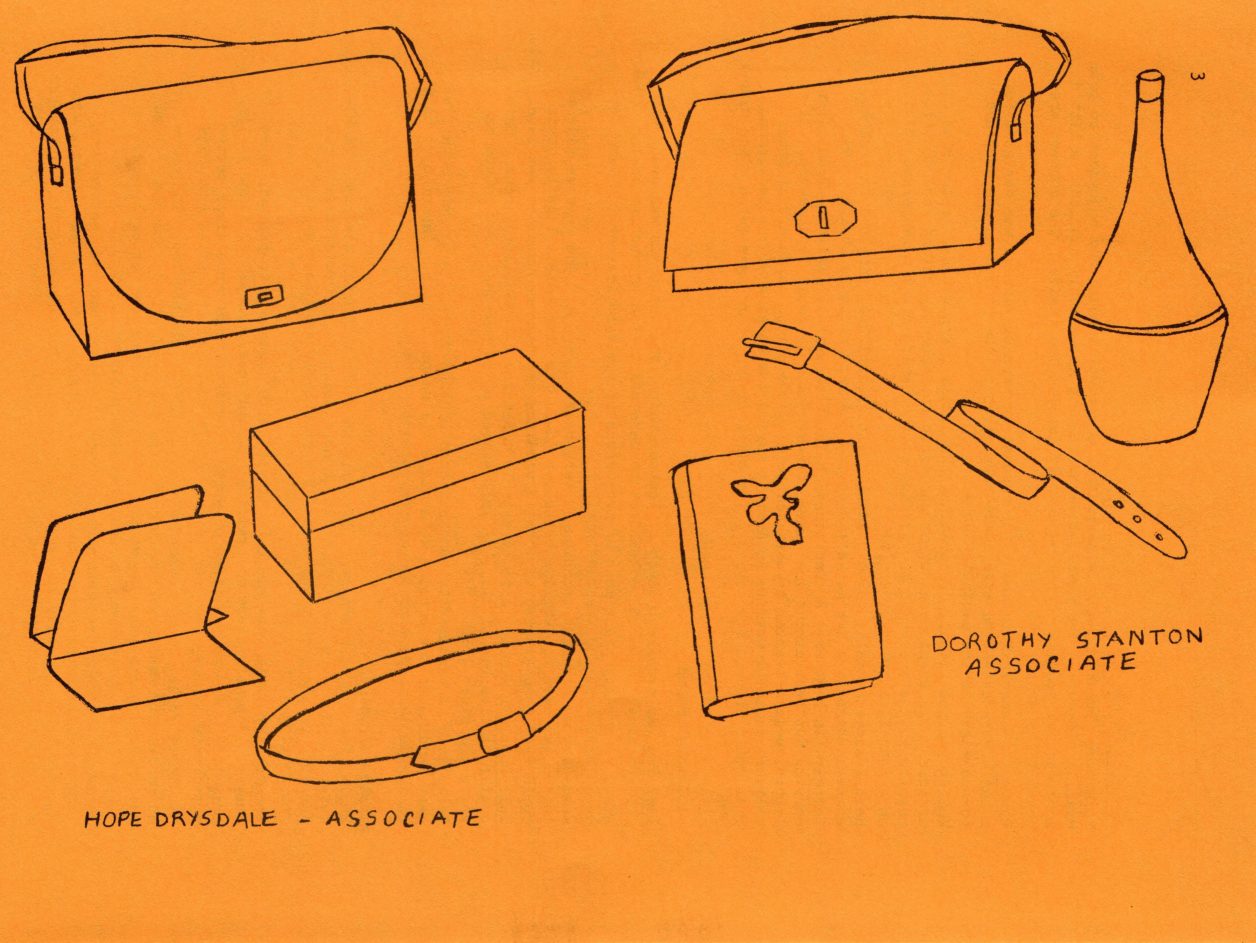
[This page is a plate of pen-and-ink sketches of leather pieces submitted for Associate designation, captioned with the two candidates' names, set out below. This matches the Associate elections of Hope Drysdale (Hamilton) and Dorothy Stanton (Woodstock) reported on p. 2 of this issue.]
Hope Drysdale - Associate
Dorothy Stanton - Associate
Page 4
Toronto 85.4%
Bookcover (Itsuko Yasui) A delightful cover which would add enjoyment to your reading pleasure, The piece of decoration is excellently handled. A little more careful scoring in the bend would improve the inside. The corners are beautifully done. 94%
Pendant (Daphne) This beautiful pendant in heraldic design was designed for a man. More attention might have been given to the finish on the cord and to the edges of the pendant. 89%
Wallet (Jessie Little) Decoration is a little overpowering for the size of article. The edges were not straightened sufficiently before lacing, which results in the uneven look, Rolling of the lacing might have helped. This is a beautiful color job. 76%
Belt (Gladys Riddell) A very dainty belt, beautifully finished on back and edges, Attractive design well executed. A very suitable buckle. 89% Holster (Jack Meharg) A fine sturdy holster beautifully skived. Traditional carving has been used, The curved ornamental cuts could be improved, If lighter weight leather is used for holding the strap, cardboard or other backing should be used to support it during the working of the background, This would prevent stretching. The slick lining would make for a quick draw/ 79%
Woodstock 84, 6%
Desk Pad An excellent piece of leathercraft. Mission grain was used, with felt backing. Squared bookbinders corners add to the attractive design. 94% Flask A novelty piece made of two colors of pre-dyed leather. A very handy nide-away for the book shelf!
Weed Bottle A resist technique. Very nice color job. The reverse side of lacing was used to facilitate the dye job, The base rocks slightly, this could have been avoided by working with the wet leather until it was level. 94%
Tall Bottle A well finished article. Skiving is excellently done. This bottle handles beautifully. A well skived strip has been used to conceal where the sides join. 83%
Receptacle A beautifully hand-and-knee moulded piece. A day and a half of hand sanding on the outside to acquire the smooth finish. Garnet dyes used on inside, with Nonsuch dye on the outside. 91%
Purse Pleasing appearance. Obviously made for a special costume, Pickle rather than bronze findings might be more suitable for this color purse, The edge of the pocket has split, but this could have been avoided by reinforcing with cord, 69%
Shoehorn This is very elegant. It is quite ingenuous to put two roles for hanger. A pretty piece of braiding. Could have been skived finer at tip. 90% Lampshade Tremendous piece of work. Sections would have given better appearance if they had been firmer, or it they had all puffed out. 75% Two Piece Wallet Very commendable attempt. Nicely handled, The pockets might be more useful if cut further from the bend. If it had been rolled after glueing the top edge would be flatter. Note how perfectly even the tooled line is, Perhaps it could have been deeper. 72%
Pendant A nicely designed piece of work, Crinkled batiked leather with copper enamelled insert. (made by the craftsman also.) Chain is made with knotted thonging which is very well finished. The closing button is covered with matching leather. Mixed media makes this an interesting piece. 83%
Page 5 — LEATHER '76
The Hamilton member who took a ribbon for a deer-skin and braided bottle is typed here as Dan Harrington, while the report of the Weston Trophy three pages earlier in this same issue types the same Hamilton group — Bea Austin, Irva Ford, Art Morris, Margaret Weldon — and with them Dan Hanington. Both spellings are set out here exactly as the pages print them. Whether they are one man written two ways is unsettled.
LEATHER '76
Irva Ford and Olivia Smith presented the certificates for Leather '76. The awards were as follows:
Most outstanding piece Rex Lingwood Sculpture Most original entry Gladys Riddell Boat
Best craftsmanship Carol McLean Purse
Best functional design Anne Hook Tote bag Memorial award Daphne Lingwood Necklace
Honorable Mention went to the following:
| Daphne Lingwood | Mask |
| Jessie Little | Pocket secretary |
| Mary Patterson | Pendant |
| Dave Trotter | Wall hanging |
| Margaret Weldon | Box |
| Paul Williams | Rattles |
| Paul Williams | Sculpture |
| Itsuko Yasui | Belt with mini-purse |
Ribbons for Leather '76 went to the following:
CRAFTSMEN'S AWARDS Ribbon
| Bea Austin | 1 | Dried Flower Basket |
| Lillian Beach | 1 | Jewel Box |
| Clara Cavanagh | 3 | Shoe Horn, Jug, Purse |
| Hope Drysdale | 1 | Box |
| Vera Ferrara | 3 | Carved Bag, Jewel Box, Vase |
| Irva Ford | 5 | Spoon rack, Mirror, Book Cover, Tray and coasters, Music Hath Charms (violin) |
| Pam Frith | 1 | Belt |
| Ruth Haig | 1 | Black Secretary |
| Dan Harrington | 1 | Bottle-Deer skin and braiding |
| Anne Hook | 2 | Tote Bag, Weed vase |
| Jessie Little | 1 | Pocket Secretary |
| John Marsden | 1 | Belt with Marble buckle |
| Carol McLean | 2 | Mask, Batik Belt |
| Edith Melchior | 1 | Blotter for Desk |
| Art Morris | 1 | Saddle Bags |
| Beula Reynolds | 1 | Bottle |
| Gladys Riddell | 1 | Belt |
| Olivia Smith | 2 | Tray, Pendant |
| Dorothy Stanton | 2 | Binder, Picture ''Holly Hobby" |
| Margaret Weldon | 1 | Box |
| Itsuko Yasui | 1 | Book Cover |
[This list prints the surname “Beach”; she is Lillian Beech in most of the Society’s other papers. Kept as printed.]
Page 6 — SALON AWARDS; QUESTION BOX
SALON AWARDS
| Fred Brown | 1 | Guest Book |
| Clara Cavanagh | 1 | Shoe Horn |
| Irva Ford | 3 | Spoon Rack, Violin Hanging, Book Cover |
| Jessie Little | 1 | Pocket Secretary |
| Carol McLean | 1 | Moulded receptacle |
| Edith Melchior | 2 | Bottles - 1 medium, 1 small |
| Mary Patterson | 1 | Pendant |
| Gladys Riddell | 1 | Belt |
| Dorothy Stanton | 1 | Jewel Box |
| Margaret Weldon | 1 | Box |
| Edith Melchior | 1 | Brooch |
Beula Reynolds, president of the Woodstock branch, extended the group an invitation to hold the next annual in Woodstock,
Saturday afternoon, several craftsmen gave notable demonstrations in the following techniques:
Leather - Sadie Roebuck
Bookbinding and restoring Bibles - Clarence Redman Knife sharpening - Walter Mickey
Ashtrays - Frank Torry
Purse gussets, strap hangers - Clara Cavanagh Covered bottles - Carol McLean
Lino cuts - Anne Hook and Olivia Smith
QUESTION BOX
Questions submitted by the members during the weekend:
Q. A square, intended for a hot plate has been carved. How can you protect the leather to make it heat and moisture resistant? A, Although plexiglass or heat resistant glass might be tried, this does not seem to be a suitable use for leather if you have to go to such lengths to treat it.
Q. How can you remove the powder that is found on suede?
A, Cornmeal can be rubbed on and vacuumed off. You can then spray with a silicone spray,
Q What are the ways of finishing earth leather?
A, This type of leather does not have to be wet to carve. Several coats of Carnauba or neutral shoe cream may be used,
Page 7
[This page is a plate of line drawings, hand-lettered with the initials of the makers named below. The word SALON is lettered sideways at the edge of each half of the plate, once at the head of the upper group and once at the head of the lower.]
SALON
I. Ford · E. Melchior · C. Cavanagh · E. Melchior · J. Little
M. Weldon · E. Melchior · M. Patterson
SALON
I. Ford · I. Ford
C. McLean · D. Stanton · G. Riddell · F. Brown
Page 8 — BASIC DESIGN
After a delectable meal served by the ladies of West Plains United
Church, Irva Ford presented the speaker for the evening, Huldy Gutekunst, who comes from Buffalo and who has been involved with crafts from early childhood, She has since been involved in teaching, exhibiting, judging, and working with craft organizations.
Huldy spoke of the craftsman's pleasure in the art of creation when he takes an idea to make an exciting one-of-a-kind object. He has to consider the colour, design and suitability of the material, but by knowing the technique of the craft, he can bring everything possible from the material used, She compared leather to other media and urged craftsmen to be more daring in the use of colour and technique, The craftsman should discipline himself and learn to sketch all the designs that please so that when he needs an idea, he can refer to these sketches,
To stimulate the imagination and to get inspiration, she urged that we all go to art galleries, look at gardens and architecture to expand our perspectives as there is beauty in everything around us, We should make design awareness a way of life. We are presently living at a time when there is a public awareness and acceptance of all crafts and she suggested that we all take advantage of this.
The evening was pleasantly concluded when we were entertained by June Sommerville and her youthful choir of ringers and later by the Golden Seniors with their toe-tapping ten member band,
BASIC DESIGN - Demonstrated by Anne Hook at the Toronto branch meeting,
January, 1976
The true meaning of DESIGN is the order or plan on which any work is constructed, It is good when based on the principles of order and unity, and bad when it is not.
Anything made by man has to be designed, Someone has to plan its size, material and form to fit the purpose for which it is to be used, It may be difficult at first glance to see if something is truly good, but can be easily detected if it is bad.
If when the article is completed, and it is in good taste, is functional and fits the purpose for which it was designed, then the design is good. To know how good it is, ask yourself the following questions:
1. Is it functional?
2, Is the decoration a part of the whole or simply an embellishment to disguise poor construction?
3. Do I like it well enough to live with it? There are two distinct kinds of DESIGN, These are - 1, STRUCTURAL or form, which is 3-dimensional 2. DECORATIVE, which is 2-dimensional
The leather craftsman is always concerned with both,
Page 9
Basic Design continued...
Let us first consider Form and Line. All forms can be grouped into four sensations, These could be classified as follows:
! The vertical line which gives the feeling of energy The horizontal line which gives the opposite feeling of repose s The oblique line suggests the pull of gravity
The curved line suggests grace--the line may be almost straight of or at the opposite extreme, it becomes a circle
The straighter the line, the more strength it denotes, From an arrangement of these lines, the triangle, the square, the rectangle and the circle are formed, All manufactured articles, from the saucepan to the steam engine are designed using these basic lines since they all start by being drawings on a drawing board, What they will be made of, will influence their form, so the manufacturer must work within the nature of his material.
When I design a leather handbag, I must make several decisions. The bag will be out of 24 oz. cowhide and must hold envelopes 95" long; therefore, it should be 11" wide and have a base 3" wide to hold a quantity of trivia. If it is 11" long, how high should it be to keep a pleasing proportion? As a square bag of that height would be awkward, possibly 7-3" high would be better. The gusset would probably be about 7' wide.
These are the basics I go by -
I construct the bag from heavy wrapping paper I decide if I want a flap, and the shape it will be so that I can allow for the overlap at the top
I consider the type of closing
I decide how I want to carry the bag, and consider the shape of the straps as part of the whole design I finally plan the lining and am ready to start
Decorative Design
There are two basic lines--the Straight line and the Curved line. These give nine abstract units of pattern, and these are all the lines with which we work,
The STRAIGHT line can be used exclusively — or its variations. The CURVED line gives all forms of wavy line and rounded shape. These again fall into two groups:
1. Continuous units
2. Static units, with variations
[Beside this passage the newsletter prints a small hand-drawn chart illustrating the line types described: a plain straight stroke and its zigzag variations, a wavy curved stroke, and a row of static shapes — circles, a U, a square, a diamond, a grid of small rectangles, linked rings, and a cursive C.]
The border design is the simplest way in which to begin adapting the principles of design to decoration, Take a sheet of paper and experiment yourself until you have made a page of patterns and have experimented with all the units, Use one continuous unit and one or more of the static units, but not too many at once, Never correct, but simply start another design. To stimulate your own imagination, look for pattern in your daily life. Every person is a special kind of artist, and it is never too late to start. Consider this quote from John Farleigh in "Graven Image". 'There are no limitations to thought; only a craft has limitations, and these must be constantly strained for what we know of a craft is only what has already been said or done. Why should that knowledge be defined as Limitations?"
Page 10 — Fred Brown and his wife, Phylis
This year marks the 25th anniversary of The Etobicoke Art Group. In 1951, a handful of Etobians gathered at the home of Fred Brown to discuss the organization of a group of citizens that had a common interest in the arts. That gathering-was one of the first steps to Fred Brown's current position.as manager of The Arts, Crafts and Hobbies Building at the Canadian National Exhibition.
Fred Brown and his wife, Phylis, have been involved in the field of crafts for a long time.
"I guess it all started through a sister of mine who was an instructor of crafts with the Canadian Women's Army Corps during the war. She was so good at her job that both Phylis and I talked her into teaching us as a hobby. We both became interested in leather work, and, before we knew it, I was working with it full time," says Fred.
Born and raised in Toronto, Fred took his schooling at Bloor Collegiate where he met Phylis.
- "T left school in the early Thirties and took a job selling real estate with a Toronto firm. Considering the times, I didn't do too badly, but I eventually left the real estate field to take a position with Canadian Steel Strapping, a firm that sold strapping for shipping rooms. One of my customers was Lewiscraft, who were one of the biggest suppliers to the crafts industry.
"Well, I was spending so much time buying their materials and selling them steel strapping that they finally offered me a job with them as crafts director. I joined Lewiscraft in 1946, and stayed with them until 1950, when I returned to the real estate business with Jack Key of Etobicoke."
Fred left that firm in 1965 to take his present position with the CNE.
"The Browns' involvement with The Etobicoke Art Group was rather fortuitous. Their son, Eric, was attending Islington Public School and was being taught by Miss Mabel Apple, who handled the crafts program for the school.
-"J guess she saw that Eric knew something about crafts. When she found out that both Phylis and I were interested, she gave us a call. We became friendly, and it was she who invited us to participate in the founding of the group,'Fred recalls
"Tt all originally started as an offshoot of the then Toronto Art Gallery. At the time, the gallery was encouraging the formation of local groups in the Toronto region. Mabel introduced us to Mrs. Vivian Williams, who was a cor- A tip of the Etobicoke headdress to... Fred Brown Etobian of the Week "Courtesy of The Etobicoke Advertiser-Guardian as of Wednesday, January 14, 1976." nerstone in the organization of the group and became the first president."
The Etobicoke Art Group started in a small way, with about a dozen members. It operated both adult and children's classes, and held open meetings at which artists addressed the group on various forms of art. Canadian painter A. Y. Jackson spoke to many of their meetings.
GREW RAPIDLY
"T guess it was really a community service in Etobicoke in the early years,'' Fred adds. ''We didn't have the community programs that are being run today. As a result, our ranks grew at a rapid rate."
Today, the group operates from The Willows, 56 Neilson Dr., and presents a selection of classes in the arts: painting, drawing, life workshop and art appreciation.
Phylis Brown holds the position of corresponding secretary.
Phylis has held that position, or the office of recording secretary, since the organization was formed.
"At one time, Alice Ryecroft ran children's classes at nine different schools across Etobicoke, but they became so popular that the art group couldn't keep up with the administration on a volunteer basis. The recreation department has taken over the children's classes in the past few years. However, the group continues to operate two Saturday morning classes for the children of the borough."
The financing of such an organization is always a problem.
"We kind of operate on the crossed-fingers method," says Fred. ''The classes pay for themselves, and our sustaining membership helps with the rest, along with a grant from the borough. It's meant to be a non-profit organization, and that's just what it is."
Since joining the Canadian National Exhibition in 1965, Fred has seen a great change in the field of Canadian arts and crafts.
"Before joining the Ex, we used to attend the arts and crafts displays that were part of the Women's Building. Even then, there were very few Canadian displays.
"During my first years at the CNE, I practically had to plead with people to show their wares. Today, we operate from the old British Government Building, with a floor showing space of 4,200 square feet.
"Eighty percent of our show is Canadian. Half of our show is staged by the different volunteer groups and clubs,
Fred Brown and the other half is rented out to commercial craftsmen and suppliers. We also have a few boutiques."
Fred Brown works on a contract basis with the CNE, and, as a result, still finds time to act as a crafts instructor during the winter months.
"At this time of the year, I spend about 3% days a week at the Exhibition, putting things together for the show. But, come March, I'm going full-time."
His teaching of crafts consists of three senior citizens' classes and one night class at Central Technical School in Toronto. Fred also operates The Garnett Company, which manufactures dyes for the leather crafts. His dyes are sold through Lewiscraft.
The Browns now reside at 9 Nashland Ave. in Etobicoke. Their only son, Eric, is a teacher in Mississauga. He is married, and the Browns have three grandchildren.
ACTIVE AT 63
Fred Brown, at 63, is still a very active and busy, life member of the Etobicoke Art Group, he is also a member of the Canadian Society of Leathercraft, of which he was president for four years; a member of the Ontario Art Gallery and a member of the Ontario Crafts Council, which is opening its new craft gallery and resource centre at 346 Dundas St. in Toronto.
If there is anyone in Etobicoke who makes a living by doing exactly what he likes to do, it's Fred Brown... Etobian of the Week.
The page is a newspaper cutting, ruled off with a heavy black line under its heading
Page 11 — "CREATIVITY AND YOU"
"CREATIVITY AND YOU" - by Huldy Gutekunst, May 1, 1976.
It has been my pleasure to have been asked to participate in selecting the Salon awards and to be your speaker. For such a long time I have so greatly admired the Canadian Society For Creative Leathercraft--its purpose, the organizations commitment to promoting the craft of leather, the encouragement of creativity, the respect shown for the material, the emphasis on GOOD craftsmanship, AND, last and not least, the dedication of your members.
In late October 1954 I attended the First International Assembly of Leathercraftsmen at the Hotel Statler in Buffalo, and there became acquainted with many of the CSCL members and was very impressed with their work. In the intervening twenty-two years I have personally benefited greatly in all aspects of my craft, and have so much enjoyed the fellowship of your members. I feel honoured to be here.
When asked to act as one of the jurors, I was enormously pleased that Jean Newton and I would be making the Salon selections together. This is a most difficult job--not greatly pleasing to those who do it. It is necessary for you to understand the criteria for making selections for Salon ribbons:
1. Creativity and Uniqueness
2. Craftsmanship--always:
3. Function--does it work?
4, Suitability of the use of the material
We have so long taken for granted this basic medium, so versatile, so sensual, so amenable to the mind and hand of the craftsman. What is this wonderful thing that is the reason behind our making of objects? Why is anyone a craftsman? Is it the pleasure in the act of creation? Is it because the individual needs the feeling of being able to have an idea, put it together and say, "I did it"? The feeling that you can identify yourself with something you have totally made and the satisfaction achieved in executing a one of a kind object is a heady feeling, indeed!
As with any other craft, the basis for success is an aptitude for colour and design, plus knowledge of the materials, their advantages and limitations, knowing how to fully exploit the technique of the craft and to wring every possibility from the nature of the material.
This knowledge of materials and the ability to use them--open upwidening vistas of design--and inevitably develops new skills.
Our craft has been through the "cowboy" period, through the gypsies and the crazies--now, maybe, along with fashion, a renewed appreciation of realistic art, and a return to a more stable period in our society, there will be more appreciation of the beautiful material in which we work and the truly beautiful objects created from it.
In creating objects of apparel--the Bauhaus theory that form follows function is, of course, used in solving design problems. A leather bag should not be so heavy in its construction to make it a burden to carry when filled with essentials. Belts must of necessity fit the wearer and have a secure fastening, preferably of an appropriate material and original design. Briefcases and wallets must be easily opened for ready accessibility. These utilitarian objects, unless exciting in concept, will not attract the attention of judges in an all media exhibit.
Page 12
Too often in craft exhibitions, the jurors know little or nothing about the creative craft of leather or the technical skills required for a submitted piece of work, They have been lead to believe (and this I have heard) that, ''there is nothing good being done in leather today". The basis on hick this judgement is made eludes me,
Much exhibited in the visual arts today I consider a "put-on": the runs, blobs and streaks heralded as uniqueness in the Jackson Pollack paintings, the lop sided pots, crude and without meaning, the copies of bathroom fixtures, rope sculpture, earth sculpture--it is endless.
In a review of the work of one of our prominent New York state potters, "the raku pieces confront their viewers with their delicate irradiant colour. He pushes clay out of the nest of tranquility and makes it fly"!!! Now, all that from a lump of clay. Compare that humble beginning with the beauty of the material in which you create!
To find acceptance in the contemporary crafts (if it is your aim) you must seek freedom from restrictions of old techniques and be daring enough to try new ones--still retaining your high ideals of good craftsmanship. I challenge you to be more daring in your use of colour, more flair in your pattern-making and out of yourself create!
There are possibilities in leather that have never been explored--and they are virtually endless. Discipline yourself to produce on paper one original idea per day, be it surface decoration, a combination of lines or colours, or indeed a new idea for a utilitarian object. As an idea slips into your consciousness, make notes and rough quick drawings. Do it quickly before the idea is gone.
Buy a pad of cheap newsprint at your art supply shop and an assortment of magic markers and felt tip pens in a variety of colours. Learn to draw with the markers--thick lines, thin lines, the interplay of contrasting colours in curves. Don't buy good drawing paper for if you do you will be reluctant to make a single mark on it. Throw your inhibitions to the wind--have fun--create! Who would think that with a simple line and a dot the most fantastic designs could be created? Some time ago I saw a 10 minute cartoon on television created by MGM and called the ''Line and The Dot''. If you ever have the opportunity to see it - do!!!
Don't pass up any opportunity to visit craft shows, of which I am sure you have many here in Ontario and throughout Canada. In the northeastern region of the United States during the summer months they are endless. Learn what other craftsmen are doing in their crafts and it may indeed inspire you to enter shows and let the public know more about the fine craft of leather.
To stimulate your imagination and to inspire you, visit your art galleries-- and as you see pleasing shapes and colour combinations think how that could be applied to leather, Look at the modern sculpture in your galleries and gardens-- look at the art in architecture--expand your perspective. Become more aware of the inherent grace and beauty of average things.
Begin to see and feel a richness of design all around you. Heighten your awareness--and make design a way of life::: There is a major cultural explosion in all the visual arts. JUMP ON!