
An issue of the Society’s newsletter, transcribed from the original.
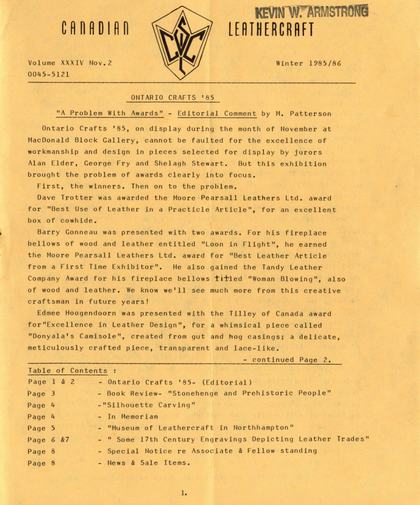
(8 pages, 1.4 MB)
the full-resolution scan, 23 MB, for close research
Page 1 — Ontario Crafts '85- (Editorial )
Canadian Leathercraft
Volume XXXIV Nov.2 Winter 1985/86
0045-5121
ONTARIO CRAFTS '85
"A Problem With Awards" - Editorial Comment by M. Patterson
Ontario Crafts '85, on display during the month of November at MacDonald Block Gallery, cannot be faulted for the excellence of workmanship and design in pieces selected for display by jurors Alan Elder, George Fry and Shelagh Stewart. But this exhibition brought the problem of awards clearly into focus.
First, the winners. Then on to the problem.
Dave Trotter was awarded the Moore-Pearsall Leathers Ltd. award for "Best Use of Leather in a Practicle Article", for an excellent box of cowhide.
Barry Gonneau was presented with two awards. For his fireplace bellows of wood and leather entitled "Loon in Flight", he earned the Moore Pearsall Leathers Ltd. award for "Best Leather Article from a First Time Exhibitor". He also gained the Tandy Leather Company Award for his fireplace bellows titled "Woman Blowing", also of wood and leather. We know we'll see much more from this creative craftsman in future years!
Edmee Hoogendoorn was presented with the Tilley of Canada award for"Excellence in Leather Design", for a whimsical piece called "Donyala's Camisole", created from gut and hog casings; a delicate, meticulously crafted piece, transparent and lace-like.
- continued Page 2.
Table of Contents
Page 1 & 2 - Ontario Crafts '85- (Editorial )
| Page 3 | Book Review- "Stonehenge and Prehistoric People" |
| Page 4 | -"Silhouette Carving" |
| Page 4 | In Memoriam |
| Page 5 | "Museum of Leathercraft in Northhampton" |
| Page 6 &7 | Some 17th Century Engravings Depicting Leather Trades" |
| Page 8 | Special Notice re Associate Fellow standing |
| Page 8 | News Sale Items. |
[p1: the award name reads "Practicle Article" on the page, not "Practical" — the Society's own typo (also visible in the "titled" correction mark nearby), kept as printed rather than corrected.]
Page 2
Ont. Crafts '85- Editorial (cont'd)
These pieces were all excellent, but, unfortunately, only one of the four was' truly leatherwork!
Barry Gonneau's entries showed real skill in wood crafting, but since the only leather areas were the small folded bellow sides, usually tucked in, out of sight, they scarcely meet the criteria of "leatherwork".
Similarly, Edmee Hoogendoorns "Camisole" was made entirely from a non-leather material. Dictionary definitions of "leather" are "the skin of animals dressed and prepared by tanning, tawing or other processes", Gut is defined as the "intestinal canal of an animal; the stomach and digestive apparatus". Quite a different thing! There is as much difference between the two materials as there is between leather and wool, which is the hair of the animal. And nobody has suggested grouping woven wool with leather as a category for award decisions!
It is more than unfortunate that there were not more "leather" pieces of sufficient calibre from which the judges could have chosen. Of 400 entries submitted, 89 were placed on display. Obviously, amongst the 311 rejected pieces there were other articles of leather that failed to meet present exhibition standards, and I can find no quarrel with that! Judges can only work with what IS available.
However, it is NOT acceptable to place awards donated for a specific material on pieces not really made of that material! Surely the donors find a problem with their company names being placed on such items. The whole concept becomes ludicrous, Surely it would be wiser to withhold awards if suitable work is not available in the sponsor's medium. This is fair, and would honestly meet with the sponsor's intentions. I know that a fear exists in organizations for the arts that if an award is not presented one year, there may not be funds forthcoming from the donor next season. But even MORE serious, I believe, is the possibility of sponsor withdrawal due to incorrect award money usage!
A A possible solution from this quandry might be the establishment of an "awards fund", where all but the top one or two awards in each material category could be pooled for presentation wheresoever required! And this could well encompass the many pieces that "fall between the cracks" in such competitions: pieces of either unusual craft materials or those of multi-media construction. I believe that this would meet with a happier reception by the sponsors and it would also enable those working in new and exciting mediums or combinations of mediums to receive well-deserved rewards.
This new type of "pooling" would also be most suitable when courting new donors not directly connected with craft material manufacture,
[p2: "tawing" (a real leatherworking term, not "taking") is what the page prints. "quandry" is printed without the second a — the page's own typo, kept as printed rather than corrected to "quandary".]
[A stray underscore is not part of the printed text: "forthcoming from_ the" is set out here as "forthcoming from the".]
Page 3 — Book Review- "Stonehenge and Prehistoric People"
It might also encourage individuals to contribute towards PART of an award, without feeling obliged to make a financial commitment that they may not feel able to maintain every year. A very broad base for award fund-raising is extremely desirable, and an awards fund is the easiest form in which to encourage these smaller, but more extensive, sources of contributions.
As for Ontario Crafts '85; those that deserved to have their work displayed generally were chosen, and the individuals whose work was worthy of special notice were, on the whole I'm sure, selected for awards..... only a few designations were wrong, NOT workmanship! Our congratulations to all winners, and may we. hope to see more active participation by those in our own craft area next year!
Editor, "Canadian Leathercraft".
Book Review: STONEHENGE AND PREHISTORIC PEOPLE by Alex. Keileer, Prof. Archaeology, Avebury Museum: Windmill Hill.
submitted by Mary Whately, Toronto Branch.
Neolithic peoples used bones and antler tools for leather working.
For many thousands of years, up to about 4000 B.C., the people living in this area of Britain consisted of a few roving bands of hunters who lived on game, fish and wild plants.
Their clothes were of leather, (somewhat like the suede used today), and hide was probably used for some of their domestic utensils.
Their baggy, round-bottomed pots of clay looked like imitations in clay of the leather vessels appropriate to a pastoral people. For shelter, they built huts or windbreaks of brushwood at their temporary camp sites, and perhaps used skin tents as well.
The heavier stones of Stonehenge must have been dragged overland for miles from where they were quarried, on massive sleds and rollers, and once again leather was used, to form the ropes for the sleds. Below are some of the bone tools used as their primitive leathercraft tools.
Left:
pair of bone
scrapers
OS Right:
two bone
needles
Page 4 — "Silhouette Carving" In Memoriam
SILHOUETTE CARVING - by John Marsden
Silhouette carving is one of the easiest carving methods and requires a minimum of tools.Proper care of the leather projects and ease of design produces a fast and easy product.
The initial step is to case the leather, by soaking your leather project in water for five minutes and then placing it in a plastic bag, then refrigerate this overnight. After choosing your design, transfer it to tracing film and sharpen your swivel knife, and make sure that you have all the tools required to finish the project.
When the leather is properly cased, transfer your design and cut the outline, making sure that the leather does not dry out. With the completion of the carving, you may bevel the design on the inside of the cuts. After all carving is completed you should now matt down the inside, making sure that all the matting is even. Do not let the leather get too wet or your knife cuts will close, and if the leather is too dry, it will be too difficult to carve correctly.
When the matting is completed, make sure that the knife cuts are nice and wide. To finish the project, one only needs to use antique finish on the leather and assemble. The craftsman may be more creative if desired, by colouring the matted areas darker or lighter than the rest.
Tools required are a hollow ground swivel knife, (which gives you the nice wide cuts that you need), two background tools #'s A104 and A98, two bevelers, #B801 and B836, antique finish and applicator for finish.
Please remember that the design should be simple, with few overlapping sections or any large areas to be matted down. The lines of the design should flow gracefully from one to another. Remember, simplicity is the key in silhouette carving.
Correction: Fred Brown asks that we clarify the article on Gel Brigden (Fall/85 issue) by saying that "Lorna sat quietly, while CSCL members discussed things in an unparliamentary manner. Gel NEVER sat quietly!"
IN MEMORIAM
We are sad to report that one of Toronto Branch's original members, Jean Newton, passed away on Christmas Eve, Dec. 24th. Members of all branches join in sending condolences to May Corbett (Barrie) on the early December loss of her husband. Sympathy is also extended to Gladys Riddell on the sudden death of her aunt, Dorenda Durey, who passed away on Christmas day.
the In Memoriam paragraph is set in a cursive typeface
Page 5 — "Museum of Leathercraft in Northhampton"
Museum of Leathercraft in Northhampton
The museum of Leathercraft in Northhampton was originally sponsored by the National Leathergoods and Saddlery Manufacturers Association for educational purposes. The museum is one of three devoted to the history of one single item, and in this respect, is unique.
Leather, generally a neglected material without a separate museum classification, nor a corpus of scholarship relating to it, has a history of unbroken use long before weaving, pottery or metalwork and can provide an enormous field for research.
With this tremendous potential in mind, technical colleges, trade associations and London Livery Companys that made or used leather were invited to become involved with the orignial proposal for a Leather and Allied Trades Museum.
The original prints "the orignial proposal" — letters transposed — kept exactly as printed.
These groups became trustees whose first act was to establish the museum as a non-profit institution with a full constitution and a body of supporters whose privilege it was to subscribe money to support the project. The trustees then established charity status for the museum, enabling it to recover income tax on seven year covenants.
As with any proposal of such scope, the necessity of funding and publicizing the project became essential and in 1948 a preliminary exhibition was held with approximately fifty objects. Liberal-minded firms in the industry, as well as the Carnegie United Kingdom Trust were approached successfully for funding, and during the Festival of Britain, a second exhibition was held,establishing the worthiness of the project with approximately three-hundred objects on view.
The Museum of Leathercraft was finally opened in 1953 and for four years was housed at the Leathersellers Technical College at Bermondsey. Then, after a three year interval at the Guildhall Museum in London, it found an excellent location in Northhampton, centre of the shoe and leather trade for many years,
The importance of such an institution cannot be understated. The services it provides to the public and the trade are invaluable. For manufacturers, stylists, researchers and writers, the information services provide an excellent interface between technical colleges, the fashion trade and the public.
We would benefit greatly from such an institution in Canada. The promotion of the industry, badly need at this time, is an obvious one. Models for designers and stylists as well as a resource centre for those industries utilizing leather is another benefit. The outflow from a proper stylistic source for the industry is both aesthetic and economic; better styling equals higher sales both domestic and export. This is not a repository of lifeless objects. It is a living body of tradition.
Page 6 — Some 17th Century Engravings Depicting Leather Trades"
SOME 17TH CENTURY ENGRAVINGS DEPICTING LEATHER TRADES
To those amateurs interested in the history of the trade, the engravings of late 17th Century German Trade Dictionaries provide a window to what was produced and the prevailing feeling of the day is captured in the quaint verse attached.
The first engraving is that of the Tanner and one can see the various operations, many out of doors, such as "beaming, scudding with the circular knife, softening by foot, rinsing and so forth." By the look of the build on the beamer, it was a task that required great strength in the shoulders and forearm. The verse reads:
"He who wants to pine for luxury, her soft smooth talking weakens the will, Thou scraping, rubbing, oiling and stretching firms the leather. The hard suffering moves us ever towards the jewel of a beautiful courage.
Page 7
The second engraving done in 1698 depicts the Gurtler-Girdle or Belt Maker. One gets a good idea of what they produced from the goods that hang on the wall behind the men to the partially finished buckles in the foreground. Sword and money belts as well as all types of strap-work would have been done in these shops. The verse reads:
"My God, let my heart at all times, be securely girdled by clear conscience and truth. And when treachery and lies are overcoming me, I know I can finally, exalted, move beyond the battlefield."
The Belt Maker was an important part of the leather trades and no doubt would have worked hand in hand with the Bag Makers, Armourers and perhaps, doing strap work for Case-Makers and Saddlers.
The third plate shows that the Saddler would probably have done girth straps as well as saddlebags in addition to different types of saddles. The verse reads:
"The horse with far and proud snorting, finally takes on rein and saddles and follows him who can lead it, thus the spirit tamed through word and faith, the wild beast, its flesh and blood and chases a higher Good."
Editor's Note: We are indebted to Rene Hackstetter for the foregoing historical plates, showing the art of the leatherworker, and for the translation of the German verses accompanying the plates.
Page 8 — Special Notice re Associate Fellow standing; News Sale Items
SPECIAL NOTICE
All CSCL members planning to try for their Associate or Fellow standings this year are advised that the deadline for work to be received for assessment by the Fellows is Friday, March 14th. Information or forms to accompany work can be obtained by telephoning either Fred Brown, (Past Chairman of Fellows) at (416) 626-3184, or Jean Hunter, (Chairman of Fellows), at (416) 846-1217. (We include Jean's address as well, but remember, time is of the essence, and hope for no mail strike!.)
Mrs. Jean Hunter, Snelgrove, Ont. L0P 1M0.
GOOD NEWS! (And don't we all need it at this time of year!? Jack Meharg, Past President CSCL, Past CNE CSCL show organizer, Past OCC representative, Past Toronto Branch President, etc. etc is NOW unofficially a past police officer as of 12 am Mon. Jan. 6th. (Heard of counting the days, but counting the hours is REALLY going some, Jack.) Official retirement for Jack starts on March 1st- and we all wish him years of hard work and enjoyment at his chosen full-time hobby of leathercraft!
For Sale or Trade: The following volumes on leathercraft- Genfan & Taetzsch- "Latigo Leather" - (hardcover - $10.) Genfan & Taetzsch- "Leather Decoration"- (hardcover-$15.) Hayes, M. Vincent- "Making It In Leather"-(hardcover-S6. ) Manning, Mary A.E.- "Leatherwork-A Step by Step Guide"(HC-$7.50) Faulkner, Jan - "Leathercraft by Hand" -(Paperback, large $10) Vivian, June - "Home Tanners Handbook"-(Paper/large-$10. )
Torbet, Laura & Famm, John- "Leathercraft You Can Wear" (S6.) Please contact Rene Hackstetter- days- (416-532-9053. Prices do not include postage and handling for mail-out orders.
All material published in Canadian Leathercraft is the property of the Canadian Society for Creative Leathercraft and may not be reprinted in any form without the permission of the Society.
President: Madeleine Mitchell- 17 Light St., Woodstock, Ont. Corr. Sect.: Lillian Kay, 195 Exbury Rd., #1703, Downsview, Ont. Editor: Mary Patterson, 270 Durie St., Toronto, Ont. M6S 3G3 Reporters this issue: Toronto Branch Members.