
An issue of the Society’s newsletter, transcribed from the original.
(12 pages, 1.9 MB)
the full-resolution scan, 30 MB, for close research
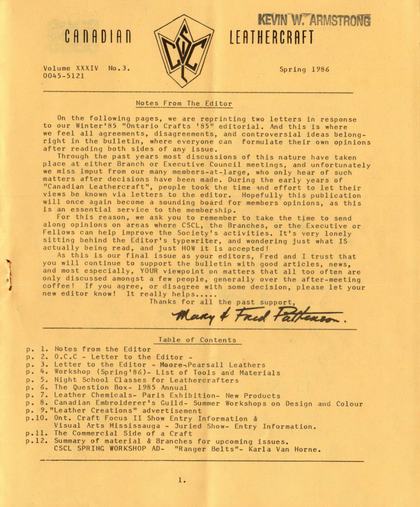
Page 1 — Notes from the Editor
CANADIAN LEATHERCRAFT
Volume XXXIV No. 3                    Spring 1986
0045-5121
Notes From The Editor
On the following pages, we are reprinting two letters in response to our Winter'85 "Ontario Crafts '85" editorial. And this is where we feel all agreements, disagreements, and controversial ideas belong right in the bulletin, where everyone can formulate their own opinions after reading both sides of any issue.
Through the past years most discussions of this nature have taken place at either Branch or Executive Council meetings, and unfortunately we miss input from our many members-at-large, who only hear of such matters after decisions have been made. During the early years of "Canadian Leathercraft", people took the time and effort to let their views be known via letters to the editor. Hopefully this publication will once again become a sounding board for members opinions, as this is an essential service to the membership.
For this reason, we ask you to remember to take the time to send along opinions on areas where CSCL, the Branches, or the Executive or Fellows can help improve the Society's activities. It's very lonely sitting behind the Editor's typewriter, and wondering just what IS actually being read, and just HOW it is accepted!
As this is our final issue as your editors, Fred and I trust that you will continue to support the bulletin with good articles, news, and most especially, YOUR viewpoint on matters that all too often are only discussed amongst a few people, generally over the after-meeting coffee! If you agree, or disagree with some decision, please let your new editor know! It really helps.....
Thanks for all the past support,
Mary & Fred Patterson
Table of Contents
p. 1. Notes from the Editor
p. 2. O.C.C - Letter to the Editor --.
p. 3. Letter to the Editor - Moore-Pearsall Leathers
p. 4. Workshop (Spring'86)- List of Tools and Materials
p. 5. Night School Classes for Leathercrafters
p. 6. The Question Box- 1985 Annual
p. 7. Leather Chemicals- Paris Exhibition- New Products
p. 8. Canadian Embroiderer's Guild- Summer Workshops on Design and Colour
p. 9. "Leather Creations" advertisement
p. 10. Ont. Craft Focus II Show Entry Information & Visual Arts Mississauga - Juried Show- Entry Information.
p. 11. The Commercial Side of a Craft
p. 12. Summary of material & Branches for upcoming issues.
CSCL SPRING WORKSHOP AD- "Ranger Belts"- Karla Van Horne.
The editorial on this page is signed by hand, and the signature is not easy to read. It is Mary & Fred Patterson: the two letters reprinted in this same issue are addressed to “Mary Patterson, Editor” and “Ms. Mary Patterson” in clean type, and Mary Patterson is the Society’s Editor of record from 1980.
Page 2 — O.C.C - Letter to the Editor
Ontario Crafts Council
346 Dundas Street West
Toronto, Ontario M5T 1G5
Telephone 416/977-3551
March 11, 1986
Mary Patterson, Editor
Canadian Leathercraft
I read with much interest your very well considered editorial in The Winter 85/86 issue of Canadian Leathercraft.
Your assessment of Ontario Craft '85 was both generous and fair. The definitions that you provided for leather and gut were helpful to me, since I take the responsibility for having placed the Hoogendoorn camisole in the leather category. You described the piece as whimsical. I was, perhaps, a little too whimsical myself when designating it as leather.
The Gonneau pieces may be a little more arguable but in general your points are well taken.
On the other issue of responsibility to the sponsor, I offer the following:
One should have at the outset an understanding with a sponsor of how far interpretations of a medium may be stretched. Some have a preference for one category or another such as, best new work, or best functional, or best experimentation but many offer to leave these subject to change if submissions warrent. As you suggest, the most open interpretations are allowed by those not having a professional reason for choosing one medium.
The "pooling" idea you mentioned, does, in fact take place now. The Ontario Crafts Council has an awards fund to which anyone can contribute and several of the awards in Ontario Crafts '85 came from this fund. We attempt to see that each meduim is provided for and that a cross section of categories is created.
Thank you once more for your thoughtful editorial. I have taken your reservations to heart and appreciate your kind words about the exhibition in general.
Yours sincerely,
Alison Parsons
Manager of Extension Services
Page 3 — Letter to the Editor - Moore-Pearsall Leathers
Moore-Pearsall Leathers Limited
47 FRONT ST. E., TORONTO, ONTARIO, CANADA M5E 1B3
PHONE (416)363-5881          TELEX 06-22035          CABLE: MOOREPEAR, TOR.
March 5, 1986
Ms. Mary Patterson
Editor
Canadian Society for Creative Leathercraft
270 Durie Street
Toronto, Ontario
M6S 3G3
Dear Ms. Patterson:
I have recently read the Canadian Leathercraft, Volume XXXIV Nov. 2, 0045-5121, Winter 1985/86.
I wish to commend you on your article "Ontario Crafts '85 - A Problem With Awards". The article expresses very clearly our exact feelings -- it is indeed disappointing to see our company name being placed on items which are not really made of the material the award is being presented for.
We have some reservations regarding your recommendation to establish an "awards fund" as a possible solution, but are willing to consider some alternative approach in the future. Once again, thank you for expressing our views in this article.
Yours truly,
MOORE—PEARSALL LEATHERS LIMITED
R.J. Pearsall
MONTREAL OFFICE: 4291 RUE GARAND STREET, ST. LAURENT, QUEBEC (514) 332-6800
The letter’s own reference to “Volume XXXIV Nov. 2” is printed exactly so — the correspondent’s slip for “No. 2” — and is left as printed.
Page 4 — Workshop (Spring'86)- List of Tools and Materials
Workshop - SPRING '85 - Ranger Belts with Karla Van Horne
Karla has sent along this list of tools and equipment needed for the May 24th CSCL workshop, (see ad on back page of this issue).
The workshop is a two-part venture, who says that, "It's first purpose is to show how the ranger belt is made. The second is to teach and review basic principals such as edging, creasing, measuring etc.". Karla also points out the although this is a lengthy list, it is important that people bring as many of these items as possible. She will be bringing some of her own tools as well as sewing needles and extra thread for those who may require them.
If you are planning to attend, we suggest that a few of the larger items, such as skiving marble, etc. be shared amongst a small group. Tool & Leather: List 1. Cardboard for pattern-making 2. Measuring tape 3. 3/4" buckle
4. 3/8" x 6" strip of 3 1/2 oz. -4 1/2 oz. leather for belt loops 5. 8-9 oz. leather for belts and billets (or a1 1/4" or 1 1/2" belt strip cut down the entire length of the hide PLUS a piece of the same weight leather, either 1 1/4" x 18" OR 2 3/4" x 10". 6. A good cutting knife
7. rotary punch
8, stamping tools (for a simple stamping design) 9, swivel knife (if necessary for design)
10. stamping block ll. mallet
12. stitching groover
13. #6 overstitch tool
14. cutting board (black rubber pounds board is good ) 15. skiving tool. and skiving glass or marble
16. dye for edges- (light brown, dark brown or cordovan spirit dye preferred), plus felt applicator
17. finish coat of choice plus dye of choice for so louring belt 18. applicator or soft, wide brush suitable for applying finish 19. fine paint brush
20. 3/4" slot punch
21. bone folder
22. diamond blade awl
23. scratch awl
24, rivets, (medium preferred, but large will do). 25. rivet setter plus riveting surface or anvil 26. small piece fine emery or fine sandpaper
27. 2 harness sewing needles (with blunt points) 28. linen sewing thread to match your chosen dye colour (predye if recess.) 29, beeswax for waxing sewing thread
30. #4 or #5 edge creaser
31. newspaper (for dyeing surface)
32. modelling tool
33. sponge and small container for water
34. piece of coarse denim or Canvas or Similar cloth If this list sounds lengthy, remember that many of these items can be shared. (If you plan to share, label your tools for easy identification at the end of the day.)
Once again, check back page for ad. If any questions need answers re this workshop, Karla is at 80 Carrick Ave., Apt. #3, Hamilton, L8M 3W1. Plan to attend this most interesting workshop !
Page 5 — Night School Classes for Leathercrafters
NIGHT SCHOOL OR ADULT DAY SCHOOL CLASSES FOR LEATHERCRAFTERS
One of the problems in some centres with dwindling membership in their Branches, is the result of Leathercraft classes being dropped from adult night classes. This is the MAIN source for new members, and, unfortunately, if a course is dropped due to lack of demand during any one season, it may be next to impossible to have this course replaced in future years.
For this reason, we are most pleased to announce that Toronto, having lost the important Central Tech. School classes of Fred Brown some years ago, will now have a change of instructors at the only remaining Night School Leather course. As well, this course will be expanded to have a second course run on another evening.
Lillian Kay has been approached by West Park Secondary School, at the corner of Dundas and Bloor, (1515 Bloor St. West), to take over the Tuesday evening class of the present retiring instructor. As well, a second, similar course will be offered on Thursday nights.
As is usual, these courses will run for 20 weeks, from (approx..the start of Oct. through to late March. For information, watch for the fall night school course catalogue, or telephone 591-8149 for information. Registration night is usually near the 21st of Sept. (The above tel.# is for the Toronto Board of Education. ) The school number is 532-2861.
For all those in the Toronto district who feel that they would be helped by extra instruction, (or even for those many of us who find the urge to work on a project on one's own is too easily lost when facing the many odd jobs around one's home), this is the opportunity to expand your knowledge and work with a most helpful and informed leathercrafter. Lillian has both the skills and knowledge needed to be a professional leathercrafter, as well as the patience and training required for crafts instruction, having worked in this capacity for many years.
Classes run from 6:30 to 9:30 each evening, and West Park is right on the corner of the Dundas/Bloor subway station, convenient for many.
Other Toronto classes involved with leatherwork are those held in the Kensington campus of the George Brown College. This course is entitled "Fur and Leather Design", and is really meant for those who wish to make leather clothing manufacture their trade. This course is 60 hrs. in length, and falls under the direction of the George Brown Fashion Dept., at 967-1212, ext. 4303, or 4336.
We would appreciate hearing from other Branches in other cities with information on their courses. This material is of vital importance if membership in our Society is to increase. Branch secretaries may send such information on in time for the summer issue of Can. Leathercraft, (by late June).
Many of our recent members have joined with us due to the efforts of Joyce Scruton, and Harold Brister, of the Mississauga Branch. Many of us have come to count on Joyce's knowledge and skills when we have a problem with material purchases, finishes,etc., and Joyce has proven to be a remarkably helpful instructor for newcomers at Mississauga, through her capacity as manager of the Tandy store there. Those in the Mississauga area that have been working on their own should call Harold Brister at 279-0333 for information on the Mississauga meetings, which always are conducted as mini-workshops.
Page 6 — The Question Box- 1985 Annual
Questions and Answers from the Question Box — Annual 1985
Q. How can one tell the various types of leather?
A. Over a period of time, the craftsman should compile a loose leaf scrap book. Attach swatches of as many types of leather as possible. List the name of the leather, source of supply, the plus and minus effects and any special properties noted while working on it. How does it take dyes and finishes etc. Keep your book up to date and question tannerys and retailers to obtain as much info as possible. In the reply to this good question we were reminded of Bob Muma's collection of leather samples which would make a wonderful historical display at some future leather show.
Q. What makes some leather "eat" Acrylic dyes? They just seem to disappear into it.
A. Such dyes should be applied to damp leather, if you rub fairly hard you will close the pores of the leather and therefore the dyes should not be absorbed as deeply. After you achieve the desired effect finish as usual.
Q. Why, no matter how much you burnish a dyed edge, will the dye transfer to any natural leather which may rub against it? For instance, the top of a purse gusset rubbing against the lining of the purse?
A. Milk can be used as a burnishing medium, and will sometimes seal a dye. Other finishes such as Leather Balm and Resoline were suggested.
Q. Our office purchased some leather placemats. These were cowhide and not finished in any way. Could you suggest a suitable finish to protect and waterproof?
A. Grumbachers Fixative was suggested, although it is not flexable. Fiebing's Saddle Lac has a high gloss, is flexable and reason -ably waterproof. The latter can be applied over acrylics or other dyes.
We appreciate the above submission by Kay Cloughley from notes taken at last year's Annual Meeting Question Box period.
Amongst other material received recently was information on new leather chemicals at the Paris Exhibition. You will notice, in the following page summary of this material, that Acrylics are becoming a common colourant in leathers. Although this was originally meant to be a "trade" information fact sheet, we are well aware that the "in" colouring of leathers is acrylic Most Canadian leathercraftsman at the professional level are well skilled in using this type of colourant which enables us to break away from brown tones and deal in bright primary colours for the first time.
Unfortuantely, the actual "look" of leather is generally lost when colours are too bright, as acrylic colouring is opaque in nature. But we urge you to read the following material to see just how far the industry is progressing! (And just a hint! Wouldn't acylic dyeing be an excellent subject for a workshop or "Annual" demonstration?
Page 7 — Leather Chemicals- Paris Exhibition- New Products
[Another oddity is the Society’s own typing and is left exactly as printed: “compatible … with s wide range of vegetable extracts” (s for a, neighbouring keys). In “a method of allowing manufacturers” the e is typed over the m, and the word is given as intended.]
LEATHER CHEMICALS ON DISPLAY AT PARIS EXHIBITION FROM ROHM & HAAS HELP INCREASE OUTPUT, IMPROVE FINISH,
Four lines of leather-treating chemicals that can improve finish and increase factory output were highlighted at the Rohm & Haas exhibit at the 1985 Semaine International du Cuir, Port de Versailles, Paris.
These four products are Leukotan(R) group of acrylic syntans; the Chromesaver(R) Pretan Process; Primapel (TM) M Aqueous Top Finish; and, Primal(R) Soft-Touch Finishing Resins.
Leukotan syntans: These are based on acrylic chemistry, and provide lightfastness of colour, full-level colour, and ease of formulation. They make leather more receptive to basic dyes, as opposed to acid and direct dyes, thus producing very level shades. Most of them are also compatible both with each other and with s wide range of vegetable extracts.
Chromesaver process: This is a method of allowing manufacturers to reduce the amount of chrome used during tanning. (A money-saving, and timesaving process. )
Pretanned hides treated with Chromesaver Pre-tan A-31 can be split, shaved, trimmed and sorted before tanning. The resulting CHROME-FREE trimmings, shavings, etc. can then be processed for other uses, as they are safely free of chrome, (These shavings etc. can be sold for animal food (!) gelatin, or fertilizer!!)
Primapel aqueous top finishes: These are a group of water-based, nonpolluting systems, which give versatile, cost-efficient topcoatings to a variety of leathers. May be sprayed, has good drying quality, and good recoatability, according to information in this bulletin. (Is there really such a word as recoatability? Ed's note.)
These include auxillaries which can either increase or reduce the gloss of the leather, the feel of the hides and the overall topcoat properties. Primal emulsions: These are made of acrylic resins in a water solution, used as base coats for binding pigments and allowing penetration of colours. They also impart flexibility, toughness and water and abrasion resistance to leather finishes. Since they are acrylic in nature, they will not become less flexible or light-fast.
Courtesy: Rohm and Haas Co., Philadelphia, PA 19105 USA. For more information, contact Deborah Zimmer, Polymer, Resin and Monomer Division.
From the above, we should be able to look forward to shoes that are virtually waterproof, never stiffen even when in contact with water and then dried off, can be produced in any colour of the rainbow and be either shiny or matte in finish, not become scraped, and all the trimmings from the manufacturer can be fed to livestock or spread on the front lawn as fertilizer. Now I ask you, what more could you ask of a pair of shoes?
Oh yes, they forgot! They'llistill give all we women sore feet, leg cramps, and will get kicked off under tables when no one is looking!
Page 8 — Canadian Embroiderer's Guild- Summer Workshops on Design and Colour
[“the Textile Museum, Toront,” is printed exactly so and is left as printed.]
CANADIAN EMBROIDERER'S GUILD - 2-week Summer Workshop for Embroiderer's June 16-27 (Mon. to Friday, 9:30-4:30 weekly)
BRESCIA COLLEGE- UNIVERSITY OF WESTERN ONTARIO- LONDON, ONT. Artists: Rhett Delford-Brown and Judith Dingle.
Fee for 2-week workshop - Guild members $225. Non-members- $250.
(Rooms extra).
Fees should be paid by May 1st, with pre-registration fee of $25. due by Apr. 15th (extension of this date possible if course not filled). For further information: Write to Canadian Embroiderer's Guild, P.O.Box541 London, Ont. N6A 4W1.
As many of our members are connected with other parts of the fibre arts, including embroidery and the design of patterns in quilts, wall pieces etc., we include this infommation on this workshop.
Rhett Delford-Brown is at present teaching for the Embroiderer's Guild of America and for the Brookfield Craft Centre in Connecticut. Her certification is in mixed-media stitchery from the Valentine Museum, Richmond Virginia. A graduate of Duke University she is noted for her mixed-media wall hanging exhibitions in New York City, where she has had regular shows in the New York City Gallery.
Rhett plans to encourage exercises in colour control, the use of colour, as it affects balance, spacial relationships, movement (of design), and will also approach design study as it relates to good composition.
Judith Dingle is a full time textile artist with a studio in Toronto, and has exhibited in numerous juried exhibitions in Canada, Europe and the United States, (including a 1-person show at O.C.C.)
She is most noted for her architecturally scaled quilted wall hangings commissioned for both residential and corporate interiors, including such companys as Seiko, Bristol Place Hotel, and the new C-I-L Ltd. headquarters. At present she is moving in the direction of 3-dimensional textile constructions of geometric imagery.
Her works are included in many publications and her work has been purchased twice by the O.C.C for their permanent collection, and other pieces in permanent collections include those purchased by the Textile Museum, Toront, the Massey Foundation, National Museum of Man, Ottawa.
Judith will allow students to enrich design and visual vocabularies through use of daily slide lectures, colour and design exercises, and informal critiques will help them to evaluate their work. Three areas of consideration will be colour relationships, form and structure, and the potential for use of non-traditional materials.
Either or both workshops may be registered for on the basis of space, if after the due date of April 15th.
We include the above information for those sincerely interested in improving their concept of form, colour and design as it relates to fibre art. Although the medium is different, the approach should not be, especially in Judith Dingle's workshop where embroidery is not emphasized, but where colour, shape and design will be studied.
Page 9 — "Leather Creations" advertisement
[Place names are as printed — the gallery at Bowmanville is printed “New Castle”, in two words.]
Special Notice to All Members & Friends of C.S.C.L.
ANNOUNCING
“LEATHER CREATIONS” — A TRAVELLING EXHIBITION
PRESENTED BY: THE CANADIAN SOCIETY FOR CREATIVE LEATHERCRAFT AND ONTARIO CRAFT COUNCIL
DATES:                              PLACE:

Dec. 9/85 to Jan. 9/86              WELLINGTON COUNTY MUSEUM
                                    R.R. #1, FERGUS, ONT.

Jan. 19 - Feb. 21/86                VISUAL ARTS CENTRE OF NEW CASTLE
                                    BOWMANVILLE, ONT.

March 3 - March 29/86               BELLEVILLE PUBLIC LIBRARY
                                    BELLEVILLE, ONT.

April 1 - 30 and May 1 - 30/86      TRENT LIBRARY SYSTEM

June 15 - July 15/86                ATIKOKAN, ONT.
                                    CENTENNIAL MUSEUM.

Aug., Sept., Oct. 1986              TO BE ANNOUNCED.

Nov. 1 - 22/86                      LINDSAY ART GALLERY,
                                    LINDSAY, ONT.

Dec. 1986                           TO BE ANNOUNCED.
— A programme of entries will be available at each show site.
— Please see that local craft centres and libraries in your area are notified of this show.
Special Leather Show
CAMBRIDGE TEXTILE FESTIVAL — SALE OF FIBRE AND LEATHER WORK
June 7-30   (Exhibition and contest) - Cambridge Library
June 7-8    Retail sale of Fibre and leather work (Cam. Textile Festival)
June 7-8    Retail and Trade Show (Cam. Leather Festival)
            Retail sale and show at Dickson Centre, Cambridge, Ont.
Page 10 — Ont. Craft Focus II Show Entry Information & Visual Arts Mississauga - Juried Show- Entry Information
UPCOMING SHOWS: Entries are now being accepted for a number of shows, and we point out some for ypur information and, hopefully, participation!
The original prints "ypur", kept exactly as printed.
ONTARIO. CRAFTS. COUNCIL. - CRAFT. FOCUS II
Open to all O.C.C. members anywhere in Canada, and to members and nonmembers resident in Ontario.
Approximately 75 winning entries will be printed in full colour in catalogue form, to be included as a supplement in the Winter 1986 issue of OntarioCraft.
As this is a highly visible part of the Craft Community today, we urge all leathercrafters to make the effort to send applications in to O.C.C. Awards are selected from SLIDES of pieces- it is not necessary to take your work in for jurying- and all entrants are encouraged to try to achieve professional quality slides from their own photo work, or even more wisely, by contacting a professional photographer versed in achieving the best possible effect from lighting, etc. etc. Many of our members are, we know, quite skilled in photography, and many were present at Randy Brinkman's workshop on "Photographing Crafts", put on some years by C.S.C.L. This is the best time to make use of this acquired skill!
Entry fee: $15. (OCC members) $25.00 (non-members).
Deadline: June 20, 1986. For details, entry blanks, etc. contact
O.C.C. at 346 Dundas St. West, Toronto. M5T 1G5.
Judges: Joan Chalmers, founding President, O.C.C.; Larry Richards,
Director of the School of Architecture, University of Waterloo; Vincent Tovell, Craft collector, film producer (Hand & Eye,CBC).
VISUAL ARTS MISSISSAUGA-. 8th Juried Craft Show
Having been part of this show last year, we can highly commend the fine setting of the gallery at Erindale College (The Gallery, South Campus Building, 3359 Mississauga Rd., North).
Work must have been completed since Jan. 1/85. No commercial kits. Limited to 3 entries per craftsperson,
Entry fee- $7. for V.A.M. members, $10. for others.
Jurying:and Delivery of pieces:
All work to be delivered to Springbank Visual Arts Centre, 3057 Mississauga Rd., North, Mississauga Ont., L5L 1C8, by mail- by May 30th. Entrants are encouraged to hand-deliver work, if they choose, on Sunday June 1st- 3 to 7 p.m.
Jurying: June 2nd Pick-up of non-accepted pieces- Tues. June 3rd, 3 to 7 p.m.
Reception and Awards: June 4th- 7:30 p.m.- The Gallery, Erindale College. For details and applications, contact Springbank Visual Arts Centre at address above.
Page 11 — The Commercial Side of a Craft
[“all mthods used for selling” is printed exactly so and is left as printed.]
The Commercial Side of a Craft
There has been a heated debate raging amongst American potters for over a year now, following publication of an article by a potter who suggested that, if one was to make a living in the commercial field of arts and crafts, then regular methods of sale should be adopted. In other words, all mthods used for selling of manufactured products in stores should be assessed, and those useful to the individual should be followed.
Now this sounds sensible. Perhaps the time has come for people who sell crafts to stop sitting back in the corner, working at some small article while the crowds at craft shows are left on their own to decide whether or not to make a purchase. This is quite familiar to all of us, isn't it?
At a recent tour of the Winter's End Craft Show here in Toronto, I noticed that there was a definite change in attitude from the early days of this show, when most craftspeople hung shyly back, waiting for the customer to make up his/her mind to stop in at the booth.
No aggressive "sales techniques" have been generally found at most of these shows. People don't put up huge "SALE" signs, or reach out and hand out business cards helter skelter to passers-by, and try to talk them into looking at their wares. But why not?
According to the article submitted to "Ceramics Monthly", that started all the ruckus, if someone stopped and bought a, say, mug or two, the craftsperson should then suggest that a matching cream and sugar would look good with it, and even go so far as to suggest that this type of item was an excellent choice if the buyer had anyone with an upcoming birthday.
Now it seems that this is akin to beating your wife amongst potters! Something as crassly commercial as suggesting that you buy something extra drove scads of people to answer the writer in indignation! Only a VERY few suggested that their might be something in the idea of "actively pursueing sales". We wonder why crafts are something that are approached with rather "religious fervor" where one works hard, long hours, at a pittance, and shouldn't attempt to make more money than the independant buyer chooses to leave behind, with no influence by suggestion of increase of purchase.
But we all do it don't we?
We all sit back and far be it from most of us to personally push our wares forward with any such remark as, "this will make a nice gift for your Mother for Mother's Day". For some reason this is an'indecent' suggestion, and most of us let many sales go by because we're not willing to "push" our work on people. Wonder where we'd be if ALL salespeople followed this line of reasoning!
Anyway, I still can't do it, and apparently most potters can't either, and maybe that's where the expression comes from "a stick-in-th-mud!" Isn't it strange though, at the C.N.E., we could quite easily push some else's work forward without blinking! Guess the trouble is, we're all people who would rather work with our hands, and few of us manage to also work with our mouths.
Watch at the next show, and see how we ALL undersell ourselves! Maybe we need a workshop on "the self-confident salesman!" (In the meantime, does anyone know of a good salesperson? I could sure use one!)
Mary Patterson.
Page 12 — Summary of material & Branches for upcoming issues
[The workshop notice is a boxed, hand-lettered advertisement beside a small drawing of a belt tip: the year is 1986, the subject is RANGER BELTS, and the time is 9:45. The masthead prints the President as “Madeline Mitchell”, without the second e — the Society’s own typing.]
Next issue: All material should be prepared by June 15th.
Reporters Next Issue: This would normally be the Woodstock Branch issue, but any extra material from the Annual is appreciated, as well as any material from Members-at-Large.
Fall Issue: This should sum up any reports missed re the Annual and will be going to press around the time of our Biannual Show. Hamilton Branch, along with the Members-at-Large are in charge, and we stress that the Members-at-Large are expected to make a definite commitment to providing material for this issue as Hamilton has supported two issues in 1985.
Winter Issue: The responsibility of Norland and Mississauga Branches.
Much of the material will encompass our Biannual Show. This summary of upcoming issues should be noted by Branch Rep's, as the new Editor will be approaching you for your contributions. (Try and have them pre-prepared, as you have so often done for this present one! It REALLY helps! Thanks!!)
NOTICE OF SPRING WORKSHOP · CSCL – 1986
RANGER BELTS

DATE:  SATURDAY MAY 24th
TIME:  9:45 – 4:00
COST:  TBA ($10. APPROX.)
PLACE: ST. MARTIN-IN-THE-FIELDS CHURCH –
       1 BLOCK NORTH OF KEELE/BLOOR SUBWAY STN.
       – GLENLAKE AVE. –

INSTRUCTOR – KARLA VAN HORNE
TEA/COFFEE PROVIDED          – BRING LUNCH –
All material published in Canadian Leathercraft is the property of the Canadian Society for Cretaive Letahercraft and may not be reprinted in any form without the permission of the Society.
The Society's own copyright line prints "Cretaive Letahercraft"; both transpositions are kept exactly as printed.
President: Madeline Mitchell- 17 Light St. Woodstock, Ont.
Corr. Sect.: Lillian Kay, 195 Exbury Rd., #1703, Downsview, Ont.
Recording Sect.- Karla Van Horne- #3 80 Carrick Ave., Hamilton, Ont.
Treasurer: Jean Pickering- 204 Elizabeth St., Thamesford, Ont.
Editor: Mary Patterson, 270 Durie St., Toronto M6S 3G3.