
An issue of the Society’s newsletter, transcribed from the original.
(12 pages, 2.1 MB)
the full-resolution scan, 31 MB, for close research
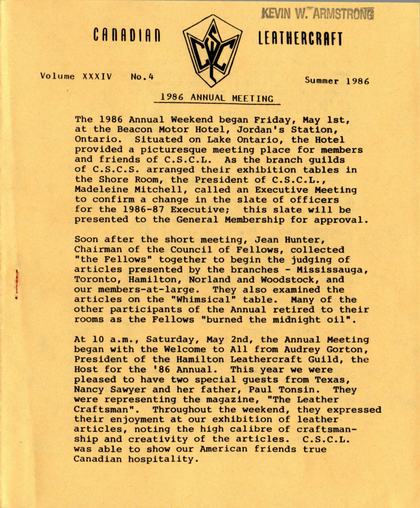
Page 1 — 1986 ANNUAL MEETING
Canadian Leathercraft
Volume XXXIV No.4 Summer 1986
1986 ANNUAL MEETING
The 1986 Annual Weekend began Friday, May 1st, at the Beacon Motor Hotel, Jordan's Station, Ontario. Situated on Lake Ontario, the Hotel provided a picturesque meeting place for members and friends of C.S.C.L. As the branch guilds of C.S.C.S. arranged their exhibition tables in the Shore Room, the President of C.S.C.L.,
[Two small readings: "Friday, M4Y 1S7," plainly reads "Friday, May 1st,"; set out here corrected. "C.S.C.S." two sentences later is genuinely printed that way, right next to a correctly-typed "C.S.C.L." in the sentence before — the Society's own typo, kept as printed.]
Madeleine Mitchell, called an Executive Meeting to confirm a change in the slate of officers for the 1986-87 Executive; this slate will be presented to the General Membership for approval.
Soon after the short meeting, Jean Hunter,
Chairman of the Council of Fellows, collected "the Fellows" together to begin the judging of articles presented by the branches - Mississauga, Toronto, Hamilton, Norland and Woodstock, and our members-at-large. They also examined the articles on the "Whimsical" table. Many of the other participants of the Annual retired to their rooms as the Fellows "burned the midnight oil".
At 10 a.m., Saturday, May 2nd, the Annual Meeting began with the Welcome to All from Audrey Gorton, President of the Hamilton Leathercraft Guild, the Host for the '86 Annual. This year we were pleased to have two special guests from Texas, Nancy Sawyer and her father, Paul Tonsin. They were representing the magazine, "The Leather Craftsman". Throughout the weekend, they expressed their enjoyment at our exhibition of leather articles, noting the high calibre of craftsmanship and creativity of the articles. C.S.C.L. was able to show our American friends true
Canadian hospitality.
Page 2
The Annual Meeting, with about 80 members present, proceeded through business reports, the President's Report, Announcements, and correspondence. The Executive Council of the past year had busily kept the C.S.C.L. an active and interesting organization.
Among the reports, the upcoming Biennial Exhibition - Leather '86 was mentioned in detail.
This exhibition is open to all members. The Call for Entry indicates that articles must reach the home of Mr. and Mrs. Robert Muma, 625 Rushton Rd., Toronto, by 10 a.m. Tuesday, August 5th. The exhibition will be set up September 2, 1986, at the Etobicoke Civic Centre, and the Official Opening will take place Thursday, September 4th, at 8 p.m., for members and invited guests. A long list of awards is being offered to participants of Leather '86. If any member requires more information regarding this show, please contact either your branch President or Jean Hunter.
George McPhail was this year's recipient of an Honorary Life Membership. Since George was not present at the Annual, Hilda Chynoweth, Membership Chairman, will present the certificate to George at the May 23rd Executive Meeting. At this point in the meeting, Ruth Haig, 1st Vice President, was called upon to present the Weston Trophy - the 1986 winner - Hamilton Leathercraft Guild. Presentation of the trophies and ribbons were given to the Hamilton team.
The Report of the Nominating Committee was then presented for the members' approval, and unanimously carried.
Page 3 — Your 1986-87 Executive Council of C.S.C.L.
Your 1986-87 Executive Council of C.S.C.L. is as follows:
Past-President: Jack Meharg
President: Madeleine Mitchell
1st Vice-President: Ruth Haig
2nd Vice-President: Jean Hunter
Recording Secretary: Karla Van Horne
Corresponding Secretary: Sharon Gogoschwili
Treasurer: George McPhail
Library: Marg Hunter
Editor: Jean Hunter
Chairman of the Council of Fellows: Jean Hunter
Teaching Standards: Bob Muma
Archivist: Carol McLean
Directors: Bea Austin
Jean Pickering
Marg Hunter
Branch Presidents: (H) Audrey Gorton
(M) Bob Quinn
(N) Hilda Chynoweth
(T) Fred Brown
(W) Beulah Reynolds
Others: Lillian Kay (ex officio)
Our newest branch guild, Mississauga, kindly invited C.S.C.L. to the Annual in 1987.
[Each role:name pair prints on its own line; read straight through, some roles split across two paragraphs ("1st" / "Vice-President:...2nd Vice-President:...") and others merge onto one line. No name-to-role mapping was ever ambiguous, but the paragraph breaks are set out here to match the sheet, one role per line.]
Page 4
The Annual Meeting closed following Questionsand-Answers by the expert panel of Fellows headed by Fred Brown.
After a leisurely lunch overlooking Lake Ontario, the Weekend activities continued with an afternoon of various leathercraft demonstrations. In the periods between demonstrations, our draw tickets took precedence. The Executive Council had requested only craft-related articles be put on the Draw Table, and this seemed quite a successful idea. At the completion of the activities listed above, members were able to make purchases of various leathercraft supplies and surplus supplies from the previous C.N.E. booth.
A sumptious buffet was enjoyed in the Shore Room before the entertainment and presentations of the evening began. Kara McPherson danced a Highland Fling to the delight of the audience. Then Fred Brown, assisted by Jean Hunter, presented Craftsman and Salon Award Ribbons. 1986 is a record year, with 40 Craftsmen and 10 Salon Ribbons presented - the largest number ever awarded.
[Printed "sumptious" (the Society's own spelling of "sumptuous"); "bumptious" is an easy b/s misreading of the same word.]
Congratulations were extended to all winners.
The evening's Guest Speaker was Dr. Ingratta, from the Horticulture Institute of Ontario, Vineland, Ontario. He spoke on the research and activities in horticulture that have and will affect the crops and residential gardening of Ontario. A lively Question-and-Answer period followed the speaker.
As displays were dismantled, members visited and reminisced, enjoying the opportunity to get together.
Page 5
On Sunday morning, many members attended the discussion group called by the President, Madeleine Mitchell. This was an opportunity for members to express concerns, opinions and ideas for the betterment of C.S.C.L.
Among the topics discussed:
~ Associate and Fellow Standards:
Jean Hunter, Chairman of the Council of Fellows, encouraged our members to explore these possibilities. She Clarified judging standards, and suggested that "design should complement but not dominate".
- Members were reminded about Leather 1986 and asked to note the numerous awards available for this exhibition.
- A number of members were interested in resource lists of supplies, suppliers, and businesses (within our membership). This is to be investigated by the Executive Council and followed up in the Bulletin.
- A lively discussion re C.S.C.L. goals was conducted with many members taking part. Goals identified were to further leathercraft and to promote C.S.C.L.
- Sales, either individually, or as a group, were discussed. This indicated a great difference of opinion, and as a result an interest group was formed to investigate. The group members are: Jack Meharg, Ruth Haig, Bea Austin, Sharon Gogoschwili. Hopefully, through their efforts, some continuity and guidelines might be realized.
Page 6 — 1986 CRAFTSMAN AWARD WINNERS; 1986 SALON AWARD WINNERS
The Sunday morning meeting ended the Annual Weekend. Many thanks were extended to Audrey Gorton and our Hamilton hosts and hostesses.
As members and guests packed up to return home, they took with them pleasant memories of friends, interesting activities, and stimulating ideas found at the 1986 Annual Weekend of the Canadian Society for Creative Leathercraft.
1986 CRAFTSMAN AWARD WINNERS
Bea Austin (1)
Fred Brown (3)
Lea Chadwick (1)
Sharon Gogoschwili (1)
Ruth Haig (5)
Jean Hunter (1)
Lillian Kay (1)
Jessie Little (1)
Lois MacPherson (1)
Loreen Manuel (1)
Carol McLean (2)
Dave PcPherson (2)
Cliff McTavish (1)
Jean Pickering (1)
Betsy Rennie (2)
Beulah Reynolds (2)
Karla Van Horne (9)
Laura Bush (1)
Kay Cloughley (2)
Hilda Chynoweth (1)
Bob Milford (1)
[This list prints "Dave PcPherson" (P for M); kept as printed. The Salon Award Winners list just below spells the same man "Dave McPherson".]
1986 SALON AWARD WINNERS:
| Ruth Haig (2) | Carol McLean (1) |
| Jean Hunter (1) | Cliff McTavish (1) |
| Jessie Little (1) | Hilda Newitt (1) |
| Dave McPherson (1) | Jean Pickering (1) |
Karla Van Horne (1)
Page 7 — REPORT ON ONTARIO ARTS COUNCIL - SOUNDING
REPORT ON ONTARIO ARTS COUNCIL - SOUNDING JUNE 4, 1986, TORONTO, ONTARIO.
As you may know, the Canadian Society for Creative Leathercraft has, to date, applied for and received two Ontario Arts Council Grants.
The first grant, in 1984/85, of $1,140.00, was used to promote and provide expenses for C.S.C.L.'s current travelling exhibition, called "Leather Creations". The grant paid jurying expenses, honorariums, and sundry expenses of the exhibition.
The second grant, 1985/86, of $942.00, is being used to preserve leathercraft skills. A recent workshop was photographed and will be edited into a slide-tape presentation that branches, or even members, may use. The grant provided artist's fee and expenses, film and publicity. A second slide-tape presentation may be completed before the end of 1986.
On June 4th, 1986, the Ontario Arts Council called a "Sounding", to discuss with participating groups the grant system, the O.A.C. objectives, and how O.A.C. is meeting its goals and objectives in the eyes of the groups (and individuals) present.
Among the participants were representatives of The Ontario Potters Association
Textile Dyers and Printers, Surfacing Embroiderers Guild
Ontario Hookers and Spinners
Stained Glass Artists
Page 8
Canadian Bookbinders
Koffler Gallery, North York Highland Gallery, Haliburton Canadian Society for Creative Leathercraft Ontario Crafts Council independent Design Artists and, the Craft-Writer of the Toronto Star.
Walter Sunahara, Senior Officer of the Community Arts Division of the O.A.C. chaired the meeting, held in the Board Room of the Ontario Arts Council Office, 151 Bloor Street West, Toronto, Ontario.
The structure and organization of O.A.C. was discussed by Mr. Sunahara. He included 1985 budget figures that indicated that the Craft area budget is less than 1% of the total O.A.C. budget. Of that, only 17% is bestowed upon craft organizations as grants. It was noted that O.A.C. helps fund the Ontario Crafts
Council (1986 - $160,000) for exhibitions, promotions, cataloguing and other non-administrative activities. Several organizations have "seed" funds from O.A.C. for administrative expenses, but this type of funding is limited.
Individual artists may also apply for projects - in 1985, 99 applications were received: 35 received grants, 19 of those received their full grant request. Although this grant system for individuals was not the mandate of this meeting, it was noted that partial funding from O.A.C. can cause problems to both the craftsman or the craft organization. The group suggested that guidelines for resubmission or downgrading of projects should be discussed with those who receive less than their full request.
The group was surveyed as to their past grant experiences and comments. Most groups who
Page 9
received grants used the money for exhibitions, Workshops, travelling expenses and artist fee for a guest demonstrator. Occasionally funds were used for travelling of a group member to a special Workshop or Conference. Special projects were also funded, e.g. our slide-tape presentations.
It was interesting to note that many of the groups expressed problems with declining memberships, administrative skills and space for storage of archives. Some groups have full, or part-time, staff and office space. This is an area that O.A.C. is willing to investigate, although funding for these kind of administrative expenses is not endorsed greatly by present policy. It was suggested that the O.A.C. might arrange Board Management courses for Board members of various groups. This type of course would include organizational skills, policy and procedure manuals, and present guidelines for grant submissions. Also, the Ontario Arts Council is presently computerizing its files and the grant system will be included, and hopefully aid the organizations applying for future grants.
Several suggestions for the Ontario Arts Council were forthcoming from today's discussions: an office or officer strictly for "Crafts" should be installed to separate "Crafts" from the "Community Arts" umbrella; continuing education for the Craft groups from the Ontario Arts Council, i.e. Board Management courses; greater visibility of O.A.C. personnel at Craft openings and exhibitions; assistance with grant applications in the form of written guidelines;
Page 10
newly-allocated funding, when found, might be directed into the organization's administrative skills (core-funding), and development of a permanent location for the group.
Based on these suggestions, a resolution was pronounced declaring that a Craft and Design office is needed within O.A.C. Also, new funding allocations for core-funding and administrative skills should be a separate entity from the normal funding requests for exhibitions, Workshops, etc. The group also fully supported Mr. Walter Sunhara and his staff for their untiring efforts on behalf of Ontario craft organizations.
All in all, June 4, 1986, was a dynamic and provocative day for attendees. As the President of C.S.C.L., I not only learned first-hand about the inner workings of the Ontario Arts Council, but also had an opportunity to speak with other Chairpersons of a number of craft organizations.
Additionally, the presence of Gallery personnel, media representatives and our friends, Joan Foster and Alison Parson of the Ontario Crafts Council, added more points of view in the multi-faceted world of "Crafts".
Respectfully submitted,
Madeleine Mitchell,
President, C.S.C.L.
Page 11 — LEATHER TIPS
LEATHER TIPS
i) Use a 1/2 scale ruler to make patterns smaller and accurately. Available at most art supply stores and knitting machine shops.
ii) Want to make patterns larger exactly? Go to a photocopier. Some will blow pictures double size: if that isn't large enough, photocopy that one again to make it 4 times original size. NEAT!
iii) Wondering what to do with all those business cards you pick up? Rub jewellers rouge thoroughly over backside of card. Place card on smooth surface to strop. There is no "give" to the card, and the full cutting edge will be stropped evenly.
iv) Mystery belt edges should be bevelled. To do this, place the slitted belt against a straight edge (ruler). Bevel outside edge first, all strands together. Push outside strand away from straight edge, bevel middle strand, push it out, bevel inside strand. Turn belt to do other edge. Turn over and bevel flesh side edges.
v) To dye belt edges or any other edge, use a clothespin and 1/2" piece of felt. Felt takes dye well, and goes on evenly.
vi) Coarse cloth, or canvas, works well to burnish edges of carving leather.
vii) To set hard-to-get-at rivets, try using a piece of leather over head and vise grips.
viii) If rivets are too long, cut a leather washer to put over the stem, then set rivet. If stem is too short, skieve leather around rivet, then set rivet.
ix) In lightweight leather straps, use eyelets to reinforce holes.
x) When setting bar snaps, place a heavy piece of paper between bar and metal, to prevent marking finish of snap.
xi) When trying to get prongs of an eyelet through leather,
["Mystery belt" (iv), "slitted belt" and "skieve" (viii, and again on p12) are the column's own wording, kept as printed.]
Page 12 — SPECIES: LEATHERWORKER BURN-OUT
use rubber on end of a pencil to push leather down over prongs (use with garment snaps, too).
xii) Watch at flea markets for small files to sharpen leather tools - punches, gouge, french edgers.
xiii) To skieve thick leather to a fairly uniform thickness, e.g. 6 oz. to 4 oz., at turnover of belt at buckle end, lay a piece of 4 oz. leather each side of the 6 oz. belt. Begin skieving, laying edge of skieving tool on 4 oz., take extra thickness off 6 oz. leather, being careful not to cut 4 oz. pieces.
[Illustration: a cartoon figure labelled "Leatherworker Burn-out", with sixteen hand-lettered captions around the drawing — "Hair frazzled: from trying to get Christmas orders finished." "Wrinkled brow: from trying to figure out mystery braid." "Bad eyesight: from staying up all night getting Weston Trophy pieces done." "Black bags under eyes: due to an order for 20 black belts wanted within 2 weeks." "Bad posture: from bending over carving and stamping." "Twisted tongue: from trying to explain technique found by accident." "Tennis elbow: from trying to get gussets in purse cut from kit." "Crippled thumb: from cutting 100 key fobs from 4 to 5 oz leather." "Hand bandaged: skived chunk out of finger." "Finger cancer: from poking finger while saddle stitching." "Tacky clothes: from spilling dye and glue." "Leatherworkers' rear: from sitting on stitching pony." "Wallet falling apart — no time to do leather for yourself." "Pattern grabbed you: spilled contact cement on it — wiped hands on clothes." "Marks from using clothes to burnish belt." "Ankle cast: from slipping on kitchen floor rushing to finish pcs. for show." Read straight through rather than as separate captions around the drawing, this whole block gives near-total nonsense ("Hae Feazzeo: WRinkleo Geow..."); set out above instead as the sixteen captions.]
SPECIES: LEATHERWORKER BURN-OUT (submitted by Jean Pickering)