
An issue of the Society’s newsletter, transcribed from the original.
(8 pages, 1.2 MB)
the full-resolution scan, 21 MB, for close research
Page 1 — ELEVENTH INTERNATIONAL ASSEMBLY
Canadian Leathercraft
Volume XIV No. 4 Summer, 1965
ELEVENTH INTERNATIONAL ASSEMBLY
May 7-9, 1965, Flint, Michigan
Report by Jack Layton, Belleville
There was a well organized programme of events at our 11th International Assembly of Leathercraftsmen.
We were all extended a very warm welcome at the Pick-Durant Hotel by our hosts Flint Leathercraft Guild. Each person registering was presented with a unique grab bag suitably decorated with an international symbol and containing numerous handy items.
After registration, I examined and took pictures of the exhibits. Whereas Friday was taken up with a close study of items on display, the following day was filled with demonstrations by many of the participating Guilds. Also, cars were provided by the Buick Company in order that we and guests might tour the Civic and Cultural Centres.
Saturday was climaxed by a grand banquet when presentation of the Salon ribbons took place and many door prizes to the lucky ticket holders. Following this, a troupe of Highland Dancers provided excellent entertainment. The Flint Guild went to a lot of trouble to obtain these excellent dancers as they knew they would be especially appreciated by the Canadian Guilds.
What the organizers did not realize was that one member of the Canadian group was a dancer in her own right. She proceeded to prove that this was an art that once learned was never lost, by doing her version of the Scottish dance.
continued
All material published in "Canadian Leathercraft" is the property of the Canadian Society of Creative Leathercraft, and may not be reprinted in any form without written permission of the Society.
Editor: Mrs. Margaret McFarlane, 151 Glenvale Boulevard, Toronto 17, Ontario.
Authorized as Second-Class Mail by the Post Office Department,
Ottawa, and for payment of postage in cash.
Page 2
All in all this most helpful and stimulating 11th Assembly fulfilled its purpose - to provide a time and place when American and Canadian Leather Craftsmen can:
- meet and exhibit their work - exchange leathercraft ideas - foster and encourage the art of Leathercraft
- improve the craft
- supply stimulation and inspiration to the Leathercraftsman.
SALON AWARD WINNERS
| May Corbett | Covered bottle | Barrie |
| Larry DeRosia | Handbag | Detroit |
| Larry DeRosia | Covered bottle | Detroit |
| Clarice Packham | Gloves | Weston |
| Harry Wykes | Tray | Flint |
CRAFTSMAN AWARD WINNERS
| Bea Austin | Phone book cover | Hamilton |
| Fred Brown | Guest book | Toronto |
| Fred Brown | Pocketbook cover | Toronto |
| Clara Cavanagh | Pin and Earrings | Barrie |
| Clara Cavanagh | Book Ends | Barrie |
| Clara Cavanagh | Tote Bag | Barrie |
| May Corbett | Covered bottle | Barrie |
| Eleanor Coutts | Tote Bag | Barrie |
| Larry DeRosia | Covered bottle | Detroit |
| Larry DeRosia | Handbag | Detroit |
| Mrs. DeWit | Photo Album | Hamilton |
| Irva Ford | Covered Card Box | Hamilton |
| Harvey Frick | Stone Door Stop | Dearborn |
| Harvey Frick | Handbag | Dearborn |
| Huldy Gutekunst | Sandals | Buffalo |
| Viola Harris | Alligator Handbag | Toronto |
Page 3
| Reta Holman | Pigskin Handbag | Hamilton |
| Reta Holman | Gloves | Hamilton |
| Nora Huyck | Brief Case | Barrie |
| Nora Huyck | Pen Stand | Barrie |
| Walter Mikolajczak | Lamps | Buffalo |
| Gladys Miles | Tray | Toronto |
| Clarice Packham | Gloves | Weston |
| Rhea Patterson | Writing Kit | Buffalo |
| Mrs. Amert Payne | Jewellery | Barrie |
| Ruth Waechter | Braided Belt | Hamilton |
| Harry Wykes | Tray | Flint |
| Harry Wykes | Book Ends | Flint |
DEMONSTRATIONS
There were demonstrations on almost every phase of leathercraft, including novelties: Turned Edges on Book Ends - Clara Cavanagh; Aspects of Design in Leatherwork - Paul F. Payne; Photo Album - Pauline Bill; Dyeing Leather - Jessie Little; Pattern Making - Nora Huyck; How to Create Design in Leather -Rhea Patterson; Gussets - Carol Ruflin; Clinic-Bag Design and Construction-Harvey Frick; Bible Recovering - Mary Myrkle; Stacked Penholder - Elsie Tuck; Decorative Cut Designing - Larry DeRosia; Gloves - Clarice Packham; Novelty Articles - Hazel Beardslee; Glass Trays - Dwayne Trew; Technique of Dyeing Leather Grey - Marion Kehoe; Morocco Wallets - Alvin Haig; Sewing Leather Garments - Bee Marble; Creative Leather Designs - Hulda Gutekunst; Covering Boxes - Irva Ford; Coasters-Linoleum Block Technique - Olivia Smith; Fine Art in Leathercraft - Mrs. Alberta VanDoren; Brush and Air Brush - Mr. Dick Giehl.
12th International Assembly
The 12th IALC will be held in Buffalo at the Hotel Statler- Hilton, April 29,30, May 1st, 1966, with Frontier Leather Art Guild as host. Registration fee will remain at $1.50. Hope to see you there.
[The demonstrations paragraph prints "Mary Myrkle" and "Hulda Gutekunst" (the same person is "Huldy Gutekunst" on p2's Craftsman Award table — the Society's own spelling wobble; each page keeps the spelling it prints). Irva Ford's entry ends with a semicolon at the line end, before "Coasters-Linoleum Block Technique", and the last demonstrator runs over the line break as "Mr. Dick / Giehl."]
Page 4 — FLAP FASTENERS - VARIATIONS
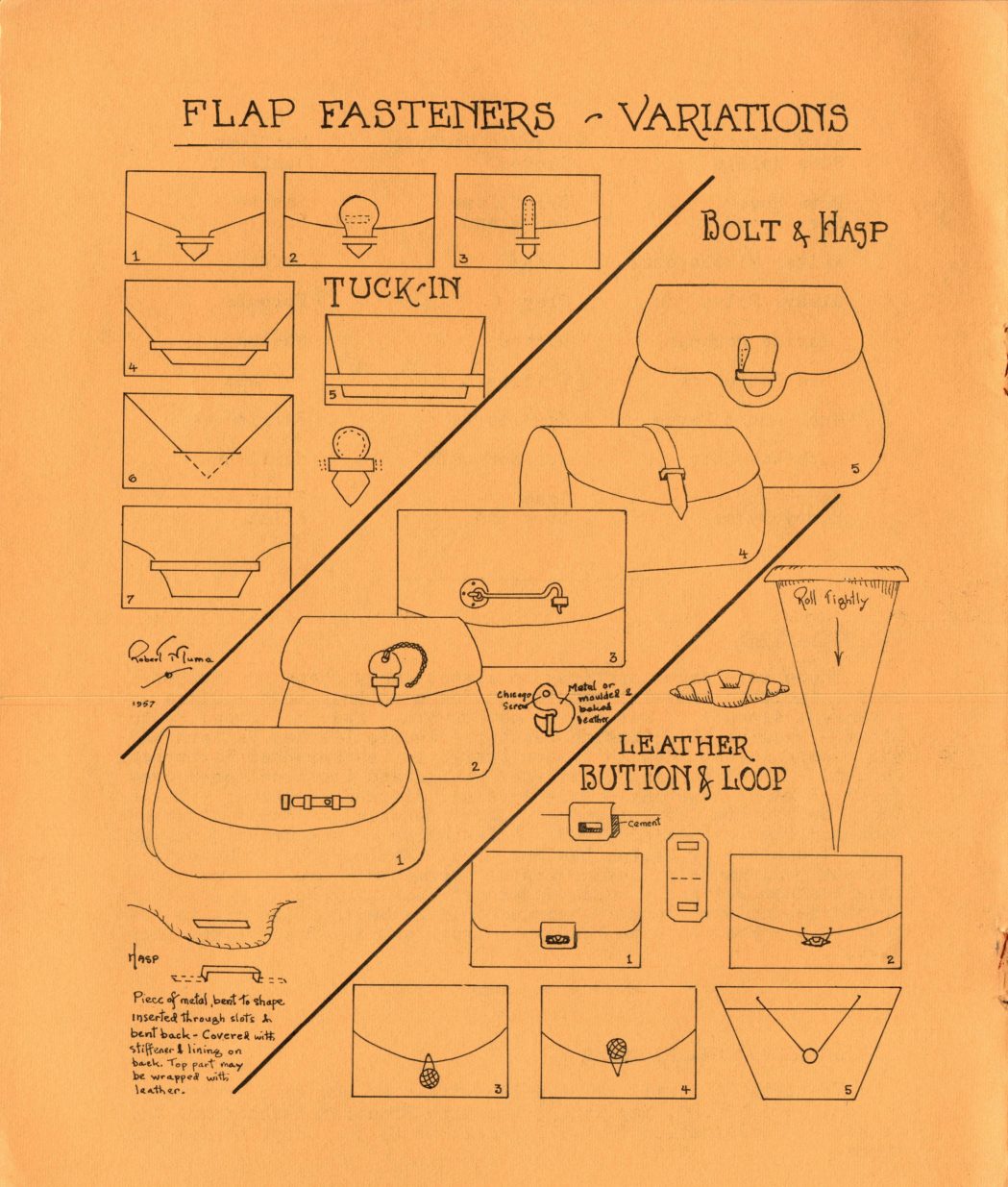
FLAP FASTENERS - VARIATIONS
[Diagram of flap-fastener types, hand-lettered and signed "Robert Muma - 1957"; read straight through, almost none of it comes out as text. Transcribed below instead.]
TUCK-IN (examples 1–7). BOLT & HASP (examples 1–5). LEATHER BUTTON & LOOP (examples 1–5).
Hasp: piece of metal, bent to shape, inserted through slots & bent back — covered with stiffener & lining on back. Top part may be wrapped with leather.
Chicago screw. Metal or moulded & baked leather. Roll tightly. Cement.
Robert Muma - 1957.
Page 5 — A POCKET YOU CAN TAKE OUT FOR REPAIRS (3 Methods)
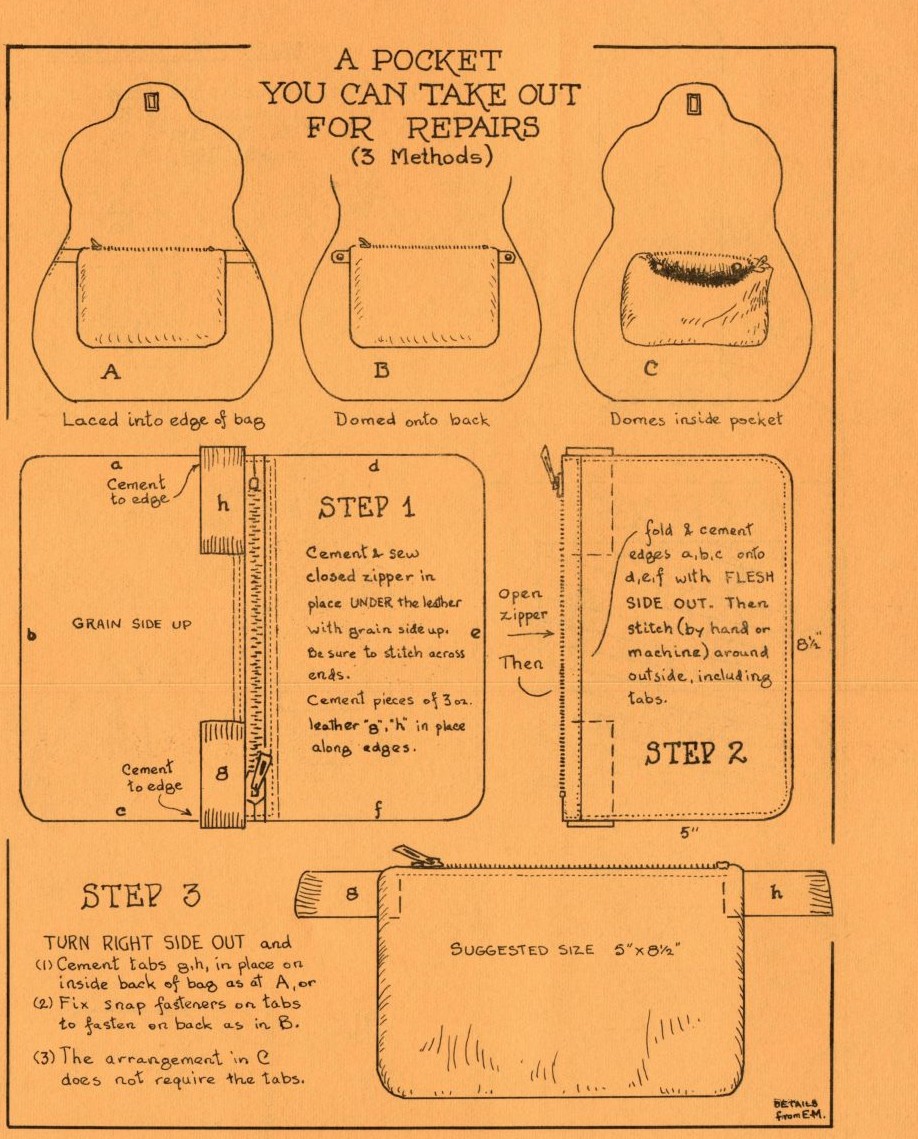
A POCKET YOU CAN TAKE OUT FOR REPAIRS (3 Methods)
[Detailed hand-lettered diagram, credited "Details from E.M."; read straight through it gives only fragments. Transcribed below instead.]
A
Laced into edge of bag
B
Domed onto back
C
Domes inside pocket
STEP 1: Cement & sew closed zipper in place under the leather with grain side up. Be sure to stitch across ends. Cement pieces of 3 oz. leather "g", "h" in place along edges. (Grain side up; cement to edge at a, c.)
STEP 2: Open zipper, then fold & cement edges a, b, c onto d, e, f with flesh side out. Then stitch (by hand or machine) around outside, including tabs. (8½" x 5".)
STEP 3: Turn right side out and (1) cement tabs g, h in place on inside back of bag as at A, or (2) fix snap fasteners on tabs to fasten on back as in B. (3) The arrangement in C does not require the tabs. Suggested size 5" x 8½".
Details from E.M.
Page 6 — LEATHER PICTURE FRAME
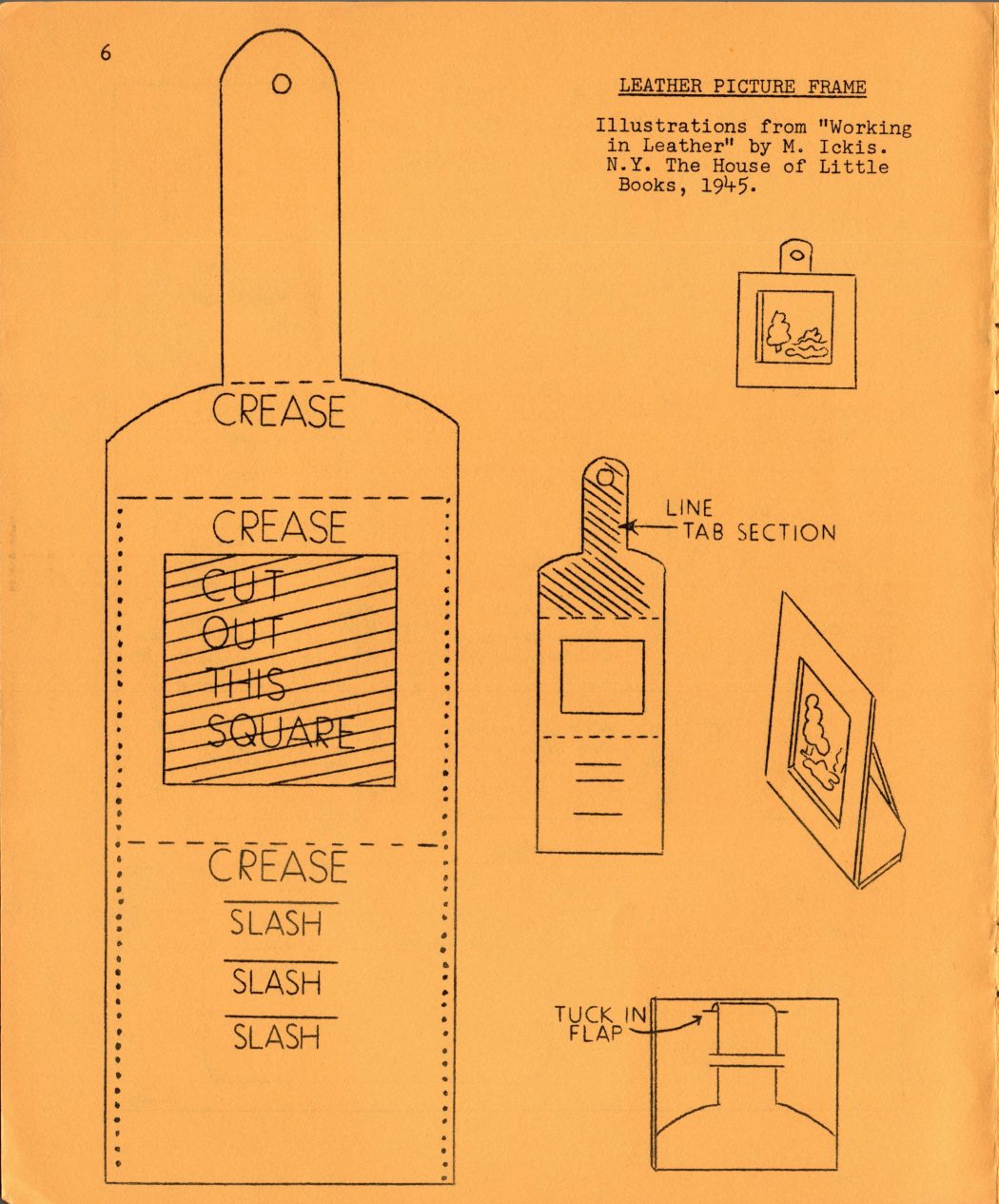
LEATHER PICTURE FRAME
Illustrations from "Working in Leather" by M. Ickis. N.Y. The House of Little Books, 1945.
[Pattern diagram; read straight through only the printed credit line above comes out as text. Transcribed below instead.]
CREASE. CUT OUT THIS SQUARE. CREASE. SLASH. SLASH. SLASH.
LINE TAB SECTION. TUCK IN FLAP.
Page 7 — OFFICERS AND EXECUTIVE COUNCIL, 1965-1966
WATCH YOUR MEASUREMENTS CONSTANTLY.
l. There are two pieces of leather - the main strip and the lining for the tab section. The main strip is divided into Sections A, B and C. 2. The frames are so simple they should be perfect. Every flaw shows. One thing is a MUST - a perfect right angle at the base. 3. The tab must be in the centre and at right angles to the bottom of the frame. It must be firm at the base and tapered evenly. fining
4, This tab section (Section A),is 'cut from 1/16" to 1/8" shorter at the base to allow for the fold. 5. The slashes for the tab (in Section C) must be cut about 1/4" wider than the tab to allow for the insertion of the double thickness of leather. 6. The back section (Section C) is about 1/16" to 1/8" shorter than the front section (Section B) to allow for easy insertion of pictures.
7. 'The frame must be flat on the front. Allow for any "give" in the back section (Section C). If the frame is made to hold several pictures, allow extra leather on the sides of Section C. When fitting "C" to "B", always put in a piece of cardboard to make space for your picture. 8. Lace as close to the folds as possible. This keeps the front of the frame rigid. 9. In frames of any size, the front section (Section B) needs to be reinforced.
OFFICERS AND EXECUTIVE COUNCIL, 1965-1966
President:          Mrs. Dorothy Muma,118 Hazelton Ave., Toronto,Ont.
Past President:     Viola E. Harris, 47 Snowdon Ave. Toronto 12,Ont.
Vice-Presidents:    Mrs. Irva Ford. 30 Arkell St., Hamilton, Ont.
                    Mrs. Margaret McFarlane,151 Glenvale Blvd.,Tor.17.
Recording Sec'y:    Mrs. Thelma Terry, 27 Cliffside Dr.,Scar.,Ont.
Corresp. Sec'y:     Mrs. Sherle Bottrill,107 Donald St.,Barrie, Ont.
Treasurer:          Mr. C. J. Roebuck, 22 Khedive St., Tor. 19,Ont.
Executive Council
| Gel Brigden | Toronto |
| Fred Brown | Toronto |
| Clara Cavanagh | Barrie |
| Mae Corbett | Barrie |
| Dr. R. K. Larmour | Grimsby |
| Reta Larmour | Grimsby |
| Bob Muma | Toronto |
| Jean Newton | Welland |
| Sylvia Gerster | London |
| Betty Henstridge | Hamilton |
| Ann Hook | Toronto |
| Nora Huyck | Barrie |
| Clarice Packham | Weston |
| Sadie Roebuck | Toronto |
| Olivia Smith | Toronto |
| Ruth Waechter | Hamilton |
Branch Presidents
Helen Anderson, Longford Mills, Ontario. (Barrie)
Mrs. Dorothy Harwood, 83 Octavia Street, Belleville, Ontario.
Mr. Alvin Haig,Hamilton Health Association,P.O. Box 590,Hamilton.
Mrs. Marion Kehoe, 1244 Hillcrest Avenue, London, Ontario.
Dorothy Proctor, 70 Glendonwynne Road, Toronto 9, Ontario.
Page 8 — LET US IMPROVE, AND ADVANCE THIS YEAR
LET US IMPROVE, AND ADVANCE THIS YEAR
Leathercraft as a hobby can be fascinating, absorbing and profitable, but it is only through our own efforts that it becomes such.
Fine workmanship in itself is outstanding, and demands attention, so in the field of leathercraft, this is what we should aim for.
If you have the opportunity to examine the work of beginners, those of two or three years experience, and the master craftsman, it will be very easy to notice the difference, and to know where your improvements will come in.
When you started to lace a project, and the first piece of lacing came to an end, did you just add on another piece and persevere with it until the join was worked into the lacing, or did you figure out where would be the best possible place to join it so there would be no strain on it, and with use the end would not loosen up?
When you started in to punch the lacing holes in a wallet,did you consider the sections of the interior, or did you just punch around the outside, and then discover that you had spaced your slits too close to the edge of the interior sections, and that when it was laced it had broken through?
Do you get tired of doing just one or two types of lacing,and did you know that one book alone describes, and illustrates 32 lacing stitches? (Leathercraft Techniques and Designs by John W. Dean)
Are you tired of tooling on natural and glazed types of leather or carving on natural leather only? Did you ever consider adding colour to your leathercraft? There is a book on the market on coloured leathercraft that takes you through several different phases step by step in an easy to follow manner so that even a beginner can master it. (Colour in Leathercraft by Robert Muma) Why not truy colour this year, and see what results it will bring, and what a new field it opens up to you.
For those of you who are well advanced in the craft, what is there for you to do? There is a field of design beckoning to you. Perhaps you figure that you are not the designing type, but you will never find out if you never try. A simple design based on a flower or article, a new type wallet interior, a new shape for a purse will get you started on your way. Let us make this year a red letter one in Leathercraft.
by Edith Melchior
CANADIAN NATIONAL EXHIBITION: The CNE is again sponsoring the popular Hobby Show in the General Exhibits Building. Members will be asked for articles for display. Also demonstrators and volunteers to man the booth will be required.
CHRISTMAS SALE: Our fall sale of leathercraft will be held in the Gallery of the Canadian Handicrafts Guild, 77 Bloer Street West,on November 3-6. We hope to have a good quantity of fine quality articles to present to the public at this popular sale.