
An issue of the Society’s newsletter, transcribed from the original.
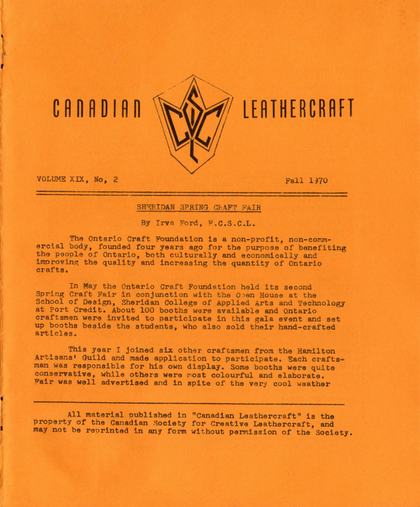
(12 pages, 1.7 MB)
the full-resolution scan, 30 MB, for close research
Page 1 — Sheridan SPRING Craft FAIR
Canadian Leathercraft
VOLUME XIX, No, 2 Fall 1970
Sheridan SPRING Craft FAIR
By Irva Ford, F.C.S.C.L.
The Ontario Craft Foundation is a non-profit, non-commercial body, founded four years ago for the purpose of benefiting the people of Ontario, both culturally and economically. and improving the quality and increasing the quantity of Ontario crafts.
In May the Ontario Craft Foundation held its second Spring Craft Fair in conjunction with the 0»en House at the School of Design, Sheridan College of Applied Arts and Technology at Port Credit. About 100 booths were available and Ontario craftsmen were invited to participate in this gala event and set up booths beside the students, who also sold their hand-crafted articles.
This year I joined six other craftsmen from the Hamilton Artisans! Guild and made application to participate. Bach craftsman was responsible for his own display. Some booths were quite conservative, while others were most colourful and elaborate. Fair was well advertised and in spite of the very cool weather
All material published in "Canadian Leathercraft" is the Property of the Canadian Society for Creative Leathercraft, and may not be reprinted in any form without permission of the Society.
Page 2 — A DILEMMA
there were crowds of people who paid.50° admission to see the great variety of hand-crafted work. Several customers were buying Christmas presents, others were adding to their collections, but many just came to observe the type of craft work being done in Ontario to-day.
There were three other leathercraft booths besides mine, two with jewellery, and one with very "Mod" articles all fringed or braided. Other booths included batik, weaving, sculpture, glass, enamelling, hooking and a great variety of pottery.
The school itself was of great interest. The displays were excellent and much knowledge could be gained from the student demonstrations. The sales were rewarding and besides, it was educational as well as a pleasure to meet and chat with other craftsmen who use other media than leather.
Craft Fairs are usually profitable and fun; Won't you join us sometime?
A DILEMMA
A special order for a carved handbag came in and I went specially to buy a really nice piece of leather for the job. After much searching, I found the quality that I needed but it was just enough for the order and not an inch to spare}
Back home, it was cased in the usual manner and the task of tracingthe design was commenced. Oh dear! a knock at the door followed by a second rather impatient one. Not thinking I placed my scissors down and my tracer and went to the door. Friends that I had not seen for a long time had come to visit me. They stared and talked, I gave them tea and two hours later I returned to my task. Oh horrors! The scissors were right in the centre of the front panel and their complete outline was firmly imprinted with a deep brown rust mark. The customer had clearly asked for a natural leather finish with slight shading in the carved areas.
I was stunned - what could I do, I had no more leather end no chance of getting any in time either.
Soft rain water does wonders for lots of things, I live in the country and have two water butts. Out I went and brought in a large bowl full, I immersed my bag panel in this and left it for a few minutes. Then I laid it out to dry. The best thing for me now was to do other pressing jobs and forget the disaster.
Page 3 — C.S.C.L. EXHIBITION AND SALE AT THE C.N.E. 1970
Some hours later, I took a look at the leather. Yes, the stain was lighter. I again doused the panel with rain water. This I had to do six times in all and finally there was no sign of my blunder.
Good tip? Yes, but better still----Never leave a tool on top of a damp tracing!
Evelyn R. Burgess
C.S.C.L. EXHIBITION AND SALE AT THE C.N.E. 1970
Once again we were given space in the Arts, Crafts and Hobby Building.
Olivia Smith did a grand job of organizing but had to leave Toronto on August 9th to attend the World Crafts Council in Dublin. Gladys Riddell was appointed to take over at this point and Clara Cavanagh to do the books.
A committee was formed - Gladys Riddell, Nan Astley, Gertrude Bush, Margaret La Chappelle, Gerry Mills, and Dorothy Proctor.
One hundred and seventy names were on the chart for duties and many gave several stints. Thrity six members submitted 2,113 articles for sale and total sales brought in $4,550.96 gross sales. Sales tax took from this $219.56 and seven articles were lost to a value of $32.00.
It took Clara two full weeks to sort out the books. This is a great task. The committee have come up with a number of suggestions for improvement for next year and if all members give these the thought and attention due to them we should again have a grand show.
Fifty demonstrations were given. This is something that all branches must give more thought to. Demonstrations attract the public and approximately 100 inquiries re member-
[Restored against the printed page: the account is signed "Evelyn R. Burgess", the heading reads "C.S.C.L. EXHIBITION AND SALE AT THE C.N.E. 1970", and the sentences begin "...to attend the World Crafts Council" and "It took Clara two full weeks". The page types "Thrity six members", and that stands as printed.]
Page 4 — LEATHERCRAFT AT THE HOSPITAL BEDSIDE
ship etc. were received.
In 1971 Woodstock is to host the Annual Meeting. Already much preparatory work has been done by the Guild.
The location is to be Old St. Pauls Church, Dundas Street, woodstock, on the 17th of April. Pre-registration for meals is needed. Dinner will cost "2.75, lunch 71.00. Coffee and donuts will be sold during the morning.
LSATHERCKAFT AT THE HOSPITAL BEDSIDE
The work of volunteers teaching crafts at the hospital bedside is fairly unknown. This work is called "Diversional Therapy". Its purpose is to help patients to spend long hours while having to stay in hospital. All adults are eligible, including teenagers, but in the latter case, parent consent is needed since there is a cost price involved. The requirement is a requisition to work signed by the doctor of the patient or the head nurse on the ward. Maternity patients are eligible if they have to be in hospital longer than the normal time.
The work included many crafts such as making stuffed animal toys, covering coat hangers with nylon, embroidery, macaroni Christmas treas (in the Christmas season), paint by numbers, rosettes, and leather work, etc. In the leather work we learned from experience that kits were the only practical items to do, but we supply goat lacing and teach them the proper lacing stitch, rather than use the plastic lacing in the kit. In most cases, the volunteer will finish off the lacing for the patient. For those who wish to learn more, we are happy to tell them about night classes held in many High Schools in the Hamilton area, and hopefully they will find a class in leather work near them.
You might be interested to know about the costate.
The hospital buys wholesale with no tax when used for patients. In this way the patient pays a minimum and owns the article. It is surprising the gift lists that get filled in this craft work in hospital, plus the happiness of the patients involved. Also you might wonder how much time is given to the patients.
Page 5 — THE HISTORY OF LEATHER
In the Henderson General Hospital in Hamilton, there are five pairs of volunteers, which covers one pair per day from Monday to Friday inclusive. There might be as many as 25 patients and take as long as + hours, but never during visiting hours. In this particular hospital Diversional Therapy has been available to patients for about 7 years, and is under the direction of the Occupational Therapy Department. It is a very rewarding work, and continues through 52 weeks in the year.
Mildred Kemp
THE HISTORY OF LEATHER
Some of our newer members are unaware of the great history behind leather and a few details may help them to appreciate its antiquity and realize its fascination through the ages.
It is not known who first used cured skins but savages fashioned protection from the hides of animals they had killed for meat.
Wandering tribes made tents, beds, carpets and harness from skins. They learned that leather breathes and so they could keep water cool and fresh in leather bottles. One of the reasons that plastic can never replace leather is this breathing quality. Shoes need to breathe and evaporate moisture and a good leather sole will last 6 months when a plastic one may become tired in two.
When some of the Weyptian tombs were unearthed, leather articles thirty-three centuries old still in good preservation were discovered.
The Hebrews are said to have been among the first to find the value of oak bark tanning, a process still used in the tanneries in Kent, England to this day.
Greeks, Romans, Pompeiians and Egyptian tenners all used lime water for de-hairing skins.
All through Europe, leather was used for armour and some beautiful work was carried out on shields made of wood and encased in leather.
Page 6 — ARTHUR FORD
During the middle ages industry was organized into trades or guilds. Apprentices were ruled with an iron hand to insure quality of craftsmanship.
In France the Fraternity of Leather workers was established by Charles Sage in 1397 and was controlled by the church. of the first of five guilds formed in London in 1422 one was the Saddlers and Skinners and a little later out of a listed 111 trades eleven were for leather.
Cordwainers or leather workers worked in certain sections of the cities and these were called wards. The word cordwainer comes from: the French word Cordovan. Cordova was one of the great leather cities in Spain.
St. Crispin of the early Christian era fled to France and became a shoe-maker. Of noble Roman blood, ha and his brother were martyred for their faith in 287. Called the patron saint of leather workers, St. Crispin's day is honoured on the 25th of October.
All over the world the working with leather has been one in which the highest standards have been set. [Misprinted "b3en" for "been" in this line; read from the page.] Moors were famous for their delicate and intricate work in book bindings.
Most work in curing, cutting and tanning skins is now done by machine, but still, the hand-made article is the article that is acclaimed. It is no small wonder that the officers of the C.S.C.L. demand and get a very high standard of craftsmanship!
ARTHUR FORD
At this time our hearts are filled with sympathy for our President in her time of sorrow.
Arthur Ford was well known to most of us. A genial kindly gentleman. For some time he was a member of the C.S.C.L. and at all times his interest and understanding were such that it gave Irva the freedom to do so much for Hamilton and the C.S.C.L. His failing health over the past year or so has been of genuine concern to all who knew him. we shall miss his kindly smile and trust that the extended hand of friendship to Irva from all members may help to assuage the vangs of grief that only she can bear.
Page 7 — Dr. Larmour
Dr. Larmour died October 2nd, 1970.
He was a Charge member of the Canadian Society of Creative
Leathercraft, and was of outstanding value to the organization. with his wife Reta, he gave a great deal of time to the development of C.S.C.L. and was greatly concerned about high standards, always giving encouragement to members who tried.
Dr. Larmour achieved merits as professor, research director and as world authority in fundamental grain research. He was a Canadian delegate to the founding meeting of U.N.§N.5S.C.0. in Paris, also served as scientific adviser to the Canadian High Commissioner in London, England, as a member of the National Research Council's Defense Board (Food Section).
In the food industry of the country, Dr. Larmour held an honoured place, he was acclaimed as the "Dean of Cereal Chemists". The Royal Society of Canada honoured him with a fellowship - F.R.S.C. The Canadian Baking Industry with its first award of Merit, and the American Association of Cereal Chemists with an Honourary Life Membership.
In 1947, Dr. Larmour joined the Maple Leaf Yilling Company. There for fifteen years, he worked to improve the Canadian diet and nutrition. The Monarch mixes are among his brain children.
Mrs. Larmour believes his greatest contribution and his first love was in education. Dr. Larmour was a professor at the University of Saskatchewan, over the years, thousands of students drew from his rich mind, personality, and were stimulated as only the gifted teacher can stimulate. Top men in science and education recognize their debt to him, university presidents, scholars and administrators.
His mind was essentially creative, we see this in his master minding of highly important research projects, in the lovely grounds of their home, and in his part in setting up the Canadian Society of Creative Leathercraft.
As a chemist, he created as a hobby the Garnett dyes that have given the mark of distinction to Leathercraft Exhibitions in Europe and America.
We in C.S.C.L. have been left a legacy we must always revere and cherish.
Page 8 — CROSS DYEING
CROSS DYEING by Irva Ford
Rather than mixing dyes to obtain colours that are not manufactured for retail sale, the desired colours may be obtained by cross dyeing. The following chart may be of assistance when colouring your leather.
| Brown | over Orange | makes Havana Brown |
| Brown | Yellow | Light Brown |
| Brown | Purple | Seal Brown |
| Green | Violet | Light Blue |
| Green | Orange | Olive Green |
| Green | Light Blue | Peacock Green |
| Yellow | Blue | Green |
| Yellow | Green | Bright Green |
| Yellow | Light Blue | Light Green |
| Yellow | Brown | Golden Brown |
| Yellow | Purple | Green Brown |
| Yellow | Orange | Orange Yellow |
| Yellow | Pink | Peach |
| Yellow | Red | Bright Red |
| Red | Blue | Purple |
| Red | Dark Blue | Plum |
| Red | Light Blue | Garnet |
| Red | Dark Brown | Maroon |
| Red | Brown | Henna |
| Red | Purple | Wine |
| Red | Yellow | Scarlet |
| Red | Orange | Tangerine |
| Red | Lavender | Rose |
| Red | Gray | Taupe |
| Purple | Green | Medium Blue |
| Purple | Bright Red | Wine |
| Purple | Dark Green | Navy Blue |
| Dark Blue | Orange | Dark Brown |
| Light Blue | Dark Red | Garnet |
| Light Blue | Yellow | Light Green |
| Pink | Light Blue | Lavender |
| Pink | Orange | Deep Orange |
Page 9 — FOR CREATIVE BARRIE WOMAN CRAFT IS MORE THAN HOBBY
FOR CREATIVE BARRIE WOMAN CRAFT IS MORE THAN HOBBY
Most closets are filled with clothes, but one closet on Duckworth Street is a storeroom for something else.
When you open the closet door in Mrs. Kenneth Cavanagh's den the sight and smell of leather is overwhelming. Hold after roll of uncut leather is wrapped in raper and hung horizontally in the closet. There are boxes of finished articles and other materials of her craft on the closet floor and the upper shelf.
"Ttts there because I never like to run short" she'll tell you if you express surprise.
In her spare time, Mrs. Cavanagh is a leathercrafter and has been one for the past twenty years. She took her first lessons in leathercraft about twenty years ago at a class sponsored by the Simcoe County Recreation Department. "we had only 12 lessons," she said, "but my interest was sparked and I carried on."
After the lessons ended Mrs. Cavanagh read books on leathercraft and worked to perfect her abiltiy. "Finally after a few years of working on my own I became a leathercraft teacher."
She has been teaching leathercraft to night-school students for about sixteen years.
Although she has been working with leather for many years and has won many prizes for her work, Mrs. Cavanagh still taxes time out for lessons.
For example, she went to Toronto for a ten day crash course on leather carving. "Because I didn't want to spend a lot of time away from my home I attended classes every afternoon and evening and often in the morning too."
Though not a founding member of the Canadian Society for Creative Leathercraftsmen which was organized in 1951, she joined in 1953. She is one of the fifteen active members of the Barrie branch of the organization. while she does sell some of her work, she is not interested in going into business. "I don't believe I have ever made any more money by making and selling my work than is necessary to kep my closet filled," she said looking into her den closet.
[This page reprints a Barrie newspaper feature on Clara Cavanagh; its headline is set in capitals.]
Page 10
Working at the cr-ft and taking lessons does broaden a leathercrafter's outlook and improve his or her work, but Mrs. Cavanagh believes having a judge evaluate your work is the most valuable way to improve it.
According to Mrs. Cavanagh "...the judges can pick out your faults, make you aware of changing styles, show you new ideas..."
Over the years Clara Cavanagh has won her share of prizes but the ones she values the most highly are those awarded for craftsmanship. These prizes are given for the most perfectly made articles rather than for the most intricate design or novel idea.
This year Mrs. Cavanagh submitted four articles to the C.N.E. craft competitions - a molded leather orchid mounted on a walnut plaque, a molded two-tier tray, leather case for carrying road maps and a combination tote-bag and purse. She won four prizes.
When discussing her work, Mrs. Cavanagh refers to it as a craft rather than a hobby because "...a craft is something you work at. It takes time, while a hobby is more a here-today-gone-tomorrow type of thing."
One of the reasons she feels there are so few leathercrafters around is because of the time-consuming detailed nature of the craft. "People tire of things quickly. They decide they would like to make a leather purse, but soon discover you can't make one overnight. Then they get bored..."
While much of her spare time is consumed by her leatherwork, Mrs. Cavanagh also quilts and does copper enamelling, and has painted in the past.
But much as she enjoys leathercrafting she does admit there are some disadvantages to the intensely demanding activity.
"...It does cut down the time I spend with my friends and neighbours, Even my family, and I have really neglected my reading" she admits.
Mrs. Cavanagh was born and raised in Oro Township and attended high school in Barrie. She and her husband Kenneth have two children - a son, Douglas, a daughter, Helen and five grandsons.
(This article appeared in the Barrie Examiner, Aug. 15, 1)70)
Page 11 — CONGRATULATIONS!; C.N.E. PRIZE WINNERS
CONGRATULATIONS!
London guild has just celebrated it's 20th anniversary.
The London members observed the occasion with a picnic. All former members were invited, six past presidents and six charter members were among the 38 attending. They had a cake with very appropriate decorations formed of icing - a mallet, swivel knife, etc. Fun and games followed the picnic and a good time was enjoyed by all.
C.N.E. Prize WINNERS
217 - Any tooled leather article, Commercial design
1st - Mrs. K. Cavanagh, 10 Duckworth Street, Barrie
218 - Any tooled leather article, Original design
1st - Mrs. K. Cavanagh, 10 Duckworth Street, Barrie 2nd - Miss Anne Hook, 32 Mountainview Avenue, Toronto 165 3rd - Mr. J. Zalitis, 52 Aberdeen Avenue, Toronto 5
219 - Any carved leather article, Commercial Design
1st - Mrs. B. Lingard, 23 Woodglen Road, Scarborough 2nd - Mr. W. Lightheart, 30 Gardenview Drive, Burlington
220 - Any carved leather article, Original design
1st - Mr. J. Zalitis, 52 Aberdeen Avenue, Toronto 5 2nd - Mrs. G. H. Riddell, 609 Indian Road, Toronto 165 3rd - Mr. W. Lightheart, 30) Gardenview Drive, Burlington
221 - Non-tooled leather article
1st - Mrs. C. McLean, 555 Huron S7R 2S7, Woodstock 2nd - Miss O Smith, 32 Mountainview Avenue, Toronto 165 3rd - Mrs. K. Cavanagh, 10 Duckworth Street, Barrie
Page 12 — DID YOU KNOW?
222 - Leather gloves
1st - Miss D. Proctor, 70 Glendonwynne Road, Toronto 9 2nd - Miss M. Wilkie, 77 Mavety Street, Toronto 9
3rd - G. R. Prestwick, 58 Orton Park Road, Scarborough 721
Special Chatelaine Award - Mrs. K. Cavanagh, 10 Duckworth
Street, Barrie
Paul Stanley Williams $60 Best Leather in Show
| E. Astley | $25 Credit Note Lewiscraft, Undecorated Leather |
| C. Cavanagh | $15 Credit Note Lewiscraft, Undecorated Leather |
| Anne Hook | $35 C.S.C.L. Best Functional Design |
DID YOU KNOW?
On October 4 and 5 Helen and Harold Wheaton, Dorothy
Stanton end Beula Reynolds attended the Midwest Federation of Leather Guilds Annual Show. There were nearly a hundred craftsmen present from Illinois, Michigan, Missouri and Ohio. The exhibits were fascinating, some original carving designs, quite a bit of western style carving and Flint has done a lot of work with suede. Sunday afternoon was taken up with demonstrations, the main one being by Darrell "Hawk" Hawkins of Ogden, Utah. We left with instructions from the Buckeye Leathercrafters to invite anyone interested to attend their annual September 25/26, 1971 at Dayton, Ohio.
[Restored against the printed page: "nearly a hundred craftsmen present from Illinois", "a lot of work with suede", and the Buckeye Leathercrafters' show "September 25/26, 1971". The page types "Dorothy Stanton end Beula Reynolds", and that stands as it is printed.]
Last January, Woodstock Branch sent a letter to Mrs. Blaine Cole of Coco TV in Kitchener asking for publicity for our Prestige Exhibition at Toronto City Hall in February. She very kindly obliged and invited us to bring 1 or 2 craftsmen and a display of articles down sometime and be part of her show. We were thrilled!
The show was booked for April 6th. Irva Ford and Margaret Weldon came from Hamilton and Beula Reynolds and Carol McLean from Woodstock, a wonderful display of Woodstock and Hamilton articles was arranged by the Art Department of the television station and from all reports it went quite well. Our farthest away "listener - C.S.C.L. member" was Nora Huyck in Newmarket. We were very pleased to be able to promote the C.S.C.L. especially in the Kitchener area where there is n> branch.