
An issue of the Society’s newsletter, transcribed from the original.
(12 pages, 1.5 MB)
the full-resolution scan, 28 MB, for close research
Page 1 — TRICKS OF THE TRADE IN LEATHERCRAFT
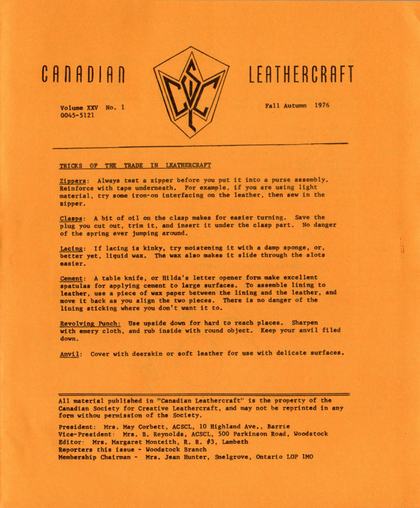
| CANADIAN | LEATHERCRAFT |
| Volume XXV No. 1 | Fall Autumn 1976 |
| 0045-5121 |
TRICKS OF THE TRADE IN LEATHERCRAFT
Zippers: Always test a zipper before you put it into a purse assembly. Reinforce with tape underneath. For example, if you are using light material, try some iron-on interfacing on the leather, then sew in the zipper.
Clasps: A bit of oil on the clasp makes for easier turning. Save the plug you cut out, trim it, and insert it under the clasp part. No danger of the spring ever jumping around.
Lacing: If lacing is kinky, try moistening it with a damp sponge, or, better yet, liquid wax. The wax also makes it slide through the slots easier.
Cement: A table knife, or Hilda's letter opener form make excellent spatulas for applying cement to large surfaces. To assemble lining to leather, use a piece of wax paper between the lining and the leather, and move it back as you align the two pieces. There is no danger of the lining sticking where you don't want it to.
Revolving Punch: Use upside down for hard to reach places. Sharpen with emery cloth, and rub inside with round object. Keep your anvil filed down.
Anvil: Cover with deerskin or soft leather for use with delicate surfaces.
All material published in "Canadian Leathercraft" is the property of the Canadian Society for Creative Leathercraft, and may not be reprinted in any form without permission of the Society.
President: Mrs. May Corbett, ACSCL, 10 Highland Ave., Barrie
Vice-President: Mrs. B. Reynolds, ACSCL, 500 Parkinson Road, Woodstock
Editor: Mrs. Margaret Monteith, R. R. #3, Lambeth
Reporters this issue - Woodstock Branch
Membership Chairman - Mrs. Jean Hunter, Snelgrove, Ontario L0P 1M0
Page 2 — ONTARIO CRAFTS COUNCIL
Use plasticine to experiment with possible shapes when designing molded trays or sculptures.
To hold a few tools while working, use a distributor cap.
No lacing needles? Cut lacing to an angle and dip end in melted wax or white glue and leave to set.
[At "an angle" the page carries a small hand-drawn diagram of the lacing end itself — a long narrow strip closed at the left by a short diagonal, showing the tapered cut — not a printed arrow or rule; it is not transcribed as text.]
Food For Thought:
A skin of leather is the supreme sacrifice of an animal, so use every scrap.
Some will never become professionals in the field of leathercraft, but the work you do will give you personal satisfaction, relaxation, and the feeling of accomplishment.
Always remember that you may not have a masterpiece in design on a project, but if it falls apart through poor construction, you have nothing.
ONTARIO CRAFTS COUNCIL
A sketch of a moulded leather tray, hand-lettered "ONTARIO CRAFTS COUNCIL" above and "IRVA FORD" below as the maker's credit — the illustration for p3's own entry, "ONTARIO CRAFTS Council: Leather Irva Ford Moulded tray - No competition hence no award".
Page 3 — CANADIAN NATIONAL EXHIBITION 1976 - HANDICRAFTS
CANADIAN NATIONAL EXHIBITION 1976 - HANDICRAFTS
#217 Household articles: 1st - Margaret Weldon, also CHATELAINE AWARD
3rd - Hope Drysdale
#218 Wearing apparel 1st ----
3rd - Sally Barrett
#218A Belts 1st - Dave Elliott
3rd - Sally Barrett
#219 Handbags, etc. 1st - Dave Evans
2nd - Hope Drysdale
3rd - Dave Elliott
#220 Pocket sized items 1st - Joyce Ecker
2nd - Dave Elliott
3rd - Hope Drysdale
#221 Moulded articles 1st - Dave Evans
2nd - Olivia Smith
3rd - Hope Drysdale
#222 Canadian Indian
Bead Work No entries
#223 Leather jewelry 1st - Joyce Ecker
3rd - No other entries
ONTARIO CRAFTS Council:
Leather Irva Ford Moulded tray -- No competition hence no award
Page 4
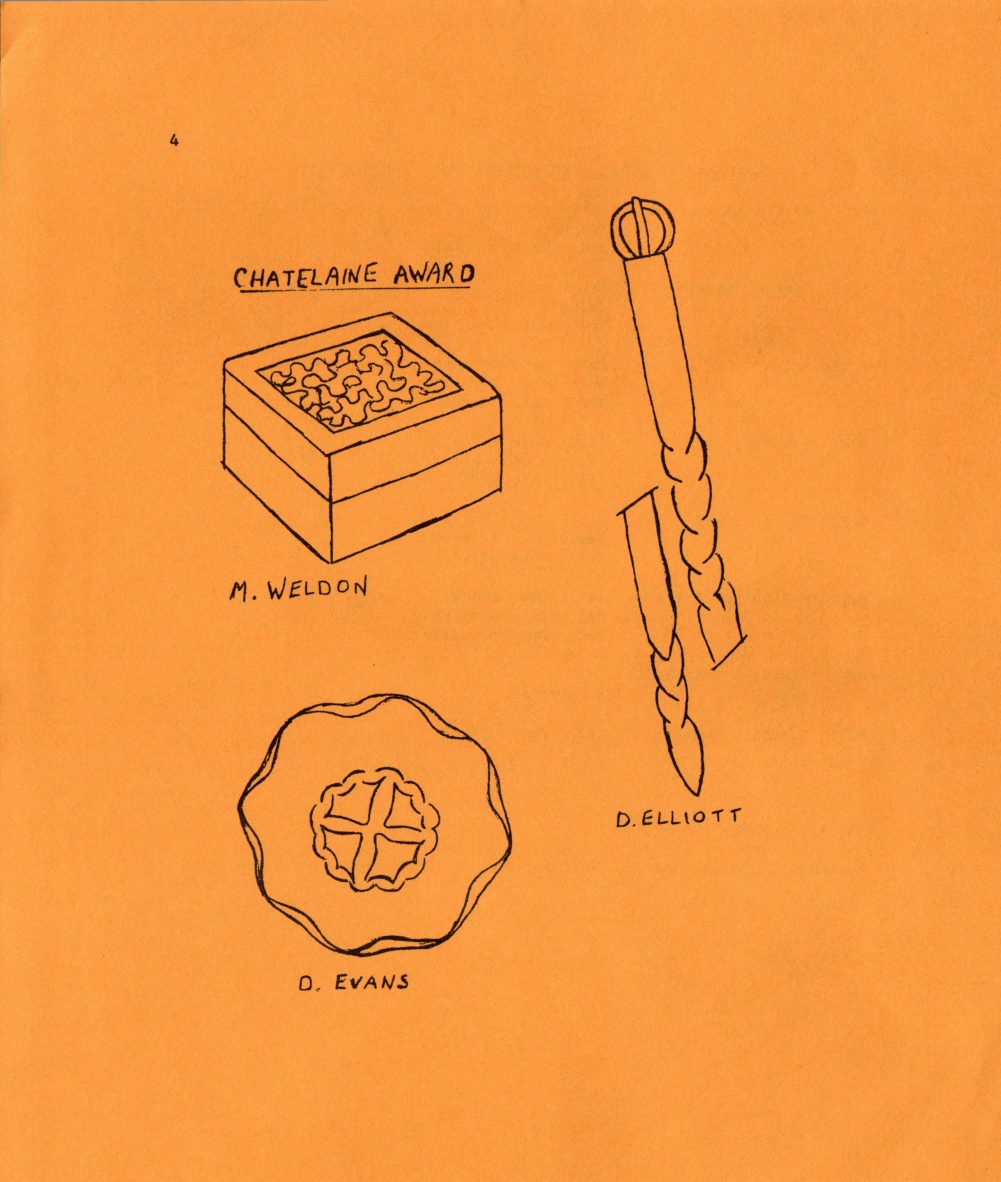
(This page is a plate of line drawings; the only text on it is hand-lettered.)
Hand-lettered on the page:
CHATELAINE AWARD — a lidded box with a tooled lid — M. Weldon
a braided item with a loop end — D. Elliott
a round tooled medallion — D. Evans
[Previously marked "This page is an illustration; no text to transcribe." Three sketches of 1976 Canadian National Exhibition prize entries, matching the results table on p3: the Chatelaine Award box (Margaret Weldon, #217 Household articles), a braided belt (Dave Elliott, #218A Belts), and a moulded medallion (Dave Evans, #221 Moulded articles).]
Page 5 — Book Report
Book Report - Carol McLean F.C.S.C.L.
MAKE YOUR OWN GLOVES - Gwen Emlyn-Jones
Publisher - G. Bell and Sons Ltd., London, England
The author has nearly 40 years experience as a glove maker and has taught many Women's Institute groups and other organizations. She has judged at many competitions and exhibitions as well.
She designed this book especially for people who must work at home without the help of a teacher. There are numerous photographs and clear line drawings to help the novice, as well as inspire the expert.
She stresses good eyesight and accuracy as being essential.
Photos in the Historical Chapter contain many gloves courtesy of The Museum of Leathercraft, The Worshipful Company of Glovers of London and the Royal Scottish Museum.
Each chapter is headed by a quotation of a famous poet or author concerning gloves and is a most refreshing way to begin.
She shows the proper method for measuring the hand with a gloving tape, how to measure the length of the fingers and to transfer this to your pattern. Then how to lay the pattern pieces in the right direction on the skin, tools and materials needed to make a pair of gloves.
The diagrams on inserting the fourchettes and closing the finger-tips are especially well illustrated.
She even deals with "different" types of gloves such as gardening gloves, buttoned cuff style, lined gloves and brochet backed gloves. There is a section on how to make mitten patterns--for the fur lined version.
Chapter 18 is devoted to care of the gloves followed by a complete size range of both ladies and gents glove patterns, a listing of good books on the subject and locations of supplies.
I am by no means a handy glove maker but after reading this book I do feel more confident about working on gloves and hope it will be of assistance to others as well.
Page 6
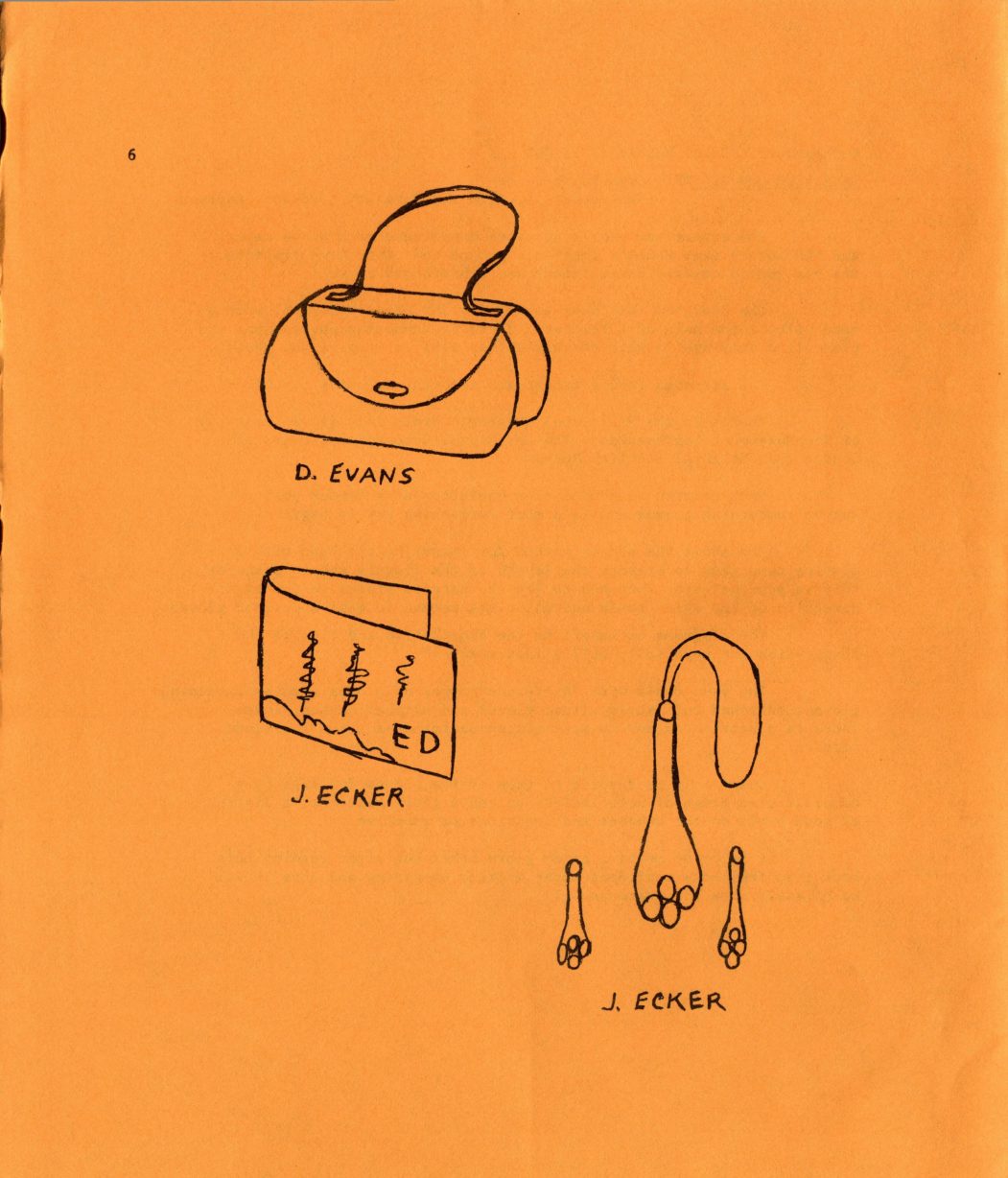
(This page is a plate of line drawings; the only text on it is hand-lettered.)
Hand-lettered on the page:
a handbag with a curved handle — D. Evans
a wallet or card case, tooled, monogrammed "ED" — J. Ecker
a looped bracelet or keychain — J. Ecker
[Previously marked "This page is an illustration; no text to transcribe." Three more sketches of 1976 Canadian National Exhibition prize entries, matching the results table on p3: a handbag (Dave Evans, #219 Handbags, etc.) and two pieces by Joyce Ecker (#220 Pocket sized items and #223 Leather jewelry, both first prizes). See p4 for the rest of the set, now recorded.]
Page 7 — PRIZE WINNERS WESTERN FAIR 1976
Purse
Strap
While travelling in South America a few years ago, I discovered that you needed three hands instead of two to handle baggage, passport, and purse all at the same time, so before going to Europe, I came up with the idea of an under-collar purse strap hanger, which I have found indispensable ever since, especially while shopping.
To make this gadget, use no heavier than 3 1/2 oz. cowhide, or a scrap of wallet weight morocco. Cut as per pattern, edge-crease all around-- a design may be put on between the two dots on the longer part. Affix a dome, fold on the dotted line, and attach to your coat under the collar with a large safety-pin. The dome end goes through your purse strap, holding your purse strap on your shoulder.
Happy travelling!::
flesh side
Prize WINNERS WESTERN FAIR 1976
Small article: 1st - Robert W. Kelly, London
2nd - Mrs. Joan Carroll, London
3rd - Mrs. Margaret Monteith, Lambeth
Large article: 1st - Mrs. Carol McLean, Woodstock
2nd - Robert W. Kelly, London
3rd - Kim Johnson, Sarnia
Honourable mention - Mrs. Anne Hook, Toronto
Page 8 — SOME SUGGESTIONS FOR BETTER LEATHERCRAFT, AND A BETTER PURSE
SOME SUGGESTIONS FOR BETTER LEATHERCRAFT, AND A BETTER PURSE
Choice of Leather: Good leather always pays dividends. Choose a weight suitable for the project, utilizing texture if any, and quite often, blemishes which cannot be avoided will work a design and not be noticeable.
Design: Design and shape go hand in hand. Study the design and make sure it is pleasing to the eye, and has a nice balance. The size and shape of large projects such as purses should be carefully considered as to their serviceability.
Workmanship: Construction plays a very large part in all leather articles. A design may be well executed, but the finished project may fall apart due to poor construction.
After a piece of leather is worked, and is ready to be assembled, give it coat of polish, which seals the leather, and avoids marking by cement, fingerprints, etc. See that all edges are as per pattern, neatly cut and polished if necessary.
Skiving should be neat and well done to eliminate bulky edges. If stiffener is used, it should also be skived, and lining, if it is thick and heavy, will defeat its purpose. Stiffener can be gouged or omitted on folds as required.
Cement should be of good quality and viscosity, well applied to give good adherence on the entire area, and especially on the edges.
Pockets should be reinforced if the leather is thin, and also any parts where strain is located on the body of the lining. Make sure all pockets are serviceable, and access easily obtained. It is wise to check that they are put on straight.
Put your stiffener and lining on and press the leather back to the lining to give less prominence to the lacing. Put your gusset on the back of the purse first, and make sure it is evenly distributed. Cement it together, and stand it on end to see if it is balanced.
Do not punch edges of gussets until all other lacing is complete as they may have to be trimmed. When gusset is aligned, punch the outside edges. Be particular about your punching; a good rule to follow is the width of the lacing between slits. Make sure you hold your punch level, and do not punch too close to the edge of a gusset where it may rip out with strain. Lace the back all around, then put the front of the purse on the gusset. Remember, you can always trim the front panel if you have to.
Cement it together and stand it up to see that it is level and straight to look at. Punch the front as you did the back, also the top of the front panel, and lace. Close your purse over the gusset and check to see that they are snug, with only allowance for the lacing. Punch and lace, tucking the ends under the lacing on front and back.
Page 9
Attach your metal strap hangers and be sure they are properly spaced so your bag will carry well. Measure and be sure.
Mark, and put in the clasp part on the flap. Check to be sure it is straight and in the proper location, Close your bag and align it, making sure the flap is straight. Using the other part of the clasp, mark where it goes, cut slits and attach. Put a small, neatly-cut piece of lining over the prongs on the inside of the purse. If repairs need to be made, the whole purse will not have to be dismantled to get at the clasp. This also works well for strap hangers.
Your purse is now ready for the final finishing. Dampen and rub down your lacing with a bone folder, then give it a good coat of polish.
Take pride in your work and do a good job.
Edith Melchior
Making a guage to mark holes for a Mexican Braided Belt, - Terry Burt-Gerrans Use a typewriter to make a guide for punching holes in a straight line. Each machine is different, so you will have to experiment on vours, My typewriter gives me the following:
Ex. 1 - 11 periods to one inch
Ex. 2 - 6 marks per inch using 1 period 1 space 1 period 1 space etc.
Ex. 3 - 7 marks per inch using the line spacer and printing a period each time
Ex. 4 - for a 1" belt for Mexican Braid print 1 period 5 spaces 1 period one line space apart. Repeat as desired.
The second typewriter example gives 6 marks per inch; the digit is a 6 on the page, distinct from the 5 printed five lines below it.
Make a cardboard guage - punch out the holes with your rotary punch or use a scratch awl and keep repeating down Ex 3 the length of the belt,
Page 10 — WORLD CRAFTS COUNCIL (Seventh Biennial International Conference), OAXTEPEC MEXICO
WORLD CRAFTS COUNCIL (Seventh Biennial International Conference) OAXTEPEC MEXICO - June 6 - 12, 1976 (pronounced has - te - pek)
The conference setting was a beautiful government recreational complex -- the size of a small city--originally completed for the 1968 Olympics held in Mexico, and complete with buses to facilitate travel from the Cabanas (sleeping areas) to the conference buildings and cafeteria.
Greeting us on arrival to the main Civic Plaza and the registration desks were many very helpful Mexican university students capable of conversing in many languages. All were young ladies in beautiful native dress which they wore throughout the entire conference and were easily spotted if assistance was needed. The plaza and hotel registration area were decorated with huge pictorial flower arrangements of the Mexican Free of Life' and word greetings. These contained many thousand hand-mounted freshly cut flowers assembled on a large supporting wall-size grid.
It was a time of renewing friendships and making new ones as well as seeing work, demonstrations and film presentations of some of the finest craftwork in the world.
Local C.S.C.L. members attending were: Margaret Weldon and Irva Ford of Hamilton Branch, Anne Hook, Olivia Smith and Viola Harris of Toronto Branch and Denta Coveyduck and Carol McLean of Woodstock Branch.
On our first evening we were serenaded and entertained by local dancers. Anyone who has ever been to Mexico will know the "Old Man's Dance". It is performed by men wearing very thick wooden-soled shoes and papier maché masks to which is attached long strands of white hair, with a flat hat topping all. The "Old Man" carries a cane also and sets up quite a staccato rhythm with his cane and shoes, The rafters ring when it is performed on a raised wooden platform. Refreshments were served at the reception and everyone was carefully avoiding the ice cubes. Everyone was so sure that they could avoid the promised disaster of sickness if they watched carefully, food and drink as well as taking prescribed medication. All I can say in that vein is--at least 60% of our tour busload got ill and we weren't the only bus in the same predicament. One learned to carry on and disregard the discomfort as much as possible. Most of the problems didn't start until near the end of the conference and the beginning of the tours. We can now look back on it and laugh, but it's not fun being a passenger on what was known as "'the sick bus" on our tour.
One learns to enjoy Mexican home-made soups quickly. They are excellent, although many had reservations about FRIJOLES REFRITOS (Retried Beans)--especially for Breakfast. The fruit far surpassed our expectations with pineapple, watermelon, guava, papaya, bananas, cantelope and grapes. One had to adjust to the different mealtime hours of Mexico: Breakfast 7:30 - 8:30 a.m., Luncheon 1 - 3 p.m., Dinner
Page 11
President H. E. LUIS ECHEVERRIA and Senora ECHEVERRIA officially opened the conference and welcomed everyone to Mexico, as well as inviting the 1200 delegates to attend a state luncheon in their honour at "Los Pinos''-- their official presidential residence in Mexico City. Many craftsmen presented President and Mrs. Echeverria with their work, Irva Ford's daughter presented Mrs. Echeverria with one of her gold wire rings and T presented one of my leather maple leaves.
On the grounds of Oaxtepec a market was set up with Mexican craftsmen bringing their wares to the delegates, Many luncheon hours were spent strolling the displays and bartering. Also on the grounds were master craftsmen from many countries of the world. The Mexican Government brought their top crafts people from all over Mexico to show their various arts. I had the opportunity and honour of being taught backstrap weaving by a Mexican Indian lady called Eulalia--for 1 1/2 days, Neither of us could speak the other's language but I learned my numbers to 20 in Spanish and carried my little Spanish dictionary and we managed not too badly--tied up under a tree, moving as the sun crossed the sky. Tt was a most exciting experience for me and one of the main reasons for attending the conference. Another was to purchase a hand made guitar--which I did and many others also did, including Anne Hook,
The "Leather People" attended a slide presentation of work by Daphne and Rex Lingwood. A few of their pieces of work were displayed along with articles of Ian Scott of P.E.I.--another C.S.C.L. member. We drafted a formal request to have leather demonstrations included in the next W.C.C, which is to be held in Kyoto Japan--Sept. 6 - 11, 1978. Plan now to attend and save towards that end.
We were treated to dances performed by the BALLET FOIKLORICO dancers costumed in traditional dress of Mexico, These dancers can be seen at the magnificent Palacio de Bellas Artes in Mexico City which boasts the beautiful Tiffany glass curtain. While in Mexico City we attended a premier performance especially given for the president and his wife, It was a very elegant setting for a very well performed Swan Lake,
One learned to speak a little Spanish very rapidly--especially numbers used to barter for craft articles.
The entire conference delegates were taken to Cuernavaca for a visit to the Palace of Cortes which is now being made into a museum-- their Cathedral and an informal reception given by the Major in our honour. We were royally serenaded by a delightful group of young boys--all students of the local high school. They were very good and thoroughly enjoyable, They came to Oaxtepec on the last day of the conference for a farewell performance-- again greatly appreciated by everyone.
It took 15 - 20 buses to transport the delegates whenever we left the conference centre as a group--such as our trip to Cuernavaca and Mexico City. A ride on a bus driven by a Mexican is different than a ride anywhere else in the world, Even under police escort to the Presidential Palace in Mexico City, they would pass each other and leap frog for position in the cavalcade of buses. The mountainous roads (and there are very many in Mexico) are very hard on the buses, but even when the cooling systems were blowing steam, the drivers would still be passing each other. Quite an experience.
Page 12
Our cabana--consisting of Margaret Weldon, Irva Ford, her daughter Susan Ricketts and myself had a foot deep wading pool in our patio, 3 feet from our door. We often took advantage of this during the noon hour siesta break. Stores and banks all close from approximately 12 noon until 2 or 3 p.m. when they re-open until 9 or 10 p.m. in the evening.
The conference site was a most perfect choice and everyone hated to see the delightful week come to quickly to an end. Farewells were said with many invitations to visit friends in other parts of the world. Buses were boarded to either start post conference tours or go to the airport and home.
The tours set up especially for this conference were craft oriented to show many native crafts as well as Mexican scenery and historical locations. The people were taken to see the crafts being done in studios towns and factories. Some of the crafts seen were: copper ware, tin ware, papier maché, weaving, pottery, guitar making, straw and reed work, embroidery, wood carving, enamelling, wrought iron work, making hammocks, silver shops, gemstone studios, silver and opal mining operations to mention only a few. The craft tradition of Mexico is very highly developed in that almost everyone does something--even the children. They take a pride in their work and love it very much. It was such a pleasure for the conference craftsman to attend the local craft markets, because they knew the work involved in most of the articles.
Also included in some of the tours were pyramid climbs, jungle expeditions as well as many city tours.
Everyone learned much on their tour and then returned to Mexico City before returning home. We stayed 4 days in Mexico City and cultivated a fatherly friend by the name of Carlos, who took us on a lovely tour of Mexico City as well as an all day tour to the silver town of Tasco--in the mountains.
Ann Hook broke a leg bone stepping from stairs to a marble floor in a museum and had to be escourted home via wheelchairs at all of the airports-- Air Canada went on strike the morning a lot of delegates were returning to Canada adding to the confusion and exhaustion. It is very difficult to condense two weeks' experiences into a few words--I will be happy to elaborate if anyone cares to listen.
I think everyone was very happy to get home but grateful at being able to attend, and will have many fond memories of days in Mexico at the World Crafts Conference.
Carol McLean, F.C.S.C.L.