
An issue of the Society’s newsletter, transcribed from the original.
(12 pages, 1.8 MB)
the full-resolution scan, 27 MB, for close research
Page 1
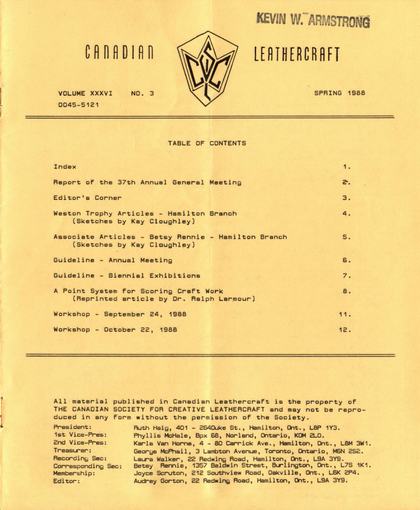
Canadian Leathercraft
VOLUME XXXVI NO. 3 SPRING 1988
0045-5121
TABLE OF CONTENTS
Index 1.
Report of the 37th Annual General Meeting 2.
Editor's Corner 3.
Weston Trophy Articles - Hamilton Branch (Sketches by Kay Cloughley) 4.
Associate Articles - Betsy Rennie - Hamilton Branch (Sketches by Kay Cloughley) 5.
Guideline - Annual Meeting 6.
Guideline - Biennial Exhibitions 7.
A Point System for Scoring Craft Work (Reprinted article by Dr. Ralph Larmour) 8.
Workshop - September 24, 1988 11.
Workshop - October 22, 1988 12.
This contents list matches the page's own order and numbers, each number set at the right. Three entries carry an indented credit line beneath the title, with no page number on it; here each credit runs on after its title.
All-material published in Canadian Leathercraft is the property of THE CANADIAN SOCIETY FOR CREATIVE LEATHERCRAFT and may not be reproduced in any form without the permission of the Society.
| President: | Ruth Haig, 401 - 264Duke St., Hamilton, Ont., L8P 1Y3. |
| 1st Vice-Pres: | Phyllis McHale, Bpx 68, Norland, Ontario, K0M 2L0. |
| 2nd Vice-Pres: | Karla Van Horne, 4 - 80 Carrick Ave., Hamilton, Ont., L8M 3W1. |
| Treasurer: | George McPhail, 3 Lambton Avenue, Toronto, Ontario, M6N 2S2. |
| Recording Sec: | Laura Walker, 22 Redwing Road, Hamilton, Ont., L9A 3Y9. |
| Corresponding Sec: | Betsy Rennie, 1357 Baldwin Street, Burlington, Ont., L7S 1K1. |
| Membership: | Joyce Scruton, 212 Southview Road, Oakville, Ont., L6K 2P4. |
| Editor: | Audrey Gorton, 22 Redwing Road, Hamilton, Ont., L9A 3Y9. |
[Table of contents: the entry already prints "Dr. Ralph Larmour" in full; there is no "Or." misprint on this page. Executive table: "401 - 264Duke St." (Ruth Haig) and "Bpx 68" (Phyllis McHale) are printed exactly that way in the original — a missing space and a p/x typing slip in the Society's own typescript — left as printed.]
Page 2 — Report of the 37th Annual General Meeting
REPORT OF THE 377H ANNUAL GENERAL MEETING
Gn Friday evening May 6, 1988 the 38th Annual General Meeting commenced. Many members arrived for the three day affair to renew acquaintances and for a general get together with the membership. Articles were then set up For judging by the Fellows for the craftsman and Salon ribbons.
Saturday morning saw the arrival of the members who were planning to stay for the day. Refreshments were served to one and all.
President Ruth asked the Executive to attend a short meeting prior to the Annual General Meeting to clear up some loose ends.
After this the Annual general Meeting was called to order by President Ruth. This meeting moved along very smoothly and efficiently. Two motions were put to the membership and were subsequently. voted on and carried unanimously. They were as follows:
4. To increase membership fees for Sustaining Members to $35.00 annually. 2. Proposal #1 - To introduce a full-time student membership up to age ¢O at one-half the current regular fee.
Proposal #2 - That membership fees be increased by $5.00 to $15.00 for 1989 and a further increase of $5.00 to $20.00 in 1990.
The 1988/89 Executive were introduced to the membership by Madeleine Mitchell of the Nominating Committee.
This year saw only one successful Associate award and this was to Betsy Rennie of the Hamilton Leather Guild. Karla van Horne gave the background which led up to Betsy receiving the Janis Zalitis pin which is only given out to those were achieve 80% or more on their four articles.
After giving the history of the Weston Trophy by Karla Van Horne, Hamilton was awarded the Trophy. Only three guilds entered this year, Hamilton, Toronto and Woodstock. Perhaps next year we could see all five guilds participate in this venture. Sketches of the five article submitted by Hamilton and also Betsy's four articles are seen on Page No. One Life Membership was awarded this year. Unfortunately Carol McLean was unable to attend the meeting and she will receive her award at a later date. Jessie Little then told the membership that the Jean Hunter award of $100.00 be given every second year beginning in 1988. This award is for the novice leather crafter that shows the most advancement on their articles.
Dorothy Muma awarded the Salon and Craftsman ribbons on the articles that they had judged the previous night. Dorothy stated that she was disappointed over the quantity and quality of the pieces on display after the excellent showing in 1987. Only four Salon ribbons were awarded to three people. Perhaps 1989 will exhibit the calibre of work needed for these prestigious awards.
The meeting then concluded and everyone went to a delicious lunch and a time for relaxation in the beautifuly surroundings around the Royal Resort. The afternoon was then broken into two sessions for demonstrations by Muriel McKnight, Karla Van Horne and Margaret Montieth. These are enjoyed very much by the membership and usually one walks away with a different technique to use.
Page 3 — Editor's Corner
After dinner the Norland Branch entertained with Emma Windatt singing and dancing as well as reciting a poem she had written about her cat. Our hats off to Emma not only for her humourous skit but also the way in which she recited her poem. Not too many people can give a recitation the way Emma did.
The guest speaker was the Curator of the Lindsay Gallery and Museum. He told the membership just what the galleries expect when someone is trying to book in a one-man show or as a group. Also he felt that C.S.C.L. should try and project an image which will attract new members. This could be accomplished, according to him, by updating our articles and making them more in line with today's vogue ranter than the traditional way that our Society creates their leather creations. After speaking, the Curator then answered many questions put by individuals about exhibitions in a gallery. The evening then broke up with some departing for home while others retired to their rooms.
On Sunday morning the membership was treated to some slides which had been acquired over the years. Many of these articles were created by members who had passed away and they brought back many fine memories. Techniques were seen which had been passed on to the newer craftsperson and one could see the -evolution of our craft.
Also on Sunday morning members were given a tour of the area around the Royal Resort. It really is beautiful country and lakes in that area. The meeting then broke up and everyone said their adieus for another year. The 39th Annual General Meeting will be hosted in 1989 by the Toronto Guild.
Respectfully submitted,
Audrey Gorton, Editor.
EDITOR'S Corner
I wish to thank Kay Cloughley for the sketches of the Weston Trophy and Associate articles. These really portray the articles that were submitted. I still would like to see some articles for the bulletin. Woodstock has submitted some material for the next bulletin and for that I thank them very much. I would rather have extra material than a shortage of same. Articles keep the bulletin going -- where are yours? You are the ones who keep asking for the bulletin.
It was nice to see our American guests. Also Gertrude Hilder came from New Brunswick and won an award. Congratulations, Gertrude.
Page 4 — Weston Trophy Articles - Hamilton Branch (Sketches by Kay Cloughley)
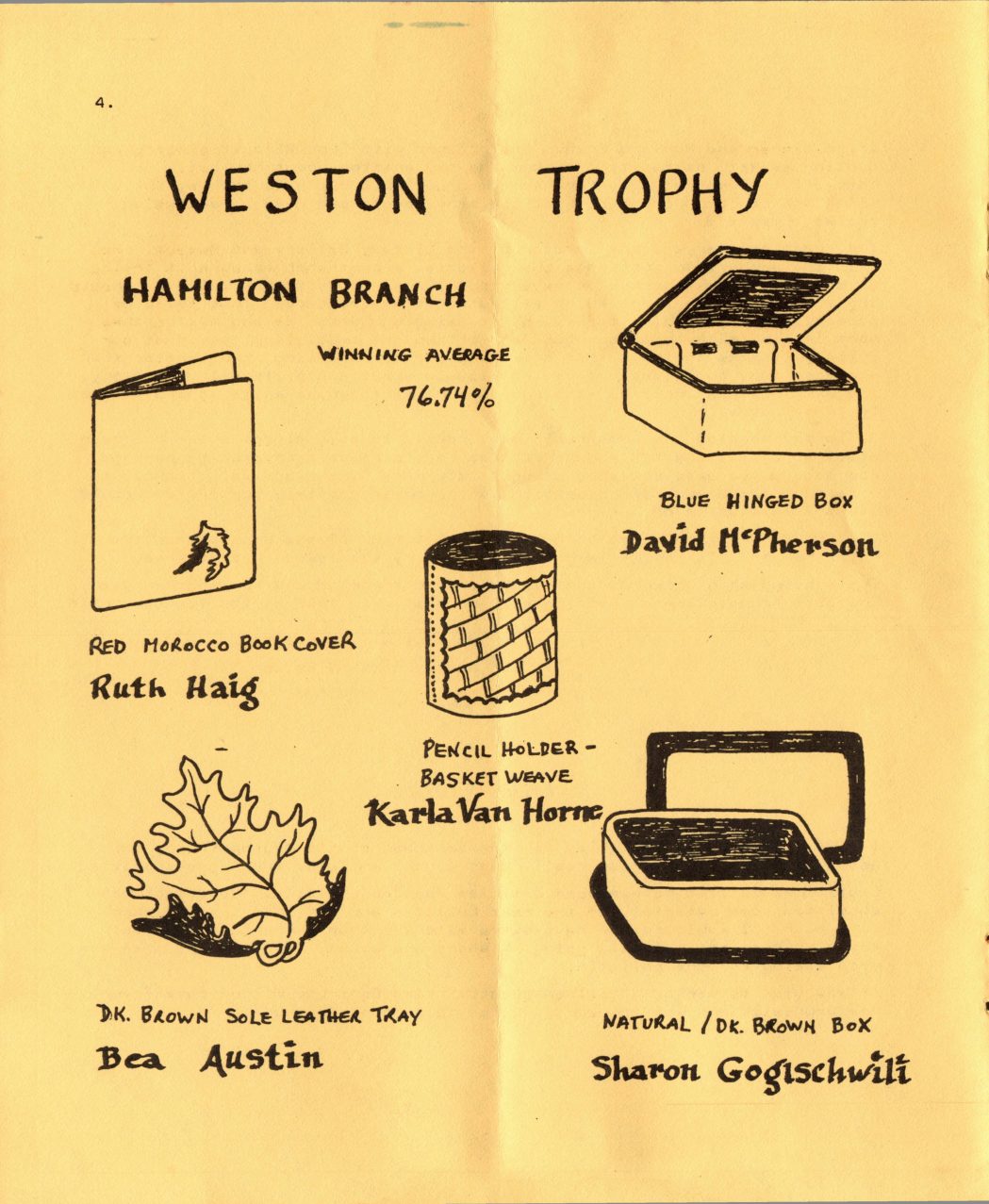
WESTON TROPHY
HAMILTON BRANCH
Winning Average 76.74%
Blue Hinged Box — David McPherson
Red Morocco Book Cover — Ruth Haig
Pencil Holder – Basket Weave — Karla Van Horne
Dk. Brown Sole Leather Tray — Bea Austin
Natural / Dk. Brown Box — Sharon Gogischwili
[The names and captions run together into nonsense if the page is read straight across, and are set out here separately. This is the team and item list for the 1988 Weston Trophy, won by the Hamilton branch with 76.74%.]
Page 5 — Associate Articles - Betsy Rennie - Hamilton Branch (Sketches by Kay Cloughley)
[The captions on this page are hand-lettered and easily misread; the writing case’s is lettered "SHaLl Gusset".]
NEW ASSOCIATE
BETSY RENNIE
Hamilton Branch
Dark Brown Phone Book Cover
Double Photo Frame — for instructions see The Leather Craftsman, Mar/Apr '88 issue
Natural Writing Case — the interior of the writing case features a magnetic dome and a small gusset
Natural Ranger Belt with design — simple but elegant
Page 6 — Guideline - Annual Meeting
GUIDELINES - ANNUAL MEETING
1. Reserve hall as soon as date for annual is set. 2. Arrange for accomodations and meals, coffee and donuts, 9-10 a.m. (Usually the morning session paid for by C.S.C.L. Afternoon cookies or whatever supplied by the Host Branch).
The original prints "accomodations", kept exactly as printed.
3. Have corresponding secretary send out Notice of Annual Meeting one month ahead of meeting. (Refer to previous notice for set-up. Advice of any proposed change in Constitution to go out with this notice).
4. No money to be spent unless passed by Executive Council. Insurance usually not needed at one day affair.
5. Write Branches asking for demonstrators and request what demonstrations wanted. Arrange demonstrator schedule. Write demonstrators informing them of time allotted to them and ask if it is satisfactory. Also what special equipment they need supplied, if any. Demonstrators to be approved in advance by C.S.C.L. Executive.
6. Invite special guests.
7. (a) Obtain speaker for occasion - (approximately 20 minutes). (b) Get someone to introduce speaker.
(c) Get someone to thank speaker. 8. Have reports sent to Corresponding Secretary, such as the President's Remarks, Membership, Treasurer, Bulletin, Programme schedule etc. at least three weeks in advance of meeting in order to have time to get them photostated.
Stress importance of people letting local registrar know of attendance at meeting and meals not later than two weeks prior to date of Annual. 9. Go over to hall with display committee before meeting and plan the location of displays -- also show table arrangement. Obtain microphone if available. 10. Have appropriate signs made -
Direction to display
Direction to General Meeting
Direction to demonstrations *
One for each demonstrator with name and what demonstration.
(Sign to be put on table or door).
One for Membership (receiving annual fees or new memberships). One for Associate (display table).
Also sign for each Associate entry with name.
Have numbered meal tickets made. Have name tags made for registered members and guests. (Adult family members are allowed to attend upon payment of registration fee and meals,but do not have voting privileges).
(a) Supply pad of foolscap for listing-names -- at registration and membership tables.
HEAD UP AS FOLLOWS:
Name Reg Fee Lunch Dinner Membership Fee Branch Fee (b) Check to see that ribbons for five winners in Weston Trophy Competition are on hand. (See Chairman of Council of Fellows). 13. Have members allotted to do various duties, i.e:
[The column headings “Name”, “Reg Fee”, “Lunch”, “Dinner”, “Membership Fee” and “Branch Fee” are underlined on the printed page.]
Page 7 — Guideline - Biennial Exhibitions
Acting as host/hostess. (Someone to take members' display items while member registers).
Taking registration and giving out meal tickets -- need 3.
Helping set-up displays.
Looking after demonstrators' requirements and seeing that they get under way on time.
Someone to take Weston Trophy articles from display room to General
Meeting room and back. Consult Council of Fellows Chairman. Have table in general meeting room for Chairman and Recording Secretary. Also one table to side for display of Weston Trophy items. See that the trophy is being looked after and is on hand.
Plan head table guests with Chairman and put their place cards in position before dinner. Also allow at least one-half hour between meeting close and luncheon (for members to use washrooms, etc.). Have Chairman announce:
(a) Where Branch meeting is to be held, if one is requested. (b) Request members to put out lunch tickets which will be picked up by caterers. (Invited guests shoudl have courtesy tickets). Suggest to treasurer to have janitor's stipend ready in envelope to be given to him.
Total tickets to be checked with registration total.
Your final account to be closed out after Annual and money to be turned over to C.S.C.L. treasurer.
GUIDELINES FOR C.S.C.L. Biennial Exhibitions
At lease two years in advance book gallery, date and time of set-up and date of opening and closing.
One year in advance book jurors and find out what they charge. Arrange place of judging at least one year in advance. Notify the Council of Fellows of the C.S.C.L.
Prepare and mail Call for Entry forms six months in advance to the membership with the fee and closing date of entry announced. Print and send out invitations one month before the opening. When judging is completed, obtain certificates for awards and print the programme for distribution during the exhibit.
Where the gallery requires black and white photographs, make these available three weeks before the opening for newspaper publication. Arrange for refreshments and guest speakers at the opening. Arrange for the Council of Fellows to present the awards.
Respectfully submitted,
Ruth M. Haig, F.C.S.C.L.
Page 8 — A Point System for Scoring Craft Work (Reprinted article by Dr. Ralph Larmour)
A POINT SYSTEM FOR SCORING CRAFT WORK
By Dr. Ralph Larmour
The judging of craft work is difficult enough when only a relative placing is required, but when it is necessary to assign definite numerical values it become arduous and controversial. I shall discuss some of the specific difficulties and suggest a more rational method that is easier to apply and leads to more acceptable end results.
In any system of judging the average score of several judges is likely to be more reliable than the score of a single judge. This is axiomatic. It is also accepted that various characteristics of objects ought to merit different maximum values and herein lies one of the cardinal difficulties of the differential value scoring system, namely, the inability to keep in mind and apply a number of different values. It is comparable to trying to measure something with yardsticks of different lengths.
THE UNIFORM MEASURING STICK.
In judging quality of objects, the human mind is accustomed to using a relatively simple yardstick with only a few divisions. We see a thing and instantly appraise it as "good", "fair" or "poor'. Or we may note that it is "beautiful", "ordinary" or "ugly". If we wish to be a little more specific we may modify these three basic categories to "very good", "good", "very fair", "fair", "poor", and "bad", making six divisions. But beyond this there is required very critical appraisal which takes time and which may not prove tool accurate. When several judges work on the same objects, even the simplest yardstick becomes split into what may be called fractional divisions as soon as an average value is calculated.
I propose first, then, that appraisal be limited to four categories, namely, EXCELLENT, GOOD, FAIR, POOR. But since these are awkward to write into a scoring sheet, and moreover, cannot be averaged, it will prove more convenient to designate them by the numbers, 4, 3, 2, 1, respectively. This very simple uniform yardstick with only four divisions can be applied to all scharacteristics of an aobject irrespective of their relative importance. The relative importance can be adjusted later by using a weighting Factor.
The first concept then is that of a simple uniform measuring yardstick to be used for all characteristics that need to be scored.
CHARACTERISTICS TO BE JUDGED.
The next step is to decide what characteristics of the objects need to be appraised. Here there can be considerable difference of opinion, but in general the number of characteristics ought to be kept assmall as possible. For leathercraft, C.S.C.L. has agreed to consider only three divisions, namely, (1) DESIGN, (2) WORKMANSHIP, (3) GENERAL APPEARANCE AND SUITABILITY OF MATERIALS. These admittedly contribute in different degrees to the total of quality and they must therefore be weighted by some differential factors which will be discussed presently. Before we come to that let us see what these three divisions mean.
DESIGN embraces shape, function and proportion, decoration, colour and the combination of these three things. Where originality is not demanded, we expect a certain degree of harmony in order to merit the rating "EXCELLENT". WORKMANSHIP embraces all the techniques that must be applied, namely, cutting, Fitting, assembly, finishing, stamping, tooling, carving, etc. GENERAL APPEARANCE, etc. refers to over-all effect and the use of the proper materials.
[The byline is set in the issue's script type, whose lower-case r is drawn like an n, in "Dr." and "Larmour" alike; the same face sets the summary paragraph lower on the page.]
Page 9
With these two concepts, namely, the uniform measuring stick and the pertinent characteristics, the judges are ready to go to work making the primary appraisal of the object. Let us illustrate with an example of what might happen with three judges scoring a ladies' purse. The scores could look like this if brought together:
EXAMPLE 1. Ladies' Purse.
| a | General | |
| Judge | Design | Workmanship Appearance, etc. |
| A | 3 | 4 3 |
| 4 | 2 2 | |
| 3 | 3 3 | |
| Average | 3.3 | 3.0 2.7 |
It is readily seen that the maximum score that could be obtained if each characteristic were scored 4 (Excellent) would total 12. Most people would agree, however, that these three characteristics are not of equal importance in contributing to the total value. And furthermore, most people would prefer to have the perfect score read 100 instead of some odd figure such as 12, or 17 or 42. Both these points can easily be attended to be a little simple arithmetic, applied to the scoring of the judges.
WEIGHTING FACTORS.
If we wish to bring the maximum total score to 100 all that is necessary is to apply a factor of 25 to the three separate characteristics in accordance with their relative importance. Obviously Design and Workmanship are more important than the third; in fact for a lot of objects it would not matter greatly if the third characteristic were omitted. Hence it is reasonable to assign the least weight to the third category, namely, GENERAL APPEARANCE. Suppose we assign it a factor of 3, which would make the maximum for it equal to 12. Then under some circumstances we might consider the other two characteristics as equal, so we could weight each of them by 11 which would allow each to contribute 4 x 11 = 44 points to a maximum total of 100.
Now let us apply this weighting to the averages of the three judges as shown in Example 1. We would have the following"
EXAMPLE II.
General
| Design | Workmanship | Appearance |
| Average x 1 | ||
| Primary Average 4.5 | 3.0 | a9 |
| Weighted Average 36.3 | 33.0 | 8.1 |
Final weighted score for Ladies' Purse is 36.3 + 33.0 + 8.1 = 79.4. While we have weighted Design and Workmanship equally in the above example, which would be justifiable for general purpposes, these weightings can be changed to meet various special requirements. For example in the qualifying tests for the C.S.C.L. Associate standing, workmanship is stressed more highly than originality of design. Hence, while still using the uniform measuring stick as shown above, we would weight the average scores as Follows: Design by 7; Workmanship x 15; General Appearance by 3. But for the Fellowship, where excellence of workmanship is taken for granted and where stress is now placed on originality, the weighting would be: Design x 15; Workmanship x 7; General Appearance x 3. In all the three above mentioned weightings the maximum score for any one article would be 100, but the final end scores would differ according to how the weighting is applied.
Page 10
QUALIFICATION LIMITS.
The final step in establishing the point system is deciding the lower limits for a passing score. This, clearly, is a matter that will require careful consideration and there ought to be full agreement on it.
It is obvious that a passing score may vary depending on the nature of the competition, i.e., whether for beginners or professionals. It may also depend on the nature of the competition in which the craft work is entered. For example in the C.S.C.L. qualifying tests for the Fellowship of the Society, it might be set as high as 85% for individual pieces and 80% for the average of the four pieces that are required for this test. On the other hand, for a general chapter, branch or guild display, the qualifying mark might well be set lower, say at 65 to.75% of the possible score. These are decisions that must be left to the Exhibitions Committee or the Standards Board of the group.
RECAPITULATION SUMMARY.
To put the plan in a nutshell, the steps in applying this system are: 1. Set up a blank scoring sheet, showing the characteristics to be assessed, with room for identifying the articles to be judged. Sample sheet is shown below. 2. Appoint two or more judges who will each score all the articles independently, using the Uniform Measuring Stick.
3. Get someone, (preferably one good at mental arithmetic) to average all the scores on the judges' score sheets and transcribe these averages to a new scoring sheet.
4. Apply the designated weighting factors to all scores on the sheet of AVERAGES.
5. Total the wighted scores for each article, and circle those that equal or exceed the passing mark.
Excellent......... 4
Good............. 3
Fair............. 2
Poor............. 1
Judge
| Name | Description | Design | Workmanship | Suitability of Material & General Appearance | Total |
|---|---|---|---|---|---|
[The scoring key (Excellent/Good/Fair/Poor) prints with dot leaders running to each number; the "Judge" line is underlined, the rule running on across the page as the signature space. The table beneath is a blank sample scoring sheet, printed empty with two blank rows for judges to fill in by hand.]
This article appeared in Volume 7, Number 4 - Summer 1958 and is reprinted at the request of some of the membership who attended the 1988 Annual.
Page 11 — Workshop - September 24, 1988
WORKSHOP
| DATE: | Saturday, September 24, 1988. |
| TIME: | 9:30 a.m. - 4:00 p.m. |
| PLACE: | St. Martin's-In-The-Field Anglican Church, Toronto, Ontario. |
| PROJECT: | Free-formed leatherbox with hinged lid by David McPherson |
| COST: | $10.00per person - Dave can supply the leather and dowel at |
| a cost of $5.00per person - If you want one let Ruth know. | |
| CONTACT: | Ruth Haig - 1-416-525-0780 |
Please note: Dave prefers to work in metric and has never actually used the imperial measurements as listed below, but there should be no problem.
If you do not have some of the above tools and supplies you will be able to borrow or use Dave's equipment.
MATERIALS:
Metric eg x 5 5 x 8 (optional) 0.5 diam. x 10 long TOOLS: strap cutter square 3/32' gouge edge beveller
Imperial (inches) sole (bottom) 2 x 3-1/8 7/8 oz. (sides) 11-1/2 x 2 7/8 oz. (inside lid) 2 x 2-1/8 4/5 oz. (hinge top) 5-3/4 x 3-3/4 4/5 oz. (hinge back) 5-1/4 x 2-1/2 wooden dowel 3/16 diam. x 4 skiver (bottom) 2-1/4 x 3-1/2 ruler for careful exact measurements - (no pattern) knives (e.g. x-acto set including saw blade) burnishing tools for flesh side and edges sandpiper (fine)
SUPPLIES:
Water - container and sponge or sprayer dyes for leather and edges acrylic (white for rub over dye) containers for mixing dyes applicators paper towels barge cement working surface (cutting and dyeing) note pad and pen or pencil
NOTE: THIS WORKSHOP IS SPONSORED BY THE ONTARIO ARTS COUNCIL.
[Restored against the printed page: the closing time is "4:00 p.m.", the cost runs on to a second line, and "CONTACT:" begins its own line. "$10.00per person" and "$5.00per person" are set without a space, as printed]
Page 12 — Workshop - October 22, 1988
DEMONSTRATION WORKSHOP
["This workshop if sponsored by the Mississauga Branch" is printed that way on the notice and is left as printed.]
| DATE: | Saturday, October 22, 1988. |
| TIME: | 9:30 a.m. – 4:00 p.m. |
| PLACE: | Cooksville United Church, 2400 Mimosa Row, Mississauga (See map below for directions) |
| DEMONSTRATORS: | Robert Beard, Farmington, NewMexico, U.S.A. General demonstration on various techniques Robb Barr, Bismarck, North Dakota, U.S.A. Air Brushing and Acrylic Dyes demonstrated on a pre-designed, pre-carved article. |
| GUEST: | Volken Serge, Switzerland. |
| COST: | $15.00 per person |
| CONTACT: | Don Macleod, President – 1-416-277-2058. |
| PLEASE NOTE: | Take plenty of note paper for taking notes on the above. This workshop if sponsored by the Mississauga Branch. |
[A hand-drawn map fills the lower half of the sheet, showing how to reach the church. The roads it letters are set out below. The Society letters the middle road The Queensawy, for the Queensway; it is kept as drawn.]
The map, road by road. Highway #5 (Dundas Street) runs across the top. Mimosa drops south from it, with the church marked on the corner, and Floradale lies to its east. #10 Highway runs down the right-hand side, crossing The Queensawy in the middle of the map and the Queen Elizabeth Way at the foot. The Queen Elizabeth Way is labelled From Hamilton, and points west at its left-hand end and From Toronto & points east at its right.