
An issue of the Society’s newsletter, transcribed from the original.
(16 pages, 2.8 MB)
the full-resolution scan, 41 MB, for close research
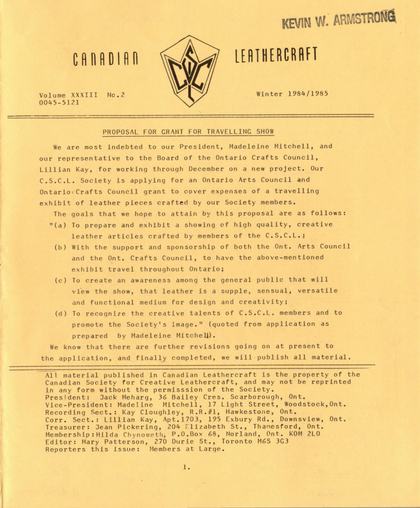
Page 1 — PROPOSAL FOR GRANT FOR TRAVELLING SHOW
Canadian Leathercraft
Volume XXXIII No.2 Winter 1984/1985
0045-5121
PROPOSAL FOR GRANT FOR TRAVELLING SHOW
We are most indebted to our President, Madeleine Mitchell, and our representative to the Board of the Ontario Crafts Council, Lillian Kay, for working through December on a new project. Our C.S.C.L. Society is applying for an Ontario Arts Council and OntariorCrafts Council grant to cover expenses of a travelling exhibit of leather pieces crafted by our Society members.
The goals that we hope to attain by this proposal are as follows: "(a) To prepare and exhibit a showing of high quality, creative leather articles crafted by members of the C.S.C.L.3
(b) With the support and sponsorship of both the Ont. Arts Council and the Ont. Crafts Council, to have the above-mentioned exhibit travel throughout Ontario;
(c) To create an awareness among the general public that will view the show, that leather is a supple, sensual, versatile and functional medium for design and creativity;
(d) To recognize the creative talents of C.S.C.L. members and to promote the Society's image." (quoted from application as prepared by Madeleine Mitchell).
We know that there are further revisions going on at present to the application, and finally completed, we will-publish all material.
All material published in Canadian Leathercraft is the property of the Canadian Society for Creative Leathercraft, and may not be reprinted in any form without the permission of the Society.
President: Jack Meharg, 36 Bailey Cres. Scarborough, Ont.
Vice-President: Madeline Mitchell, 17 Light Street, Woodstock,Ont.
Recording Sect.: Kay Cloughley, R.R.#1, Hawkestone, Ont.
Corr. Sect.: Lillian Kay, Apt.1703, 195 Exbury Rd., Downsview, Ont.
Treasurer: Jean Pickering, 204 Elizabeth St., Thamesford, Ont.
Membership:Hilda Chynoweth, P.O. Box 68, Norland, Ont. K0M 2L0
Editor: Mary Patterson, 270 Durie St., Toronto M6S 3G3
Reporters this issue: Members at Large.
Page 2 — CREDIT CARD HOLDER
CREDIT CARD HOLDER by Jean Pickering
MATERIALS:
Cut back out of morocco or leather. To avoid having too much bulk, bear in mind that the interior pieces are to be cut from the same weight. Cut back out- size - 4 5/8" x 6 3/8".
Cut 2 pes. of morocco (or leather- to match back) -4" x 2 3/4", Cut a window in each of these pieces, following diagram.
Cut 2 pieces of acetate (plastic) -4 1/16" x 2 1/2".
Skieve 1/4" to 3/8" all the way around inside of back and at top edges of inside pieces. (See diagram).
Optional - Cut lining of skiever 5 3/4" x 4".(This adds extra bulk.) ASSEMBLY: Put whatever design you desire on back piece.
Dye edges of leather.
Do all skieving.
Round corners of acetate plastic, inside pieces and back. Using sandpaper, rough 1/4" of plastic on all edges inside and out, making sure that it is no more than 1/4" or you will have scratches on window.
Glue inside pieces over plastic/ acetate. Dampen on fold line and turn top edge to back. Glue.
Glue plastic/acetate to back on 1/4" that you sanded, leaving 5/16" around outside edges.
Snip back leather at top edges of plastic. (See diagram). Dampen and fold back leather over inside pieces, making sure it does not cover the window. Glue.
Glue small pieces where you snipped, making sure edges are very well glued.
NOTE: If you carry a lot of credit cards or wish to put other papers behind cards, add an extra 1/4" to the outside measurements.
*** Scale of diagram 2 = 1 inch. If you require an accurate 1/2 scale y, TOOTH LEE Z ruler, they are available at knitting machine outlets, or I will get one for anyone requiring them. For other scales buy through,a drafting supply dealer.
[This article prints "Skieve" and "skieving" — the Society's own spelling, kept as printed.]
Page 3 — SOME TRIVIA ABOUT SHARK SKIN; In Memoriam
SOME TRIVIA ABOUT SHARK SKIN - from Beula Reynolds
The rough skin of sharks is commonly called "Shagreen", after a variety of untanned leather made in Russia and parts of the orient from the hides of donkeys, horses and camels. (The leather's coarseness is achieved artificially by pressing small seeds into the grain or hair side of the skin while it is moist, and scraping the corrugation off when it dries. The hide is then soaked, causing the indented, compressed portions to swell up in sharp relief, harsh to the touch. Shagreen leather 'is usually dyed green or some other bright colour popular on the Steppes.)
Not all sharks have a shagreen exterior- some are silky smooth. These are found mainly. near Australia and in tropic seas. There are many kinds of sharks and most have a harsh roughness that contrasts sharply with the slimy smoothness of fish scales.
The difference is due principally to the fact that shark's scales are tiny, individual teeth, with the same structure, while the fish scales are flat, boney plates. Known as placoid, the rough scales of the shark are individual basal plates of dentine, with enamel-tipped, pigmenting points. Studied under a magnifying glass, they look like a forest of tiny spikes.
Sharksin is still used for sandpaper and fine rasps in some of the less-mechanized nations of the world. It has also been wrapped around sword hilts to make a non-slippery handgrip. Other uses have included the use of it on the striking surface of matchboxes, and as a leather for book jackets, jewellery boxes, spectacle cases, and the like, in competition with the animal form of shagreen. After removal of the scales and proper tanning, it becomes 'sea leather', a strong, attractive product much in demand for use in women's shoes and purses.
WANTED
We have received a request for a leathercrafter to make some leather harness for ceramic Clydesdale horses. Anyone who is interested in such a project, please contact:
Vera Davis
Or telephone: 878-9612.
In Memoriam
We are sorry to have to report the deaths of two of our leathercrafters. Sylvia Gherster of London, and Emma Rothenburger of Ingersoll. They will be missed by all their friends in the Society.
This page prints her name "Gherster"; the archive's memorial record keeps the earlier spelling "Gerster" used for her in 1963–1969, but this page's own account is set out here to match what is actually printed.
Page 4 — THE ORIGINS OF MOCASSINS & SPORTING SHOE-PACKS IN CANADA
THE ORIGINS OF MOCASSINS & SPORTING SHOE-PACKS IN CANADA by Rene Hackstetter
One of the fascinating aspects of the history of leather in Canada is the origin and development of the sporting shoe-pack.
Oil tanned footwear was essential in most parts of Canada as much of the country was mixed bush with few actual roads. More rudimentary trails wound along old trade and portage routes.
For these mixed conditions the soled boot was limited in it's use. It was neither suitable for. in a canoe, nor good with snowshoes; in wet snow. The European-styled shoes lacked the flexibility for use in the Canadian wilderness.
This problem was resolved by the native Canadians with a low or high cut "mocassin" whose sole of oil tanned leather was pulled up over the foot in a drawstring. The top part of the mocassin had a panel which the sole, now puckered, was sewn to.
It was to this type of construction that the Europeans turned to for their footwear "in the bush". The oil tanned leather footwear was styled for the uses it was to be put to in bush or field. There were shoepacks, larrigans, mocassins, as well as the specialty sporting boots, harvest slippers, and even smoked elk fishing and wading boots!
Each maker claimed the merit of his product, the necessity of the purchaser recognizing his trade mark, and the existence of his numerous imitators, and his advertisements were accompanied by lavish, glowing testimonials, such as John Palmer's 1917 listing, which read:
"Moose-Head brand, superior to all other makes", eee. "(they) were the originators and sole tanners of the celebrated SKOWHEGAN leather- the dark brown, waterproof, oil tanned leather using only French and Chicago Packer Steer Hides.."
This type of leather becomes familiar to us if we look at the so-called
"Deck" shoe being produced today. Interestingly enough, there are a whole family or "class" of footwear of this type being produced. There are a range of names, such as slip-ons and tasseled or "penny" loafers. Even those famous Italian saddlery companys- you are right, that same mocassin style done in a rich Florentine calf! Nothing quite as rugged though as our Algonquin, Restigouche or Maine shoe of Bastien, Gendron or Bass.
[This article prints "mocassin" and "mocassins" throughout, including in its title — the Society's own spelling, kept as printed.]
Page 5
JOHN PALMER CO., LIMITED Men's Skowhegan, Waterproof Draw String,
** Moose Head Brand"
This Shoe Pack is similar in every respect to No. 20, illustrated on page 5, with the exception that it is constructed by our Draw String Non-Rip Process, and has Black Grain Top. Also supplied in all Black, if desired.
Made in Men's and Boys'.
Men's Sizes 6 to 12. Boys' Sizes 1 to 5
OUR DRAW STRING PROCESS
The construction of Draw String Packs requires expert workmen and consists of crimping the bottom of the pack around the toe and drawing it high up, with a 20-cord end of best quality linen
Shoe Thread, the top and bottom of the shoe are then sewed together with a 10-cord waxed end, with heavy hold and short stitches making a non-rip waterproof seam, the draw string around the toe relieving the strain from the sewing.
No. 20—Draw String
Some may criticize these "paler" versions of the older, more rugged sporting footwear, but times change and style evolves in response to changes in condition.
We may no longer spend long periods "in the bush", yet isn't it only fond memories that we have when we pull on a favourite pair of mocassins and think of camp?
(Editor's Note: For those in our Society who are interested in the history of footwear, our author of this article, Rene Hackstetter, is attempting to make arrangements for a tour of the famous Bata Shoe Museum here in Toronto, later in the spring. Tours are by special invitation only, and if you are interested, please pass your name on to your branch rep. or contact Rene at his new address: 30 Rosedale Rd., Toronto.M4W 2P3. Tel: 923-5852.)
No. A—Full oil-tanned flexible sole and heel sewed
No. B—Full sole leather sole and heel nailed
No. C—Sole leather tap sole and heel nailed
No. D—Full sole leather sole and heel with Hungarian or Hob nails
The above illustrates the different soles that can be attached to the various lines of Shoe Packs, Sporting Boots and Moccasins shown herein, all of which are made on straight roomy lasts, with the exception of Summer Packs which are for Spring, Summer and Fall wear and made on right and left lasts with sole leather sole and heel nailed on.
****************************************
WORKSHOP For FIBRE WORKERS......... subject - PAPERMAKING.
Monday Feb. 25 and Tues. Feb. 26- (9:30-4:30 each day )
Monday: Slide lecture on fibre working, covering all phases of paper making, and chemistry of paper making as a craft.
Tuesday: A "hands-on" workshop on paper-making, texturing & colouring.
Cost- $30. (Mon. lecture) $55. (Tues. Workshop) Attendance at Mon. lecture is obligatory for admission to workshop.
For further information- Contact Linda Joy, 816 Ossington Ave. Toronto. or call her at 532-7051. WORKSHOP LOCATION- Sheridan College.
This page sets René Hackstetter’s article and the Editor’s Note in a narrow column at the left, beside a reprint of a John Palmer Co. catalogue sheet for Shoe Packs at the right, with a boxed workshop notice below them.
[The article continues to print "mocassins", kept as printed; the reproduced John Palmer catalogue advertisement lower on the page is set in the catalogue's own type and prints "Moccasins".]
Page 6 — PURSE STRAP HANGERS
PURSE STRAP HANGERS by Carol McLean F.C.S.C.L. *** These hangers use a rectangular shaped "Ring".
No other hardware is needed or seen on the hanging assembly.
This sketch evolved some years ago from Handbag Design Sessions in my nightschool classes. I have had a couple of requests from our newer Branch members for it, and thought that this might be a good time to share this idea with all of our members in case any would like to try this method. The same technique was also taught in classes tutored by the late Irva Ford of our C.S.C.L.
as O / pes y y
SKIVE on shaded areas marked taking 1/3 to '1/2 thickness off.
SKIVE VERY THIN cn areas marked on taking 2/3 thickness of leather off. GOUGE along FOLD LINES - taking out approx. 1/3 to 1/2 of the thickness of leather, depending upon leather stiffness.
Cut handle the desired finished length PLUS approx. 2" to 3" extra on EACH end.. (e.g. If finished handle= 18", add 3" + 3" = 24" total length. ) The distance between the fold lines is the desired finished WIDTH of the handle. (e.g. If rectangle is 3/4" wide, then that is the finished width of the handle.) Allow enough extra in width so that the outer edges will overlap at the centre of the under handle. fe. The twos! small areas are folded under and glued to the flesh side of the handle. This area is where the rectangle sits when. the handle is assembled. )
The VOD shape at the tip of each end can be trimmed a bit more -
" to the dotted lines if desired, for easier folding into the "inside" of the folded handle. Fold skived tip edges to flesh side and glue. (White glue such as Weldbond is used throughout assembly. ) Place rectangles on ends of strap in the area mentioned before(BOR turn under).
Then fold the prepared "tip" end back so that it will be sandwiched between the finished overlaps of the main handle, which will be glued in place over this glued tip.
Page 7
Rectangle "Ring"
Cut turn-ins that have been skived and glued.
These are finished outer edges because of the folding and glueing.
First, side "A" is glued over the the adhered tip for the entire length of the handle; then B side is also glued for the entire length. Then you will have the skived tip tucked and glued neatly between the layers of the folded handle. This part is complete.
Next prepare the two shorter sections for insertion into the bag. These must be well skived so that they will not cause a lot of extra bulk when glued inside the bag's gusset.
Decide upon the location of the slit on the side of the gusset, - usually 1/3 down from the top edge. Do NOT go past half-way or the bag will not "balance" properly and will tip easily when carried.
Prepare and glue the small turn-in area the same as for the handle section. Have all skiving finished.
If"Ring" is 3/4" (as our example is), the slit can be cut with a 3/4" belt slot punch (or two round punch holes connected with knife cuts >=" Position the slit crosswise and at the exact 1/2 way centre point as illustration indicates. This slit is at the same position Genres Pasitiod on BOTH of the gussets.
(See Fig. #A )
The diagrams on this page are drawn and lettered by hand; their labels — “SIDE VIEW OF BAG”, “GUSSET (OUTSIDE)”, “TABS (SKIVED)”, “RECTANGULAR RINGS”, “SLIT”, “CENTRE LINE”, “POSITION SLIT HERE”, “HANDLE”, “TABS”, “⅓WAY”, “½way”, “FIG A”, “FIG. B”, “FIG C” and “Rectangle ‘Ring’” — stand on the drawings. The figure letters A, B and C are hand-inked into gaps the typewriter left in the instructions.
Slip one skived "tab" end through the"rectangular ring" on either end, as indicated in Fig. #B. These"tabs"are then passed through the slit into the inside of the bag and then opened out, with one flap going towards the top of the bag, and the other going towards the bottom of the bag. They are then glued in place as diagram shows (See Fig. # C, (Inside of Gusset) A small, well-skived "patch" is then glued over the slit opening, with the grain side of the leather placed under the slit in case it shows. This patch is then glued onto the inside of the gusset. NOTE: Sometimes the slit has to be widened JUST A TINY BIT. This depends upon the thickness of the folded, overlapped sections - use your own judgement.
Sometimes the tabs and "Rings" are assembled and fastened to the gussets, leaving the handle straps to be added after the bag is completed. This avoids the handle flapping around and getting in the way as the bag is laced or saddle-stitched.
This method of attaching a handle is one of the strongest means of which I know. I have never heard of any handle fastened in this manner coming undone. It is also one of the strongest in that it will carry virtually any weight you can put. in the purse.
However, the real beauty of this method is that it only takes two rectangular "rings"- helps eliminate the cost of the metal strap
The paper says “Cut turn-ins that have been skived and glued” — the stroke beneath “that” is the lower arm of a hand-inked balloon pointing to the handle cross-section, not an underline — and “Slip one skived ‘tab’ end through the ‘rectangular ring’ on either end”. the diagrams themselves are on the picture of the page.
Page 8 — SOME THOUGHTS AND PHILOSOPHIES COLLECTED THROUGH THE YEARS; A FRIEND FOR LIFE
hanger units which also sometimes pull out and are very frustrating to have to repair. I'm sure that those of you who have had that "lovely" task will agree with me!
Also, the "absence of unnecessary hardware" is always looked upon as a feature that will give extra marks when a handbag is judged.
I have found that it is difficult to put some of the steps of this method in to written words, and into diagrams, and I will extend an invitation to any interested craftsmen to have me show and explain any unclear steps in the project.
SOME THOUGHTS AND PHILOSOPHIES COLLECTED THROUGH THE YEARS - by Carol McLean, F.C.S.C.L.
Craftsmanship is an ATTITUDE OF MIND,
The Craftsman is concerned first and foremost with perfection and loving care. He is the guardian of the highest standards of quality that no machine can equal.
Leather was one of man's first crafts and oldest "trades". He used it to make clothes, pouches, shields, armour, and it also provided shelter for him,
Few crafts can be more satisfying than those employing leather. "Hand crafted" - A unique article made with loving hands, utilizing a media and methods completely controlled by the craftsman from inception of the thought to the finished article.
A craftsman, using his head, hands, heart and soul can surpass anything a machine can manufacture.
A FRIEND FOR LIFE - by Lillian Kay
I like the texture and aroma of leather, the warm colours that I can create which glow with richness; the toughness, the softness and the durability of the material. Most of all I like the way it responds to firm, gentle treatment and attention, because it bruises easily.
I find that working with leather is a fascinating and rewarding experience. This material is so flexible that it allows my imagination to run wild. It can be sewn, stamped, tooled, carved, embossed, sculptured, boiled baked, dyed, painted, etc. With it I can create a wide range of leather art, from everyday functional creations, sometimes unusual in form and not expected to be seen in leather, to pictures where the subject is either humorous or serious.
Any article plain or fancy, regardless of whether functional or not, turns out to be a creation of lasting beauty because it can be wiped, washed, waxed, or usually refurbished in some way.
Leather will be with you for years to come.
And a kind word for clay- from your editor. I also like clay, for, although I can't wear it, I can make a mistake, and just wedge it back to its original state, and turn a badly shaped teapot into a great bowl!
Page 9 — "ARTIST PROMOTES THE FUN OF WORKING WITH LEATHER"
"ARTIST PROMOTES THE FUN OF WORKING WITH LEATHER"
(a profile of - LILLIAN KAY)
reprinted from the Toronto Star- "CRAFTS" column by Ankaret Dean Saturday January 12, 1985 edition.
"My goal is to get leather work back into the school system and the commercial art courses," said leather artist, Lillian Kay. "Most people don't realize the things that leather can do."
Kay thinks leather, talks leather, and lives with leather. Her apartment is decorated with leather pictures on the wall, a leather lampshade, and of course she carries a leather tote bag.
During the last few years her leather art has been winning awards at all the large craft shows, including the Ontario Crafts Council, the C.N.E., and the Canadian Society for Creative Leathercraft.
Currently her work is on display in the North York Public libraries, and will be touring the area until Sept. 15. From Jan.15 to March 15 there will be a display at the Centennial Public Library, 578 Finch Ave. W., North York, and opening on Feb. 1 until Feb. 28 a display at Fairview Public Library, 35 Fairview Mall, North York.
Kay was introduced to leather work while she was a teenager at Danforth Technical School. Unfortunately, due to family circumstances, she was unable to pursue a career in the arts until she returned much later to Humber College to train as a recreation therapist.
It was both here and at her job at the Workman's Compensation Board that she rediscovered the joys of leatherwork. For a while she was teaching leathercraft by day and working on her own leatherwork at home by night. However, three years ago she gave up her job to work full-time on her own leatherwork.
Her studio is an efficiently organized space, with tools, dyes and leather all conveniently placed near her work table. While she does have a few machines, most of her work is done manually, and requires a strong, steady and controlled hand.
Her leather art pictures are designed from her own life drawings. In some, she cuts the figure with a single line using stylized texture for hair, and in others she sculpts the figure from the back, raising up the leather to maybe an inch and a half. Kay also works on a great variety of functional items which are sold in craft outlets.
One of her most fascinating lines is her variety of key fobs. On some she uses the silhouette of interesting cars and pick-up trucks, and on others dog shapes or the outline of historical houses, Using a completely different technique, she molds heavy leather into pipe holders, and recently has come up with a new idea of making a pipe holster, to save carrying a hot, smelly pipe in a coat pocket.
Each Christmas she comes up with new ideas for Christmas tree decorations, and she is brimming with ideas for leather buttons and letter holders.
Kay is an active member of the crafts community. She is a director on the Board of the O.C.C. and corresponding secretary for the Canadian Society for Creative Leathercraft. This society was founded in 1950 to improve the quality and design of leatherwork.
Anyone interested in knowing more about the Society or in learning more about coming classes may phone Kay at 241-0730,
Page 10 — THREE PRIZE-WINNING LEATHER ARTISTS AT TEXTURES; MORE COMING DISPLAYS
THREE PRIZE-WINNING LEATHER ARTISTS AT TEXTURES,
- reprinted from the West Hamilton Journal, Wed. Oct. 24, 1984,
Prize-winning leather, a show of work by three leather artists, will be held from Oct. 30 until Nov. 11, 1984 at Textures... a combined effort of area artisans.
The focus of the show is on the versatility of leather as a craft medium, as well as the quality of the pieces produced. Many of the leather pieces featured have won craftsman's awards or design awards in exhibitions. Prize-winning leather shows what leather can be, in the hands of a master craftsman.
The three featured leather artists for Prize-winning leather are extremely active in leathercraft. They are Bea Austin, Ruth Haig, and Karla Van Horne. All three are active members of the Hamilton Leathercraft Guild which meets the second Friday of each month at 124 James St.S., Hamilton, at 7:30 p.m. Each meeting features a demonstration or a programme on techniques. The guild also holds numerous workshops and has been in existence now for 25 years, far fewer years than the combined leathercraft experience of the three artists.
Bea, Ruth and Karla are also members of the Canadian Society for Creative Leathercraft(emphasis on the creative). The national Society sponsors many shows and honours outstanding craftsmen and fine pieces of leathercraft with awards at their annual show. Both Bea and Karla took prizes at Leather'84 this year. Bea also received a Design Award at the Artisans Guild of Hamilton show this year. Ruth has won her share of awards as well, including the Irva Ford award at Image'84 a held recently at the Art Gallery of Hamilton. All have received numerous awards at the CNE as well. Their work is proof that leather is indeed a very creative and competitive craft.
Prize-winning leather is being held at Textures, 30 Hess St. S., Hamilton from Oct. 30-Nov.11, 1984.
(Unfortunately, this information was not available in time to be included in our Fall 1984 issue, but we trust that many of our members were able to reach this show and enjoy it. Our compliments to the three fine craftsmen, Bea, Ruth and Karla, and we appreciate the informative remarks about the C.S.C.L.)
MORE COMING DISPLAYS - Lillian Kay
Solo Leather Exhibits by Lillian Kay, demonstrating a variety of small, unique, functional leather articles, using various techniques, will be on display in show cases at the following North York Libraries:
Yorkdale Public Library, Yorkdale Shopping Centre- Nov.15-Jan15/85
Centennial Public Library-578 Finch Ave.West      - Jan.15-Mar.15/85
Black Creek Public Library- 2141 Jane St.         - Mar.15-May15/85
Amesbury Public Library- 1565 Lawrence Ave. West  - May 15-July15/85
Brookbanks Public Library - 210 Brookbanks Ave.   - July15-Sept.15/85.
ALSO: Fairview Public Library Gallery Display- 35 Fairview Mall Dr.
      - a solo leather gallery exhibit - Feb. 1- Feb. 28, 1985.
Page 11 — "BEST OF SOUTHWEST ONTARIO" IN HAMILTON'S ART GALLERY; BUYING TIPS FOR LEATHER
"BEST OF SOUTHWEST ONTARIO" IN HAMILTON"S ART GALLERY
-reprinted courtesy Crafts column, by Ankaret Dean- Sat. Sept.15/84.
Toronto Star.
"The call for entry went out to craftsmen two years ago asking for submissions to "IMAGE'84": a showcase for the best of crafts on Southwest Ontario.
The craftsmen responded with enthusiam and vitality, and from Sept. 13 to Oct. 16 the exhibition of 250 pieces (was) on display on the 2nd floor of the Art Gallery of Hamilton.
Ten years ago the Artisans Guild of Hamilton sponsored IMAGE'74 in the Studio Theatre of Hamilton Place. "When we decided to sponsor another show we invited the crafts guild of Hamilton and District to help us," explained Andrina Carlton, exhibition chairman. "The result has been that we have had an excellent committee. The art gallery offered to host the show, and we are grateful for the wonderful reponse for funds from industries, foundations and private individuals."
IMAGE'84 was juried in June by Carol McLean, leatherworker and quilter from Woodstock; Donald Stuart, silversmith and weaver from Barrie, and Alan Vigland, potter, from Michigan, U.S.A.
They individually awarded a point to each piece that they would like to see in the show. The result of this system was that each piece with a point was included in the exhibition and each piece with three points was included in the catalogue. They also selected the prize winners.
Best in Show was awarded to Pam Norman of Dundas for her large hanging painted silk staircase. This piece (was hung) from the ceiling to the floor in a series of steps, each painted in brilliant colours.
Second prize went to Randy Kerr of Mississauga for his cherry and bird's eye maple writing desk; and third prize went to Charles Tauber of Dundas for his Renaissance lute in ebony and sycamore.
Kathyrn Thomson won fourth prize for her blown glass bowl "Rise" with sandblasted figures on the interior.
The pottery award went to Carol Ann Michaelson of London for a black and white form, saggar fired in oxidation. Ruth Haig of Hamilton won the leather prize with her realistic leather luchbox, and Dorothy Garside won the Weavers and Spinners award for her window picture in huck lace."
(We must also apologize that this material was not available for presentation during the time of the show, but we congratulate Ruth Haig for her splendid success, and also congratulate Carol McLean for having been given the honour of judging such a prestigious show.)
BUYING TIPS FOR LEATHER- reprinted from Vancouver press. (excerpts)
Leather has reached the height of its popularity thanks to its wearability and warmth - and its ability to go with everything.
And because of improved tanning methods, leather is available in almost any colour.... But to get the most out of leatherwear, use a trained eye and don't make a hasty decision. Most leathers can be worn for years, but durability is usually reflected by the price.
Examine the garments for weak spots in the skins, especially thin spots which indicate a flaw. Manufacturers may well hide weak areas as well as scars and nicks on the animal's skin, on the underside of the lapel, the inside of the leg, or on the inside near the lining.
Also check if small pieces have been sewn together to make a garment. The higher the quality- the larger the pieces of leather
Page 12 — BOOKBINDERS GOLD LEAF
(Buying leather- continued )
used, making fewer seams necessary.
Do the front and the back of the garment have the same quality, softness and texture? Manufacturers have determined that customers usually only examine themselves from the front, and to one side, usually the left, in the store. The best leather, therefore, is generally placed there.
Lining is important. Leather pants and skirts will stretch out of shape without a lining.
Untreated or natural leathers that aren't dyed are popular but should be avoided because they are impractical and almost impossible to clean.
Cowhide is the least expensive of leathers but isn't in fashion and therefore isn't widely available. (Ed. note: Let's all head out west to find some of this "cheap" cowhide!) Pigskin and wild pig suede are inexpensive because they are among the least supple of leathers. They may become rougher and even less pliable when dry cleaned. (Note: These are the heavy weight types of "garment" hides. that are being referred to obviously).
Calfskin is usually a reasonable price and is soft, although not as soft as kid or lambskin. Doeskin is more expensive and is supple, but more difficult to care for.
Kidskin and lambskin, usually imported from Europe or South America, are the ultimate in luxurious leathers, with prices to match. Usually, the softer the leather, the less durable it is.
To protect leather, spray with a rain repellant. Often raindrops will dry without leaving a mark, but untreated or supple leathers stain. (Ed.Note: This is the type of article that often misleads a leather customer, when you describe the types of leathers that you work with, since it really only refers to "wearable" leathers for garments. But the information on choosing garments to avoid bad hides is all too true. We have all seen coats where thin hides are used in areas of high stress, such as around armholes, etc., not only to "hide" the bad.skins out of sight, but also to use the thinner leather in areas where a great deal of fitting and sewing must be done! )
BOOKBINDERS GOLD LEAF
Notes from an article in the London Free Press- submitted by J. Pickering
A book of bookbinders gold leaf containing 25- 3 1/2 inch sheets costs $29. U.S. funds, including postage and handling, from: Talas, 213 West 35th St., New York, N.Y. 10001. Price does NOT include duty. (Price quoted is dated Oct. 1, 1984.)
Bookbinders gold leaf can be used in cooking, as it is entirely edible. If anyone has the time, the interest, AND the money to spend, Jean has a recipe for roast chicken breats with gold leaf covering. If this seems too exotic. for your taste, you are in the company of many others! While dining with a group of silversmiths in an East Indian restaurant, the management, knowing our occupation, tried to honour us by serving us orange "dumplings" wrapped in 100% pure silver. We did not realize that we had made a faux pas by scraping cff all the silver before eating, until the dejected waiter pointed out our error! Although these two metals may indeed by edible, we are NOT guaranteeing that you would find them DIGESTIBLE!
Mary Patterson.
["breats" is printed exactly so — the Society's own typo for "breasts", kept as printed.]
Page 13 — A SIMPLE LEATHER TIE "RACK" FOR MEN; DESK BLOTTER WORKSHOP REPORT
-A SIMPLE LEATHER TIE "RACK" FOR MEN-adapted from a commercial design - M. Patterson.
This tie "rack" is actually a 5 D-ring holder, of a type that perhaps could be adapted to hold any number of different items. The nicest part of the design is that there is no lacing or stitching required, just 2 rivets are used to hold the whole item together, making it an excellent "beginners" project for anyone to try! It does teach cutting, and dyeing too, although a prefinished leather could be used if one wanted to make it a quick, one-evening project.
The two pattern pieces shown below at 1/2 scale should be cut from a fairly firm leather of about 4 oz. weight. We tried some Mission-grain steerhide and used an antique golden-tan dye, covered with a wash of Garnett tan for a very nice shade that matched well with the 5 antique brass D-rings, of 1 3/4" width. The NARROW end of part "A" (back) is the TOP, The rivet that holds the two pieces together serves as the hanger hole for a small nail as well. The WIDE piece of part "B" is the TOP. This can be increased in width to match the other part if desired, although it does not show at all. As you weave part B through the slits in part A, at each spot where piece B emerges to the front of part A, slip a D-ring onto part B before slipping it back through the next slit.(€ marked diagram with a dotted line to show D-ring placement between 1st pair of slits. Continue all the way down. )
DESK BLOTTER WORKSHOP REPORT
Our Nov. 17th workshop was very well attended, and Fred Brown displayed his usual well-honed skills in getting all phases of desk blotter design and manufacture across to the group. Many of us were so busy that we did not get a chance to even make good notes, and we would appreciate a full description for a future issue, if anyone would volunteer. Thanks from all of us to Fred for donating his skills.
Page 14 — MEMBERSHIP DUES NOTICE TO ALL MEMBERS; NEW PRESIDENTS - SOME ASSISTANCE
MEMBERSHIP DUES NOTICE TO ALL MEMBERS
ANNUAL DUES should be paid PRIOR to APRIL 1st, 1985, to continue your membership in the C.S.C.L. Amount per member- $ 10.00
Branch members should pay their own Branch treasurer, who will see that you receive your membership cards. Branch dues are also payable to your Branch Treasurer.
Members-at-large should send their cheque in the amount of $10.00 to:
Membership Chairman, Hilda Chynoweth,
P.O. BOX 68, NORLAND, Ont.
K0M 2L0
Cheques should be made payable: Canadian Society for Creative
Leathercraft.
Please include your Name, Address, Area Code, AND Telephone Number.
Thanks!
WANTED.. WANTED.. WANTED
Leathercrafter would appreciate knowing if any members have any copies of "LEATHERLORE"
Leather Lore was a publication produced by Dean Russell prior to the inauguration of "Canadian Leathercraft", and the C.S.C.L. and was connected with the Ottawa Valley Leathercraft Studios. anyone having any copies that would allow them to be copied by Zerox, or anyone with any information on publications relating to leather that are now out-of-print should contact:
Mr. Rene Hackstetter,
30 Rosedale Road,
Tel: 923-5852.
NEW PRESIDENTS - SOME ASSISTANCE
Have you been asked to take the Chair at a Branch of C.S.C.L.
(or any other group), and been terrified about forgetting what 3 order to put motions, amendments to motions,and who seconds what etc? Next time you're by one of the Ontario Gov't. Publication Outlets, look for free fact sheet No. 84-021, (April 1984) AGDEX 057, a Ministry of Agriculture and Food publication called:
PARLIAMENTARY PROCEDURE AT A GLANCE - 3 pages of much-needed information.
Page 15
ANNUAL MEETING 1985. PLAN TO ATTEND OUR ANNUAL MEETING, APRIL 26,27, 28 PLACE: CONTINENTAL INN, BARRIE
We are looking forward to seeing as many leathercrafters as possible at our 35th Anniversary Meeting.
A weekend package price for rooms (2-days room rental ) including 6 meals(!) is priced at a special price of only:
$50. per person per night, for 2 people in a room or $60. per person per night for a single occupancy room. Naturally, reservations will be required well in advance to obtain these most reasonable rates, so contact either May Corbett at 10 Highland Ave., Barrie, Ont. L4M 1N1. or your Branch Representative for more details and bookings.
HAMILTON BRANCH has changed its meeting place to:
124 James St. S., Hamilton.
For information on their meetings, contact Audrey Gorton, 22 Redwing Drive, Hamilton. (Tel: (416) 389-9567
For Information on Branch Meetings in other centres, contact the following
Branch Presidents.
Barrie: Kay Cloughley, (705) 487-3214 Belleville: Irene Girling, (613) 962-3695 Hamilton: Audrey Gorton (416) 389-9567 Mississauga: Harold Brister (416) 279-0333 Norland: Phyllis McHale, (705) 454-3206 Toronto: Ralph Whatley, (416) 690-0178 Woodstock: Jean Pickering (519) 285-2518
[The page prints "Whatley"; this is Ralph Whately.]
SPECIAL NOTICE TO ALL C.S.C.L. MEMBERS
ALL MEMBERS OF C.S.C.L. ARE ASKED TO NOTE THE ENCLOSED QUESTIONNAIRE. IT IS VITAL TO OUR SOCIETY THAT THE QUESTIONS BE ANSWERED AND FORMS RETURNED (as noted) AS SOON AS POSSIBLE! ANYONE MISSING A FORM MAY CONTACT YOUR EDITOR FOR A COPY. Thank you for co-operating.
Page 16
The Mariposa Folk Foundation invites ALL CRAFTSPEOPLE to submit resumés & slides or prints of their work, to be juried for the 25th Anniversary of the MARIPOSA FOLK FESTIVAL the regular folk music gathering. They are seeking craftspeople Please write to our craft committee at:
July 26-28, 1985
A decorative dingbat border and part of the festival’s own logo artwork stand beneath this date line.
Ian Bell 363-4009 MaryAnn Farrell 964-1604 to demonstrate craft techniques as well as sell their work.
525 AdelaideSt. East,
Submission deadline is Feb. 28th Toronto, Ont.
for further information call:
As you can see from the above advertisement, MARIPOSA FOLK FESTIVAL is developing a craft organization to go along with Any person (or group) interested should contact them as soon as possible. The Festival is held in Molson Park, Barrie. Booth rental charges for sales are $100. with the possibility of no charges if full demonstration schedule is undertaken.