
An issue of the Society’s newsletter, transcribed from the original.
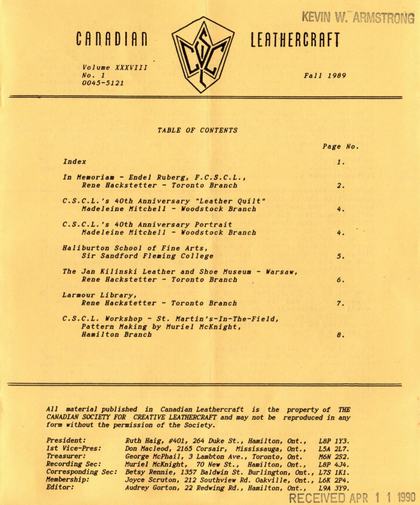
(8 pages, 1.3 MB)
the full-resolution scan, 18 MB, for close research
Page 1
Canadian Leathercraft
Volume XXXVIII
No. 1 Fall 1989
0045-5121
TABLE OF CONTENTS
Page No.
Index 1.
In Memoriam - Endel Ruberg, F.C.S.C.L., Rene Hackstetter - Toronto Branch 2.
C.S.C.L.'s 40th Anniversary "Leather Quilt" Madeleine Mitchell - Woodstock Branch 4.
C.S.C.L.'s 40th Anniversary Portrait Madeleine Mitchell - Woodstock Branch 4.
Haliburton School of Fine Arts, Sir Sandford Fleming College 5.
The Jan Kilinski Leather and Shoe Museum - Warsaw, Rene Hackstetter - Toronto Branch 6.
Larmour Library, Rene Hackstetter - Toronto Branch 7.
C.S.C.L. Workshop - St. Martin's-In-The-Field, Pattern Making by Muriel McKnight, Hamilton Branch 8.
This contents list prints one item per line with a page number at the right.
All material published in Canadian Leathercraft is the property of THE CANADIAN SOCIETY FOR CREATIVE LEATHERCRAFT and may not be reproduced in any form without the permission of the Society.
President: Ruth Haig, #401, 264 Duke St., Hamilton, Ont., L8P 1Y3.
1st Vice-Pres: Don Macleod, 2165 Corsair, Mississauga, Ont., L5A 2L7.
Treasurer: George McPhail, 3 Lambton Ave., Toronto, Ont. M6N 2S2. Recording Sec: Muriel McKnight, 70 New St., Hamilton, Ont., L8P 4J4. Corresponding Sec: Betsy Rennie, 1357 Baldwin St. Burlington, Ont., L7S 1K1. Membership: Joyce Scruton, 212 Southview Rd. Oakville, Ont., L6K 2P4. Editor: Audrey Gorton, 22 Redwing Rd., Hamilton, Ont., L9A 3Y9.
Page 2 — In Memoriam - Endel Ruberg, F.C.S.C.L., Rene Hackstetter - Toronto Branch
IN MEMORIAM - ENDEL RUBERG, F.C.S.C.L.
During the summer of 1958 I was rummaging through a bookshop on Yonge Street when I came across a book entitled "The Arts in Canada" edited by Gordon McRae and published by Ryerson Press in 1958. Hoping to find a mention of the Leather Arts I turned to the very small section on the Crafts and there I found a mention of The Canadian Society for Creative Leathercraft and a gentleman named Endel Ruberg. It was stated that Mr. Ruberg was Estonian and a prize winning leathercraftsman.
I wondered if any of his descendants were still in Toronto. Looking into the telephone directory, I was pleased and surprised to find an Endel Ruberg listed! I telephoned Mr. Ruberg and sure enough, he was the gentleman mentioned in the book! He was still actively involved in leathercraft and yes, he would be willing to meet. The class he taught was every Thursday from 1:00-4:00 p.m. at the Finnish-Canadian Centre on Eglington Avenue. The following Thursday I had the opportunity of meeting Endel, his lovely wife, an interpreter and a class of about fifteen people all engaged in modelling and tolling leather.
Born if Viruma, Estonia in 1917, Endel received preliminary art instruction at the Atheneum in Helsingfor as well as taking courses in sculpture and woodcarving. These two disciplines would serve as a solid foundation for the development of his unique style. After a stint with occupational therapy in a hospital in Finland, Endel moved to Umeo, Sweden and commenced leatherwork in earnest. It was here that he received further instruction from Estonians living in Umeo. Five years of intense production enabled Endel to further perfect his craft. Albums, photo frames, notebooks, portfolios and box-work were all a part of his production. Nordisk Companiet, a leading Swedish store commissioned much of his work.
The original prints "Born if Viruma" — "if" for "in" — and gives the place names as "Viruma", "Helsingfor" and "Umeo", for what are usually spelled Virumaa, Helsinki (from its Swedish name Helsingfors) and Umeå. Kept exactly as printed.
An interesting event occurred in 1951 when some of Endel's work was seen at an exhibition of Arts and Crafts sponsored by the Swedish Consulate. It was to change Endel's life dramatically and benefit Canadian Leathercraft in a very significant way. A gentleman representing the Canadian Handicrafts Guild saw his work, and, recognizing it's merit, suggested the possibility of living and working in Canada!
After some preliminary arrangements with the Immigration people, a flight was booked and Endel arrived in Montreal, March of 1951. Fortuitously, the gentleman who had originally viewed his work was related to the Birks Family, I believe either by kinship or marriage, and this was to facilitate Endel's introduction to Canada and to the designing and selling of his artistic productions. What a tremendous introduction it was, for within a week of his arrival, Endel was working on commissions for Birks, the prestigious Montreal find gift store owned by the family of the same name, as well as entering the Handicraft Guild competition the month following his arrival!
The original prints "the prestigious Montreal find gift store" — "find" for "fine" — kept as printed.
During the fifties and sixties Endel produced many examples of his work in a distinctive style combining repousse and the application of certain dyes of his own formulation. It was during this period that he received some of his most important commissions. The projects which he completed were for the Ottawa Branch of Birks and many were for presentations to heads of government and industry.
Page 3
IN MEMORIAM - ENDEL RUBERG, F.C.S.C.L.
The Japanese delegation alone received twenty-three gifts from the External Affairs department as well as then Prime Minister Diefenbaker. Emporer Hirohito received the personal gift of a Guest Book with the symbol of a white ram repoussed on the front cover! Dwight D. Eisenhower received a leather picture frame; Richard Nixon a presentation book; and Vincent Massey a box as well as a gold-tooled presentation folder.
The original itself misspells "Emperor" as "Emporer"; kept as printed.
Endel became an Associate in the Summer of 1954 and that Autumn took First Prize for Best Original Entry in the Canadian Handicrafts Section of the C.N.E. Apparently this was the first time the award had been given to a leathercraftsman! The following year was important in a number of respects. Not only did Endel with the "Tooled or Carved" category at the C.N.E. show, along with Honorable Mention in both "Best Design and Best Original Entry". The crowning achievement though was the awarding of Fellowship in the Society that year. It was recognized then, as it is now, that Endel was a pillar in the Society, holding the torch aloft beside Don MacKinnon, Bob Muma, Edith Roscoe, Clarice Packham, the Larmours and all those others that are equally important in the founding, such as the Roebucks, the Russels and the MacDougalls.
The original leaves out a verb: it prints "Not only did Endel with the Tooled or Carved category at the C.N.E. show" exactly so, evidently missing "win".
We could list the accomplishments that Endel achieved, the regular demonstrations that he gave at the C.N.E. or, for that matter, make a note that until his death during the Christmas season, he was still teaching leathercraft and sharing his knowledge. He will be missed by all those that knew him, however, his lamp still shines in his good works.
Respectfully submitted.
Rene Hackstetter.
Page 4 — C.S.C.L.'s 40th Anniversary "Leather Quilt" Madeleine Mitchell - Woodstock Branch; C.S.C.L.'s 40th Anniversary Portrait Madeleine Mitchell - Woodstock Branch
C.S.C.L.'S 40TH ANNIVERSARY "LEATHER QUILT"
CONTRIBUTE TO THE "LEATHER QUILT" THAT WILL COMMEMORATE C.S.C.L'S 40TH YEAR. Even if you can't attend, send a leather square that can represent you as a C.S.C.L. Member.
INSTRUCTIONS:
Take a 6" X 8" square of leather, any kind, any weight and decorate it to express your feelings, talents and love of leather. You can colour, or carve or emboss or cut or add to the surface. The finished square should still be 6" x 6" and have your name somewhere on the decorated side.
During the evening of Friday, April 27, 1990, the "Quilt" squares will be attached together to form the 40th Anniversary Commemorative Leather Quilt.
Make sure your square as simple or elaborate as you wish.
Note: Squares will not be returned. Bring your square to the Annual or send it to: Mrs. Loreen Manual, R.R. #5, Ingersoll, N5C 3J8.
C.S.C.L.'S 40TH ANNIVERSARY PORTRAIT
A group photograph of all those attending the 1990 Annual will be taken on Saturday, April 28, 1990.
Prints will be available to all members whether they attend or not.
| 8" x 10" Photo will cost | $12.00 |
| Mailing cost | 1.00 |
| Total cost including tax | $13.00 |
or also available -
| Decorative folder | 3.75 |
| 8" x 10" Photo | 12.00 |
| Mailing cost | 2.00 |
| Total cost including tax | $17.75 |
* Watch for an order form in the mailing with your registration form for the Annual Meeting.
All orders must be placed and paid for by April 28th. Make cheques payable to: "HARVEY PHOTOGRAPHERS", 458 Haines St., Ingersoll, N5C 2S5.
Madeleine Mitchell,
Woodstock Branch.
Page 5 — Haliburton School of Fine Arts, Sir Sandford Fleming College
HALIBURTON SCHOOL OF FINE ARTS INQUIRIES: Admissions,
Sir Sandford Fleming College,
P. 0. Box 339,
Haliburton, Ontario,
K0M 1S0.
Telephone: (705) 457-1680.
Combine a holiday with a learning experience. The Haliburton School of Fine Arts is located in the scenic village of Haliburton. Courses are offered during July and August. Professional artists instruct one week courses geared to a variety of levels to include the hobbyist and the professional in POTTERY, WEAVING, WOOD, LEATHER, PRINTMAKING, PAINTING, BASKETRY, PHOTOGRAPH, JEWELLERY, METAL, FIBRE ARTS, DESIGN, COLOUR AND MORE.
Families are encouraged to participate, as we have an exciting Children's Program.
During our 1989 Summer School, we offered more than 150 courses.
DATES: July 2 - August 3, 1990.
BROCHURES ARE AVAILABLE IN MARCH
Haliburton Summer '90
For over 20 years, people from across the provinces have been coming to the HALIBURTON SCHOOL of FINE ARTS
Summer School.
The original prints "artists-craftsmen/instructors". It is set here as printed.
They have been coming because of the artists-craftsmen/instructors who are among Canada's finest; the over 100 week-long courses in all media; and the natural beauty of its setting in the magnificent Haliburton Highlands. We can supply you with a list of affordable accommodations for individuals and families. Brochures are available with details. Contact: Haliburton School of Fine Arts P.O. Box 339 Haliburton, Ontario K0M 1S0 (705) 457-1680
Page 6 — The Jan Kilinski Leather and Shoe Museum - Warsaw, Rene Hackstetter - Toronto Branch
THE JAN KILINSKI LEATHER AND SHOE MUSEUM - WARSAW, POLAND
In the fall of 1987, my wife Jolanta and I were in Warsaw on one leg of a seven week honeymoon through Europe. We were visiting her "Babeia's" - grandmothers as we say in English. We were staying at Babeia Jadzia's, Jolanta's maternal grandmothers, near the east bank of the Vistula. This river was a major artery for river traffic, either south to Krakow or north to Gdansk and the Baltic.
The Barbacan, the part of the Old Town, or Stare Miasto, which encloses the original square was a favourite haunt during our days in Warsaw. On one corner of the square was an old building which housed the ancient Shoemaker's Guild. The sign on the facade reads "Dom Scewcow" or "House of the Shoemakers". Above the sign on the upper facade were various emblems such as a cow, horse, lizard and snake as well as shoemakers fitting a customer and making a shoe.
Within the building is a wonderful little Museum of Leather and Shoes, founded by a gentleman named Jan Kilinski. It seems his interest in the leather and shoe trade fired the effort to found this institution. Through the careful gathering of tools, material and written evidence of the Craft, the Museum provides the place for cultural study. We spent one afternoon looking over the artifacts and talking with Ms. Lidia Eberle, the Curator. )
Visitors to the Museum can also view a diorama of a leather shop which, due to a lack of space, contains shoe, harness and saddler's shop in such proximity to one another that it all seems to be one shop. Another aspect which we found interesting was the space devoted to a variety of leather. objects of an artistic nature such as wall panels, flowers and bas-reliefs.
—: Museums are repositories of objects for study, for reflection, for musing about learning or the Arts. Originally Ptolmey erected the first Museum as an adjunct in the University of Alexandria. Industrial
Art Museums really began in the nineteenth century and it is only a hundred years or less since the advent of specialized Museums devoted, in this case, to the Leather Arts.
It is an important step in the recognition of the central importance that the Leather
Arts held for pre-industrial as well as technologically sophisticated peoples.
[The lower part of this page also carries the museum's own sign — a horse above the word "MUZEUM" above a pair of boots — captioned in Polish, "Muzeum Cechu Rzemiosł Skórzanych im. Jana Kilińskiego", and in French, "Le Musée du Métier de Cuir de Jean Kiliński, Varsovie": the Museum of the Leather Trade of Jan Kiliński, Warsaw.]
Rene Hackstetter.
Toronto Branch.
[A stray underscore is not part of the printed text: "to a_ lack" is set out here as "to a lack".]
Page 7 — Larmour Library, Rene Hackstetter - Toronto Branch
LARMOUR LIBRARY
For leathercraft workers everywhere the perennial problem has been the accessibility to proper instruction in the crafts. A large part of this is due to the lack of good books being published on technique, and, if there are good books they are not always readily available either now or antiquarian.
Dr. Larmour very clearly perceived this difficulty, and, with the researchers penchant for seeking out the obscure, he carefully gathered the books and pamphlets that compose the Leather Arts. This is an important contribution to the Arts in Canada.
Readers might be interested to know that there is a fairly good run of "Canadian Art" as well as a bound volume of it's predecessor, "Maritime Art". They are a broken run, however, the issues start of Vol. II, No. 1 and 2, 3 and 5 are present, then it jumps to Vol. III, No. 5, July-August 1943 in "Maritime Art".
Some of the tipped-in Woodcuts such as Caven Atkins "Mountain Vision" in Vol. II, No. 1, are worth looking at. The December 1941 issue has a Donald Cameron Mackay wood engraving called "Black Buck" an original composition. In February 1942 Fritz Brandtner did an original linoleum cut called "Good Fighting Evil". It is not present. The Marguerite Zwicker lino cut, June 1942 and Christian McKiel's lino cut called "Portrait" are also not present.
This is not an uncommon occurence in Art magazines to have the tipped-in original work absent. Often these examples would be removed by the owner and framed. We do not know where these pieces are, all we can do is make a note that they are not present. This does not distract from our enjoyment of that which is, fortunately, present. However, book lovers wince when they see an imperfect copy that has been dismembered. The folded sheets of a book are called the "gatherings". When these are bound together, they start to become a book. Coherence is lost if the text or the illustrations are gone.
This divertissimo serves to illustrate the importance of not only gathering the ephemeral pamphlets, but storing these fruits of our heritage. Our foundations rest on what those who came before left us. The storehouse is full, careful sorting of all that has been fathered will ensure that the new seeds we sow will bear fruit.
Respectfully submitted,
Rene Hackstetter,
Librarian.
Page 8 — C.S.C.L. Workshop - St. Martin's-In-The-Field, Pattern Making by Muriel McKnight, Hamilton Branch
C.S.C.L. WORKSHOP
| DATE: | Saturday, June 2, 1990. |
| TIME: | 9:30 A.M. to 4:00 |
| PLACE: | St. Martin's-In-The-Field Anglican Church, Toronto, Ontario |
| PROJECT: | Pattern Making Workshop |
| INSTRUCTOR: | Muriel McKnight |
| FEE: | $15.00 |
YOU WILL BE REQUIRED TO BRING THE FOLLOWING:
1. Paper suitable for patterns, e.g. brown wrapping paper
2. White glue or a glue stick
3. Square and ruler
4. Dividers
5. Awl
6. Scissors (paper)
7. Pencil
8. Notepaper for instructions
9. Sample ideas to make a pattern, e.g. pictures from magazines, catalogues, etc. (OPTIONAL)
Workshop will include 3 kinds of gussets as applied to purses (French Purse, Regular Purse) and wallets.
Participants should accomplish at least one purse, a french purse and or wallet pattern ready to assemble at home.
Muriel will have brown paper available at the workshop.
PLEASE REGISTER DIRECTLY WITH MURIEL AS THIS WORKSHOP IS LIMITED TO 12 PEOPLE.
PLEASE SEND YOUR INTENTION ALONG WITH THE $15.00 FEE TO:
Mrs. Muriel McKnight,
70 New Street,
Hamilton, Ontario,
L8P 4J4.
Telephone: 1-416-529-9149.