
An issue of the Society’s newsletter, transcribed from the original.
(8 pages, 1.2 MB)
the full-resolution scan, 19 MB, for close research
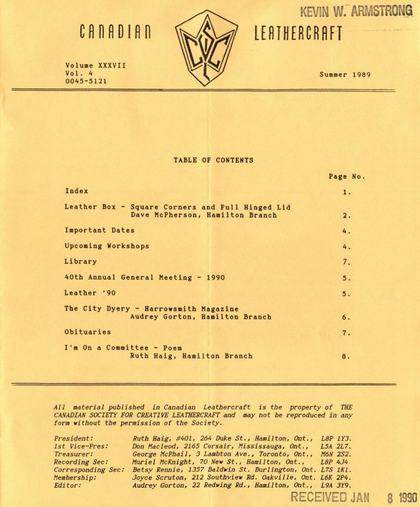
Page 1
Canadian Leathercraft
Volume XXXVII
Vol. 4 Summer 1989
0045-5121
TABLE OF CONTENTS
Page No.
Index 1.
Leather Box - Square Corners and Full Hinged Lid, Dave McPherson, Hamilton Branch 2.
Important Dates 4.
Upcoming Workshops 4.
Library 7.
40th Annual General Meeting - 1990 5.
Leather '90 5.
The City Dyery - Harrowsmith Magazine, Audrey Gorton, Hamilton Branch 6.
Obituaries 7.
I'm On a Committee - Poem, Ruth Haig, Hamilton Branch 8.
This contents list is printed one item to a line with its page number at the right. It is set out above in that form, matching the page's own order and numbers. Library is printed above the two entries for page 5, in the order the Society set them.
All material published in Canadian Leathercraft is the property of THE CANADIAN SOCIETY FOR CREATIVE LEATHERCRAFT and may not be reproduced in any form without the permission of the Society.
President: Ruth Haig, #401, 264 Duke St., Hamilton, Ont., L&P 1Y3.
1st Vice-Pres: Don Macleod, 2165 Corsair, Mississauga, Ont., L5A 2L7.
Treasurer: George McPhail, 3 Lambton Ave., Toronto, Ont., M6N 2S2. Recording Sec: Muriel McKnight, 70 New St., Hamilton, Ont., L8P 4J4 Corresponding Sec: Betsy Rennie, 1357 Baldwin St. Burlington, Ont. L7S 1K1. Membership: Joyce Scruton, 212 Southview Rd. Oakville, Ont. L6K 2P4. Editor: Audrey Gorton, 22 Redwing Rd., Hamilton, Ont., L9A 3Y9.
Page 2 — Leather Box - Square Corners and Full Hinged Lid, Dave McPherson, Hamilton Branch
LEATHER BOX - SQUARE CORNERS AND FULL HINGED LID MATERIALS.
Sole leather 7/8 oz. cowhide 7/8 oz. cowhide 4/5 oz. cowhide 4/5 oz. cowhide skiver (black, brown) dowel (wood) TOOLS strap cutter knife square 3/32' gouge edge beveller burnishing tool skiver fine sandpaper bottom 5 cm x 8 cm sides 5 cm x 29 cm inside lid 5 cm x 8 cm (optional) hinge top 14.5 cm x 9.6 cm hinge back 13.5 cm x 6 cm bottom 6 cm x 9 cm hinge pin 0.5 cm diameter x 10 cm long SUPPLIES water dyes - leather, edges white acrylic applicators paper towelling barge cement mixing containers working surface modeller
PROCEDURE.
1. Cut leather to sizes above.
2. Dampen sole leather, sign the piece with a pencil or modeller, dye, let dry and polish.
3. Dampen optional piece for inside lid, add design, if desired, by stamping or carving, keeping in mind that this piece will be trimmed a little to make it fit inside when the box is formed.
4. Dampen, then dye pieces for hinge, side and inside lid.. If desired, rub with diluted (very watery) white acrylic to accentuate the natural grain of the leather. This works well over navy blue or antique rouge.
5. Dye (dark), burnish and polish top edge and back of side piece.
6. Cut slots in hinge pieces. Be sure to mark exactly where cuts are to go with the knife blade not a pencil. Exact work is vital here. Measure up 6.1 cm from one end of the hinge top piece and place the ruler across the piece. Make the first mark in 1.8 cm from the edge, then every 1.2 cm until the last section is 1.8 cm or adjust so that the two outside measurements are the same. Make knife marks across the ends of the three pieces to be cut out. Hold knife blade vertically to cut across this end. It will be the bottom of the lid. Measure 2.2 cm along the piece to the other end of each slot, and measure across again to match the first end, i.e. 1.8, 1.2..., 1.8., and lightly mark across this second end of the slots. Cut the sides of the slots with knife vertical. The second end should be cut under on a 45 degree angle i.e. bevelled under so that it fits better on the other part
Page 3
of the hinge. Be sure not to over cut at corners. Sharp cuts are important. Now cut two slots in the back piece for the hinge in much the same way. Measure 4.8 cm in from one end which will go inside the box. All spaces across are 1.2 cm this time with the square end here. The slots are also 2.2 cm long and the other end of the slots is to be bevelled on a 45 degree angle. The part remaining is about 5.7 cm long to go down the outside of the box.
7. Edge bevel, a little, all five slots on the back side. Dye the edges of all five slots and the sides of the hinge back part. Do not finish the sides of the hinge top part since the edges will be trimmed later. Dye the back of both hinge pieces around the slots. Burnish these dyed edges and apply one coat of polish to prevent colouring other parts when the hinge is put together.
8. Dampen both hinge pieces sufficient to fit together and shape around the dowel. The pieces should be flat on the inside and fit together around a square corner. The bevelled ends of the slots should be on the outside of the hinge. The extra width of the hinge should be shaped up on the outside. Allow the hinge pieces to dry in the position it will be when it is on the box and closed. When damp, the hinge will probably be too tight to operate properly.
9. Flex the hinge to be sure it will work easily. If it is too stiff when dry it will be difficult to correct. Next time the length of the slots may need modifying to allow for differences in leather thicknesses. Take hinge apart and glue the hinge top part together. Now the hinge top part can be trimmed. There should be enough material over to allow trimming 0.1 to 0.2 (1 or 2 millimetres) off each side and the front. Measure with a square to be sure of proper shape. Dye and burnish the dyes of the hinge top part.
10. Put the dowel in the top part of the hinge. Mark the dowel ends flush with the edges of the hinge, remove it and cut off. Sand each end of the dowel smooth. Dye the dowel black and allow to dry. Use a modeller to apply Barge Cement to about 1.5 cm of each end of the dowel. Let dry.
Put the two parts of the hinge together and push the dowel into place. Press leather to the dowel to bond. Hinge is now ready to apply to box.
11. Cut four grooves across the back of the side piece at distances of 5.0 cm, 10.3 cm, 18.6 cm, and 23.9 cm from one end. Use a square across the piece and several runs of the gouge cutting a little deeper each time to a depth of a little more than half the thickness of the leather. Dye the grooves and smooth out any marks made by the gouge.
12. Dampen the leather around the grooves and fit around the sole base marking both ends of the strip. Trim off some leather if necessary but allow 1.0 cm to 1.5 cm overlap. Skive each end to a feather edge so that when overlapped there is only one thickness of the leather. Apply Barge Cement to the inside of the four grooves, around the bottom of the strip, on the two parts that overlap, and around the edge of the sole bottom. Let dry. Start at one end and press the side strip around the sole leather shaping the square corners as you go around. Fit the overlap together
[This page's six paragraphs are steps 7-12 of the procedure begun on p2, the step numbers printed at the start of each; p4 carries steps 13-16.]
Page 4 — Important Dates; Upcoming Workshops
carefully making the box length the same at the back as the front. Smooth corner grooves inside with a modeller.
13. One part of the hinge back part fits inside the box at the back and the other on the outside so that the overlap of the sides is completely covered. The inside part will need trimming to fit inside the box making the square (not bevelled) end of the slots about level with the top of the box side piece (about 4.5 cm long). Measure and trim. Apply Barge Cement to the inside back of the box and the inside part of the hinge. Do not try to do the inside piece and the outside piece at the same time. Let dry and then put together making sure the overhang of the lid is the same at both ends. Now apply Barge Cement to the back of the box and the inside part of the hinge. Let dry. Fit together being careful not to pull down too much on the back piece. Be sure the top of the hinge will stay closed on its own but sill have the hinge snug in place. Trim the excess off the back at the bottom.
The original prints "sill" for "still", kept exactly as printed.
14. Apply a strip of black dye around the bottom near the outside edge. Glue the skiver over the bottom. Trim carefully. Touch up and rub burnishing tool over the skiver edges.
15. Trim inside the lid (optional piece) to fit, dye and burnish its edges, and glue in place.
16. Apply polish coat, let dry, and polish three times.
David J. McPherson,
Hamilton, Branch.
IMPORTANT DATES
Judging for the Annual General Meeting of Articles for Associate and Fellow Standings and Weston Trophy pieces will be held at Bob Muma's at 10 a.m. on Saturday, March 24, 1990. All Fellows welcome to attend.
Judging for Leather '90 articles will be held at Bob Muma's at 10 a.m. on Saturday, July 28, 1990.
UPCOMING WORKSHOPS
January 20, 1989 - Toiletry Cases by Cliff McTavish at the Cooksville United Church. Cost $10.00 -- More information to follow in the next bulletin.
June 2, 1990 - Pattern Making by Muriel McKnight at St. Martin's-In-The-Field Anglican Church, Toronto.
Cost $15.00 -- Limited to 12 people -- Suggest that you get your name and cheque in to Muriel as this is a first-come, first-served basis. More information to follow in the next bulletin.
Page 5 — 40th Annual General Meeting - 1990; Leather '90
40TH ANNUAL GENERAL MEETING ELMHURST INN, INGERSOLL, ONTARIO
FRIDAY, APRIL 27, 1990 TO SUNDAY, APRIL 29, 1990 TO BE HOSTED BY THE WOODSTOCK BRANCH
The 1990 Annual will be hosted by the Woodstock Branch at the Elmhurst Inn, Ingersoll, Ontario. This will be held from Friday night, April 27 to Sunday morning, April 29, 1990.
Since this is our 40th Anniversary and many things are being planned by the C.S.C.L., we would like to see as many members present as possible to make this a memorable occasion.
There will be a table called "My Favourite Choice". This articles or articles will be the members own favourite/s and can have been made any time throughout the years.
As usual there will be a draw table -- please craft articles only, not necessarily leather but anything related to crafts.
Remember the fee for 1990 will be $20.00 for the C.S.C.L. We hope that you can make this fee payment up to and including March 31, 1990 to Joyce Scruton in order that we may avoid line-ups at the Annual.
Madeleine Mitchell of the Woodstock Branch would like to know as far in advance as possible the information regarding the renting of rooms for the occasion. She would like to know how many nights, one or two, what kind of accomodation, single, double, etc. so that she may make suitable arrangements for booking rooms. The prices of the rooms are as follows:
The original prints "accomodation" with one m, and "Anniversay" at the second of the two mentions below; both kept exactly as printed.
Single $74.00
Double $82.00
The registration fee will be $13.00 and the banquet cost is $22.00 for a total of $35.00.
Remember this is our 40th Anniversay and we would like to make it a real memorable event in C.S.C.L. history -- please make plans to keep this weekend aside and come and join your friends.
LEATHER '90
WOODSTOCK ART GALLERY
MONTH OF SEPTEMBER 1990
Leather '90 will be hosted by the Woodstock Branch and will be held at the Woodstock Art Gallery, Woodstock, Ontario for the month of September 1990.
Set-up of the juried articles will be on Wednesday, August 29, 1990 and the Official Opening will be on Saturday, September 8, 1990. The time of the opening will be on the offical Call for Entry.
[The page prints "offical" for "official"; kept exactly as printed. The page plainly prints "This articles or articles"; kept exactly as printed.]
Page 6 — The City Dyery - Harrowsmith Magazine, Audrey Gorton, Hamilton Branch
NATURAL DYES HARROWSMITH MAGAZINE
In the July/August 1987 (#74) edition of Harrowsmith, a Canadian magazine, I came across an article about natural dyes in conjunction with the dyeing of wool by Vivian Diane Preston of Kenabeck, Ontario. From this article I have extracted the information on natural dyes which I feel could be used in conjunction with the art of dyeing leather.
THE CITY DYERS
The discovery of natural dyes is commonly associated with searching the forests and hills for wild plants, but the city dyer, foraging in the cracks of civilization, can find abundant dye plants in the concrete jungle: burdock growing in wild profusion beside ageing buildings, bright yellow tansy flowering in abandoned lots and wild grapes spreading tendrils along the railroad tracks. Other exotic dyestuffs are usually sold by the bushel: pomegranates, onions, red cabbage and spinach. Roadside ditches yield milkweed, yarrow and goldenrod. Elderberry bushes are heavily laden with fruit in the autumn. Marigolds light the city with orange and gold. Oak, maple, poplar and walnut trees abound.
The three processes of dyeing -- mordanting, preparing dyestuff and dyeing -- are the same, city or country. Most dyers are limited to working in the kitchen, but fortunately, the required equipment is easily stored: enamel or stainless steel pots with lids, stirring sticks and rubber gloves.
The five basic mordants (chemical salts used to fix colours) and the colours they are primarily used to obtain are:
Alum (potassium aluminum sulphate) -- yellow shades
| Copper (copper sulphate) | green shade |
| Tin (stannous chloride) | red shades |
| Chrome (potassium dichromate) | orange shades |
| Iron (ferrous sulphate) | brown & black shades |
Onion skins are ideal dyestuff for apprentice dyers, with different varieties producing a wide spectrum of colour shades. Simmer 8 ounces of yellow-onion skins for one hour, strain and cool.
[Goldenrod’s second line, "gold/chrome", is a continuation row of the dyestuff table, as Black-oak bark’s and Birch bark’s second lines are two rows above. The same table continues onto page 7.]
The following are a few of the dyestuffs available, some of the colours they produce and the mordants required:
| Alder bark | brown/alum |
| Black-oak bark | tan/no mordant, |
| yellow/alum; gold/chrome | |
| Lemon-orange/tin | |
| Black-walnut hulls | browns/all mordants |
| Birch bark | tan/no mordant, |
| yellow/alum; gold/chrome | |
| Carrot tops | yellow/alum |
| Coffee | tan/no mordant |
| Dahlia flowers | yellow to gold/alum |
| Elderberries | lilac-blue/alum and salt |
| grey-blue/chrome | |
| purple to violet/alum | |
| Goldenrod | lemon-yellow/alum |
| gold/chrome |
Page 7 — Library; Obituaries
| Henna powder | reds/tin; rust/chrome |
| Holly | green/copper |
| Milkweed | yellow/alum, |
| greens/copper | |
| orange/chrome, brown/iron | |
| Poplar | yellow/alum; green/copper |
| Red Sandalwood (soaked for 3 days) | reds/all mordants |
| Sage | grey-greens/copper |
| Sloe berries | rose/no mordant |
| Sumac leaves | green/copper |
| Sunflower seeds | green/copper |
| Tansy | gold/chrome; green/copper |
| Tomato vines | red-brown/no mordant |
| Wild grapes | lavender/alum |
| purple/chrome | |
| Willow bark | tan/no mordant |
| brown-black/iron | |
| Wolf moss | yellow-green/no mordant |
| Yarrow | yellow/alum; green/copper |
| Zinnia flowers | yellow/alum; |
| orange/chrome |
[The table begun on page 6 continues here. Where a plant gives more than one result the page sets the further ones on lines of their own beneath the first, each with its own dash — Milkweed's three and Zinnia flowers' second, "orange/chrome", among them.]
Bear in mind that natural plant dyeing is not an exact art. Different soils, waters and growing conditions inevitably alter recipes somewhat. But whether one lives in the city or in the country, this ancient craft is waiting to be rediscovered.
Submitted by Audrey Gorton.
Hamilton Branch.
LIBRARY
The new librarian, Rene Hackstetter, is revising the reference, book and slide libraries. Lists of contents are being made of all material the C.S.C.L. owns. This is a very time-consuming job and we all appreciate what Rene is doing for the C.S.C.L.
Rene would appreciate any slides of personal or C.S.C.L. work that you may have in your possession in order that he may fill in gaps he has encountered.
OBITUARIES
It is with regret that the
Executive Council of C.S.C.L. announces the passing of three Toronto Branch Members -
Gel and Lorna Brigden
Page 8 — I'm On a Committee - Poem, Ruth Haig, Hamilton Branch
I'M ON A COMMITTEE
Oh, give me your pity,
I'm on a committee,
Which means that from morning to night, We attend and amend,
And contend and defend,
Without a conclusion in sight.
We confer and concur,
We defer and demur,
And reiterate all of our thoughts, We revise the agenda,
With frequent addenda,
And consider a load of reports.
We compose and propose,
We suppose and oppose,
And the points of procedure are fun, But though the various notions, Are brought up as notions,
There's terribly little gets done.
We resolve and absolve,
But we never dissolve,
Since it's out of the question for us, To bring our committee,
To end like this ditty,
Which stops with a period, thus.
Submitted by Ruth Haig,
Hamilton Branch