
An issue of the Society’s newsletter, transcribed from the original.
(12 pages, 1.8 MB)
the full-resolution scan, 30 MB, for close research
Page 1 — TENTH INTERNATIONAL ASSEMBLY OF LEATHER CRAFTSMEN
CANADIAN LEATHERCRAFT
Volume XIII No. 4 Summer, 1964
TENTH INTERNATIONAL ASSEMBLY OF Leather CRAFTSMEN
Toronto, May 1st - 3rd, 1964
The 10th IALC got off to a good start with coffee and doughnuts on the Friday evening. The hotel arrangements lent themselves to bring out the best in the displays, and éven the weatherman cooperated beautifully.
Each year shows a steady improvement in design and workmanship from all of the Guilds. Indeed the judges remarked on the improvement in styling, design and workmanship of leathercraft in a very short space of time - new ideas,techniques and materials were all to the credit of the members. There were a few outstanding pieces.
One hundred and eighty-one members registered. One hundred and nineteen attended the Banquet at which Nora Huyck's= small Trillium carved in leather was given as a favour. Bob Dengler was honoured as the "Instigator" of the IALC in a witty speech by Dr. Larmour who presented him with an honorary membership in the CSCL.
The demonstrations were crowded and notebooks were used extensively. A new idea of having the general business meeting held on Saturday night after the banquet so that Sunday morning could be devoted to a workshop proved very successful. During this meeting. a letter was read from Mr. L. F. Graff, Supervisor, Arts and Crafts Division, Government of Alberta, and brought personally to the IALC by the Government's representative Mrs. Phyllis Ponech a specialist Craft Instructor of the Recreation Branch of the Alberta Government, inviting leather craftsmen of Eastern Canada and the United States to submit entries to the Albertacraft '64 Exhibition in June.
All material published in "Canadian Leathercraft" is the property of the Canadian Society of Creative Leathercraft, and may not be reprinted in any form without written permission of the Society.
Editor: Mrs. Margaret McFarlane, 45 Summerhill Gardens,Toronto 7,Ont.
Authorized as Second-Class Mail by the Post Office Department, Ottawa, and for payment of postage in cash.
Page 2
Buffalo extended an invitation to meet there in 1966, and CSCL will again be hosts in 1967, but of course next year we go to Flint, Michigan on May 7th, 8th, and 9th. Our Flint hosts will have transportation with guides to the Planetarium and Cultural Centres. As accommodation is at a premium in Flint, reservations should be made as soon as possible at the Hotel Pickdurant, Sagneay Street, Flint, Michigan, U.S.A.
The Sunday workshop was very popular. Larry DeRosia instructed on Decorative Cuts and Design, and Clara Cavanagh instructed and supervised on making small leather trays. Congratulations are extended to the instructors and their helpers for excellent guidance. Trays were practically finished and the 58 members who registered for this project had a souvenir of the 10th IALC to take home.
[The ribbon lists are printed as two side-by-side columns — Salon Ribbons at the left, Craftsman Ribbons at the right, each grouped by guild with its number of ribbons at the far right — and are set out here a column at a time. The printed totals, 20 and 26, agree with the names and counts beneath them.]
SALON RIBBONS

CSCL - Sherle Bottrill (Barrie)    1
       Irva Ford (Hamilton)        1
       Nora Huyck (Barrie)         1
       Del Jacombs (Barrie)        1
       Gladys Miles (Toronto)      1
       Garnet Pratt (Barrie)       1
       Olivia Smith (Toronto)      1
       Jessie Trew (Barrie)        1
       Helen Wheaton (London)      2
       Janis Zalitis (Toronto)     1

Frontier
       Huldy Gutekunst             1
       Rhea Patterson              2

MLA -  Harvey Frick                1

Detroit
       Larry DeRosia               2
       Art Hinderlieder            1
       Dick Bayerl                 1

Flint
       Hazel Beardslee             1

                        Total  20
 CRAFTSMAN RIBBONS

CSCL - Bea Austin (Hamilton)       2
       Fred Brown (Toronto)        3
       Clara Cavanagh (Barrie)     2
       Hilda Darbyshire (Barrie)   1
       Irva Ford (Hamilton)        1
       Betty Heacock (Barrie)      1
       Nora Huyck (Barrie)         1
       Clarice Packham (Toronto)   1
       Janet Smith (Hamilton)      1
       Olivia Smith (Toronto)      1
       Jessie Trew (Barrie)        1
       Helen Wheaton (London)      1

Frontier
       Marjorie Brown              2
       Huldy Gutekunst             1
       Gail Stumpf                 1

MLA -  Harvey Frick                1

Detroit
       Larry DeRosia               1
       Art Hinderlieder            1

Flint
       Hazel Beardslee             1
       Dee Esler                   1

Eastern
       Gertrude Helfrich           1

                        Total  26
| Helen Wheaton (London, 2 Janet Smith (Hamilton) | a |
| Janis Zalitis (Toronto) ut Olivia Smith (Toronto) | |
| Jessie Trew (Barrie) | |
| Helen Wheaton (London) |
Frontier
| Huldy Gutekunst | dl Frontier |
| Rhea Patterson | 2 Marjorie Brown 2 |
| Huldy Gutekunst | |
| Gail Stumpf 1 | |
| MLA - Harvey Frick | i |
| MLA - Harvey Frick | |
| Detroit | Detroit |
| Larry DeRosia | 2 Larry DeRosia a |
| Art Hinderlieder | 1 Art Hinderlieder i |
| Dick Bayerl | |
| Flint | |
| Hazel Beardslee | |
| Flint | Dee Esler a |
| Hazel Beardslee |
Eastern
Total 20 Gertrude Helfrich 1
Total 26
Page 3
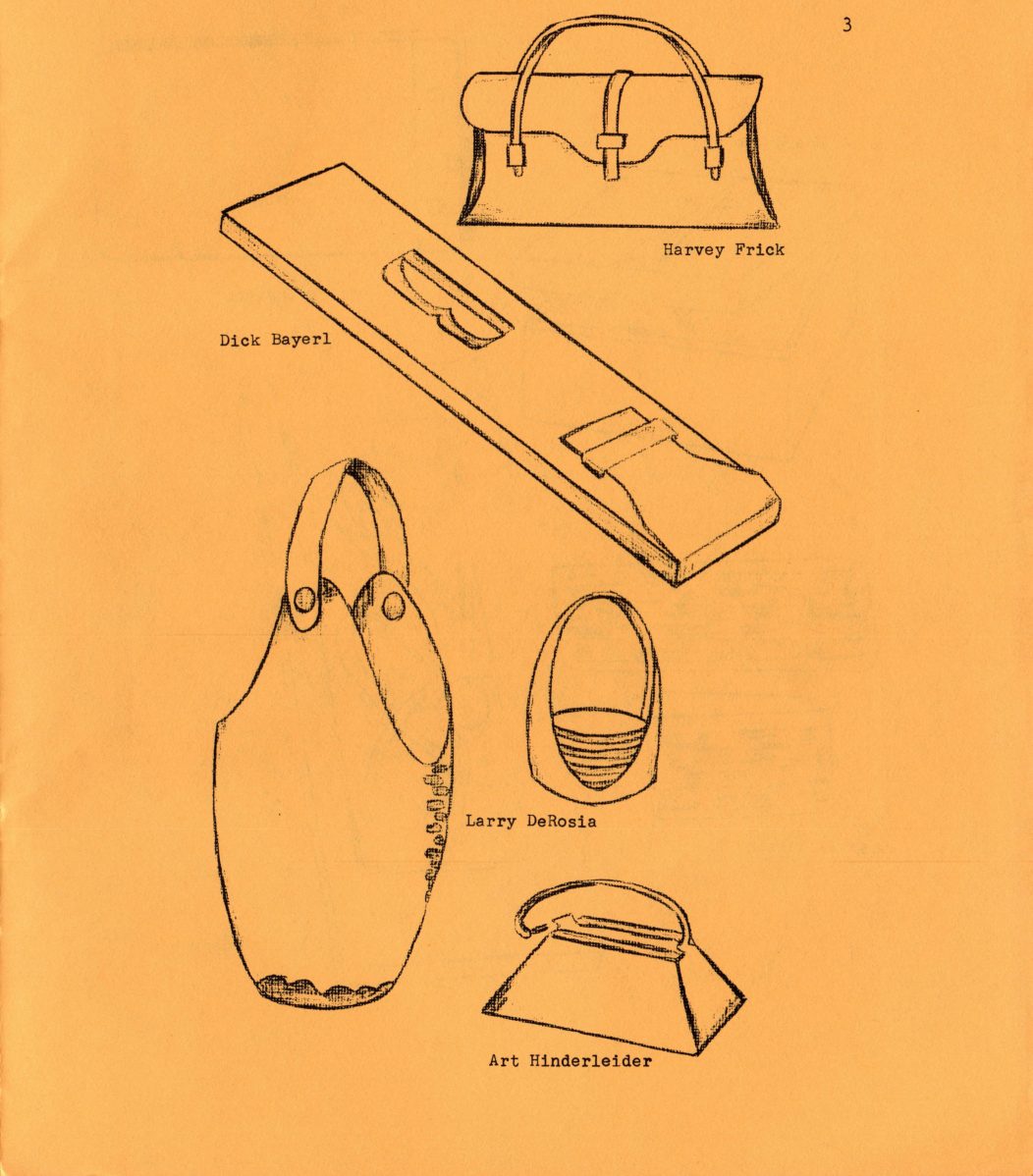
[This page is a plate of pen-and-ink sketches of leather pieces, each captioned with a maker's name, easy to read as garbled fragments of just the names. Transcribed below as printed. Context: this issue reports the 10th International Assembly of Leathercraftsmen, Toronto, May 1964; Larry DeRosia is separately named on p. 2 as the Sunday workshop instructor on Decorative Cuts and Design.]
Harvey Frick
Dick Bayerl
Larry DeRosia
Art Hinderleider
Page 4
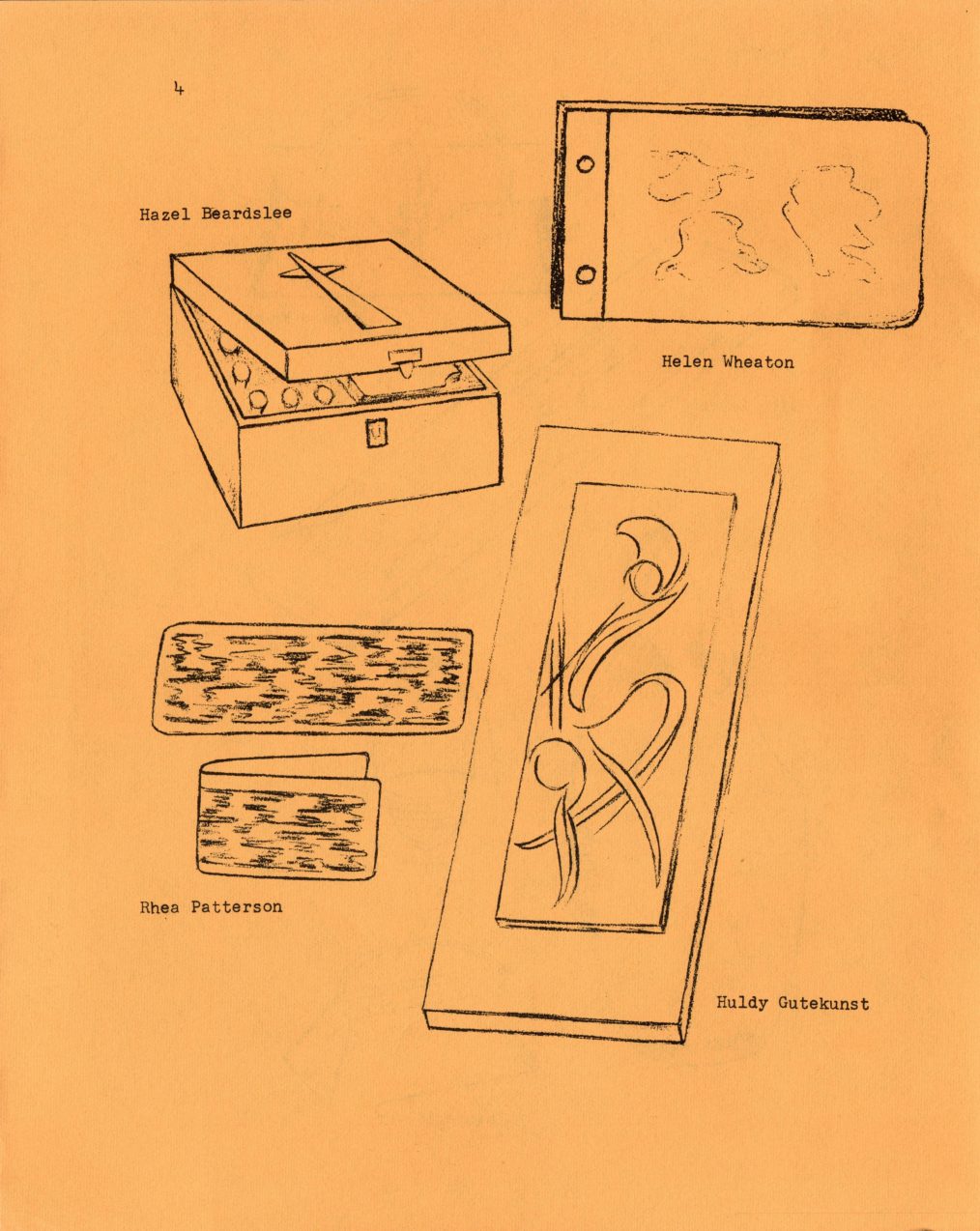
[This page is a plate of pen-and-ink sketches of leather pieces, each captioned with a maker's name, continuing from p3. Context: 10th International Assembly of Leathercraftsmen, Toronto, May 1964. Hazel Beardslee, Helen Wheaton, Rhea Patterson and Huldy Gutekunst; Helen Wheaton is separately named in the Salon Ribbons table on p2 (2 ribbons, London, Ont.).]
Hazel Beardslee
Helen Wheaton
Rhea Patterson
Huldy Gutekunst
Page 5
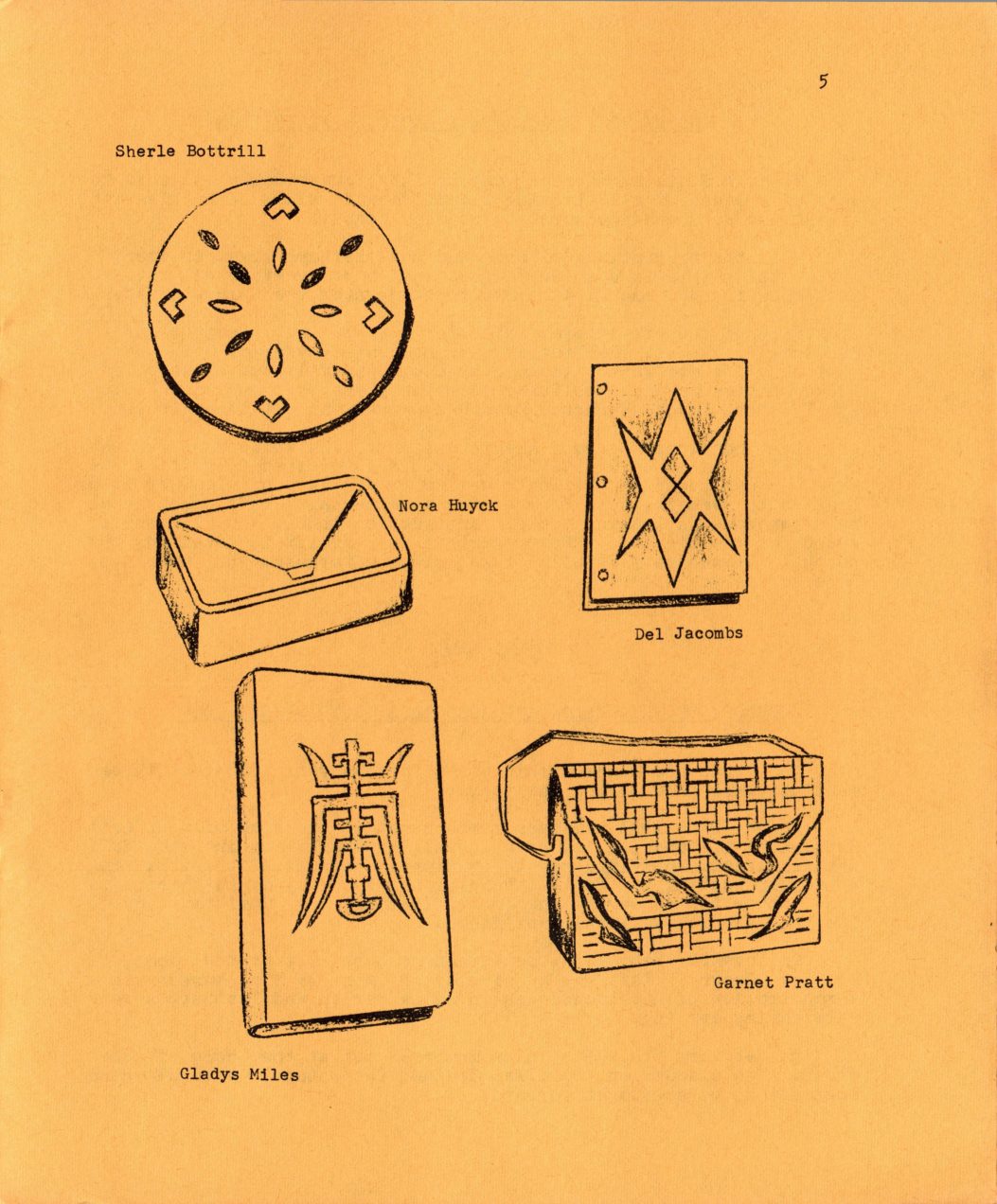
[This page is a plate of pen-and-ink sketches of leather pieces, each captioned with a maker's name, continuing from pp3-4. Context: 10th International Assembly of Leathercraftsmen, Toronto, May 1964. Sherle Bottrill, Nora Huyck, Del Jacombs, Garnet Pratt and Gladys Miles are all separately named in the Salon Ribbons table on p2.]
Sherle Bottrill
Nora Huyck
Del Jacombs
Garnet Pratt
Gladys Miles
Page 6 — HOBBY SHOW AT CANADIAN NATIONAL EXHIBITION; REPORT OF THE FELLOW AND ASSOCIATE GROUP - 1963-1964
HOBBY SHOW AT CANADIAN NATIONAL EXHIBITION
The C.N.E. is sponsoring one of the biggest Hobby Shows to be seen as a means of illustrating the different kinds of hobbies that are giving so much pleasure to so many people.
With the predictions of more and more leisure time for everyone we think this is a splendid idea and hope everyone will visit this Show in the General Exhibits building near the Prince's Gates.
Some of the crafts ares: Spinning and Weaving, Leathercraft, Metalcraft, Stamps, Railroading, Coins, and many more. In fact something for everyone's taste. No doubt you Will see or hear of these hobbies as wide publicity is being given by the Press, Radio and TV. Nora Huyck of Barrie Branch took part in one taped TV show.
Many handicraft groups are taking part. The whole show is noncommercial and is being staffed by people interested in hobbies. We have our own booth on the North wall with displays of leather items crafted by members, some from as far as Alberta. Craft houses have been generous in loaning tools, instruction books, and leather to round out the display. Forty members will assist in staffing the booth. Demonstrations will take place afternoons and evenings. Hope to see you there!
REPORT OF THE FELLOW AND ASSOCIATE GROUP - 1963-1964
The group had a membership of 40 for the year 1963-64. Three meetings were held during the year.
On May 24th 1963, sixteen members met at the home of Mr. Cecil Roebuck. The possibility of a Travelling Exhibition in the fall was discussed. This idea had to be dropped because of the work involved in hosting the Tenth International Assembly of Leathercraftsmen. Other topics were - the Annual Meeting, the Christmas Sale, and the Canadian National Exhibition.
On November 8th, 1963, seventeen members met at the home of Mr. Fred Brown. This was a display of work by Mrs. Wunsch and a demonstration of her techniques in using burlap and leather, a very interesting evening.
On February 5th, 1964, nine members met at the home of Fred Brown. The discussion topic was leather fastenings. Several good suggestions were brought forward.
Page 7 — A CASE
A KEY CASE by Nora Huyck, F.C.S.C.L.
Key cases come in many sizes and shapes to suit many needs.
If all you want is something to hold keys, then you might better buy one commercially made. If you have some special requirement - size, shape, design, etc., then you will probably have to make your own.
Mine: had to have a place for my driving licence and a small pocket for change. It is a six-hook key case about the regular size. When opened flat it is 6½" x 3¼". The keytainer is on the usual tab which is laced or stitched in at the top and V shaped at the bottom.
The pocket and licence part is made as a unit and laced or stitched in at the end opposite the flap after the lower part of the dome which closes the key case has been installed. The flap of the little pocket is elongated enough to hold the licence, thus necessitating one fold before it domes on the pocket front. The pocket front is about 1 5/8" x 34" and the bottom part of a dome is installed about 3"
Faq. 4 from the bottom Fig. 1. The back and flap is one piece of leather about 5½" x 3¼". It will fold twice as indicated by the dotted lines in Fig. 2. The front of the pocket is installed as indicated in Fig. 2. The left top part of the dome is installed in the end of the flap so that when folded it will dome down on to the part already installed on the pocket front. The cap will ry LULL (La Fig 2 pear on the flesh side. The shaded areas indicate the parts to be skived. These skived portions are folded over and cemented down to two celluloid windows through which the licence can be seen.
Two windows are necessary because of the fold. The four small pieces cut out - marked x are necessary to make the flap fold easily. The final unit ready to install is Fig. 3.
[The title is printed "A KEY CASE", underlined.]
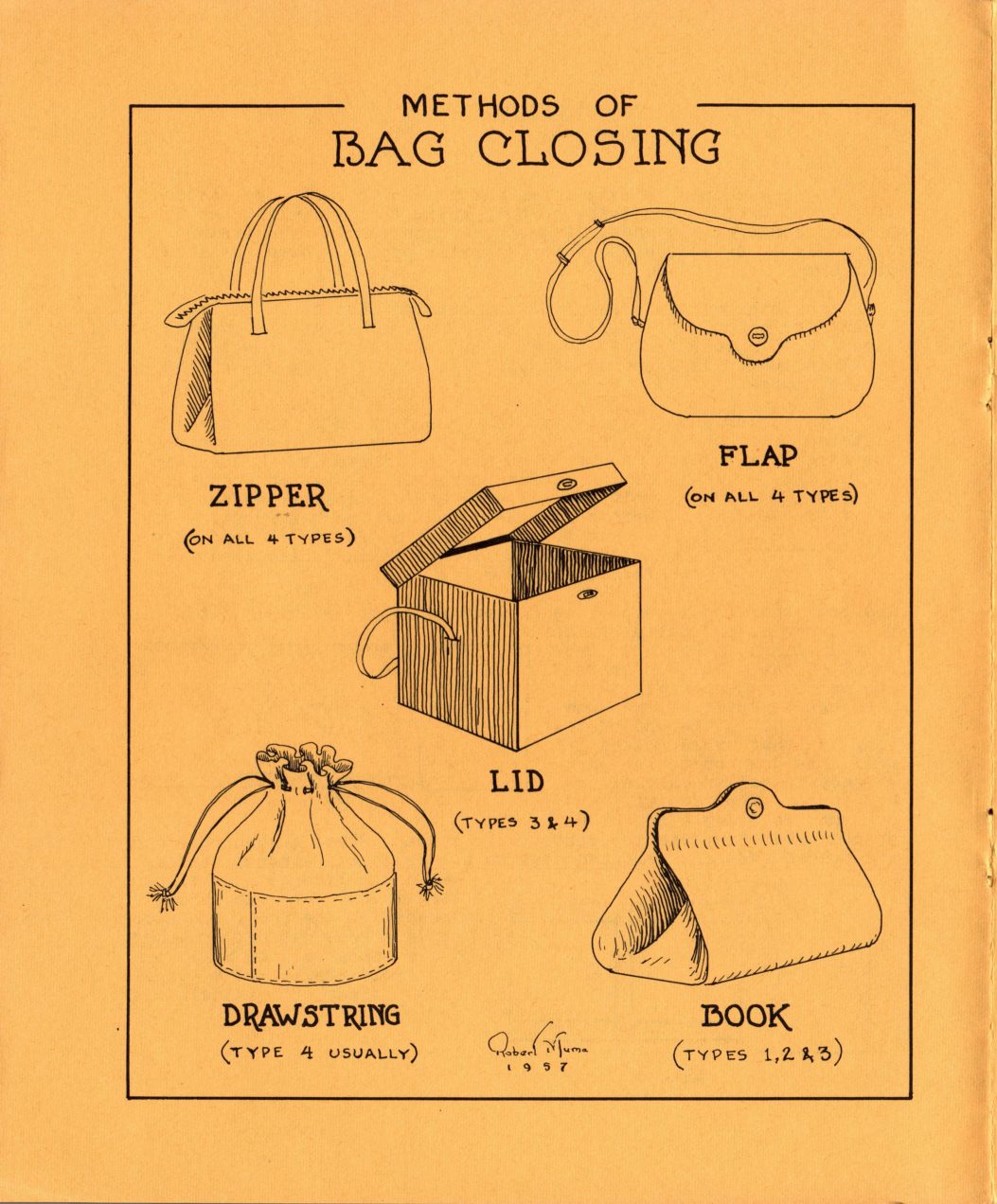
Page 8 — METHODS OF BAG CLOSING
METHODS OF BAG CLOSING
ZIPPER (on all 4 types)
FLAP (on all 4 types)
LID (types 3 & 4)
DRAWSTRING (type 4 usually)
BOOK (types 1, 2 & 3)
Robert Muma, 1957
[This page is a hand-lettered instructional plate by Robert Muma (signed and dated 1957) showing five bag-closing methods, each sketched: a zippered top-handle bag, a flap-and-stud shoulder bag, a hinged lid on a box-form bag, a drawstring pouch, and a book-style clasp purse. Set out here in full; read straight through it gives only fragments.]
Page 9 — ZIPPER CLOSING VARIATIONS
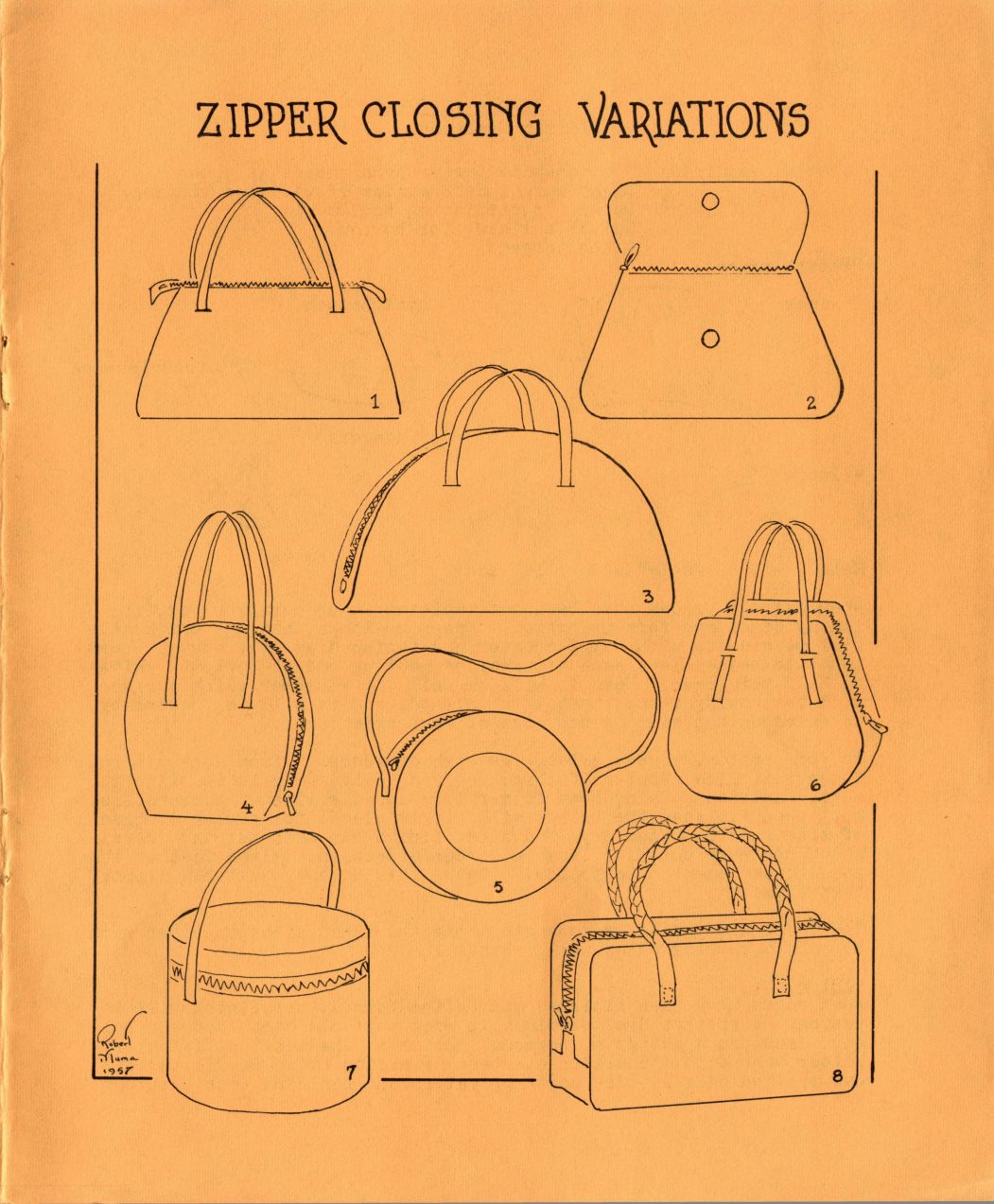
ZIPPER CLOSING VARIATIONS
[This page continues the bag-closing plate from the previous page (“Methods of Bag Closing”): line drawings of four zipper-closing variations, with no other caption text; easy to read as a few stray characters.]
Page 10 — MAKING A TOTE BAG
MAKING A TOTE "BAG by Lillian Neelands, A.C.S.C.L.
Material required: 7oz. cowhide for pattern pieces as shown.
Light weight calf strips £" wide for binding. Darex for stiffening bottom.
Suitable lining for bottom.
Linen thread.
Pattern pieces:
2 sides ae Os oval bottom
: 2 hangers Ee re 4 loops "O} oo { % ! t
Handle - 1 piece 13" wide x 18" long.
When pattern pieces have been cut, moisten in preparation for finishing edges and forming bottom. Edges on loops, hangers and handle will be creased with No. 5 creaser and finished as belt edges. Where two thicknesses lap, such as in sides meeting and at bottom, skive to half thickness. Here it will be well to remember which surface will be showing since the bag is unlined, and it will be necessary to skive on top side on one edge of each side panel.
To form bottom, make a guide line with dividers 4" from edge all round. Gouge this line about half thickness and skive from this line to edge. Moisten. Using bone folder form up edge without puckers, so that when finished the bottom will fit in place for sewing at base of side panels. When dry (and after finish has been put on) darex which has been cut 3/8" less in circumference and skived feather thin at edge is cemented to bottom. Over this cement suitable lining then trim.
The loops are formed by cementing the two flesh sides together with Barge and rubbing edges well. Press.
Finish
When edges have been finished and bottom formed, the finish will be put on. A spatter dye technique is most suitable here, and the colours used are a matter of personal choice. The most satisfactory colour scheme to the writer has been a medium brown Brazilian oil dye applied over a base coat of yellow and finished with chestnut
Page 11 — CHRISTMAS SALE
[This caption wraps around a sketch of the finished bag; read straight through instead of around the sketch, it scrambles into "has a Cy years now and is standing years now and is standing up well". Set out here as "has been in use for three years now and is standing up well".]
antique and polish coat. Lay all pieces out on newspaper and try for an even coat. This takes patience but is well worth the time spent. The flesh side was finished with Mac's brown edge dye rubbed in by hand, but there are many satisfactory finishes on the market. Assembly
The calf strips are hand sewn to the top of the side panels (5 stitches to the inch). These panels are now joined and sewn, and the bottom fitted in, glued and sewn. Care must be taken to have this fitted properly, and a small mark at the true sides (on bottom piece) will greatly help. The handle may now be sewn into the wider end of the loops and then a fitting made to find the exact place where the hangers will be sewn to the bag. first inside and then with the handle attached to the outside.
The original bag has been in use for three years now and is standing up well, but people seem drawn irresistibly to throwing scraps in it if it is ever set down.
CHRISTMAS SALE
The date of this popular Sale has now been confirmed. It will be held November 18th, 19th, 20th and 21st in the Gallery of the Canadian Handicrafts Guild Shop, 77 Bloor Street West, Toronto. The Shop is open Thursday and Friday evenings.
As mentioned in our last bulletin we hope to have a good quantity of high standard articles for our increasing clientele.
Question: To what degree should you sand back of a leather tray? Answer: It should only be sanded until you have a smooth surface to finish.
Question: Should the scars be removed? Answer: Depends on the depth of scar. Should not attempt to remove them if deep. A smooth back is more important.
[A stray underscore is not part of the printed text: "have a_ good" is set out here as "have a good".]
Page 12 — OFFICERS AND EXECUTIVE COUNCIL 1964-1965
OFFICERS AND EXECUTIVE COUNCIL 1964-1965
Elected at Annual Meeting, Barrie, Ontario, April 4th, 1964
Past President - Mr. Harold Wilson, 400 Charlton Ave. W.,Hamilton, Ont.
President - Miss Viola E. Harris, 47 Snowdon Ave.,Toronto 12, Ont.
Vice-Presidents- Mrs. Dorothy Muma, 118 Hazelton Ave., Toronto 5, Ont.
Mrs. Irva Ford, 30 Arkell Street, Hamilton, Ont.
Recording Secretary - Mrs. Thelma Terry. Apt. 6, 27 Cliffside Dr. Scarborough,Ont.
Corresponding Secretary - Mrs. Sherle Bottrill, 107 Donald Street, Barrie, Ont.
Treasurer - Mr. Cecil J. Roebuck, 22 Khedive Street,Toronto 19, Ont.
EXECUTIVE COUNCIL
Miss Bea Austin. 167 Emerson Street, Hamilton, Ont.
Mr. Gel Brigden. 404 Rosemary Road, Toronto 10, Ont.
Mr. Fred Brown, 9 Nashland Avenue,Islington, Ont.
Mrs. Clara Cavanagh, 10 Duckworth Street, Barrie, Ont.
Mrs. Sylvia Gerster, 675 Emery Street, London, Ont.
Mr. Alvin Haig, O.T. Dept., Chedoke Hospital,Hamilton, Ont.
Miss Betty Henstridge, 38 Barnsdale Ave. N.,Hamilton, Ont.
Mrs. Anne Hook, 32 Mountview Avenue, Toronto 9, Ont.
Mrs. Nora Huyck, R.R. #3, Newmarket, Ont.
Dr. and Mrs. R. Larmour, 275 Main St. W., Grimsby, Ont.
Mrs. Margaret McFarlane, 45 Summerhill Gardens,Toronto 7,Ont.
Mr. Robert Muma, 118 Hazelton Avenue, Toronto 5, Ont.
Miss Clarice Packham. 62 John Street. Weston, Ont.
Mrs. Sadie Roebuck, 22 Khedive Street, Toronto 19, Ont.
Miss Olivia Smith, 32 Mountview Avenue, Toronto 9, Ont.
BRANCH PRESIDENTS
Mrs. May Corbett, 10 Highland Avenue, Barrie, Ont.
Mrs. Jean Newton. 614 Huron Street, Toronto 5, Ont.
Mrs. Nina Wilson, 400 Charlton Avenue W., Hamilton, Ont.
Mrs. H. M. Wheaton, 100 Grand Avenue. London, Ont.
"Small World" Department
While attending the tenth IALC in Toronto, Daphne Lingwood met her brother unexpectedly in the lobby of the Park Plaza Hotel. He was passing through Toronto on his way back from Japan, and Daphne had no idea he was anywhere near Toronto.
wee
The slate is printed one office and one member to a line, each name followed by that person’s address. “Small World” Department is the heading of the piece below.