
An issue of the Society’s newsletter, transcribed from the original.
(12 pages, 1.8 MB)
the full-resolution scan, 31 MB, for close research
Page 1 — CANADIAN SOCIETY FOR CREATIVE LEATHERCRAFT - 25th Annual Meeting
Canadian Leathercraft
Volume XXIII No. 4 Summer 1975 (June)
CANADIAN SOCIETY FOR CREATIVE LEATHERCRAFT - 25th Annual Meeting Geneva Park, Lake Couchiching - April
Approximately 90 members attended the 25th anniversary convention, An exciting agenda had been drawn up for the weekend.
The business meeting dominated Saturday morning. As a point of interest, Ray Potter read the minutes of the first organizational meeting twenty-five years ago at which there were 17 people present. Robert Muma of Toronto presided at the meeting. The group called themselves the Canadian Society of Decorative Leathercraft and a constitution was drawn up. A standard of high craftsmanship was set up and it was decided that before joining the organization, each person must submit work for approval. The aims and objectives of this group was to form a society to promote leathercraft. Of the original members, Mr. Potter and Miss Clarice Packham were present for the convention.
Jean Hunter, a member of the Library Committee, then reported that of the cases of books for distribution, three cases were ready for Belleville, Hamilton and Woodstock. Barrie and Toronto were to receive theirs shortly. It was decided that the books were to stay in each branch for a period of four months and that a one month notice would be given before the books were to be returned,
Margaret Monteith, the corresponding secretary, read a letter acknowledging that space 55 would again be allotted to the C.S.C.L. at the C.N.E.
Weston Trophy - Beula Reynolds announced that this year's winner of the Weston Trophy was the Woodstock branch with a score of 87.6%. Anne Hook presented the five ribbons to the participants. The other scores were as follows: Barrie 80.2%, Belleville 66.2%, Hamilton 85%, Toronto 87%. In previous competitions, Toronto has won 8 times, Barrie 5 times, Hamilton 4 times, and London once.
Mrs. Jean Hunter, who comes from Brampton, was admitted to the Associates. Jean has been working in leather for approximately twenty-five years and has studied under Jessie Little and Isabel Joyce. She had been teaching in Peel County but retired last Christmas. Jean has taught basic crafts and leathercraft at T. L. Kennedy Secondary School.
All material published in "Canadian Leathercraft" is the property of the Canadian Society for Creative Leathercraft, and may not be reprinted in any form without permission of the Society.
President: Mrs. May Corbett, ACSCL, 10 Highland Ave., Barrie
Vice-President: Mrs. B. Reynolds, ACSCL, 500 Parkinson Road, Woodstock
Editor: Mrs. M. Monteith, Lambeth
Page 2
Jean has also sponsored a leathercraft club at the school to create an interest in the craft. Her special skills in leathercraft are: tooling, carving, colouring, lace-cutting and braiding. She has been a very valued member of the Larmour Library Committee, putting in endless hours of work so that the boxes would be ready for distribution at the 1975 Annual meeting.
Mrs. Carol McLean was given her Fellowship standing. Carol became an Associate member in 1970 and has been practicing leathercraft for 12 years. She studied Leathercraft for two years at night school in Woodstock and took Advanced Leathercraft from Irva Ford, Hamilton; from Clara Cavanagh at Georgian College, Barrie; and from Anne Hook and Olivia Smith, Toronto. Carol has taught leathercraft for five years, for Oxford County Board of Education night school, and has taught a course for Fanshawe College, London at its Aylmer Satelite night school programme.
Carol's article on Sculptured Masks appeared in Canadian Leathercraft, Vol. XX No. 2 Winter 1971 and in Craft Dimensions, June 1971. Carol is a Charter Member of the Woodstock Branch, and has held the following offices: President, Treasurer, Publicity and Historian, Programme Chairman. She has been on the C.S.C.L.
Executive Council for 7 years, during which time she has served as Recording Secretary, Publicity Chairman, and has been a member of many committees.
Miss Clarice Packham donated a book to each of the members and one to Mrs. Madeleine Mitchell, who was the newest member receiving the highest mark in the Weston Trophy competition.
Miss Bea Austin presented a life membership to Mrs. Lorna Brigden in appreciation of her many years of services to C.S.C.L. This was accepted by her husband Gel. An Honorary Life Fellowship was presented to Edith Roscoe and Clarice Packham.
Jean Newton presented the ribbons for "Leather '74"'. The craftsmen winning the awards were: Itsuko Yasui, Daphne Lingwood, Anne Hook and Irva Ford. Honourable mentionnwas given to Clara Cavanagh, Daphne Lingwood, Rex Lingwood, Jessie Little, Paul Williams and David Trotter.
After the slate of officers was drawn up for the 1975-76 year, Irva Ford presented Helen Wheaton with a gift as a token of appreciation for her three years of service as president.
Hope Drysdale, President of the Hamilton branch, then extended an invitation to the membership to hold the next annual in Hamilton before the meeting was adjourned.
During Saturday afternoon, several craftsmen gave notable demonstrations in the following: Dyeing techniques - Jessie Little Pine cone carving - John Marsden Nature tan leather - Jack Meharg Cattails - Mrs. V. Farrara, Wallet Interiors - Clara Cavanagh, Braided belt -Muriel McKnight Wallet for adult beginners - Ruth Haig, Hobbies in Aging - Margaret Jennings Inlay work - Nora Huyck.
Saturday's after dinner speaker was Marie Aiken. Marie, who hails from Alix, Alberta, now lives in Gravenhurst where she has converted an old potassium plant into a studio home where she now works primarily in weaving, spinning, primitive weaving, and creative stitchery. She spoke on leather and suede garments and by means of an overhead projector, illustrated how garments could
Page 3 — C.S.C.L. Executive 1975-76; THE QUESTION BOX
be made from skins utilizing every bit of the hide. She also illustrated styles of other periods in history to show the complete utilization of the fabrics that were available at the time.
The final morning of the weekend was taken with the viewing of award-winning slides and a question and answer period. Mr. Fred Brown with his panel made up of Carol McLean, Nora Huyck, Edith Melchior, and Jean Newton ably answered questions that had been submitted to the question box.
The weekend provided something new for everyone and proved to be very rewarding.
C.S.C.L. Executive 1975-76
Past President        - Helen Wheaton     Recording Secretary        - Kay Cloughley
President             - May Corbett       Corresponding Secretary    - Sherle Bottrill
1st Vice-President    - Beula Reynolds    Treasurer                  - Dorothy Proctor
Executive Council - Bea Austin, Clara Cavanagh, Fred Brown Gel Brigden, Evelyn Burgess, Jessie Little, Margaret Monteith, George McPhail, Carol McLean, Olivia Smith, Sadie Roebuck, Robert Sutton, Marion Kehoe Jean Hunter, Irva Ford Anne Hook - Chairman of the Council of Fellows
The branch presidents below print in two columns, the second naming Toronto and Woodstock.
Branch Presidents: Barrie - Garry Walsh, Belleville - Irene Girling, Hamilton - Hope Drysdale, Toronto - Gladys Riddell, Woodstock - Beula Reynolds.
THE QUESTION BOX
Some of the questions submitted by members during the weekend.
Q. What can be done to prevent stretching of the lower back of a leather coat after it has had considerable wear?
A. This is known in the trade as "rump sprung" and might be avoided by having the lining a little tighter than the coat. The lining can also be reinforced with the fine iron-on interfacing.
Q. How can you remove a stain from a purse that has been finished with Garnett dye and polish coat since polish coat remover is no longer available? A. Most solvents or cleaning fluid are almost as good. It may require another coat of dye. Under no circumstances should you use turps.
Q. How can you dye lacing which is pre-finished as most dyes won't take? A. Use stain remover to clean lacing off first or use fine emery paper and rub lightly, then dye will penetrate.
MEMBERSHIP FEES ($5.00) should be forwarded to the new Membership Chairman:
Mrs. Jean Hunter
39 Hillcrest Ave,
Brampton, Ontario
L6W 1Y7
Page 4
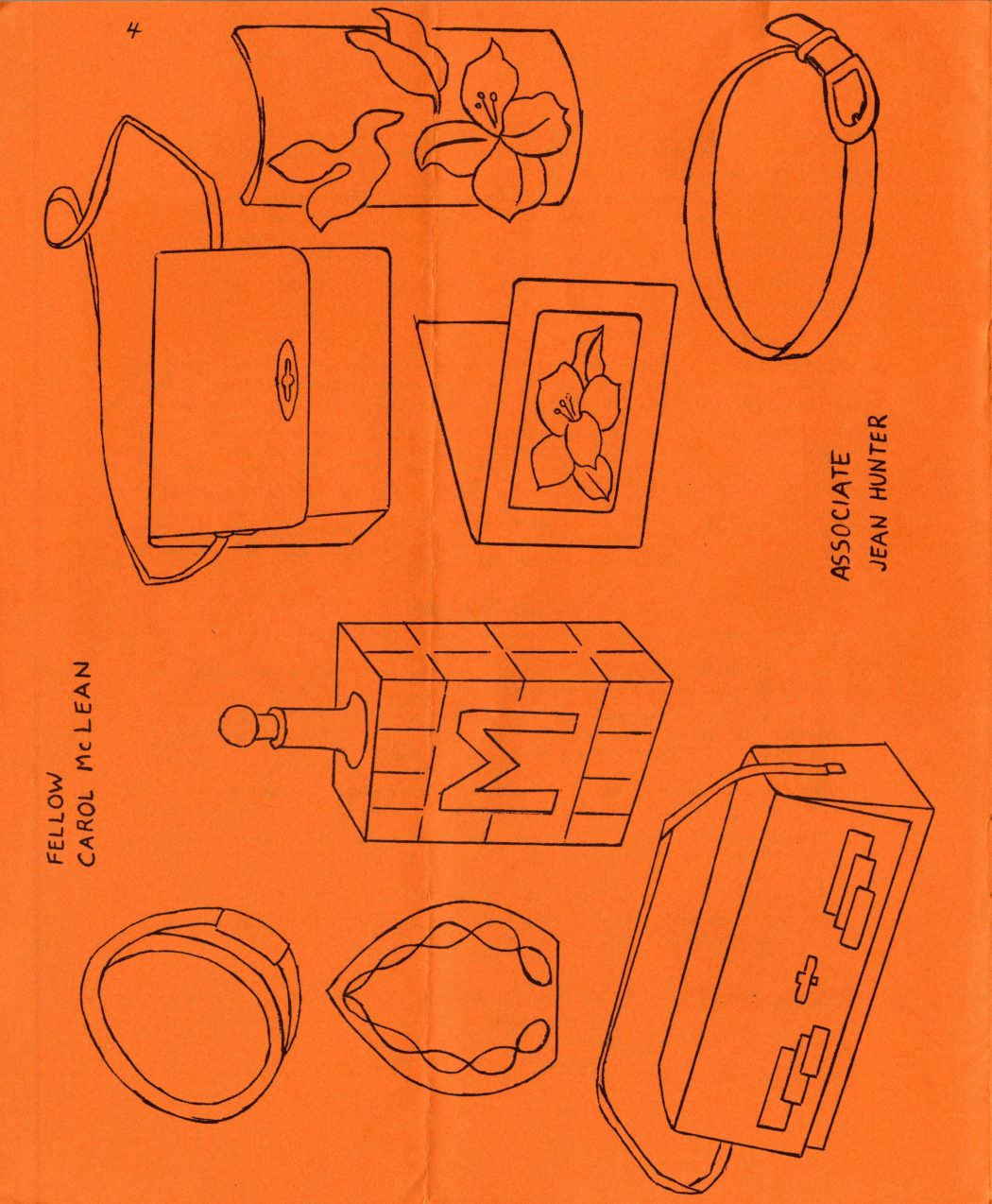
This page is a plate of pen-and-ink sketches — jewellery, handbags, a picture frame, a monogrammed box — with two names hand-lettered sideways in the margins: FELLOW — CAROL McLEAN, and ASSOCIATE — JEAN HUNTER.
Page 5 — WESTON TROPHY COMPETITION
WESTON TROPHY COMPETITION
Stamp Book - The book has a very pleasing appearance. The design is quite suitable and well tooled--even the tops of the screws have been covered. The inside lining is bumpy. It 0 is a thin shiny leather which is difficult to handle. We learned later it was the choice of the person for whom the book was made and not the choice of the craftsman. The lining was well skived and evenly applied. The embossing wheel was used around the edge.
Stamp Book - Edith Melchior
Book ends - The sponge technique has been used to dye these book ends. It has been done very nicely and no other design was necessary. Padding has been used to give a rounded appearance. The edges were bumpy in a few places and the judges wondered why. It could have come from the metal form or some of the padding could have been pulled over the edge when the leather was pulled onto the back of the metal form. The edges were well skived and turned and the lining on the back which was also dyed with the sponge technique was well applied.
Book ends - Beula Reynolds
Belt - This belt has a very interesting two tone buckle which blends in well with the design. It is a subdued design which needs to be seen close up to be appreciated. The fact that it is subdued allows it to be worn with light or dark colours equally well. The edges and back are well finished--the back almost too well. It is slippery smooth and the judges wondered if it might slide around out of place very easily when being worn.
The maker's given name below printed too faintly to read clearly; two closer readings agree on "Lerene" rather than the "Serene" a first pass gave, and it is set that way here, but the name is not settled enough to link to any similarly-named member elsewhere in the archive.
Belt - Lerene Manuel
Page 6
Brown bottle - A very elegant appearance. The cap fits loosely but only because the cork has dried out. When it is plump with moisture it will hold in place and won't detract from the appearance of the bottle. The ends of the leather that go around the bottle have been butted and the join is quite obvious in some places, where the leather has shrunk a trifle. An overlapping join might be better or the join could be worked into the design in such a way as to be inconspicuous. The tooled design is good and the bottom piece has been well skived.
Brown bottle - Hilda Darbyshire
Flame bottle - It is a beautifully chosen shape, suggesting a flame. The flame shape is emphasized in the colouring. It is shaded beautifully from bottom to top in flame colours. Two pieces of leather have been used and the joins on either side have been disguised with very narrow strips of the same leather dyed to blend with the other parts of the leather. The thin pliable leather has allowed the craftsman to mould it very well to the shape of the bottle.
Teardrop or flame bottle - Madeleine Mitchell
Page 7
BARRIE - 80.2%
Covered Bottle - The shape is interesting and the two shades of green go together very well. The darker shade used for the stripes on the four corners and on the cap appears to be a leather rather difficult to handle. It stretches as it is skived and cut making it impossible to get a fine edge.
Bookbinder - This is made of mission grain steerhide--one of those leathers which is very had to get now. It is only marred by a few scratches on the back--those scratches tell you it is leather and not plastic. The workmanship is excellent--the turned edges, as well as the skiving and application of the lining. To protect the front and back from being marred by the rings, a strip of red American pressboard has been fastened in along the spine.
Handbag - It has a very nice appearance. It opens easily and the gussets are wide enough to give lots of room to get at the contents of the bag. The gussets are a bit high, causing them to press against the top. When held by the strap, the bag seems to swing forward. The bevelling around the design is rather sharp, otherwise, the carving is good and the design is quite suitable for the shape of the bag.
Tote Bag - The body of the bag is dark brown moccasin suede, the strapping is natural cowhide--an excellent bag, both in workmanship and design. Saddle stitching is used to join the various parts of the bag and is an outstanding job. The handle is padded and even the edges of the suede on the underside are turned in under the cowhide of the handle. The draw tie is machine belting which has been highly polished.
Clutch Purse - This is a very practical shape, which fits very comfortably in one's hand and opens easily. The amount of the design is maybe a bit overpowering for a small bag. Both the carving and the colouring of the design are very good. The lacing is exceptionally well done.
BELLEVILLE - 66.2%
Gloves - The decorative points on the backs of the gloves are nicely finished at each end. The stitching could be more uniform with guard stitches at the bottom of each finger. Unfortunately, the gloves weren't pressed properly to show to good advantage.
Wallet - It is a very nice piece of morocco. The lacing is a bit heavy for the fine grain of the leather. The lap in the interior is a bit lopsided-- probably caused by the bottom part of the dome being off centre. The part of the interior that joins the two sides and provides the telescopic action is excellent.
Belt - This is a very nice belt. When worn, the rivets don't show, when outstretched, they appear to have been poorly set. The shell tool could have been used more effectively in the design. The design itself is very good and the colouring gives a very nice effect.
Purse - It has a very good appearance; the strap is a good length and continues the line of the slanted sides of the bag. The gussets are inclined to pop out beyond the sides of the bag. The lacing on the strap gives a heavy look and could wear a coat sleeve. The bag is nicely lined; it opens well and the open pocket on the back is a useful addition.
T.V. Guide Holder - This was quite a conversation piece with its little covered wagon decoration on the front. All the individual parts are well finished; a couple of edges need more bevelling. All the edges are well polished.
Page 8
Desk Pad - This has a very good appearance, even though the top and bottom edges are a bit uneven and the 3D tooling seems to need more working. The pad is all leather--the base is made of leatherboard and the raised parts of the 3D design. The design is good and the edges are well turned.
Belt - This is an eye-catching piece of work with a very "mod" look. It is a novel idea for a fastening--a harness ring which has been beautifully covered. The design is big crosses made by crossing strips of leather on the front of the belt, threading them through slits in the leather to the back of the belt and out to the front again to form another cross and continuing this way to the end of the belt. This formed raised parts on the back of the belt. The judges wondered if these would be felt by the person wearing the belt. All the edges, even the strips forming the design were well finished.
Saddle Bags - This is an ambitious piece of work, the saddle stitching is excellent and the dye job is very good. The small rose design carved on the top seemed a bit out of place. The bear on the side could be lowered some, since it ''got caught'' in some of the stitching. The really outstanding part of this project is the moulded gusset.
Box - It is a nicely designed box with a very good appearance. The leather hinge is rather tight. On some of the inside corners, the mitre is more obvious than it should be. Most of the outside corners are well skived and neatly finished. The 3D design has been well done.
Container for long matches - A very beautiful and sophisticated piece of work in excellent style. The technique is ''Cuir Bouilli''. The join had been skived and overlapped and the join was covered with a piece of lacing. The novel decoration is a piece of baby seal fur.
TORONTO - 87%
Ship - This is an amazing piece of workmanship. The detail is perfect ''beyond belief". It is actually a double pen stand with the pens acting as the masts. Since the boat is in natural coloured leather, the dark colour of the pens has been made part of the overall design by having the rudder and the figure on the brow a dark colour. The name plate for the boat was written with a felt pen.
Purse - This is a dainty elegant bag. The only bit of applied design is the small amount of tie dyeing around the bottom. The straps are beautifully finished and it is very neatly lined.
Bag - This is a very colourful bag with the design in yellow, orange and red shades. It is a well controlled job--a resist technique. The part of the gusset that holds the loops for the strap needs some reinforcement and deeper crimping of the gusset would have avoided the slightly dished appearance of the front and the back. The judges' comments on the design were interesting--for some, the design seemed to pull one's eyes to one side, for others the design was lost as it continued onto the back, for others the design was fine.
Wallet - This was a beautiful wallet; the flow of the design and the colouring are both excellent. The only suggestion for improvement offered concerned the top centre of the interior piece that joins the two sides of the interior--It is so close to the top that it can't slide back and forth easily.
Jar - This is an elegant piece with excellent design. The stacked leather technique was used with tooth brush spatter dyeing on the top and bottom. Every detail has been thought out well--even the way the leather is stacked-- just slightly uneven to avoid the monotony of perfection, but that unevenness so carefully planned as to retain the overall rectangular appearance. The rectangular knob on top tapers to smaller at the bottom for easy lifting.
Page 9 — PATCHWORK ANYONE?
PATCHWORK ANYONE? by Carol McLean, F.C.S.C.L.
Have you ever thought how the simplistic beauty of a patchwork design would look on a leather article? We have seen how lovely macramé can be when adapted to leather as well as the knitting or crocheting of leather lace or thonging into vests or bags. Why not patchwork and quilting I asked myself?
Having been raised in Mennonite country, quilts and patchwork have always been a family love as well as a tradition. This spurred me on to take a night course in it as well.
Most patchwork patterns are kept fairly simple to ensure ease of assembly, This simplicity applies well to leather work too, Many times with only 2 colours involved, creating striking effects.
I then got out my quilting books and found many, many designs which I felt would work well on leather. The more I looked and compared, the more convinced I became that we could use some of these ideas. Once the spark was kindled I became more enthused, thinking what techniques could be used with each particular pattern.
Some patterns proved to ornate, I felt, but if modified, would work well.
The Counterchange Principle of colour reversing is used very often as in Lafayette Orange Peel or Robbing Peter to Pay Paul.
Quilting TENS
RING
ORANGE PEEL on KEYCASE
Patchwork designs are often composed of basic geometric shapes,
Most are made by simply dividing the initial size block into equal parts and then folding to form diamonds or triangles--leaving some squares as well. You could apply the same principle to a rectangular wallet back, if you wished.
If you want to try some of your own ideas, cut out a few diamond, triangle and square shapes and re-arrange them until you have a pleasing motif for your project. Squared graph paper is good for this type of pattern experimentation.
The heading “PATCHWORK ANYONE?” is underlined on the printed page
Page 10
Here are a few designs I thought might work well and a suggested technique or project with each,
EIGHT POINTED
STAR
HEXAGONS on A =
WALLET BACK Clam SHELL
DIAMOND CUBE or TUMBLING BLOCKS - use for the front of a photo album using 2 or 3 shadings of browns or colours,
THE EIGHT or SIX POINTED STAR - would work nicely in inlay or onlay work for example on the top of a box, also would make a beautiful lino-block motif. THE LOVER's KNOT - would look well done in the 3-D technique or the single k intersecting petals used for a lino-block cutting.
OLD ENGLISH HEXAGONS (or MOSAIC) design would enhance a wallet and keycase set or a book cover, Let your mind explore the many dyeing possibilities. THE CLAM SHELL - would make a lovely book cover inside a border or used as a centrally radiating design on a round tray. (Use a tea cup or glass for your pattern and partly trace around it each time.
Here is one pattern of only 2 basic shapes-- (1's ana A's. It gives the illusion of one square set diagonally upon the other. It could be tooled and dyed or think how well it would work as a 3-D pattern on a box lid, The top square would be a lovely place for a monogram.
While I'm talking of monograms, have you ever searched for just the right initial and been unable to find it? I've found that embroidery patterns have very good letters in all shapes, styles and sizes--again one craft benefitting another,
- CONTRASTING TRIANGLES (or 1/2 squares) - could be applied on a book cover, wallet back or just about any rectangular or square project, Just the original idea--repeated over the entire area,
Page 11
TUMBLER is another variation of the same theme.
Here are a few more I'd like to share with you,
TUMBLER
Honey comb
Honeycomb and SQUARES
KALEIDOSCOPE PATCH
MYSTERY WHEEL
HICKORY LEAF
As a starting point, get out any quilting books you have--if you do not have any, your library will have some. Let the patterns stir your imagination--cut out some basic shapes with which to work--start "doodling'' with your pencil on graph paper, and you'll be surprised how much fun you'll have and what great ideas you will find.
A tote bag with a Martha Washington star on the sides--applique patterns on wall hangings--a picture composed of onlay as well as padding some of the pieces before they are glued to the backing as one of our members has done.
How about a Patchwork Suede full length skirt, great for using up smaller pieces too. Utilize the Crazy Quilt idea to use up smaller pieces of many kinds of leathers all at once! The true old time Crazy Quilt had many materials mixed together such as satins, silks, velvets, laces, ribbons, wools and cottons.
Also, the actual quilting technique could be used to enhance a softly padded project that needs just a "little something" to finish it. There are many patterns for these too (check your quilting books again) or have fun creating an original all your own!
I'm sure you will be able to think up many many applications in addition to my suggestions and this is good, because it's the main reason behind this article. This is what one person thought of, just imagine what 200 people can do. The possibilities are staggering: Have fun and let's see some patchwork designs at next Annual.
Page 12 — BRANCH REPORTS
LEATHER '76 will be held at the Canadian Guild of Crafts Gallery, 346 Dundas Street West, Toronto.
The official opening will be on March 6th, 1976. Set-up day will be March 1 and closing day March 27th.
Have you started to prepare your articles for Leather '76?
BRANCH REPORTS
Barrie - Following the Annual demonstration by Vera Farrara, the Barrie members were eager to try constructing a Cat-tail from leather. "The May meeting took the form of a workshop lead by Kay Cloughley. In June we enjoyed our annual June barbecue and cook-out.
Belleville - Meets twice a month.
Hamilton - Their June meeting ended with a delightful indoor picnic, and Bazaar items demonstrated by Marg. Jennings.
Toronto - The May meeting featured Ray Potter showing book repair and the covering of paperback books. In June a reunion of past and present members resulted in the re- joining of a former member.
If you are interested in attending any of the Toronto meetings contact Gladys Riddell.
| October 10 | Covered Bottle | Clara Cavanagh |
| November 14 | Cattail Making | Vera Farrara |
| December 12 | Pine Cones | John Marsden |
| January 9 | Discussion on Basic | |
| Shape Design | Anne Hook | |
| February 13 | Book Cover Turned | |
| Corners | Fred Brown | |
| March 12 | Gun Holsters | Jack Meharg |
| April 9 | Small Articles | Gel Brigden |
May 14 - Book Repair & Binding Ray Potter
June 11 - Finished edges Gladys Riddell
Woodstock - The May meeting took the form of a celebration of the winning of the Weston Trophy and congratulating of Carol on earning her Fellowship. Members enjoyed cake and fruit punch. The work portion of the meeting featured pattern adaptation (design, enlarging and reduction) by Hilda Darbyshire and Beula Reynolds. The June meeting will be a picnic at Middleton Potteries.