
An issue of the Society’s newsletter, transcribed from the original.
(15 pages, 2.9 MB)
the full-resolution scan, 42 MB, for close research
Page 1
Canadian Leathercraft
VOLUME XXXIX NO.1: FALL 1990 0045-5121
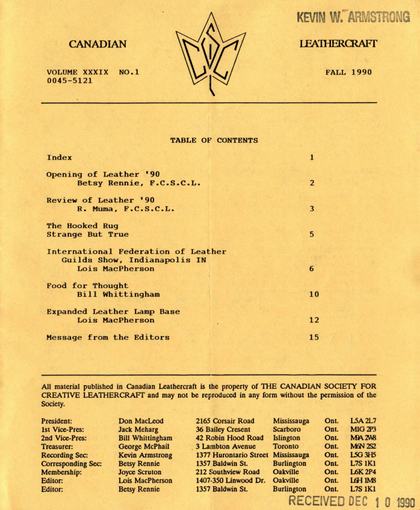
TABLE OF CONTENTS
Index 1
Opening of Leather '90, Betsy Rennie, F.C.S.C.L. 2
Review of Leather '90, R. Muma, F.C.S.C.L. 3
The Hooked Rug
Strange But True 5
International Federation of Leather Guilds Show, Indianapolis IN, Lois MacPherson 6
Food for Thought, Bill Whittingham 10
Expanded Leather Lamp Base, Lois MacPherson 12
Message from the Editors 15
This contents list matches the page's own order and numbers, each number set at the right. Four entries run to a second, indented line carrying the author and the page number; the International Federation entry runs on to a second line carrying neither and a third carrying both; here each runs on after its title. The Hooked Rug is printed on the line above Strange But True without a page of its own, and this issue sets its numbers without a full stop.
All material published in Canadian Leathercraft is the property of THE CANADIAN SOCIETY FOR CREATIVE LEATHERCRAFT and may not be reproduced in any form without the permission of the Society.
| President: | Don MacLeod | 2165 Corsair Road Mississauga Ont. L5A 2L7 |
| 1st Vice-Pres: | Jack Meharg | 36 Bailey Cresent Scarboro Ont. M1G 2P3 |
| 2nd Vice-Pres: | Bill Whittingham | 42 Robin Hood Road Islington Ont. M9A 2W8 |
| Treasurer: | George McPhail | 3 Lambton Avenue Toronto Ont. M6N 2S2 |
| Recording Sec: | Kevin Armstrong | 1377 Hurontario Street Mississauga Ont. L5G 3H5 |
| Corresponding Sec: | Betsy Rennie | 1357 Baldwin St. Burlington Ont. L7S 1K1 |
| Membership: | Joyce Scruton | 212 Southview Road Oakville Ont. L6K 2P4 |
| Editor: | Lois MacPherson | 1407-350 Linwood Dr. Oakville Ont. L6H 1M8 |
| Editor: | Betsy Rennie | 1357 Baldwin St. Burlington Ont. L7S 1K1 |
Page 2 — Opening of Leather '90, Betsy Rennie, F.C.S.C.L.
OPENING OF LEATHER '90 WOODSTOCK ART GALLERY
Betsy Rennie, F.C.S.C.L.
Woodstock Branch of C.S.C.L. has put on an excellent 11th Biennial show. There were about 35 people in attendance from Hamilton, Toronto, Woodstock and Forrest, Ontario. Leather '90 coincided with our 40th Anniversary Annual, which was also hosted by Woodstock Branch.
The 46 leather pieces, representing the talent of fifteen artisans, were well displayed on the second floor of the Woodstock Art Gallery. The fifteen people were: Kevin
Armstrong, Bea Austin, Nancy Durham, Ruth Haig, Gertrude Hilder, Lillian Kay, Jessie Little, Loreen Manuel, Muriel McKnight, David McPherson, Cliff McTavish, Madeleine Mitchell, Betsy Rennie, Beula Reynolds and Bruce White. Most of the leather pieces were at this year's Annual and some from last year. Also displayed on the 2nd floor, was a beautiful exhibition of Traditional Rug Hooking by Ox-Wood Hooking Artisans, a branch of the Ontario Hooking Craft Guild.
Before the opening, we were invited to the main floor of the Gallery for delicious refreshments, compliments of the Woodstock Branch and the Ox-Wood Artisans.
Helen Watts of Ox-Wood Hooking Artisans gave a brief history of rug hooking. The techniques have remained the same since pioneer women made rugs from old, discarded clothing. Women had to make their own dyes from goldenrod, sumac, bloodroot, tansy, and black walnut, to name a few, and drew their own designs on burlap. With today's cutting machines and commercial dyes, it is possible to create finely detailed designs. On view in the gallery were hand-hooked rugs, pictorials, wall hangings, cushions and seat covers, all beautifully done. Helen Watts finished off her talk with a poem, "The Hooked Rug" which you will find reprinted in this issue.
Brenda Irvine, an assistant to the curator of the Gallery, introduced the participants in the Leather '90 opening. Madeleine Mitchell, President of the host branch, welcomed everyone in attendance on such a fine day. The show was then turned over to Dorothy Muma, Chairman of the Council of Fellows. She read the appreciative and humorous remarks of Bob Muma and then gave the awards and congratulations to the winning Artisans. Jack Meharg, our Vice-President representing C.S.C.L. made a few amusing remarks about the exhibition. Jack stood in for President Don MacLeod who was in Denver on business.
Carolyn Vesely gave a brief history on Glenhyrst Art Gallery and also of work displayed on the main floor of the Woodstock Art Gallery. We saw contemporary Canadian work on paper: lithographs silk screens and drawings on loan from the permanent collection of the Glenhyrst Art Gallery of Brant. The exhibition gave us an idea of the high level of graphic work being produced in Canada.
[The page prints a single typewriter apostrophe in "Leather '90" throughout.]
Page 3 — Review of Leather '90, R. Muma, F.C.S.C.L.
Brenda Wenstob, curator of Woodstock Art Gallery, concluded the Opening of Leather '90, stating that with every exhibition, she learns new techniques about the different displays that pass through the Gallery and Leather '90 was no exception.
REVIEW OF LEATHER "90
Robert Muma, F.C.S.C.L.
The Board of Selection met at our place on Saturday July 28th to select appropriate entries for this exhibition. The following day, Sunday 29th, Dorothy and I sat down to assess them for awards, so we spent all Sunday morning worshipping leather, touching leather, feeling leather, smelling leather, using it, making it in our imagination with the craftsperson who submitted each piece.
We want you to know that we have here, without doubt, the best exhibition of fine leather work we have seen in some time. Not one piece of those submitted was rejected by the Board of Selection, which is without precedent in recent years. We seem to have emerging, this year, fresh talent to challenge the best of past exhibitions.
The first category on the published list is the C.S.C.L. EXECUTIVE AWARD of $75 for the Most Functional Piece, which implies a qualification by which not every piece of leather craft can be fairly judged. So we have changed this category to read: BEST Functional Piece. Functionality (if I may coin a word) means the suitability of an article to the purpose for which it was designed. Thus, how does one compare the functionality of a small object like a card case, out of sight in a purse or inner pocket, with a very visible, commercially designed, 3-legged stool kit? Creature comfort at the end of a long session of standing, decided that one in favour of the carved Tripod seat by Nancy Durham.
The whimsical originality of Lillian Kay's Glasses Rest, which she calls "Nosey Parker" gets an HONORABLE MENTION in this category.
The second category on the list is the C.S.C.L. AWARD of $75 for JUDGES SPECIAL CHOICE, which we have awarded to Betsy Rennie for her exquisitely crafted cardinal. Dorothy and I often have quite different ideas of excellence in craftsmanship' and design. I don't suppose we have to account for our choice in this. It was just a spontaneous choice of both of us simultaneously. It appealed to us without reason. We feel it is an amazing demonstration of the various feather techniques achieved by use of the swivel knife alone. Built on a plastic form, it is a realistic piece of outstanding handling of texture and colour.
Page 4
The third category, the ONTARIO CRAFTS COUNCIL AWARD OF $50 for Most Original Design goes to Ruth Haig. This is a new technique with imaginative possibilities which are also demonstrated in this show in pieces by Muriel McKnight, one of which has been moulded around two large stones which were then removed before the 3 edges were set and allowed to harden.
An HONORABLE MENTION in this category goes to Dave McPherson for his Blue Leather vase, a very simple but original and well-crafted piece.
Fourth category, the MICHIGAN LEATHER ARTISANS AWARD of $50 for Best in Show goes to Betsy Rennie for her Monarch Butterfly. This is a masterfully contrived, somewhat stylized structure of about a dozen pieces of heavy or laminated leather which fit together like a puzzle to form this attractive composition and dyed in orange, black and white. The puzzle to us is in the skill of designing and fitting these pieces together in the first place.
The final two awards, offered by MOORE-PEARSALL LEATHER COMPANY, were relatively easy to determine. David McPherson's hexagonal box, in its outstanding workmanship and design, called immediately for the BEST BOX AWARD. Likewise, Cliff McTavish's excellent knitting bag required little "knitting of brows" to place for BEST TOOLED OR CARVED ARTICLE.
For HONORABLE MENTION in this category, we have no hesitation in selecting the little Morocco Card Case fashioned by Cliff McTavish. It is a masterpiece of flawless detail, and we could not find one stitch or mark on it that was not' intended. Reminding us of a miniature painting or carved cameo, it almost begs for a category of its own, calling to mind also the miniature leather furniture by Madeleine Mitchell, a few years ago.
These are the Award winners, but there are others we would like to mention, who did not place for awards. The most dominant piece in the show, for instance, is undoubtedly Jessie Little's revolving, embossed and coloured leather-covered planter. By virtue of her usually fine construction, colouring and finishing techniques, as well as its size, it forms a worthy focal point to an unusually fine display. However, due to exhibition space limitations, we caution exhibitors against excessive dimensions in their future project planning, as this probably represents the maximum size that can be accepted.
Also worthy of note is Beula Reynold's original use of natural rawhide in the making of mobiles. The mayflies in this piece could stand a more exciting arrangement on different levels. The well-designed and skillfully crafted elements would be a winner if she could find some way to protect the rawhide from its inevitable distortion by humidity changes.
[A stray apostrophe after "Dave McPherson" is not part of the printed text; removed.]
Page 5 — Strange But True
At a time in history when it is said that French furniture craftsmen were submitting inferior wood with flaws filled in with wax, honest craftsmen began stamping their work with the Latin words "sine cera" (without wax) which may be the root of our English word "sincere". Today, as always, the integrity of the craftsperson requires that he or she use the best materials and workmanship, even in places where they cannot be seen. So it was a delight to find the plain and simple, but beautifully crafted picture frame by Cliff McTavish with the back part fastened on with carved and polished pieces of cow's horn! Inventiveness is a necessary adjunct of craftsmanship, and when a fine piece of leatherwork involved related animal parts (hide, horn, bone, etc.) or any other natural substances such as wood or stone, craftsmanship is getting down to basics. The commercial world has given us a plethora of metal and plastic findings which could very often be substituted by some natural substance like this devised by the artist's ingenuity.
We congratulate each of the successful competitors and encourage all leathercrafters to emulate the high standards of workmanship and originality displayed here. Every piece is worthy of careful scrutiny.
[This page prints two short pieces side by side in separate columns — the poem “The Hooked Rug” at the left, “Strange But True” and “Closing Observations” at the right. Set out below in the order each column is meant to be read.]
THE HOOKED RUG
My mother took a piece of cloth, A yard or two, I guess, She cut it and she sewed it And made herself a dress.
She wore that dress a year or two, Perhaps she wore it three, Then turned it on the other side And made it up for me.
A long time it served me 'Til it got old and shabby, Then she washed it. clean and made A coat for Baby Abby.
And when the baby grew too big To wear it any more, She cut it into carpet rags And hooked it for the floor.
So in our new hooked carpet, Those purple flowers you see Are made out of Sunday clothes Of Mother, Abby and Me.
Author Unknown
STRANGE BUT TRUE
Everything is farther away than it used to be. It is twice as far to the corner store and I notice they've added a hill.
CLOSING OBSERVATIONS
It seems they're making the stairs steeper than in the old days too, and have you noticed the smaller print they now use in the newspapers?
Submitted by Joyce Scruton
Page 6 — International Federation of Leather Guilds Show, Indianapolis IN, Lois MacPherson
INTERNATIONAL FEDERATION OF LEATHER GUILDS INDIANAPOLIS, IN. OCTOBER 11-15, 1190
Lois MacPherson
This year's Federation show was again attended by several members of the C.S.C.L. Betsy Rennie, Cliff McTavish, Jack Meharg, and Lois MacPherson each took advantage of at least one of the preregistered 4-hour workshops held on Friday, Saturday and Sunday. (Lillian Kay slept in!) Workshops included several on carving and tooling techniques (portraiture, figure, landscape etc.) air brushing, tool sharpening, braiding, case construction, filigree, layout and design, etc. There were also demonstrations on the floor, Saturday and Sunday.
The Federation show differs from ours in that each guild sets up a "display-only" exhibition booth. These show current and past work by guild members, but the pieces are not entered into competition. Professionals set up "solo" displays and all the booths are placed around the perimeter of the large ballroom/ banquet room. The competition pieces are in a closed, adjoining room, which is opened to the ballroom, after judging.
This year there were display pieces and competition entries from the U.S., Canada, South Africa, Germany, Spain, Australia, Japan, Holland, Mexico, Switzerland and Portugal.
Competitors enter under "Master", "Open" or "Juniors & Beginners" divisions. Entries must be preregistered under various categories and sub-categories. Professionals, those who have previously won. high awards and those who have attained special status in the leather world (e.g. Stohlman Award Winners) are expected to enter the more exacting Masters division, although anyone who wishes to enter in this division, may do so.
All competition entries are identified with preprinted division and category tags. The bottom half with the entrant's name and guild is folded up and stapled, and the piece is then handed over to the "guardians" of the closed competition room.
Teams of two or three judges are assigned to different categories and they take along a "scribe" whose job it is to write down a critique of each entered piece. This critique is left with the article, and includes the names of the judges.
There were over 400 pieces entered into competition this year. One felt like a "Babe-in-the Woods" when confronted by the great variety of pieces and techniques. The rich, dark colour combinations of the European entries had to be seen to be appreciated; the delicate oriental motifs and dye work of pieces from Japan were spellbinding; the high-relief, 3-D work and tooling techniques of the Americans and others left me in awe. And, as usual, the work of the C.S.C.L. members came in for a great deal of admiration - and awards!
[The dateline "OCTOBER 11-15, 1190" is printed exactly so — the Society’s own transposed digits for 1990, this being the Fall 1990 issue reporting an October 1990 show — kept as printed.]
Page 7
Kudos to the following C.S.C.L. members for their awards:
Betsy Rennie:
(Masters Division)
| "Fanny Bag" | Category B-5 | 1st Prize |
| "Loonie Bin" | Category B-7 | 1st Prize |
| Pocket Secretary | Category C-2 | 1st Prize |
| Inlay Card Case | Category C-3 | 3rd Prize |
| Monarch Butterfly | Category F-1 | 2nd Prize |
Lillian Kay
(Masters Division)
Cat Tote Bag Category B-5 2nd Prize
Cat Face Key Fob Category C-3 2nd Prize Bracelet, Earrings
& Barrette Category D-7 Hon. Mention
Laminated, Spatterdyed Picture Frame Category F-2 2nd Prize
Cliff McTavish
(Open Division)
Inlay Card Case Category C-3 1st Prize & Best of Cat.
Inlay belt Category D-3 1st Prize & Best of Cat.
Punch Case Category F-1 1st Prize & Best of Cat.
Standing Picture
Frame Category F-2 2nd Prize
Covered bottle Category F-3 1st Prize & Best of Cat.
Lois MacPherson
(Open Division)
Bracelet/Earrings Category D-7 Hon. Mention Wood Sprite Mask Category F-1 2nd prize
Page 8
FEDERATED ESTABLISHED CLASSES
CATEGORY A PICTURES- READY TO HANG, must be 90% leather,
| Class A-1 | Pictures, Plain, 154 square inches or larger. No dye, stain, color or antique. |
| Class A-2 | Pictures, Plain, under 154 square inches. No dye, stain, color or antique. |
| Class A-3 | Pictures, Monotone, 154 square inches or larger. Shades of one color dye. |
| Class A-4 | Pictures, Monotone, under 154 square inches. Shades of one color dye. |
| Class A-5 | Pictures, Stain Dyed, 154 square inches or larger. Using spirit dyes only. |
| Class A-6 | Pictures, Stain Dyed, under 154 square inches. Using spirit dyes only. |
| Class A-7 | Pictures, Colored, 154 square inches or larger. Using acrylic, water colors, oils |
| Class A-8 | Pictures, Colored, under 154 square inches. Using acrylic, water color, oils |
| Class A-9 | Pictures, 3-Dimensional, 154 square inches or larger. |
| Class A-10 | Pictures, 3-Dimensional, under 154 square inches. |
Please note: An example of a picture 154 square inches or larger would be 11x14 or larger.
CATEGORY B CASES
| Class B-1 | Carrying Cases, camera cases, brief cases, etc. |
| Class B-2 | Sporting Cases, quivers, gun cases, knife sheaths, etc. |
| Class B-3 | Holsters |
| Class B-4 | Holsters attached to belts. |
| Class B-5 | Purses, Carved. |
| Class B-6 | Purses, Stamped. |
| Class B-7 | Purses, Plain, not carved or stamped, of any leather. |
| Class B-8 | Books, book covers, scrap books, note books, etc. |
| CATEGORY C | POCKET ITEMS |
| Class C-1 | Billfolds, or wallets. |
| Class C-2 | Clutch Purses. |
| Class C-3 | Pocket items, card cases, key fobs, glass cases, |
| money clip, etc., any item that can be carried in a pocket. (No billfolds). |
Page 9
CATEGORY D WEARING APPAREL
| Class D-1 | Belts, Carved. |
| Class D-2 | Belts, Stamped. |
| Class D-3 | Belts, Plain. |
| Class D-4 | Belts, Braided |
| Class D-5 | Wearing apparel, tool, or part tooled, using either tooling leather, soft leather or combination of both. |
| Class D-6 | Wearing apparel, soft leather only, may be decorated by use of ink, burning tool, beadwork or quillwork. |
| Class D-7 | Accessory items, hat bands, wrist bands, earrings, jewelry, etc. |
| CATEGORY E | LARGE COMPLEX ITEMS |
| Class E-1 | Saddles, 12inch tree and larger. |
| Class E-2 | Horse Gear, bridles, scabbards, breast collars, saddle bags, harness, etc. |
| Class E-3 | Furniture, tables, desks, chairs, stools, etc. |
| CATEGORY F | MISCELLANEOUS |
| Class F-1 | Molded Leather, sculptures, mugs, or anything freestanding. |
| Class F-2 | Household items, anything that can be used in a home or office, not elsewhere classified. |
| Class F-3 | Miscellaneous, anything not covered in any of the |
| other classifications. |
| CATEGORY G | JUNIORS AND BEGINNERS |
| Class G-1 | Juniors, anyone 17 years of age or younger. |
| Class G-2 | Beginners, anyone with two years or less |
| experience in leathercrafting. |
IN CATEGORIES 'A' THROUGH 'F THERE ARE TWO DIVISIONS;
OPEN AND MASTER
[The page prints "IN CATEGORIES 'A' THROUGH 'F THERE ARE TWO DIVISIONS;" — the opening mark before F is printed and the closing one after it is not. Kept as printed.]
Page 10 — Food for Thought, Bill Whittingham
FOOD FOR THOUGHT
Bill Whittingham
President, Mississauga Branch
Here is something for you to contemplate while you are quietly munching your morning toast and coffee. What, if anything, does the C.S.C.L. mean to you? Please understand that I, myself, am a devoted leather crafter, so I am quite serious when I ask this question. So take five minutes from your busy schedules to consider what the demise of the C.S.C.L. would mean to you. Why bother? Quite frankly, if that is your attitude, then we have problems right from the outset.
Let me cut to the meat of the matter. I have been an active member of the C.S.C.L. since march 1987, and when I joined the Mississauga Branch, the paid membership of the entire C.S.C.L. was 130. In 1988, that same statistic became 119, and in 1989, it dwindled to 92. As of the writing of this letter, our paid membership tips the scales at a paltry 72 for 1990. In other words, over the past four years we have lost 45% of our guild. (If we were a company, we would be bankrupt.) So the' burning question is why this rather sudden lack of interest? Admittedly, some of our senior members have sadly passed on, and some members may have moved away, but I suspect that this accounts for a very small portion of the aforementioned 45%. So what happened to all the other members who did not renew their memberships? Unfortunately, I cannot answer that question, but there is a possibility that you can.
As a general member of the C.S.C.L., I am concerned about' the fate of the guild; as 2nd Vice President, I am, in part, responsible for it. (If you don't understand what I mean, read Ruth Haig's poem, "I'm on a Committee", which you can find on the back of your Summer 1989 Bulletin.) At our Annual Meeting in Woodstock, one of our members confided that he felt the guild had become overburdened with executives. Upon careful consideration, I have discovered that the size of the executive has not changed, instead we have become "under-burdened" with members.
I remember when I first joined the C.S.C.L., I looked forward to the guild-sponsored workshops, because I had been largely self-taught up to that point, and any nuggets of knowledge I could absorb went a long way to improve my skills. With each passing workshop, I've learned more and more, and I intend to continue going to these workshops until I'm old and grey, with a bad heart, lousy eyesight and poor hearing. When that time comes, I'll just buy the necessary spare parts and go the next workshop. So am I the only person who feels this way about improving leather skills? I think not, but why did a recent pattern-making workshop (June 2, 1990) have only five participants? I am sure there are more than 5 out of 72 members who
Page 11
make a pattern of an item before they cut their leather, so why the lack of interest in one of the fundamentals of our craft? (To the 67 members who did not attend: You missed some valuable information. )
As a concerned member of the executive, the only thing I can attribute this poor attendance to is a substantial lack of interest, and that needs to change. If you don't like what is being offered in the workshops, speak up and let yourself be heard. Don't just sit at home and "wish" the C.S.C.L. would offer this workshop, or that workshop. Do something about it! Make a suggestion, give advice, or heaven forbid, even offer assistance, but don't just sit there and "wish". We have some incredible talent in our guilds, why not tap these natural resources and, through participation, give something in return. The fate of the guild is not in the hands of the executive, it is in the hands of each and every member of the C.S.C.L. It is only through communication, cooperation and participation that the guild can grow and flourish.
IS IT WORTH IT? Well, you know my answer, what's yours?
For those who are offended by this appeal, get mad and write me a letter to tell me why. For those who don't care, get motivated and write me a letter to tell me why not. And for those of you who agree with me, let's work together to make a difference. Please send your responses, good, bad or indifferent to:
Bill Whittingham
42 Robin Hood Road
Islington, ON M9A 2W8
Don't want to take the time to write? Then please phone 239-3743 or 231-4913 to leave a name, message and phone number so I can contact you.
Bridges built and bridges burned,
Bridges crossed and bridges spurned,
The seas of life with spans abound,
Take care you don't fall off and drown! Lois MacPherson
Page 12 — Expanded Leather Lamp Base, Lois MacPherson
EXPANDED LEATHER LAMP BASE
Lois MacPherson
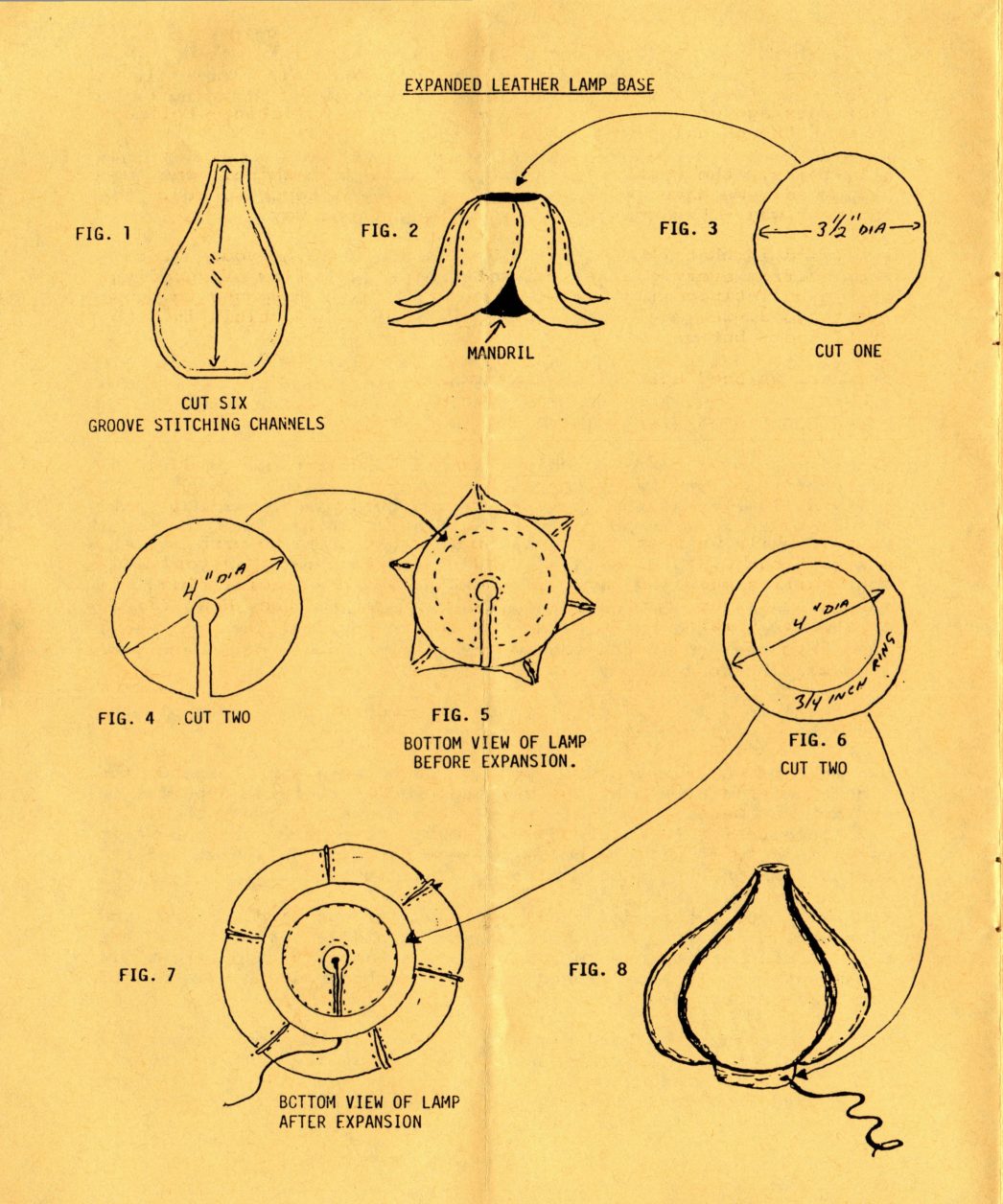
Before reading this article, study the diagram page. It is probably clearer than my instructions and handy to refer to during the article. (My magnificent drawings, obviously, are not to scale!)
Cut six equal sides from 8-oz leather, with the bottom edge of each side carefully measured so that the completed base end will fit around a 3-1/2" dia. x 6" long mandril, after the seam allowances have been' sewn. The top ends must be similarly measured to fit around a 1-1/2" dowel, which will also be used to tamp (pound!) the sand into the form later. Shape and length of your pieces between the top and bottom ends is up to you. (See FIG 1) Gouge stitching channels 1/4" to 3/8" in from the edges (depending on the thickness of your leathers).
Glue and stitch the sides together, from the bottom up, but only to a point where the width of the opening will allow insertion of the 3-1/2" dia. mandril. Take this semi-stitched form and upend it on the mandril, with unsewn portions spread around it like a banana peel. (FIG 2) Now glue a 3-1/2 dia. round (FIG 3) into the base, with the edges flush with the bottom edge of the base. Do NOT "forty-five" these edges because of the width of the "spines" formed by the seams and because the pounded sand will force a 45° seam open between stitches, allowing sand to leak through and cause a messy join between the eventual base and this section. However, stitch the bottom to the lamp in the same way as if it were "forty-fived". The good news is that these stitches will be covered at the bottom, so, within reason, you don't have to be super careful about where they land.
Now you are ready to apply the base. Use two glued-together 4" dia. rounds, with a "keyhole" cut through both pieces. (FIG 4) This will later serve as an exit point and channel for your electrical cord. SAVE THE "KEYHOLE" CUTOUT.
Leaving the partly assembled lamp on the mandril, glue the keyhole round onto the bottom, centering it perfectly. Gouge a stitching channel approximately 3/4" in from the edge, to avoid puncturing your previous stitches, and around the keyhole. (Remember, this "keyhole" round is 1/2" diameter larger than the first one, so the 3/4" takes that into account.) Stab stitching holes through to the mandril. Remove the mandril and stitch firmly through the three thicknesses of leather. (FIG 5) The partly stitched form allows for easy access to facilitate the stitching.
Now continue gluing and stitching the sides together to the top of the forms. After all stitching is finished, push the "keyhole plug" back into place, to ensure a flat surface while tamping in the fine sand.
[Doubled quotation marks around "keyhole" and "forty-fived" are reduced to single.]
Page 13
Now soak the whole form until it is thoroughly saturated. When ready start pouring and tamping in the sand. (A funnel is a wonderful gadget here.) Make sure your form is standing on a flat surface.
Keep pouring and pounding the fine sand until not one more grain will fit and then keep pouring more in anyway, until you have to hammer the dowel very forcefully to make more space and the leather will be incapable of expanding one more millimeter.
Let the form dry for a minimum of 48 hours before removing the dowel (with brute strength!) and shaking and "drumming" out all the sand. Since the lamp is not to contain liquid, it's not necessary to rinse it out, like a "bottell".
Remove the "keyhole plug" and upend the expanded form over the "tamping dowel", making sure the dowel is centered on the inside. Punch a 1/2" dia. hole through the inner base of the lamp, using the top end of the keyhole as a guide.
Since you have been pounding with a dowel much smaller in, diameter than the base, the bottom can easily be "bowed" by a silly millimeter at the centre. Even this is enough to make the lamp "rock" instead of sitting flat. So now take the last two glued together 4" dia. rounds and cut out a 3-1/4" diameter centre, leaving a ring 3/4" wide. (FIG 6) Polish the inside edges of the ring and glue it to the previous base. You will now have a place for your cord to emerge, a channel and an exit hole at the side of the base (FIGS 7 & 8). Any slight "bowing" will also be contained in the centre, away from the new edges and your lamp will be rock-steady, in spite of its light weight.
Dye the lamp, if desired, finish all edges. the sides of the round base will probably need sanding.
One more piece - a round "cap" to go between the top and the electrical fixtures must be cut and dyed. the size depends on whether you want it to fall inside the seams, or cover them. A 1/2" hole to fit a threaded shank must' be punched through this cap. This "cap" will be held in place between the socket and the threaded shank, but should also be glued in place.
You will need a threaded shank and nut for the cord, a cord and plug and, of course, a socket - 3-way or single. I'll leave the details of the fittings to you. Being a complete incompetent in these matters, I simply head for my neighbourhood hardware and beg their expertise. Good luck!
NOTE: I learned the hard way not to use a lightweight hammer or mallet to tamp the sand. A reasonably heavy short-handled sledge hammer will save wear and tear on your arm and shoulder - this is a big "expansion" job.
[The opening sentence is set out here as "Now soak the whole form until it is thoroughly saturated. When ready start pouring" — easy to lose "turated. W" between "sa" and "hen ready" and gain a stray leading "A".]
Page 14
EXPANDED LEATHER LAMP BASE
FIG. 1 — petal-shaped piece, CUT SIX, GROOVE STITCHING CHANNELS
FIG. 2 — the six petals draped over a form, MANDRIL
FIG. 3 — circle, 3½" DIA, CUT ONE
FIG. 4 — circle, 4" DIA, CUT TWO
FIG. 5 — BOTTOM VIEW OF LAMP BEFORE EXPANSION
FIG. 6 — ring, 4" DIA, 3/4 INCH RING, CUT TWO
FIG. 7 — BCTTOM VIEW OF LAMP AFTER EXPANSION
FIG. 8 — the finished expanded leather lamp base
[Pattern-piece plate for an expanded leather lamp base, continuing from the preceding page. The figure captions and measurements are easy to run together, dropping Figs. 2, 5 and 8 entirely; all eight figures and their hand-lettered dimensions are set out here. Fig. 7's caption is lettered "BCTTOM VIEW OF LAMP", beside the closed O of Fig. 5's "BOTTOM" on the same plate. No names.]
Page 15 — Message from the Editors
A MESSAGE FROM THE EDITORS
Two issues ago we enclosed a letter with the Bulletin, telling you what "tough gals" we could be.
Well, folks, the next issue just could be the skinny one we threatened! We have no articles, "how to's", reports, etc. to send your way - because no one has sent them our way.
As we said in that letter - don't wait for it to be your "turn" everyone from every guild is asked to keep the flow of goodies for the bulletin coming at all times. If your response to our plea is good, we may not be able to print your article in the next issue - but we will print it.
Remember, we need help in staying nice!
And now, while we're still being nice - we'd like to wish every member of the C.S.C.L. a wonderful holiday season. May you and your families know peace and serenity at this special time of year and may our Society grow and flourish in the New Year. Let's work at it!
Merry Christmas
Happy New Year!