
An issue of the Society’s newsletter, transcribed from the original.
(16 pages, 2.1 MB)
the full-resolution scan, 38 MB, for close research
Page 1 — C.S.C.L. ANNUAL MEETING 1981
| CANADIAN | LEATHERCRAFT |
| XXIX, No. 4 | Summer - (June) 1981 |
| 0045-5121 |
C.S.C.L. ANNUAL MEETING 1981
Eighty-seven members of the C.S.C.L. met at the Beacon
Motor Inn at Jordan Station, Ontario, on May 1, 2, and 3, for the annual meeting of the Society. Barrie, Belleville, Toronto, Norland and Woodstock Branches, along with seven of our Members-at-large, (from both Canada and the U.S.A.) were welcomed by the host Branch, Hamilton.
On Friday evening, tables were set up for the Branch displays. A special table was created for the exhibiting of old and new handmade leather gloves, some of which dated back as early as 1920. The Fellows of the Society judged the articles displayed for the selection of those pieces deemed worthy of Craftsmen Ribbons.
On Saturday morning, the business meeting took place, chaired by our President, Hope Drysdale, with Secretary June Somerville assisting. Hope welcomed all representatives and outlined the programme for the day. Due to the retirement of our Treasurer, Dorothy Muma, we are fortunate in having one of our members-at-large, Joyce Poulsom, take on this position. Mr. Ray Potter, of the Toronto Branch, was elected as 2nd Vice-President. All other offices remained the same.
Jean Hunter, who is one of our most valued and talented members was elected by the Committee as. a Fellow, and we all extend our congratulations to Jean.
(cont'd Page 2.)
All material published in "Canadian Leathercraft" is the property of the Canadain Society for Creative Leathercraft, and may not be reprinted in any form without the permission of the Society.
"Canadain Society" is printed exactly so in this issue's masthead boilerplate (transposed letters, the Society's own typo) — kept as printed rather than silently corrected to "Canadian".
President: Hope C. Drysdale, ACSCL, 130 Young St., Hamilton, Ont.
Vice-Pres.: Jack Meharg, 36 Bailey Cres. Scarborough, Ont.
2nd Vice-Pres: 'Ray Potter, 106 Guestville Ave., Toronto.
Editor: Mary M. Patterson, 270 Durie Street, Toronto M6S 3G3. Corr. Sect.: Lorna Robson, R.R.#1, Fonthill, Ont. Reporters this issue: Norland Branch, and Members-at-large. Membership
Chairman: Miss B. Austin, 167 Emerson St., Hamilton.
Page 2
(C.S.C.L. Annual Meeting, 1981- cont'd)
Life Memberships were presented to the following long-time members of the C.S.C.L. in recognition of their years of service to the Society; Clara Cavanagh, Viola Harris, Nora Huyck, and Olivia Smith.
Four of the Branches were represented in the Weston Trophy Competitionthis year, with Barrie Branch winning the coveted award. Congratulations to Barrie for an excellent entry. Bea Austin made the appraisal of the items to the assembly, with the assistance of Carol McLean, and Gladys Riddell.
A short "Question Box" followed that brought two particularly interesting questions on leather processing to the "experts".
Toronto Branch will be serving as hosts for the 1982 Annual. Following luncheon, the afternoon session of demonstrations started with the following:
Jack Meharg - Belts
Jean Hunter - Lace Cutters and Lacing
Hilda Chynoweth - Carving
There was a mid-afternoon break for coffee, during which time the annual draw for prizes was conducted, and the demonstrations continued with the following: Carol McLean - Lino Block Cutting
Jessie Strain - Soft Flowers
Vera Ferrera - Moulded Bowl
The demonstrations were excellent, and many tips and hints were picked up by the members attending. A general complaint was that there was just too much fine demonstration material being presented in a short time allottment, and justice could not be done to all demonstrations presented!
A delicious dinner was served, and presentation of the Craftsmen ribbons, (nine Awards this year,) was made during the dinner hour,
Lorna Robson introduced the guest speakers, Mr. & Mrs. McIver, who gave a very interesting show and talk on their work with owls and other birds of prey. There was a fine display of slides accompanying the lecture, which included slides of injured birds which they have worked with to heal, as well as pictures of their bird sanctuary. The McIvoer's make their home in the Hamilton area.
Two stray "@" marks (after "Nora Huyck," and after "Hamilton area.") do not appear on the printed page at all, and have been dropped. "The McIvoer's" is printed exactly so — the Society's own typo for "McIver's", the guest speakers named two sentences earlier — kept as printed, not corrected.
Displays were dismantled following the dinner, and some of the delegates left for home. Those that remained were entertained on Sunday morning with a film on the World Craft Conference, held in Vienna, Austria, in 1980, with this showing being presented by Gordon Barnes and Mary Clark.
... reported by Norland Branch, C.S.C.L.
Page 3 — LIFE MEMBERSHIPS 1981 ANNUAL: FOUR PROFILES
LIFE MEMBERSHIPS 1981 ANNUAL
FOUR PROFILES —
Clara Cavanagh became a member of C.S.C.L. in 1953. She achieved her Associate standing in 1955, and became a Fellow of the Society in 1956.
She has been a hard working member of the Society, serving for many years on the Executive Council, as well as being a founding member of the Barrie Branch which was organized over twenty years ago. Clara has been President of the Barrie Branch for a number of years in the past, as well as being the Chairman of the Fellows. Another task that she undertook for many years was the managing of the C.N.E. Leathercraft Sale.
Viola Harris became a member in the 1950's, with her Associate standing being granted in 1960, followed in 1970 by her recognition as an Honorary Fellow of the C.S.C.L.
Through the years, Viola has served both as President, and as a member of the Executive Council of the C.S.C.L. Although she is no longer on the Executive, she is always willing to help in any way possible. She has worked for the Canadian Guild of Crafts, and has also been involved with O.C.C.
Viola has judged for our juried shows on several occasions and has been a staunch supporter of the Society in the Toronto area.
Nora Huyck also became a C.S.C.L. member in the 1950's, In 1954 she achieved her Associate rating, and became a Fellow in 1955. Nora was on the Executive for years, and set up our instructions for Membership. She herself served as Membership Chairman for a good number of years, and also has headed the Fellows as the Chairman.
Her work has included teaching summer courses and yearly courses in the Guelph and Newmarket areas. She has numerous awards for her talents, being particularly noted for her inlay and onlay and filagree work. Her leathercraft skill is noted for its exacting precision.
Olivia Smith became affiliated with the C.S.C.L. in the early 1950's. She achieved her Associate standing in 1956 and her Fellow status in 1958. She has served on the Executive Council for numerous years, and has been the Social Convenor of the Society in the past. Olivia has won many awards over the years for her craftsmanship in leather. She is also noted as a craftsman in another medium, being actively involved in the Metal Arts Guild.
Due to her skill and wide areas of expertise, Olivia's opinions are always highly valued at the Executive Council meetings.
Page 4 — WESTON TROPHY
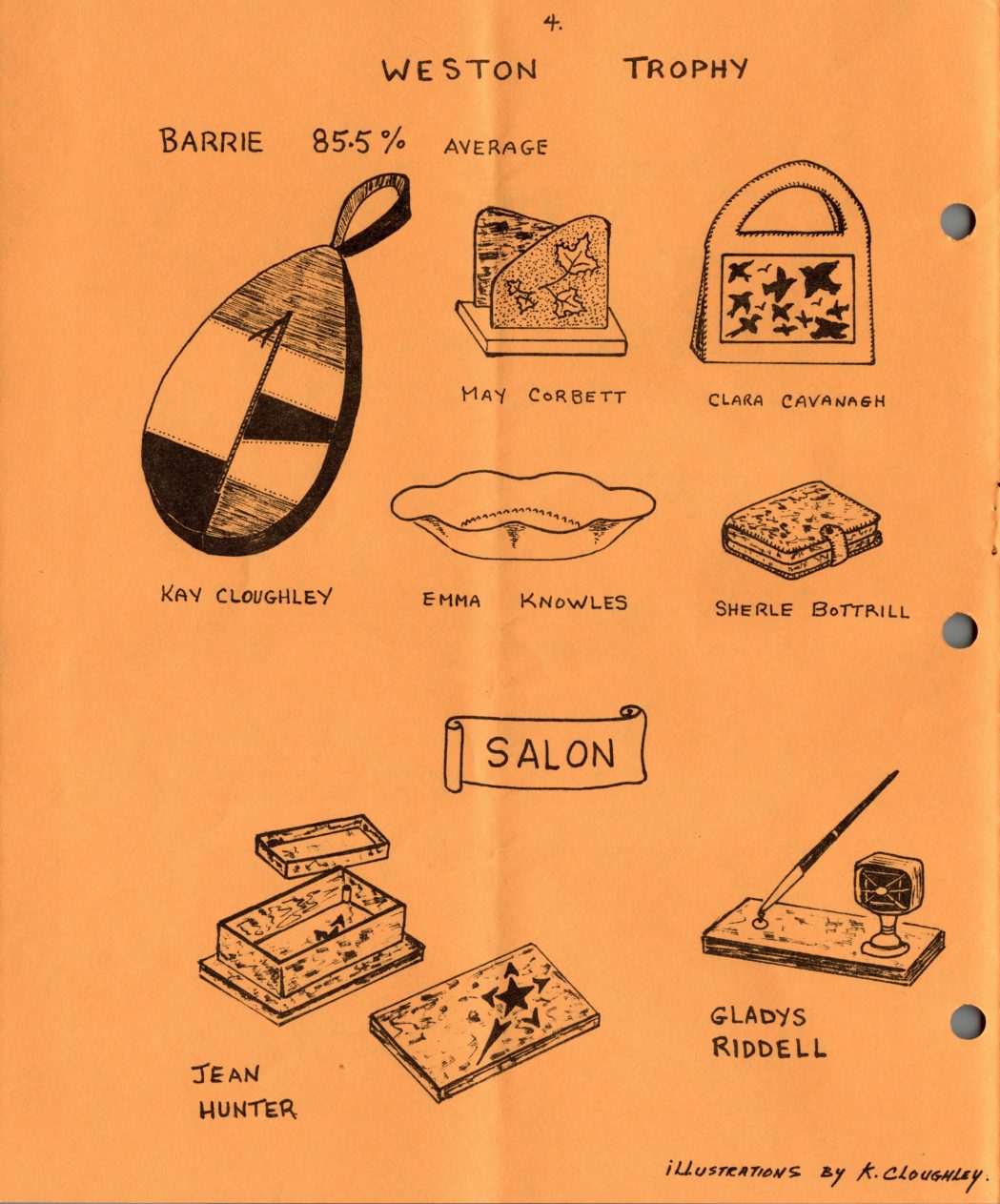
WESTON TROPHY
BARRIE 85.5% AVERAGE
Kay Cloughley — patchwork shoe bag
May Corbett — bookend, maple leaf design
Clara Cavanagh — carrying case, birds cutout
Emma Knowles — bowl
Sherle Bottrill — card case
SALON
Jean Hunter — jewel box, shooting star motif
Gladys Riddell — desk penstand, in the design of a Citizens' Band microphone
Illustrations by K. Cloughley.
[Page headed "4." at the top. The five Weston Trophy sketches (Barrie’s winning entry, 85.5% average) and the two Salon sketches for Jean Hunter and Gladys Riddell are hand-drawn and signed "Illustrations by K. Cloughley"; each is captioned with its maker’s name only, and none carries a printed description of the item.]
Page 5 — JUDGING COMMENTS ON WESTON TROPHY PIECES
JUDGING COMMENTS ON WESTON TROPHY PIECES
BARRIE:
(1) SHOE BAG - A lovely soft lightweight bag - Most suitable for shoes. It was thought that the handle perhaps could have been a little longer so that a coat sleeve could slip through easily, and that a rounded or padded handle would give an easier grip. Note the beautiful hand stitching! A very useful, functional bag.
(2) SERVIETTE HOLDER - A Dandy! A nice piece of splatter dyeing with a lovely delicate design of leaves. Precision cutting, with nicely finished upright sections.
(3) CARD CASE - An easy-to-handle project. The type of corners chosen for inside were difficult to bring together. Perhaps an open or cut-out style corner would have helped. The dome tension is a bit loose, and the lacing holes might have been a bit more even, but, all in all, a very useful: article.
(4) TRAY - A very pleasing article. A lovely dye job, very smooth. A chaste and beautiful design for a tray.
(5) BOOK HOLDER - Beautiful! So absolutely functional- a very well thought out article. The book is readily available, but still well protected when walking through the brush or on a trail as a bird guide should be - very utilitarian.
HAMILTON:
(1) PAINT BRUSH CYLINDER - Also a very useful article. The lid fits beautifully - stitching would have added strength to the handle. Beautiful interior dye job. On the base, a very difficult method of saddle-stitching was used, and it was felt that another method could have been used to
Page 6
6.
(Judging comments cont'd)
better advantage. It was intended as a belt carrier for water colour brushes, but could work equally well for other things, such as a knitting needle container, or a holder for fireplace matches, the long type.
(2) MOULDED BOX - A near perfect job! A very beautiful box made entirely of leather - no interior structure of other materials- The only improvement could have been made on the join. A good, substantial lifting knob was used which blends in well with the shape of the box. A good dye job- Red pigskin lining - a very attractive piece.
(3) BANK - A very novel idea - nicely skived joins - some spots of The leather was not damp when glueing was done - The 3-D design is a bit over-worked, leaving extra smooth areas. The covering of the form has been well done.
(4) CARVED HAND BAG - A pleasing bag to hold - a very functional handle - nice lacing - we liked how the strap hangers were mounted - D-rings make the handle very flexible - we wondered if a leather fastening could have been used instead. The bag balances very well.
(5) BELT - A new acrylic dye-over-dye technique has been used to advantage with today's style colours. The fastening is pleasing to look at, but very time-consuming to fasten. A lovely belt for a lady to wear.
WOODSTOCK:
(1) TUTENKAMEN BOOK ENDS - A lovely combination of ancient and contemporary design- well made - nicely skived tooling and embossing techniques were used to advantage. The antique colouring used carries out the feeling of antiquity.
(2) MOROCCO BOX - A beautiful job of skiving was done on this box- the corners are lovely- The hinge is a little too tight as the lid will not stay open - It was felt that perhaps the 3-D design is a bit too angular, although it has been worked well and the morocco grain has not been flattened in the process, which is most desirable, but often difficult to achieve. A pleasing box.
Page 7
(3) FLUTED BOWL - A very beautiful bowl- lovely dye job with an interesting shaded effect. A fine example of moulded work in leather - sits level with no rocking - The antique colouring has been carried out on the back, which has been boned to finish. (4) FILAGREE BELT - a difficult design to do- well executed, well finished,- a pleasing combination of antique tan and brown shades. We liked the stippled effect around the well-tooled design. (5) HORSE PLAQUE - A very realistic silhouette, nicely moulded to bring out the bone and muscle structure of the animal. Lies flat against the wall when hung - edges are well-rubbed - a neat, simple hanging assembly.
TORONTO:
(1) TIE HOLDER - A nice way of storing and displaying ties - more detail needed on the carving - perhaps with a bit more vigor - We found it difficult to get the metal loops to hand straight and uniformly - a pleasing elongated shield shape - a very a masculine article.
(2) PEN STAND - A beautiful piece of stacked leather - excellently dyed and polished, as noted on the gorgeous edges - they have involved a lot of work.
(3) BOOK - a beautifully done ring binder. The design is suitable to the project. Note the decorative cuts used almost exclusively on the design - very fine dye job - the squared-off wide spine protects the inner surfaces of the cover where it rests against the rings - a lovely example of leatherwork - very pleasant to hold.
SUMMARY OF COMMENTS - AN OVER-ALL VIEW
"In general, the marks were all very high, giving a good indication of the work submitted- The branches are to be commended on their entries. Such excellent workmanship was a real joy to judge. Keep up the good work!"
Page 8 — RESULTS OF THE WESTON TROPHY COMPETITION FOR 1981; MEMBERSHIP DUES
RESULTS OF THE WESTON TROPHY COMPETITION FOR 1981.
BARRIE: Shoe Bag ------- 87
Serviette Holder --- 80
Card Case ---- 75
Tray ------ 87
Carrying Case ----- 98.5
(for bird book)
Average: 85.5% 1st Place
WOODSTOCK:Tutenkamen Bookends --- 81
Morocco Box ------- 83 Fluted Bowl ------ 91
Filagree Belt ------- 86
Wall Plaque -------- 83
Average: 84.8% 2nd Place
HAMILTON: Container ---------- 78
Belt ------------ 83
Bank ------------ 76
Purse, carved ------- 82
Box ------------ 86.5
Average: 81.1 3rd Place
TORONTO: Tie Rack -------- 71.5
Pen Set --------- 93
Note Book ------- 97
Average: 52.3% on 3 out of required 5 items
BELLEVILLE: Did not compete
NORLAND: Did not compete
Respectfully submitted,
Helen Wheaton
Chairman,
Council of Fellows.
MEMBERSHIP DUES
All members are reminded that Annual fees were due and payable at the Annual Meeting, May 1-3, 1981. Members who have omitted sending in their dues are reminded that ONLY PAID-UP MEMBERS are eligible to receive notices of meetings, bulletins, and all other rights and privileges of membership.
The Weston Trophy results table is printed with a row of hyphens between each item and its score. Each branch’s own printed average and place agree with its scores.
Page 9 — RESULTS OF JUDGING - MAY 1st, 1981
RESULTS OF JUDGING - MAY 1st, 1981.
SALON
Jean Hunter - Jewel Box - Shooting Star Motif
Mottled Background with inlaid red star.
Gladys Riddell- Desk Penstand
Stacked laminated leather
Design- "Citizens Band" Mike.
CRAFTSMAN AWARDS
| # | |||
|---|---|---|---|
| 1. Sharon Alderson | Round Tray, fluted | Woodstock | 1 |
| 2. Bea Austin | Small hinged oval Box | Hamilton | 2 |
| 3. Laura Bush | Bullrush design bookends | Belleville | 3 |
| 4. Clara Cavanagh | Bear & Woods design bookends | Barrie | 4 |
| Folded writing case | Barrie | 5 | |
| Bird Book Carrying Case | Barrie | 6 | |
| 5. Kay Cloughley | Patchwork Shoebag, (hand-stitched) | Barrie | 7 |
| 6. Hope Drysdale | Jewel Box, Floreated Morocco | Hamilton | 8 |
| 7. Jean Hunter | Tote Bag, hand-stitched | Toronto | 9 |
| Jewel Box, Shooting star | Toronto | 10 | |
| 8. Joy Hutcheson | Molded rooster plaque | Woodstock | 11 |
| 9. Emma Knowles | Red molded tray | Barrie | 12 |
| 10. Jessie Little | Ring binder, spray design, coloured | Toronto | 13 |
| 11. Loreen Manuel | Belt, stamped, dyed | Woodstock | 14 |
| 12. Jack Meharg | Stacked, laminated, octagonal box | Toronto | 15 |
| 13. Carol McLean | Molded Zulu mask | Woodstock | 16 |
| Filagree circle belt | Woodstock | 17 | |
| 14. Jean Pickering | Book cover, Initial "P" | Woodstock | 18 |
| 15. Gladys Riddell | Easel Picture Frame | Toronto | 19 |
| Stacked, laminated penstand | Toronto | 20 |
Fifteen Craftsmen received 20 ribbons for their fine workmanship.
Helen Wheaton,
Chairman,
Council of Fellows
[The page prints a "SALON" heading above the Jean Hunter and Gladys Riddell entries, and its own running count of the 20 ribbons in an unlabelled column beside each entry.]
Page 10 — WHO'S WHO IN LEATHERCRAFT - JEAN HUNTER
WHO'S WHO IN LEATHERCRAFT - JEAN HUNTER
Fellowship Award, Annual Meeting, 1981.
Jean has been a member of C.S.C.L. for fifteen years, and a practitioner in the craft of leatherwork for thirty-three years. In 1975 she attained Associate standing in the C.S.C.L. and this year has successfully completed her Fellowship.
Jean received instruction in the craft from Mrs. Isobel Joyce, Mrs. Jessie Little, Mr. Paul Williams, Mr. David Trotter, and Mr. Rex Lingwood, and also acknowledges learning from just about all the leathercrafters in the C.S.C.L.
As a craft teacher, Jean has taught night school leathercraft courses at Bramalea Secondary School, as well as accepting a number of private students of the art. She is well known for her many leathercraft demonstrations which have been appreciated by all of us.
The Executive Council has been fortunate in having had Jean's services as Membership Chairman, as a valued member of the Larmour Library Committee, and she is now the chief Librarian of the C.S.C.L.
Jean's special skills in leathercraft are wide in scope, with tooling, carving, colouring, lace-cutting, braiding, embossing, filagree, and inlay work being her main interests.
Jean has won the following awards:
C.N.E. Chatelaine Award
C.S.C.L. Biennial Exhibitions - Twice awarded Most Original Entry.
C.S.C.L. Annuals - one Salon Ribbon
- several Craftsman Ribbons
As her required technical article for Canadian Leathercraft - see Volume XXVI, No. 1, Page 8, - "A Survival Kit". She also has written an article for the Who's Who page, re Jessie Little.
Jean Hunter will now, as a member of the Council of Fellows, be assisting at judging and jurying for Annuals, Associate and Fellow standing, Biennial Exhibitions and helping screen articles for the C.N.E. sale. Her contribution has been great in the past, and we welcome her knowledge and abilities as a Fellow.
Besides all this, Jean is a swell human being!
by Helen Wheaton, Chairman, Council of Fellows.
Page 11 — NORLAND BRANCH - A SUMMARY
NORLAND BRANCH - A SUMMARY
(This issue of Can. Leathercraft is featuring Norland Branch as reporters)
Greetings to our fellow branches of the C.S.C.L. from your newest recruits. Our branch was formed after a visit to a convention by our two founders, Peggy Weaver, who has been interested in leather work for about 5 years, and Hilda Chynoweth, who has been doing leathercrafting for approximately 25 years. Our first meetings were held in the Norland Library, but we found that we got more out of meetings in Hilda's workshop, so it became our meeting room.
We began in April 1978 with 12 members, and even though we've lost some, we've gained an equal number, and so still have 12 in our Branch. The first two years were muddled through and our third year seems to have ended on a high note with bigger and better things ahead for our fourth season. (At least, we pretend that we now know what we're doing!)
The Leather '80 display that was sent in to the Lindsay Public Library was received with great success in the area. People were amazed at "the things that could be done with leather", and even more surprised that there was a leather club in the area.
An interesting and successful workshop, on Leather- Cuire Bouille, was held at the Norland Community Hall on Sept. 13th, 1980. Our instructor, Hope Drysdale, made an early start from her home in Hamilton for this all-day workshop. Braving a severe thunderstorm en route, she arrived in Norland before 9 a.m. and, of a membership of 12 in this newly-formed branch, we are pleased to point out that eleven members partici½ated in this workshop. The pattern demonstrated was the small Black Jack Mug, and several successful efforts have been since included in Norland's display at various exhibitions.
["Cuire Bouille" is printed exactly so — elsewhere in this archive’s techniques index the standard spelling is "Cuir Bouilli" — and is kept as printed. The page also prints "partici½ated" for "participated", a stray fraction-key strike rather than a misprint of the word itself, kept as printed.]
Five members of the Norland Branch travelled to the two Saturday workshops held in Barrie, where Glove-making, with Shirley Montague as instructor, was demonstrated. These Feb. 14th and Feb. 21st workshops introduced us to the business of making a self-fitting pattern, and the process of cutting, fitting, and sewing fourchettes into place. Mrs. Montague had a beautiful display of many of her own hand-made examples of the glover's craft, including samples of the materials used and some interesting books on the subject. It was a most enjoyable workshop, and Barrie Branch hosted the occasion with a delicious lunch.
Jack Meharg gave a most informative demonstration on belt making in the Norland Public Library. Jack has a marvellous collection of tools he uses to create his belts, and some very ingenious inventions he has made himself, to handle the needs of his craft. The demonstration was a real inspiration, especially for some of our newer members.
Page 12 — TIPS ON LEATHER - NORLAND BRANCH; SUPPLIERS ADDRESSES
TIPS ON LEATHER - NORLAND BRANCH
Hair spray will take off the stains of ballpoint pens easily and very neatly, and leaves no marks on the finished piece.
If you are using a compressor sprayer for dyeing a whole hide, be sure and use alcohol-based dye so the sprayer nozzle won't clog.
Sprinkle baking soda on unfinished leather for cleaning, as the baking soda absorbs the dirt.
Use an oval punch for making buttonholes in garments.
Be careful when buying leather as some leathers go through a chrome-tanning process. When the leather is being compressed, a white line is left between the flesh and the grain side. This is how one can tell that the leather is not suitable for carving or stamping, as it will not hold an impression, and it shrinks.
If your leather is too "sticky" to carve, run your sponge across saddle-soap and apply to leather.
To soften hard leather, dissolve a tablespoon of baking soda in half a gallon of water; let the leather soak at least six hours, or even overnight, before you begin to carve it.
Fingernail marks are hard to smooth out of leather, so keep your nails short if you are a leathercrafter.
- SUPPLIERS ADDRESSES - courtesy Norland Barnch.
Saran: Crepe, sole leather, and other leathers - 710 King St. West, Toronto.
Industrial Tanneries: For tanning hides - 52 Toronto St., Uxbridge.
Moore-Pearsall: Kip, snakeskins, and leathers of many weights and types - 47 Front St.E., Toronto.
Canada Thread: Thread for garment-making - King St., east of Spadina.
Capitol Findings: Dyes, leather knives, findings - 580 King St. W. Toronto.
Gloverville Chamber of Commerce: Pigtex glove leather - Gloverville, New York, U.S.A.
This page prints "Gloverville" (no "s") for the New York glove-making town properly spelled Gloversville, and "Barnch" for "Branch" in its own credit line — the Society's own spelling, kept as printed both times. Two passages are reset to match the printed page: "buying leather as some leathers" (a phantom period had split the sentence in two) and the supplier address list, whose entries had run together with stray brackets, colons and a doubled dash.
The Leather Warehouse: Moving shortly- address later.
Page 13 — DESIGNING FLOWER PINS
DESIGNING FLOWER PINS -by Margaret Monteith
Obtain ideas from: colouring books, flower books, nature books, seed catalogues, cards, magazines, newspaper ads, embroidery patterns, etc. Several ways to start designing patterns:
1. One way is by tracing: - a petal or whole design - if a petal is traced the desired number must be put together to make the complete pattern (e.g. 3, 4, 5 or 6 petals) - a tracing may need to be enlarged or decreased to the desired size. 2. Work from a circle:
- divide the circle into the number of petals desired, then shape or round outer edges as desired.
Three diagrams follow, showing the stages of laying out a five-petalled flower from a circle, captioned in the original "1. How to divide a circle for five-petalled flower", "2. Outline of five-petalled flower in a circle", and "3. The finished five-petalled flower". Below the page's text, three more uncaptioned sketches show the same construction worked from overlapping ovals and circles. These are pictures, not printed text, and are described here rather than transcribed as running prose; their three captions had previously run together into a single garbled fragment, now separated to match the original.
3. Work with plastic templates: - circles or ovals --squared paper works nicely for these using a square for the centre arranging petals around it.
Cut basic patterns out of cardboard or plastic containers. They are then easily traced around and will stand considerable use without being damaged.
Page 14 — MAKING LEAVES FOR FLOWERS
MAKING LEAVES FOR FLOWERS
Cut the pieces in between basic patterns to make leaves in different sizes and shapes. Arrange patterns in such a way that you do not have small pieces--- move pattern around, up or down making a space suitable for leaves.
FLOWER CENTRES
After making basic pattern the shaping and centre have to be considered.
i. covered button
A 4-5 oz. circle covered with a slightly larger circle which has been skived on outside and slit to make it shape nicely over circle. -button covers can be: plain, cut with knife making cross effect flesh side up - gives a nice two toned effect when dyed
(any of above can be any size desired--small, medium, large)
ii. fringe type
A strip of leather 3 - 3 1/2 oz. cut and glued at the uncut edge.
iii. folded fringe
1 - 2 oz. leather strip which is 1/2 to 5/8" wide.
Glue outer edges only together, then cut and continue as above.
iv. shaped over marble
Shape a circle of leather over a marble in your hand, then tie it in a square of organdy or net shaping edges with bone folder.
v. Fringe centre on circle cut and shaped as follows
vi. Stem with spiral
A piece of leather 1/4" wide and approximately 3" long cut down centre on back, then glued together. Slant one end. Now glue any type of fringe in a spiral fashion on stem
vii. Circle cut in 4 - 6 and shaped up
This page's diagrams (the covered button, both fringe types with their "roll up" / "glue together" labels, the fringed-centre wheel, the spiralled stem, and the four shapes under item vii) are pictures, not printed text, and are described here rather than transcribed as running prose. Two further faults are corrected to match the printed page: the page heading had picked up a phantom word from the page-number glyph, and item iii's width was dropped ("which is 1/2 to 5/8" wide", not "which... to 5/8" wide"). Item v ("Fringe centre on circle") had also been mislabelled "vi", duplicating the numeral used for the Stem item that follows it.
Page 15
Shaping (with modellers)
Dampen basic pattern then continue with one of the following: i. draw modeller down centre of each petal, then pinch end in and up. ii. shape over round part of modeller. --- push in to centre iii. shape petal over modeller but leave fairly flat (not pinching end). iv. shape up like open apple blossom. v. shape like apple blossom then push modeller in on centre of petal. vi. shape like a violet or hibiscus with two top and three bottom petals.
vii. shape centre of end of petal in around modeller. viii. shape like vii above then pinch ends in. ix. pinch edges of petals together making points. x. Use ball modeller around outside of petals, then shape edges down over the end of your finger.
Each item on this page is illustrated with a small sketch of the shaped petal; pictures, not printed text, and not transcribed as running prose. Item i's closing word ("up.") had dropped out, ending the instruction mid-clause; restored to match the printed page.
After shaping flower put desired centre in it. Set it on leaf which has been shaped and allowed to dry before dyeing.
As you can see the same pattern and shaping for a flower with the different centres enables you to have a variety very easily. Again each type could be dyed in any number of colours making them different.
by Margaret Monteith, Member-at-large
Page 16
TWENTY FIVE YEARS AGO = - Summer 1956 ISSUE
We were rather amused to see that this Summer '81 and Summer'56 issues had a similar notice: The Muma's are moving to new quarters...... I notice that the 1956 issue mentioned an Open House to survey the new premises... I believe those doors at 118 Hazelton were open to leathercrafters for the following 25 years!!
Another item that caught our eye was the mention of the Third International, with Helen Wheaton reporting..... new and outstanding were the moulded and stitched leather jugs created by Bob Muma... also mentioned was the apparent change in general C.S.C.L. designs away from elaborate scrollwork, something that has stayed fairly constant for the past 25 years also.....
The first paragraph had a whole clause missing between "moving to new" and "House to survey the new premises" ("quarters...... I notice that the 1956 issue mentioned an Open"), leaving a nonsensical jump from the 1981 notice straight to the 1956 one; restored to match the printed page.
PLEASE NOTICE THE PAGE NUMBER... 16 !!
That's right! We knew that Norland Branch was concerned that they would be able to fill their issue of 12 pages, and the members-at large were also slated to contribute..... by the time the reports of the Annual were in, we found that we had to go to a "Special Edition" length!! This is the type of extra work that is most gratifying, and is a sign of a busy and supportive Society.... thanks to all those who helped out in this issue. Next issue will be our September one, with Toronto acting as reporters. If anyone is planning to participate in any summer craft courses, please send us along a summary, if you can spare the time, as we are all interested in what is new in any of the related crafts.
The Editor.
C.N.E. SALE AUGUST 19th-Sept. 7th.
We trust that all Canadian Members have received their entry blanks for the C.N.E. Sale, and are hard at work on sale items. If you need extra blanks, please contact your Branch President, or Gladys Riddell, Apt. 204, 65 Southport St., Toronto M6S 3N6. If you cannot get your work to your representative to bring to the jurying prior to the sale, please send to G. Riddell at the above address in ample time to be included. Code numbers for new contributors are also available from Mrs. G. Riddell.
MEMBERSHIP LISTS & MAILING ADDRESSES
Please remember to let Bea Austin know in ample time if your address will be changing -Address: Membership Chairman, Miss Bea Austin, 167 Emerson Street, Hamilton, L8S 2Y1.
We have been experiencing some problems with a few addresses, and we are trying to correct all our lists for misdirected mail.