
An issue of the Society’s newsletter, transcribed from the original.
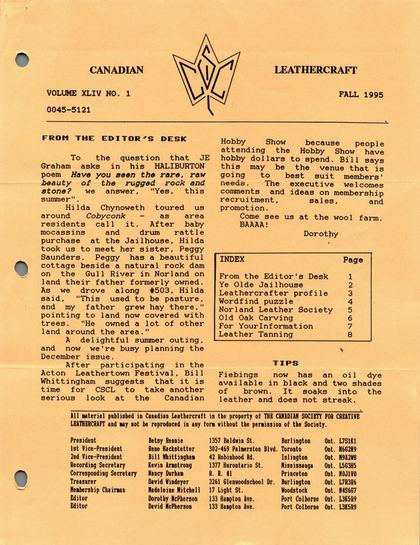
(8 pages, 2.6 MB)
the full-resolution scan, 33 MB, for close research
Page 1 — From the Editor's Desk
[Transcribed from the original eight-page issue. Spelling, punctuation and wording follow the original, including its own inconsistencies. Editorial notes appear in [square brackets].]
CANADIAN LEATHERCRAFT
VOLUME XLIV NO. 1                  FALL 1995                        0045-5121

FROM THE EDITOR'S DESK
To the question that JE Graham asks in his HALIBURTON poem — "Have you seen the rare, raw beauty of the rugged rock and stone?" — we answer, "Yes, this summer".
Hilda Chynoweth toured us around Coboconk — as area residents call it. After baby mocassins and drum rattle purchase at the Jailhouse, Hilda took us to meet her sister, Peggy Saunders. Peggy has a beautiful cottage beside a natural rock dam on the Gull River in Norland on land their father formerly owned.
As we drove along #503, Hilda said, "This used to be pasture, and my father grew hay there," pointing to land now covered with trees. "He owned a lot of other land around the area."
A delightful summer outing. and now we're busy planning the December issue.
After participating in the Acton Leathertown Festival, Bill Whittingham suggests that it is time for CSCL to take another serious look at the Canadian Hobby Show because people attending the Hobby Show have hobby dollars to spend. Bill says this may be the venue that is going to best suit members' needs. The executive welcomes comments and ideas on membership recruitment, sales, and promotion.
Come see us at the wool farm. BAAAA! Dorothy
INDEX
From the Editor's Desk 1
Ye Olde Jailhouse 2
Leathercrafter profile 3
Wordfind puzzle 4
Norland Leather Society 5
Old Oak Carving 6
For YourInformation 7
Leather Tanning 8
The Society printed this index in a ruled box beside the editor's column, one item to a line with its page number at the right. It is set out above in that form. For YourInformation is printed exactly so, without the space.
TIPS
Fiebings now has an oil dye available in black and two shades of brown. It soaks into the leather and does not streak.
All material published in Canadian Leathercraft is the property of THE CANADIAN SOCIETY FOR CREATIVE LEATHERCRAFT and may not be reproduced in any form without the permission of the Society.
OFFICERS

  President                Betsy Rennie       1357 Baldwin St.        Burlington     Ont.  L7S 1K1
  1st Vice-President       Rene Hackstetter   302-469 Palmerston Blvd. Toronto       Ont.  M6G 2N9
  2nd Vice-President       Bill Whittingham   42 Robinhood Rd.        Islington      Ont.  M9A 2W8
  Recording Secretary      Kevin Armstrong    1377 Hurontario St.     Mississauga    Ont.  L5G 3H5
  Corresponding Secretary  Nancy Durham       R.R. 4                  Princeton      Ont.  N0J 1V0
  Treasurer                David Windeyer     2261 Glenwoodschool Dr. Burlington     Ont.  L7R 3R6
  Membership Chairman      Madeleine Mitchell 17 Light St.            Woodstock      Ont.  N4S 6G7
  Editor                   Dorothy McPherson  133 Hampton Ave.        Port Colborne  Ont.  L3K 5R9
  Editor                   David McPherson    133 Hampton Ave.        Port Colborne  Ont.  L3K 5R9
Page 2 — Ye Olde Jailhouse
YE OLDE JAILHOUSE
The Jailhouse is a retail outlet located on Water Street next to Thompson's Marina just off Highway #35 — Coboconk's main street.
The jail, built in 1890, measures 15 X 19.2 ft. This solid building boasts original 2-foot-thick limestone walls mined from Coboconk's quarry. Originally the jail contained two separate cells as well as the sherrif's desk. The original cell doors are on display inside, and original iron bars are in the windows.
For the past 21 years the walls have been lined with lovely handmade articles. Jane Sawulak, cashier for the day, points out woodwork, knitted baby sweater sets and childrens' patterned sweaters, leatherwork, fabric articles, and tickets for sale on a quilt to be raffled off. Everything in the store, including leathergoods, is made by seniors. All of the leathergoods originate from classes taught by Hilda Chynoweth at Coboconk New Horizons Seniors Club, Coboconk Lions Community Centre.
More than 200 seniors are involved in the club and about twenty of them make crafts for the shop. About thirty of them gather every Monday in Coboconk.
Apparently, Council was going to tear the building down after 50 years of disuse but in 1974 New Horizons started renting it for a dollar a year rent — a figure that remains unchanged today.
Proceeds from Jailhouse sales pay for the Club's craft supplies and for their rent at CLC Centre. They meet there on Tuesdays for euchre and bridge. A quilt raffle and bazaar in winter earn more proceeds.
Five Norland Leather Society members, who belong to Coboconk Seniors Club, make leathergoods for the Jailhouse — surely Canada's smallest retail outlet.
Open: Sat 10-4, May 24 – June 30. Mon-Sat 10-4, July and August.
GREAT LEATHER SALE — Oct. 16-31 Williams Design Studio, Hwy 7A, Bethany
Good hides from $2.75/sq.ft., some coloured — black, burgundy, tan — 3 1/2 to 6 oz. Bleached sides 3 to 4 1/2 oz. — $3.25/sq.ft. Some hides 6-8 oz. — $3.25/sq.ft. All veg-tanned hides, great for wet forming. Some extra special very interesting hides — $2.00/sq.ft. (or best offer)
Bring a friend — share a hide Call Paul or Bev (705) 277-2666
Demonstrating and tending CSCL's table at Acton's Leathertown Festival were Ruth Haig, David Windeyer, Joyce Scruton, Al Foss, Roselle Wallace, Keyna Ooyevaar, and Bill Whittingham.
Page 3 — Leathercrafter profile
PORTRAITS
SENIOR'S HOBBY EXPANDS FROM WOODSHED TO WORKSHOP
The farm house sits on a rocky prominance in its 140 acres 2 miles (3km) east of Norland on Highway #503. On the hillside near the Highway, cows and goats graze near a small boarded—up roadside building.
"For three or four years I sold leather and crafts from that building but it was too much for one person to handle," Hilda Chynoweth, says adding "I was teaching leathercraft in Coboconk on Mondays. I got paid $4 a day and then $10 a day for teaching.
"I drove mail for 28 years: my husband, Harold had the mail contract but he was farming and was a carpenter busy building cottages,'' Hilda continues as she leads the way to her workshop the door of which opens onto a wall of granite.
Hilda, the most recent life member in the Canadian Society for Creative Leathercraft, was so honoured at this year's annual spring convention, Woodstock. At the CSCL conventions, this active great-grandmother participates in hands-on workshops and observes what's happening in leather circles.
Hilda Bryant Chynoweth was born in Norland in 1910. Mother of seven children she began leather crafting for a night out, at night school in 1957, at Fenelon Falls where she made a wallet and keycase.
"I sent to Tandy'’s fora starter kit, then made Harold buy that finished product for $5, and with that money I ordered a kit. I joined CSCL after that but was out for a few years. I remember Nora Huyck from two CSCL Toronto conventions at the Park Plaza. I met Irva Ford in Peterborough where she was selling leathergoods at the annual craft show
Hand of Man. I found out from her where to send my CSCL membership again. "I first started working out of a drawer in the kitchen, then I took over a small room. After Harold died I converted the 20 x 24 ft woodshed into a workshop." Lined with dozens of belts, tools and in-progress projects the room smells warmly of leather. Sitting about are samples of work she made during summer leather courses at Haliburton School of Fine Arts proof of her continuing efforts to expand her knowledge. Once again, in August this year, she drove up to inspect that summer
[The page prints "in 1957" and "onto" plainly.]
Page 4 — Wordfind puzzle
school class output. At home she generously shares her knowledge at Norland Leathercraft Society meetings, and teaches leather classes for Coboconk New Horizons Club.
Teaching: After Coboconk New Horizons Seniors Club started in Coboconk in 1974 someone wanted Hilda to show them how to make a pair of gloves and it went from there to other articles and then that club paid her to teach leathercrafting classes. She still teaches in Coboconk.
Hilda's work has been exhibited at Kinmount Fair, the heritage building in Kinmount, Leather '80 at Lindsay Public Library, Niagara, London, Woodstock, and most recently at Leather '94 at Etobicoke City Hall where her deerskin vest was awarded the Michigan Leather Award for Best Soft Leather. Other articles that have earned awards for her include gloves, weed pot, and corner hanging plant mache pot.
From her home workshop Hilda sells dolls outfitted in buckskin, pictures carved and dyed, jewellery, purses, belts and wallets. Plans for future projects include a deer antler plaque. Lots of know-how is near at hand: neatly Piled for ready reference almost within arm's reach is a stack of Leather—crafters' Journal magazines - every issue Since 1957.
"Leather used to cost $1.95 a § square foot but now it’s $8. I enjoy most fiddling around. At night I dream up things to make," Hilda laughingly confides. However, she admits that her favourite article to make is wallets. She can carve a wallet in an hour and a half and lace it in an hour. Last winter she had orders for nineteen wallets.
"When New Horizons started in Norland, about 5 to 7 years ago, I tried teaching leathercraft in Norland but it hasn't caught on there yet," she said.
She crochets Indian blankets, knits, does decorative T shirts and sweatshirts, plays euchre and is on the executive of Norland Leather Society - a group she helped found in 1978.
Both the community and CSCL have been enriched by her leathercrafting, a hobby this vital senior has pursued for 38 years with a determination as enduring as the northern granite landscape.
WORDFIND
by Betsy Rennie
Locate at least 20 words which may appear forward, backward, or diagonally relating to the 1995 CSCL Annual Meeting. All the words can be found on the front page of the Annual Reports. Don't look now but the word list is on page 8.
[A 20 x 20 letter grid follows. The grid is reproduced on the page but its letters are not set out here; the answer word list is on page 8.]
Page 5 — Norland Leather Society
NORLAND LEATHER SOCIETY
Hilda Chynoweth, who had already been leathercrafting for seventeen years, and Peggy Weaver, another area leathercrafter, founded the Norland Leather Society (NLS) with its first meeting in 1978. This group is a branch of the Canadian Society for Creative Leathercraft, the other branches being Hamilton, Woodstock, Toronto, and Mississauga.
Early meetings of NLS were held at Norland Public Library but then switched to Hilda's home workshop 3 km east of Norland on Highway #503.
The group, with Art Cousins as president, continues strong with nine members. Della Howard is vice-pres, Phyllis McHale sec-treas, and Hilda Chynoweth and Della Howard are craft convenors. Monthly meetings are held the third Monday of each month at 7:30 pm,
This group's on-going success can be attributed in part to their excellent hands~—on programs. Hilda assembles supplies into kits ahead of time, and at each meeting Della demonstrates how to make up the kit. Each member purchases a kit to work on, thus eliminating the need for individuals to buy and store the supplies in bulk.
NLS members Jack and Marian Sim, were introduced to leathercrafting by Hilda at Coboconk Seniors Club. Jack began with a wallet in 1991. He remembers making a large shoulder bag that had to be remedied by replacing the dome fastener. Marian also began with a wallet, in 1992, and admits that her most challenging project has been filigree work.
Carol Broumley began working with leather in 1983 and especially enjoys tooling. Jean Montgomery has worked with leather for 15 years. Her favourite leather project is belts.
Besides leathercrafting skills, Emma Windatt is known in CSCL circles for her ability to craft, and perform, delightful poetry. An NLS member since 1979 Emma's most challenging project throughout the years was wallet and matching keycase.
Della Howard, Hilda's daughter, was introduced to the craft “in Mom's workroom" in 1958. She recalls making bike saddle bags that had to be remedied - her most challenging project along with Checker/Snakes and Ladder board. Her work has been awarded two CSCL Salon (design) ribbons and two
Craftsman(craftsmanship) ribbons.
Phyllis McHale,another of Hilda's daughters, likewise began leathercrafting under her mother's helpful guidance. Phyllis began in 1982 by making gloves that went on to earn for her a CSCL Craftsman ribbon.
Art Cousins, Past President Coboconk Seniors Club ('91-92), began leathercrafting in 1989. Art confesses that in between fixing the cottage to live in and leatherwork he has not been able to get items finished. However, he now has more time to complete leather projects. “If it can be done, I'll try to do and finish it," he said, adding "my wife, Gloria, doesn't get too much leatherwork done as she is in charge of Ye Olde Jailhouse and getting seniors throughout the year to sew, knit, and crochet crafts for sale there in the summer."
Five Norland Leather Society members, who belong to the Coboconk Seniors Club, make leathergoods for the Jailhouse.
Norland Branch? An ambitious group, this, that just keeps on going and making and doing!
Page 6 — Old Oak Carving
AROUND THE WORLD
OLD OAK CARVING: HOW OLD IS THE TRADITION?
by René Hackstetter, ACSCL
Madame Emilie de Condé ran an ad in the Times of London in 1849 to instruct in the "imitation of old oak carving". In the introduction to her brochure she indicates that there were 242 replies and 75 personal applications. We see revealed the hardship of that era in her statement that many, who in the absence of remunerative occupation, were seeking the chances of a new employment. Remedies, she says, are perpetually promulgated, but as yet unattained, for the relief of the impoverished gentlewoman.
Madame de Condé taught in Liverpool and Chester in 1850, as well as exhibiting in Arts and Crafts exhibitions in London. She mentions that others had claimed precedence for originating the art, however, she gives its origins around 1400 and leaves others to the glory...'if such it be' as she says.
The revival of Leatherwork, she says, "...has had the beneficial effect of aiding the sinking funds of many, some by working it for sale, others by teaching it again". It sounds familiar!
Madame de Condé's instructional pamphlet outlines the cutting and tooling of leaves, the making of stems and flowers, as well as additional instructions for the covering of frames in oak leaves, acorns, holly and ivy. The flowers are roses, tulip, fuschia, hyacinth, jessamine, camilias, quilled chrysanthemums as well as grapes.
In the section on tools, de Condé mentions that only three are required: "One is.a fine pointed instrument to force the leather into corners, another rounded, another chisel shaped, which may be had at any depositary for materials”.
Washing the work with either size or prepared stiffening at intervals of three days is the first step before a copal varnish is applied. Three coats at intervals of twenty-four hours are applied before the application of "Barnards Flemish Oak Stain". Jabez Barnard was an Artists Colourman and the publisher of Madame de Condé's little pamphlet. His list of oil paints and materials runs to ten pages at the back. We could suppose that he carried the leather, tools, varnishes and stains. The final treatment is painting the work with burnt umber, another coating of Flemish Stain and a final coat of varnish.
Madame de Condé's final directions are for casting moulds from "Plaister of Paris" and indicate in which direction her thinking was going. She suggests castings of works of Antiquity with the intention of moulding the leather into the casting.
The author opens her pamphlet with Pope's statement, "Let such teach others, who themselves excel, and censure freely, who have written well".
She concludes with the lines of a celebrated poet:
"Content, if hence the unlearned their wants may view. The learned reflect on what before they knew: Careless of censure, nor too fond of fame, Still pleased to praise, yet not afraid to blame: Averse alike to flatter or offend: Not free from faults, nor yet too vain to mend."
[This page sets Rene Hackstetter's article in a left column beside a facsimile of the original pamphlet's title page, reproduced as an illustration. The facsimile itself, read whole: "LEATHER WORK; A CONCISE AND CLEAR EXPLANATION OF THE ART KNOWN AS THE IMITATION OF EVERY DESCRIPTION OF OLD OAK CARVING, BY EMELIE DE CONDÉ. ‘Let such teach others, who themselves excel, And censure freely, who have written well.’ — Pope’s Essay on Criticism. PRICE ONE SHILLING. London: Barnard, 339, Oxford Street. 1853." Note the pamphlet’s own title page spells the author “Emelie de Condé”; Hackstetter’s article spells her “Emilie” throughout — both kept as printed.]
Page 7 — For YourInformation
IN MEMORIAM
Howard F. Brock Sr., 80, McKees Rocks, Pennsylvania, retired chemical operator from USS Chemicals, leathercrafter, firearms instructor, scouter, passed away March 16, 1995. He was a distinguished 65 year veteran of Boy Scouting.
CSCL was saddened to learn of Howard's passing. A professional leathercraftsman, and CSCL Member-at-large, he was founder and president of the "Pitt Pounders" leathercraft guild. The guild is alive and well and the new president is Chris Kearns, 120 Valley Dr., Harmony, Pa., USA, 16037. An annual award will be presented in Howard's memory. His wood shop and leather shop will be maintained.
submitted by Howard (Bud) F. Brock Jr.
Edith Melchior-Hawkins FCSCL, Tillsonburg, passed away on Monday July 31, 1995, in her 74th year. Woodstock branch is mourning the death of one of its most valued members. Edith was a gifted craftsperson. She joined CSCL shortly after it was formed, and soon earned her Associate and then her Fellow standing. She was instrumental in forming a branch in Tillsonburg that carried on for several years. Edith was an exceptionally good teacher, and was always ready to help anyone with problems. Edith was a wonderful gardener. She grew the loveliest miniature roses, taught classes on drying and pressing flowers, and made beautiful hasty notes and cards as well as little bouquets of dried flowers. She also had a great love of music and often played the organ for us. We will certainly miss her friendship and her many talents.
submitted by Beula Reynolds, ACSCL
NOTICES
MISSISSAUGA: Cooksville United Church, 2500 Mimosa Row. Bill Whittingham, instructor. · "Wild Rose" carved pocket notepad, Oct. 11. · Colouring the notepad using the "antique" dry brush technique and also a demonstration on how to line the notepad, Nov. 8. · Christmas party: Making a miniature Indian headdress Christmas tree ornament. Bill will supply materials for $5 each, or buy your own supplies for approximately $12, Dec. 13.
WOODSTOCK
·
Folded masks: Beula Reynolds' home, Sept. 28. ·
Braided belts: Madeleine Mitchell's home, Oct. 19. ·
Leather tooling bookends: Loreen Manuel's home, Nov. 16. ·
Christmas party: Dec. 1.
[Printed “St.Margarets Anglican Church, 138 Emmerson St.”, without the apostrophe and with the double m; kept as printed. Other issues print Emerson Street.]
HAMILTON: St.Margarets Anglican Church, 138 Emmerson St. ·
Dream catchers: Nancy Durham, Oct. 20, 7 pm. · 40th anniversary party: restaurant, Nov. 10. ·
Christmas potluck supper: planning session for annual, Dec. 8, 6 pm.
WAINFLEET STUDIO TOUR: township west of Port Colborne, 10 sites, David and Dorothy McPherson as guest artisans at Warm & Wonderful wool and herb farm: Oct. 28, 29, 10-5. Tour maps at 2X4 Restaurant, corner Regional Roads #24 & 27.
1996 Annual: May 3-5
HATS OFF TO
Allan Foss, Toronto Branch, who braved July heat and enrolled in a leather course at Haliburton School of Fine Arts.
Page 8 — Leather Tanning
'TIS AUTUMN
When the grass turns brown on yon hillside, Through the sky the flock of swallow glide, The poplar leaves show their underside. 'Tis Autumn!
The goldenrod waves her plume with pride, The flocking grackle southward flies, The golden straw, the baler ties. 'Tis Autumn!
The pony swishes his tail at the flies, The bluejay screams his raucous cries, And mom is baking pumpkin pies. 'Tis Autumn!
Emma Windatt
LEATHER TANNING
We do not know exactly how prehistoric man first tanned leather, but very probably it was similar to a process developed by North American Indians. Fresh hides were buried in the ground, soaked in a lye solution of wood ashes and water, scraped with bone or flint knives until the hair was removed.
At that point the actual tanning began. The hides were sprinkled with a wood powder (wood contains tannic acid, or tannin, the preservative that gives the tanning process its name), rubbed with an oily compound consisting of animal fats and brains, further softened by hand. Finally they were smoked over a smoldering wood fire.
The Hebrews first used oak bark to tan leather several thousand years before Christ, and vegetable tanning remained the predominant tanning technique in the western world until the 19th century. Oak bark was the main source of tannic acid, though North American and European tanning also relied upon spruce, chestnut, and hemlock. The process was a long one.
In the 19th century, it was discovered that leather could be tanned by using certain chromium salts, and chrome tanning is now the most often used method. Chrome tanning is quick, reducing the tanning process from months to several days. Also, it made possible a far greater variety of leathers. Vegetable-tanned leather is firm, heavy, and more water resistant than chrome-tanned leather, which by comparison is softer and more supple.
[exerpted from Reader's Digest Crafts & Hobbies]
CORRECTIONS
Oops! Don MacLeod was CSCL president for five years. Keyna Ooyevaar (note correct spelling) is a member of Mississauga Branch and did not make the jewellery attributed to her in the last issue.