
An issue of the Society’s newsletter, transcribed from the original.
(16 pages, 2.7 MB)
the full-resolution scan, 42 MB, for close research
Page 1
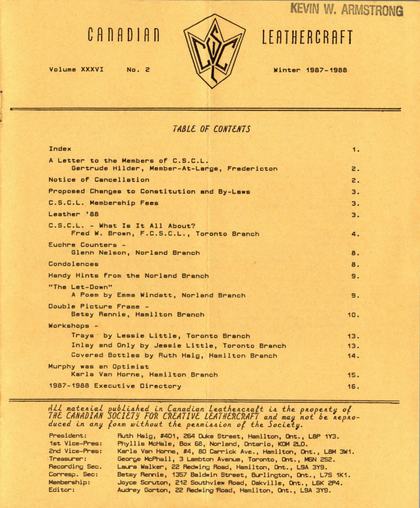
| CANADIAN | LEATHERCRAFT |
| Volume XXXVI No. 2 | Winter 1987-1988 |
| TABLE | OF CONTENTS |
| Index | 1. |
A Letter to the Members of C.S.C.L.
| Gertrude Hilder, Member-At-Large, Fredericton | 2. |
| Notice of Cancellation | 2. |
| Proposed Changes to Constitution and By-Laws | 3. |
| C.S.C.L. Membership Fees | 3. |
| Leather '88 | 3. |
C.S.C.L. - What Is It All About?
Fred W. Brown, F.C.S.C.L., Toronto Branch 4. Euchre Counters -
Glenn Nelson, Norland Branch 8. Condolences 8. Handy Hints from the Norland Branch 9.
"The Let-Down"
A Poem by Emma Windatt, Norland Branch 9. Double Picture Frame -
Betsy Rennie, Hamilton Branch
Trays by Lessie Little, Toronto Branch 13. Inlay and Only by Jessie Little, Toronto Branch 13. Covered Bottles by Ruth Haig, Hamilton Branch 14. Murphy was an Optimist
The contents page prints "Lessie Little" on this line and "Jessie Little" on the line below; both are kept exactly as printed.
Karla Van Horne, Hamilton Branch 15.
1987-1988 Executive Directory 16. All material published in Canadian Leathercraft is the property of THE CANADIAN SOCIETY FOR CREATIVE LEATHERCRAFT and may not be reproduced in any form without the permission of the Society.
| President: | Ruth Haig, #401, 264 Duke Street, Hamilton, Ont., L8P 1Y3. |
| 1st Vice-Pres: | Phyllis McHale, Box 68, Norland, Ontario, K0M 2L0. |
| 2nd Vice-Pres: | Karla Van Horne, #4, 80 Carrick Ave., Hamilton, Ont., L8M 3W1. |
| Treasurer | George McPhail, 3 Lambton Avenue, Toronto, Ont., M6N 2S2. |
| Recording Sec. | Laura Walker, 22 Redwing Road, Hamilton, Ont., L9A 3Y9. |
| Corresp. Sec: | Betsy Rennie, 1357 Baldwin Street, Burlington, Ont., L7S 1K1. |
| Membership: | Joyce Scruton, 212 Southview Road, Oakville, Ont., L6K 2P4. |
| Editor: | Audrey Gorton, 22 Redwing Road, Hamilton, Ont., L9A 3Y9. |
Page 2 — A LETTER TO THE MEMBERS OF C.S.C.L.; NOTICE OF CANCELLATION
The signature below and the membership year both print clearly, not faintly, and needed no restoration. The year she names for her Associate Membership prints clearly as 1982.
A LETTER TO THE MEMBERS OF C.S.C.L.
I have been a member of The Canadian Society for Creative Leathercraft for over thirty years. It's about time I let you know I have appreciated the privilege of belonging. You encouraged and helped me in many ways. The bulletins have helpful information in them and give me news of what's happening in the various Branches. The times I have been able to get to Annual Meetings, the times I got to our sales at the C.N.E., the time I was in Toronto.and could attend Branch meetings there, were all valuable help to me. Except for the short time I lived in Toronto, I have been a member-at-large and very far away.
Most of what I know of leathercraft has been from books, and from what I have observed of others' work, especially yours. An awful lot of it has been trial and error. Your criticism when I sent things to sales or brought them to the Annual Meetings was very helpful. If I was not careful as I should have been, and hurried to get things Finished to send to our sales I got them back with a note telling me why. Next time I tried not to make that Mistake! All of this helped to improve my work. It must have, because, in 1982, I applied for and received my Associate Membership. My work would never have met thos standards if I had not had your help. This year I am applying for Fellow Membership and whether I am successful in obtaining it or not, I hope to get to the Annual Meeting and see you all there. It will be good to see you, hear what you think of my work, and to see your work again.
This letter does not tell you much about the hours and hours I have spent doing leatherwork and the enjoyment I have had from doing it. But you Know about that becuase you have done it too. The best time is spent creating things but even the repetitious things are good practice, and all of it is worth doing. Working with leather has enriched my life in many wayland I want the members of C.S.C.L. to know that their share in it is appreciated. It is good to know you and I thank you for your help.
Sincerely,
Gertrude Hilder,
Fredericton, New Brunswick.
NOTICE OF CANCELLATION
Due to the lack of enthusiasm and support, the proposed C.S.C.L. Sale at Black Creek Pioneer Village on the Victoria Day Weekend - May 21 to May 23, 1988 - has been cancelled.
Page 3 — PROPOSED CHANGES TO CONSTITUTION AND BY-LAWS; C.S.C.L. MEMBERSHIP FEES; LEATHER '88
The second proposal's number, the age given in the student membership proposal (20), and Muriel McKnight's telephone number all print clearly and completely on this page; nothing here needed restoring.
PROPOSED CHANGES TO CONSTITUTION AND BY-LAWS
On motions duly made, seconded and carried at Executive Meetings in Toronto, the Following resolutions are to be brought before the 1988 Annual Meeting and voted on at the 1989 Annual Meeting.
PROPOSAL #1.
That the Constitution and By-Laws be amended to add the following membership classification:
Student Membership: Student Membership for full-time students up to the age of 20 be at 1/2 of regular membership fees at the time.
PROPOSAL #2.
That the following change in membership fees be instituted as follows:
"Membership fees be increased by $5.00 to $15.00 in 1989 and a further increase of $5.00 to $20.00 in 1990."
According to the By-Laws and Constitution, these proposed amendments must be in the memberships' hands four weeks before the Annual Meeting in order that they be brought before the upcoming Annual Meeting.
C.S.C.L. MEMBERSHIP FEES
The membership is reminded that the 1988-1989 membership fees are due and payable by April 1, 1988. If you are a Member-At-Large please forward your fees to Joyce Scruton along with your current address. Branch Members are to pay your Branch Treasurer and they will be sent to Joyce as a group. CURRENT MEMBERSHIP RATE IS $10.00 PER YEAR.
LEATHER '88
Leather '88 is being held at the Hamilton Spectator Gallery in Hamilton From September 27 to October 31, 1988. Together with our display of leatherwork, the Hamilton Quilters' Guild has been invited to put some of their quilts on exhibit. The Chairperson of this exhibit is Muriel McKnight of the Hamilton Guild. Muriel's phone number is 1-416-529-9149. The entrance fee is $5.00 and up to 5 articles may be submitted with 3 of these being allowed entry. Adjudicating dates will be given with the Call of Entry which will be mailed to the membership in late May.
Articles will be needed for this display of creative leatherwork and the membership is asked to work on and submit their entries and make this biennial show a very successful one.
Page 4 — C.S.C.L. - WHAT IS IT ALL ABOUT?
The founding year in the second paragraph below, the decade named further down (the "60's"), and the title above ("WHAT IS IT ALL ABOUT?") all print clearly and completely on this page; nothing here needed restoring.
C.S.C.L. - WHAT IS IT ALL ABOUT?
There are times when we are asked by new and prospective members about C.S.C.L. How, why and when it came into being? What are its objectives and what does it mean to its members? These are natural questions to ask prior to uniting with any organization, and with this.in mind, I hope the following brief history will provide some background and answer some questions.
In 1950 a group of leathercraftsmen, some professional, some part-time, but all keenly interested in furthering the craft and setting some standards, got together. The Name "Canadian Society for Creative Leathercraft" was adopted with the emphasis on the word "CREATIVE". At that time, leathercraft was very popular but so much of the work was very poor. Although there were a few excellent classes in existence, most of which were private and conducted in the craftsmen's own studios, there were many in community centres, churches, etc. where the instructor was only one jump ahead of the students. Kits were used fairly extensively in these latter classes and overall Western carving was stressed with little thought given to creativity and originality. It was indeed a time when some good guidance was badly needed.
With enthusiasm running high in the early days, C.S.C.L. took full advantage of all opportunities to exhibit the best of the craft whereever possible. The first major public showing was held at Ryerson Polytechnical Institute which turned out to be a tremendous success. Visitors were seeing a style of leathercraft never before exhibited in this area. Good styling and good craftsmanship were very much in evidence. One visitor remarked that it had the "Fifth Avenue Look". The exhibition resulted in several new members. A large travelling exhibition was put together which travelled around Canada for a goodly length of time and was in considerable demand. Over the years other travelling exhibitions have been put together and sent on their way. The last one was in 1985 and 1986 in conjunction with the Ontario Arts Council and the Ontario Crafts Council.
The Society in the early 1950's joined the Canadian Handicrafts Guild, Ontario Branch as an affiliate member. The C.H.G. later became the Canadian Guild of Crafts and eventually amalgamated with the Ontario Crafts Foundation in which the Society was also an affiliate, to become the very strong Ontario Crafts Council which has its headquarters, craft gallery and research department on Dundas Street West, Toronto, across from the Ontario Art Gallery, as well as operating the Guild Shop in Toronto's Yorkville. The O.C.C. having recently purchased a much larger property on McCaul Street, Toronto, will be re-locating in 1989.
The connection with the Canadian Handicraft Guild was indeed a very beneficial one. Our members became acquainted with the craftspersons in other disciplines. Our president was and still is, a member of the Board of Directors which keeps C.S.C.L. in touch with the total craft scene. During the 1950's and early 60's, we held an annual sale at their headquarters and shop at Bloor and Bay Streets in Toronto. This took place until 1964 at which time the Society became a part of the C.N.E. Arts, Crafts and Hobbies Show and continued in that role until 1985. During this time, all work had to be submitted for approval and although the selecting was not too strict, it did provide a certain standard. All work being shown or sold under the: Society's name must pass the Board of Selection.
Page 5
The year below prints clearly as 1953; nothing on this page needed restoring.
In 1953 some C.S.C.L. members met with some American craftsmen resulting in the birth of the International Assembly of Leathercraftsmen with the first Assembly being held in the Hotel Statler in Buffalo, followed by the second in the Royal York Hotel in Toronto. The Assembly was made up of guilds from Buffalo and Rochester, New York and Detroit, Dearborn and Flint, Michigan, and of course, the Canadian Society. Held in early May from Friday til noon on Sunday, they were indeed, very successful affairs with an abundance of talent available for workshops, demonstrations, talks, etc., and as is the case with C.S.C.L., the by-product was the making of many worthwhile and lasting friendships. The International Assembly operated for many successful years, but finally, due to the break-up of the American Guilds, the last Assembly was held in May 1969 and with deep regrets, it wound up its affairs. On that occasion, the Michigan Leather Artisans from Dearborn, now disbanded, donated their treasury funds to C.S.C.L. for the purpose of setting up a special award for excellence in design and craftsmanship. This award is known as the Michigan Leather Artisans Award. A number of American craftsmen who were not already members of C.S.C.L. joined our ranks. It is interesting to note that the majority of awards in the various Assemblies were won by Canadians. The Canadian designing and craftsmanship: was much appreciated and influenced other craftsmen.
Following the demise of the International Assembly of Leathercraftsmen the Executive of C.S.C.L. decided to change the Society's Annual meeting from a one day affair to a weekend, running from Friday evening til Sunday noon. They are now held in either late April or early May, depending upon availability of accommodation. They are hosted by the Branches in turn and are located in hotels or other facilities around the Province. The exhibition of members' work is set-up on Friday evening followed by the adjudicating by the Board of Selection for Craftsman and Salon Awards. Craftsmen Ribbons are for fine craftsmanship and overall pleasing design. The Salon Ribbons are awarded for excellence in design, and of course, fine craftsmanship. They must have that little extra something that sets them apart. A Branch Competition for the Weston Trophy is also very much a part of the Annual. Five articles may be submitted by each Branch with only one piece per craftsman. The judging is done several weeks in advance in order to have the large trophy prepared and the small one made. The Weston Trophy originated when the Weston Guild members amalgamated with the Toronto Branch and donated their funds for this purpose.
The business meeting, election of officers and executive and the presentation of awards, etc. takes place on Saturday morning. The afternoon is filled with a full programme of demonstrations and workshops. The banquet, of course, takes place in the evening followed by the presentation of ribbons, a speaker and/or entertainment.
Sunday morning programmes vary greatly in content and are pretty much left to the ingenuity of the host guild. This has resulted in some very interesting surprises. The programmes are finished by noon. Since the Annual is a members only meeting and members are encouraged to bring along their finished work for display, regardless of whether they are beginner or professional, and consequently as the display is not adjudicated, it is not open to the public.
The Society's Biennial Exhibitions are critically adjudicated in order that a prestige show of well designed, beautifully crafted leather
Page 6
articles may be presented to the public. Many cash awards are available in different categories. LEATHER '86 was held in the Etobicoke City Hall Gallery along with our travelling exhibition which was created through a grant from the Ontario Arts Council and booked and shipped by the Ontario Crafts Council. On this occasion, the leather was complimented by a splendid exhibition of quilts by the members of The Oxford Quilters' Guild. LEATHER '88 is scheduled for September in Hamilton at the Hamilton Spectator Gallery. This is also to be in conjunction with a quilt exhibition to be put on by the Hamilton
Quilters' Guild.
C.S.C.L. consists of the members of several branches plus many members-at-large. The Branches produce their own programmes and conduct their own business. Over the years, many members have travelled to other branches to demonstrate or conduct workshops. Members are always willing to share their skills to help a fellow craftsman and For the good of the craft.
Membership is divided into six categories as follows:
GENERAL MEMBERSHIP is open to anyone interested in leathercraft. The only requirement is a desire to help promote good leathercraft and the Society.
ASSOCIATE MEMBERSHIP is a qualifying membership which requires two years as a general member, the submission of four articles for judging and involvement in the various projects of the Society.
FELLOW MEMBERSHIP requires one year as an Associate, the submission of four articles which must be original in design and decoration and of a very high degree of excellence, involvement in the workings of the Society, an article for publication in the CANADIAN LEATHERCRAFT and acceptance by vote of members of The Council of Fellows. The Council of Fellows is an organization within the Society complete with Chairman and Secretary. It is responsible for all policies involving standards and adjudicating. The Council of Fellows appoints annually from its members the Board of Selection which is the body responsible for all adjudicating including Associate and Fellow Membership submissions, Weston Trophy Competition, Society's Biennial Exhibition, Craftsman and Salon Awards at Annual Meetings, approving articles entering a Society Sale and any other related duty as may be required from time to time. HONOURARY LIFE. This membership is voted upon by the Executive Council Following a serious consideration, to be bestowed upon a member, who For many years has served the Society in an exemplary manner, over and above the call of duty.
CHARTER MEMBERS are the Founding Members of the Society.
SUSTAINING MEMBERSHIP is generally a commercial membership which could be a company, an organization or an individual wishing to aid the Society.
"Dr." before Ralph Larmour's name below, and "a great way" a few lines on, both print clearly; nothing on this page needed restoring.
The Society also operates the LARMOUR MEMORIAL LIBRARY. Dr. Ralph Larmour and Reta Larmour were founding members of the Society and their Support, hard work and devotion were in a great way responsible for its Success over many years. When Ralph died, and Reta, who was a highly skilled craftsman and designed, could no longer practice her craft due to crippling arthritis, had to leave their beloved home in Grimsby and
Page 7
move to Vancouver. At that time she donated their complete art and craft library, which was very extensive, to the Society along with all her tools, leather and fittings. Two auctions were held which were open to Fellow and Assoicate Members. The proceeds amounting to $1,084.00, plus the library, set-up the Larmour Memorial Library, to which of course, new books have been added from the library fund and also from members donations. It was a monumental task to set-up the library which has now been circulating for many years. Each Branch is issued a case of books which they keep for a set period of time after which they are turned in to the librarian for checking and passing on to another branch. There is, of course, a case of books for each Branch in charge of the Branch Librarian for circulation to the members.
The Society also publishes a quarterly bulletin known as the CANADIAN LEATHERCRAFT which, as well as containing general information, features technical information and projects. It is an excellent little publication and members are encouraged to submit material to it.
The page prints Assoicate for Associate; set out here as printed.
Workshops are a great boon to craftsmen and during the years workshops are sponsored by the Society and conducted by members with special skills or by outside instructors. Branches also sponsor workshops to which all members are invited to attend.
The business of the Society is conducted by the Executive Council consisting of all officers of the Society, the immediate Past President, the Chairman of the Council of Fellows, Presidents of the Branches and not less than ten nor more than fifteen members elected at the Annual Meeting. The Executive meets monthly with the exception of July and August. Many out-of-town Executive Members travel great distances to attend these meetings and devote a great deal of time to the Society, all without remuneration what-so-ever since the Society is completely operated by volunteers.
It would not be right to end without setting forth the AIMS AND OBJECTIVES of the Society to which it strived to adhere since the founding in 1950. They are laid down in the Constitution and By-Laws as Follows:
A. To encourage originality in design.
B. To establish high standards of craftsmanship by improved standards in teaching and. judging. C. To advance education in the craft.
D. To organize exhibitions and sales.
E. To encourage members to participate in art and craft exhibitions.
F. To co-operate with other societies in furthering the creative arts.
G. To identify the creative work of its members and to discourage the plagiarizing thereof.
In conclusion, it should be noted that there have been and still are, members like the Larmours, many dating back to the early days, who have worked long and hard for the Society and the betterment of Canadian Leathercraft. Many of us are proud to be members of C.S.C.L. and have Found that the rewards are great, not only regarding our craft but also for the great many friendships that have been created over the years. A PERSON WITH MANY GOOD FRIENDS IS WEALTHY INDEED.
Fred W. Brown, F.C.S,C.L.
Toronto Branch.
Page 8 — EUCHRE COUNTERS; CONDOLENCES
EUCHRE COUNTERS
[A hand-drawn square heads this article: a counter with the four card suits stamped in its corners, the numerals 0 to 9 round its face and a long arrow pivoting from the centre. They are set out below as they are printed.]
Many card players find it difficult to count using the 2 and 3 cards when playing Euchre.
I made a pair of counters using 2 pieces of 6-7 oz. shoulder. Each square was cut 3" x 3". Punch a #3 hole in the centre. To apply the Club, Diamond, Spade and Heart in the corners, Midas Stamping Tools #A323, A324, A325 and A326 were used, but can be cut with a swivel knife and backgrounded. These were coloured red for Heart and Diamond, and black for Spade and Club. For the numbers, 1/4" Number Stamps were used. Antique was applied, polished, edge dyed, and a large speed rivet puts it all together. Do not make the rivet too tight as the arrow must turn. Remember a pair is needed for the game.
Glenn Nelson,
Norland Branch.
CONDOLENCES
Condolences are extended to Jessie Strain of the Hamilton Branch on the recent loss of her husband Bill.
Page 9 — HANDY HINTS FROM NORLAND; "THE LET-DOWN"
HANDY HINTS FROM NORLAND
Those who have trouble fining something to pound on -- a piece of plexiglass 3/8" x 12" x 16" will do the job very well.
Try using a neutral shoe polish for a leather finish. It gives a rich looking tan colour and is water repellent.
When storing tools to take to demonstrations or other places -- dip the cutting edges of knives in rubber cement. It saves them and is easy to remove.
At times needs to park their needles when saddle stitching. Here's how to make a parking place. Buy two round magnets 7/16" in diameter, drill two holes 7/16" diameter about 4" from the top of each jaw.of your stitching horse. Glue the magnets in these holes. Have the magnets stick out a bit. It is easy to grasp your needles which you have parked there.
An old fork is handy to have around when doing leathercraft. You can make different widths of borders, also you can use the tines to mark for sewing holes.
"THE LET-DOWN"
The March winds have come,
The trees swing and sway.
The old dried leaves play tag
Across the lawn all day.
The Grosbeak hesitate,
As northward they go,
And on the sunny bank
The grass seems to grow.
There in the winds lea
Where the sun shines so mellow
Poses a young willow tree
In a gown of brilliant yellow.
The dainty little white birch
Is gathering her jewels with care.
Soon you will see
The dangling gems she'll wear.
The clouds like tufts of wool
Are driven across the sky
Constantly changing form
As they pass us by.
April with magic powers,
Will wash away winter's grim
And after the warm spring showers
May flowers?!!?
No - we know it is house cleaning time. Emma Windatt,
Norland Branch.
Page 10 — DOUBLE PICTURE FRAME
DOUBLE PICTURE FRAME
Looking over my pictures one day, I came across a couple that I wanted to frame. These particular pictures were taken vertically. I went to the store to see what I could find for a frame. In the "reduced bin" I saw a vinyl double frame for a 3%" x 5" picture. It was crooked and not vertical, but that didn't matter because I wasn't planning on using it anyway. I figured I could make a vertical frame with leather. This is one way of making a double picture frame.
Materials Required:
3-4 oz. vegetable tanned leather
4-5 oz. vegetable tanned leather
skiver lining
x-ray plate or stiff cardboard
clear plastic -- heavy acetate sheet protector or heavy overhead projector acetate 1. Make cardboard templates of the back and the inside.
2. Cut a back and two inside pieces from 3-4 oz, vegetable tanned leather. From 3-4 oz. vegetable tanned leather, cut two strips 5/8" wide X the length of the back. Cut two more strips the same size but using 4-5 oz. vegetable tanned leather; and four strips 5/8" wide X width for the inside piece. Cut one piece from skiver leather slightly larger than the back.
3. Round the corners on the back piece using a nickle or a dime as a template.
4. Stamp a border around the outside of the back and on the inside frame pieces, if desired. To get a straight line all around, use a spring divider, pressing lightly. Be careful to stop 1/4" from each corner.
5S. Dye and finish the leather pieces including the two 3-4 oz. strips. It is not necessary to dye the 4-5 oz. leather strips.
To Construct the Frame:
6. The x-ray plate or cardboard stiffener should be 1/4" smaller than the outside back measurements. Use the same size of coin used earlier, to round the corners of the stiffener. With a scratch awl, cross-hatch the four pieces of x-ray plate. This will give the glue something to stick to. NOTE: You only need to use the two pieces of cardboard on the back, applying it in the same Manner as the first layer of x-ray plate; and also it's not necessary to cross-hatch.
7. Apply contact cement or barge to the unfinished side of the back and to the first two pieces of the x-ray plate or stiffener. Let dry thoroughly.
8. Put two pieces of x-ray plate or cardboard on the back leaving the 3/4" for the spine. Apply glue to the two remaining pieces of x-ray plate. Let dry. Align the pieces over the first two. Apply glue to the whole back piece and to the skiver lining. Allow to dry before putting the lining to the back. Trim the lining.
9. Fit the 4-5 oz. strips of vegetable tanned leather together, lay them on the back and see if your picture will fit in the enclosure. Check both sides. With a scratch awl gently draw a line on the lining on the aside of the strips.
Page 11
10. Cross-hatch the lining between the scratched lines only and the border. Cross-hatch the grain side of the leather strips. It should look something like this:
41. Apply glue to the cross-hatched areas. When dry, carefully align the strips on the back making sure the inside is square and the size of your picture.
42. Trim the corners of the leather strips to match the back.
13. Touch up the line drawn with the scratch awl with dye and a fine brush.
14. Using a bone folder, and wetting the spine of the leather enough to make a fold at the edge of the stiffener, make a fold on both Sides. This fold should be quite firm as the finished picture frame should close like a book. Allow to dry in a closed position.
15. Edge bevel the inside edges of the inside frame with a #1 edge beveler. Dye and burnish the edges.
16. Cut two pieces of clear plastic to fit the inside frame. The plastic should be 1/4" smaller than the outside.frame measurements. With scratch awl, cross-hatch the plastic that goes on top of the leather strips stopping 1/8" from inside edges.
17. Apply glue to the cross-hatched part of the plastic and to the back of the inside frame. Be careful not to get glue on the plastic as that will show through the front. When dry, centre the plastic over the inside frame.
18.0 RO Glue Cross-hatch the plastic all around the framing ya 3-4 oz. strips as you did in Step
16. Apply glue to the 5 te i ea leather edge closest to the spine and also to the two strip 3-4 oz. strips. When dry, align the strips onto to the back of the inside frame. Edge bevel with edge. #1 edge beveler on both sides. Dye and burnish these two edges.
19. Apply glue to the 4-5 oz. strips and tithe three remaining edges of the inside frame. When dry, line up the inside frame to Fit the back, making sure everything is straight. Do both sides.
20. Round two of the corners so that they look even, then close like a book and round the other two corners to match the top two. Trim all four sides to make the frame square, if necessary. Hold the knife straight so that you don't get an angle on your edges.
21. If necessary, round the corners again (with the coin used earlier). Edge bevel all the outside edges and the inside too! Dye and burnish the edges. Sand the edges with emery cloth, then re-dye and burnish again. It may be necessary to do this a third time. While glue alone should be sufficient to hold this piece together, you may hand sew or buckstitch it for added strength and durability as well as added looks. I hope you enjoy making this project.
Betsy Rennie,
Hamilton Branch.
Page 12
SIZES REQUIRED FOR A 4" x 6" PICTURE
[This page is a hand-lettered pattern diagram; the drawing carries the pattern and is described here in words rather than reproduced stroke for stroke.]
BACK: 1 — 3-4 oz. veg-tanned leather. 1 — skiver lining. 7¼" x 11¼".
INSIDE, cut two: 3/4" cut out border, 7¼" x 5½".
2 — 4-5 oz. veg-tanned; 2 — 3-4 oz. veg-tanned (side strip, 7¼" x 5/8"). 4 — 4-5 oz. veg-tanned leather (base strip, 5/8" x 5½").
STIFFENER: 2 pieces cardboard or X-ray plate, 7" x 5¼"; 4 pieces, 5/8".
Size of Picture (two openings), 5/8" borders, 3/4" centre gap.
TO DETERMINE SIZE OF LEATHER NEEDED. 1. Measure the picture (they should be the same size). For the width: 5/8" + width of picture + 3/4" + width of picture + 5/8". For the length: 5/8" + length of picture + 5/8". 2. Adjust other pieces accordingly.
Page 13 — WORKSHOPS
WORKSHOPS
St. Martin's-In-The-Field Church, Toronto
| DATES AND TIMES: | Wednesday, April 13, 1988 -- Regular Meeting -- 7:30 p.m. Saturday, April 14, 1988 -- 9:30 a.m. to 4:00 p.m. |
| PROJECT: | Trays by Jessie Little |
| COST: | $15.00 per person plus nominal charge for pre-cut trays |
Materials Required:
| Square | Cutting Knife |
| Dividers | Cutting Board |
| Edge Beveler | Fine Sandpaper |
| Edge Creaser | Denim or Canvas for smoothing |
| Bone Folder | Own pattern if desired |
| Edge Slicker | Ball Tool |
| Marble | Stippler/Modeler |
| Stamping Tools | Carving Knife |
NOTE: Jessie will supply the dyes and string.
This workshop is sponsored by the Toronto Branch. Trays will be started at the Regular Meeting on Wednesday night and finished on the following Saturday.
| DATE:. | Saturday, May 28, 1988. |
| TIME: | 9:30 a.m. to 4:00 p.m. |
| PROJECT: | Inlay and Only by Jessie Little -- C.S.C.L. Workshop. |
| COST: | $10.00 per person |
Materials Required:
Scissors Skiving Knife and Hone or lots of blades Bone Folder Tracing Film Modeler Glass or Marble to skive on X-Acto Knife or Scalpel with pointed blade Rubber Cement Note Book
6 pieces of 4-5 oz. leather 2" x 3" Small pieces of thin coloured leather or morrocco Water Container and Brushes Round Form - ie: half or silver dollar Pattern of Choice - not over 2½" square - example: pine cone or ivy leaf - more geometrical the better.
NOTE: Please bring sufficient leather already cut out for a wallet, change purse, notebook, bottle, etc. THIS IS A "K I S S" PROJECT
CONTACT: Ruth Haig (1-416-525-0780) if you wish to attend either of these workshops.
NOTE: Bring you own lunch -- Coffee and Tea will be provided.
Page 14 — WORKSHOP
WORKSHOP
| DATE: | May 14, 1988. |
| TIME: | 9:30 a.m. to 4:00 |
| PLACE: | St. Margaret's Church, 138 Emerson Street at Royal Avenue, Hamilton (See Map Below). |
| PROJECT: | Covered Bottles by Ruth Haig |
| COST: | $10.00 per person |
Contact: Ruth Haig if you wish to attend this workshop.
(1-416-525-0780)
Bring your own lunch -- Coffee and Tea will be served.
PLEASE NOTE: This workshop is sponsored by the Hamilton Branch and is in place of their final meeting for the 1987-1988 year.
IMPORTANT: Sterilize the bottle to be covered by putting it into a cold oven, then turn it on to 300° for one hour. Remove bottle when cold. 00 NOT STERILIZE THE CAPI!!!!!
Materials Required:
| Bottle | Paper for pattern |
| Ruler | (ie: brown paper bag) |
| Square | Thin natural skiver |
| Scissors | (sheep or calf) |
| Skife | Dye of your coice or |
| Cutting Knife | Pre-dyed leather large |
| Cutting Board | enough to cover the entire |
| White Cement | project |
| Measuring Tape | Notebook |
Woodstock and points west
FROM TORONTO - Use the Main Street West Exit and turn left onto Main Street then left onto Emerson.
FROM WOODSTOCK ETC. - Take #2 Highway through
Ancaster down Wilson Street to Main Street West. Keep on Main to Emerson and turn
Queen Elizabeth to Toronto
Queen Elizabeth to Niagara
Page 15 — MURPHY WAS AN OPTIMIST
MURPHY WAS AN OPTIMIST
Leathercrafting can be lots of fun. It can bring joys and fulfillments beyond the wildest of imaginings. It can also drag you to the brink of despair and insanity and has been known to turn rational and reasonable Folks into ranting, irrational and unreasonable ones. And Why????
Because…
There is no other rational answer.
Why is it that…
- you always run out of lace just a few holes from the end of a project? - if you try to stop the above dilemma from occuring, that the lace (or thread) will promptly break just a few holes before the end? - the cat prefers your carving water to her own water dish?
- dropped rivets, snaps, sewing needles, etc. are always more easily
Found by the foot than by the naked eye?
- if you need X number of rivets for a job that you always have X-1?
And that when you go into the store to buy more, that they will only have gilt when you desperately need nickel?
- you will never find a misplaced tool, package of hardware, etc. until you replace it?
- other people's tools only work for other people?
- the chances of your leather project falling glued side down vary directly with the cost of your flooring material? - anything dropped in the workroom will immediately roll into the least accessible corner after first hitting your toes? - if you put away a tool, you will need it immediately? - there is always an easier way to do it?
- when you get a great bargain on a bunch of 1-1/4" buckles, all you get is orders for 1-1/2" ones?
- when you are at a creative peak, the only orders you get are for key
Fobs and plain black belts?
- the phone never rings until you're up to your eyeballs in dye or glue? - interruptions never come at the point where you need to concentrate the least?
- orders come in droves rather than a steady dribble?
- real leathercrafters persevere despite all potential and real problems and dilemmas and still manage to come up with projects that turn out looking like a million bucks?
Karla Van Horne,
Hamilton Branch.
Page 16
This directory repeats, entry for entry, the 1987-1988 Executive printed in the previous issue (Summer/Fall 1987, p.20). Every name on this page already prints on the same line as its own telephone number, and the page number above prints clearly as 15; nothing here needed restoring.
Page 15.
C.S.C.L. EXECUTIVE - 1987-1988
OFFICERS
| Past President | Madeleine Mitchell | 1-519-537-7821 |
| President | Ruth Haig | 1-416-525-0780 |
| 1st Vice President | Phyllis McHale | 1-705-454-1237 |
| 2nd Vice President | Karla Van Horne | 1-416-547-4518 |
| Treasurer | George McPahil | No Telephone |
| Recording Secretary | Laura Walker | 1-416-389-9567 |
| Corresponding Secretary | Betsy Rennie | 1-416-639-0771 |
DIRECTORS
| 1. Kevin Armstrong | 1-416-278-4666 |
| 2. Bea Austin | 1-416-522-8282 |
| 3. Fred Brown | 1-416-626-3184 |
| 4. Laura Bush | 1-613-392-1475 |
| 5. May Corbett | 1-705-728-3259 |
| 6. Kay Cloughley | 1-705-497-3214 |
| 7. Jessie Little | 1-416-783-8603 |
| 8. Lea Love | 1-416-276-7340 |
| 9. Don MacLeod | 1-416-277-2058 |
| 10. Dorothy Muma | 1-416-654-5635 |
| 11. Jean Pickering | 1-519-285-2518 |
| 12. Gladys Riddell | 1-416-762-7466 |
| 13. Joyce Scruton | 1-416-844-9471 |
| 14. Helen Wheaton | 1-519-432-0178 |
EX-OFFICIO
| Archives | Carol McLean | 1-519-537-7684 |
| Editor | Audrey Gorton | 1-416-389-9567 |
| Librarian | Marg Hunter | 1-416-459-9798 |
| Teaching Standards | Bob Muma | 1-416-654-5635 |
| Membership Chairman | Joyce Scruton | 1-416-844-9471 |
| Publicity | Audrey Gorton | 1-416-389-9567 |
BRANCH PRESIDENTS
| Hamilton | Audrey Gorton | 1-416-389-9567 |
| Mississauga | Lois MacPherson | 1-416-842-1383 |
| Norland | Hilda Chynoweth | 1-705-454-3206 |
| Toronto | Bob Sutton | 1-416-633-2736 |
| Woodstock | Beula Reynolds | 1-519-539-3251 |
The next bulletin is the responsibility of the Toronto Branch as well as including the report on the 38th Annual. Any material would be appreciated from either the Toronto Branch or any other source.